Original Title: "Who is actually trading on Trade.xyz?"
Original Author: @web3_pastel, Arrakis Finance
Translation by: Jaleel Kazuo, Rhythm BlockBeats
Editor’s Note:
On the landscape of Hyperliquid, one of the most notable names of 2026 is Trade.xyz. It is the first real product to emerge after the launch of the HIP-3 "permissionless perpetual market deployment framework," transferring assets like US stocks, crude oil, and silver, which originally belonged only to traditional financial hours, into a 7×24-hour open order book on-chain.
In just a few months, it has grown from a niche experiment with only the XYZ100 index to a robust on-chain trading venue carrying several markets such as oil, Tesla, and silver, with a monthly trading volume exceeding 50 billion dollars.
However, at the same time, there has been considerable discussion on external forums regarding the controversies surrounding it: what proportion of the impressive wallet numbers are real people, and how many are witches created en masse targeting yet-to-be-released tokens?
This research from Arrakis reveals an intriguing result: a layer of witches indeed exists, with more than 30,000 wallets traceable to the same Polymarket account "Themino"; however, what supports it is the number of accounts, not dollars. The real contributors to the trading volume are several professional market-making platforms, some order-taking robots originating from Bybit, and a long tail of retail investors highly overlapping with Polymarket.
Below is the full content:
Abstract
When we wrote the first article "Who is trading on HIP-3?", the attribution method was statistical. We classified each wallet's trading behavior over the last three months: addresses mainly using limit orders were categorized as market makers, high-frequency order-taking addresses were categorized as arbitrageurs, and orders with low execution rates tagged with a builder label were categorized as retail investors. This method indeed revealed some interesting market structure characteristics, but the classifications were probabilistic, and about 70% of wallets are still unclassified.
In this article, mechanized classification replaces statistical inference. Each order on @HyperliquidX carries a set of deterministic labels signed and released by the exchange itself: valid time (ALO, GTC, IOC, FrontendMarket), builder code, transaction marks, holding time. We categorized each wallet into one of four categories using this order metadata: retail investors, market makers, arbitrage robots, and witch wallet accounts.
The second step is to identify the wallets behind these categories, extracting identity and trading behavior data from the @arkham and HyperTracker APIs. The top 450 wallets accounted for 78% of the total trading volume. Within these wallets, we identified several @Polymarket-associated accounts, including @jump_, @SeliniCapital, @wintermute_t, Abraxas Capital, etc.
Through this two-step classification method, we observed several patterns. The following will unfold them one by one.
Trade.xyz Wallet Analysis
Our observation time window was from March 10 to March 31, 2026, a total of 21 days. During this period, the four markets of @tradexyz (xyz:CL crude oil, xyz:SILVER silver, xyz:TSLA Tesla, xyz:XYZ100) recorded a total of 79,622 unique participating wallets, with a total trading volume of 51.95 billion dollars.
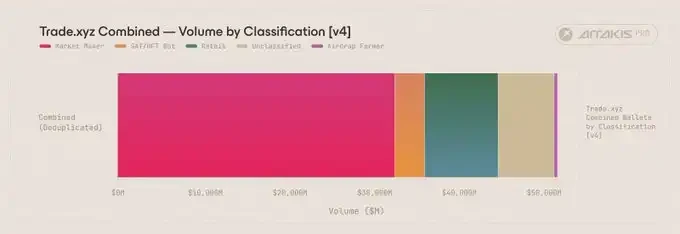
79,622 participating wallets broken down by trading volume. While market makers accounted for less than 0.5% of the total wallets, they bore 63% of each dollar traded.
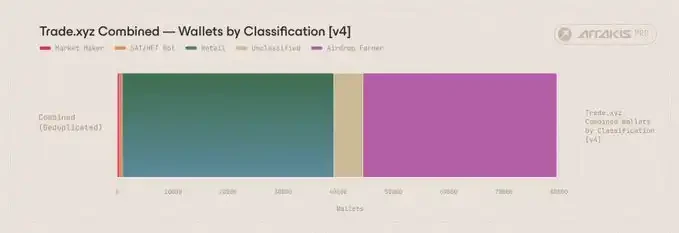
Classification by wallet count (not trading volume). There are 35,091 airdrop witch accounts, accounting for almost half of the identified wallets.
The airdrop witch account category is one of the largest classifications by wallet count, but the smallest by trading volume share. The 35,091 wallets made only 400 million dollars in volume during the entire window period, accounting for just 0.77% of the total volume of 51.95 billion dollars in that venue. Nearly half of the active wallets on Trade.xyz contributed less than 1% to the total volume.
When dissected by market, another distinct pattern emerges.
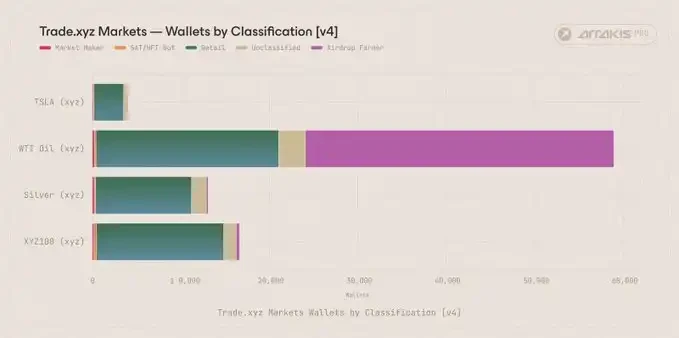
Wallet distribution by market. xyz:CL absorbed 99.3% of the airdrop witch accounts, because of its optimal execution costs.
Of the 35,091 airdrop witch accounts, 34,859 (99.3%) traded xyz:CL during the window period, with the remaining 232 scattered across xyz:SILVER, xyz:TSLA, and xyz:XYZ100. This pattern aligns with the characteristics of the airdrop witch accounts: each wallet repeatedly executes small bilateral trades, generating trading volume without bearing price risk. This strategy relies on compact execution costs and is highly sensitive to slippage. xyz:CL has the best depth among the four markets of Trade.xyz, making it the natural choice for this type of activity.
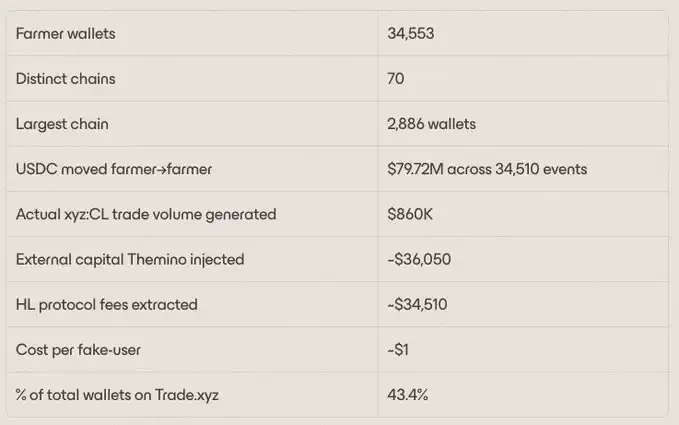
Another noteworthy phenomenon is who is behind these addresses. The on-chain tracking shown below indicates that 34,553 witch account wallets are associated with the same Polymarket operator. Just this single entity accounts for 43.4% of all participating wallets on Trade.xyz during this time window.
On the other end of classification is market making. 363 wallets, accounting for 0.46% of all active addresses, drove 32.75 billion dollars in trading volume, or 63% of every dollar on Trade.xyz. The other three categories are in between. 522 SAT/HFT robots contributed 3.5 billion dollars (6.7%). 38,307 wallets categorized as retail investors contributed 8.7 billion dollars (16.7%). 5,339 unclassified wallets contributed 6.61 billion dollars (12.7%).
The 12.7% trading volume in the unclassified category cannot be qualitatively attributed to any particular strategy based solely on metadata. It is reasonable to speculate that a considerable portion of this comes from retail investors routing limit orders through Hyperliquid, or retail investors placing both market orders and limit orders through the Trade.xyz frontend. Neither channel adds clear builder codes or dedicated TIF labels to orders, making these transactions invisible under a classification method driven by metadata.
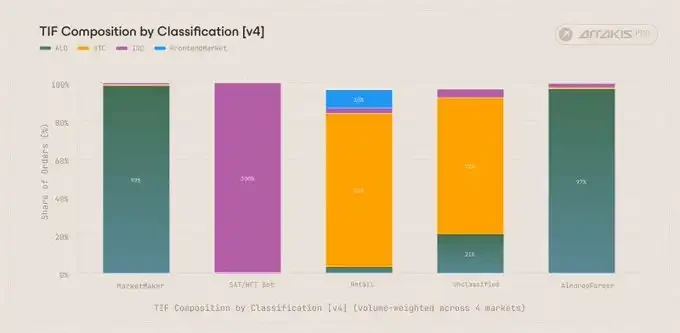
Distribution of effective time weighted by order number across categories. Market makers unsurprisingly have 98.5% ALO orders, while arbitrage robots use 100% IOC orders. The unclassified category has 71.5% GTC, a hallmark of manually placed limit orders by frontend users.
The TIF composition supports the above speculation: 71.5% of orders in the unclassified category are labeled GTC (Good Till Cancel), typically used by frontend users placing stationary limit orders.
"Themino," Unveiling Over 30,000 Wallets
In recent weeks, there has been much discussion in the market: is the impressive user count on Trade.xyz a result of real human participation, or is it propped up by airdrop witch accounts before the anticipated TGE? We do not intend to comment on the broader patterns of witch activity at the exchange, but after analyzing the transaction-level data of the four Trade.xyz markets in March, we did identify a pattern worth presenting.
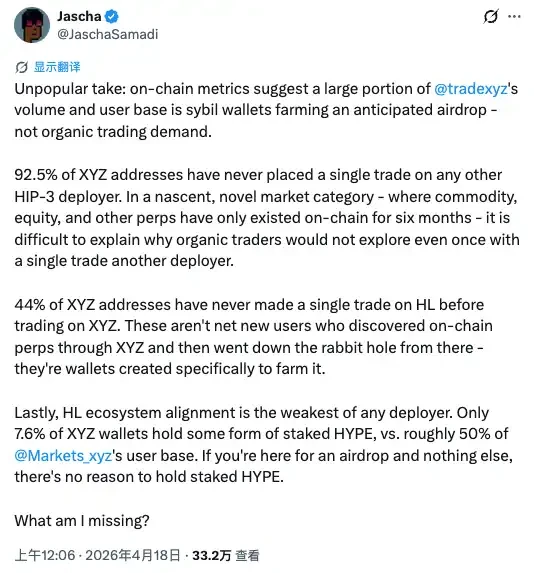
Analyst Jascha noted that 92.5% of XYZ addresses have never conducted a single transaction on any other HIP-3 deployer.
Among the 34,602 wallets categorized as airdrop witch accounts, 34,553, or 99.9%, can be traced back to the same Polymarket identity named "Themino."
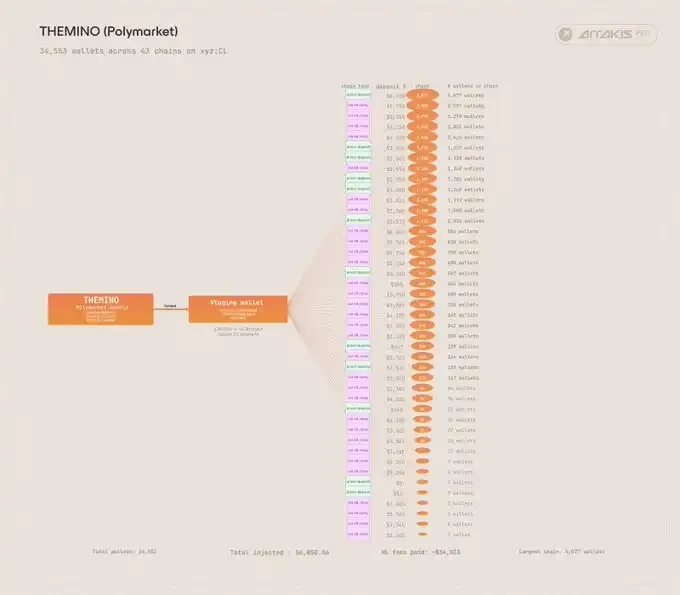
"Themino," a Polymarket identity based in Arbitrum, has spawned 70 independent linear chains covering 34,553 wallets.
How does this work? Hyperliquid's L1 offers a primitive called internalTransfer, allowing the transfer of USDC between wallets with a fixed fee of 1 dollar regardless of the amount. The operator of Themino utilized this primitive to relay a seed deposit across tens of thousands of new wallets. Each wallet executes the same five-step actions within approximately 26 seconds:
1. Receive $X through internalTransfer from the previous witch wallet, incurring a 1 dollar deduction by HL transfer fees along the way.
2. Transfer 14 dollars to the xyz subaccount.
3. Execute two IOC orders on xyz:CL, one buy and one sell, generating two transactions and boosting trading volume.
4. Transfer approximately 13.99 dollars back to the main account (that 1 cent difference is reserved for execution slippage and transaction fees).
5. Transfer $X minus 1 dollar to the next witch wallet through internalTransfer.
The next wallet then repeats the same actions.
The total of 34,510 internal transfers cost Themino 34,510 dollars in protocol fees, a technique consistent with its transaction history on Polymarket.
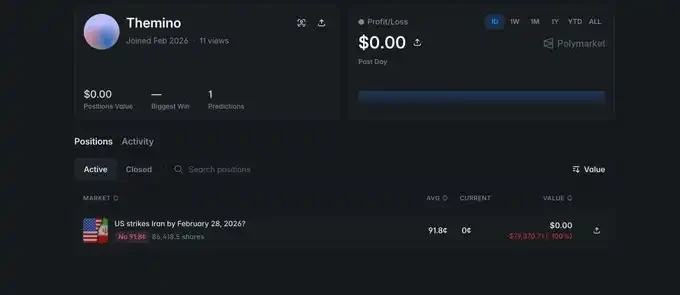
Themino also placed a bet of "no" on the question of "Will the United States strike Iran before February 28, 2026?" on Polymarket, losing about 80,000 dollars. The strike occurred on February 28.
What Types of Builders Exist?
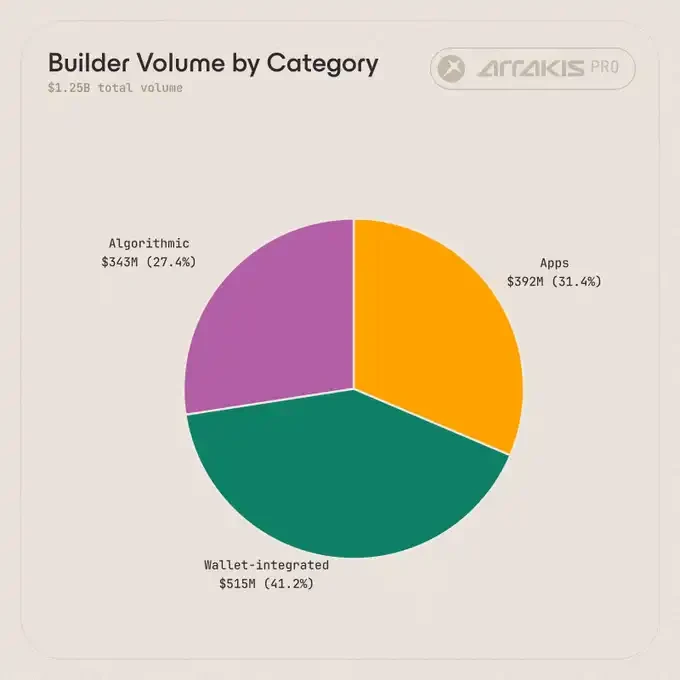
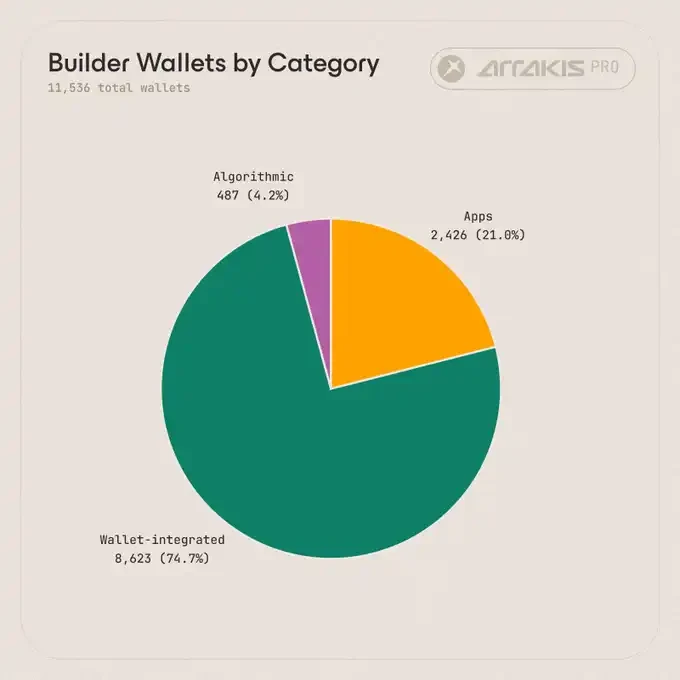
Hyperliquid assigns a unique identifier to orders routed via third-party frontends, allowing these applications to charge custom frontend fees. This identifier is the builder code, also serving as the most straightforward basis for determining which interface (if applicable) a wallet has used. Among the wallets that have traded across the four markets, these builders can be broadly classified into three types.
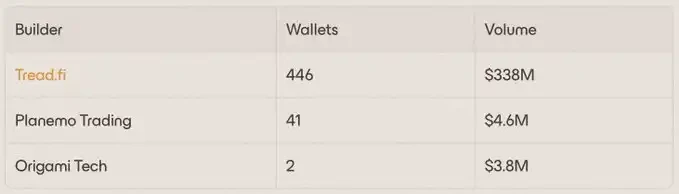
Algorithmic Builders. This category is designed for retail investors to maximize trading volume on DEXs, generating points for potential airdrops. Prior to the end of 2025, generating points on perpetual DEXs entailed either wash trading or algorithmically executing non-directional order-taking against order-taking, which was costly for participants and a net negative for exchanges. Retail market-making robots like @tread_fi, @PlanemoTrading, and @origamitech_ replaced the wash trading with true value-added market making. Each order generated by these products is post-only, meaning wallets are adding liquidity to the order book rather than consuming it.
As @tread_fi's CEO @davidyjeong stated, "Before retail market-making solutions emerged, generating points on perpetual DEXs meant wash trading, inflating trading volume at the cost of execution fees, slippage, and the risk of getting banned. We've solved this with a brand-new point generation approach: robots only place maker orders on both sides. Users generate points at lower costs and often profit from captured spreads, with the byproduct being that the market receives real top-tier liquidity, which is desperately needed during nighttime and weekend periods when traditional market makers are unwilling to make a market. This is a better way to generate points and also the reason why HIP-3 markets today have an excellent execution experience."
These market-making robots' contributions are most evident during times when traditional market makers are absent. CME's WTI futures close Friday afternoons and only reopen Sunday evenings, with perpetual stocks facing the same "night and weekend" gap. During these periods, retail market-making robots bolstered the top-tier liquidity on markets like xyz:CL and xyz:TSLA.
It's important to note that in this analysis, wallets routing through these algorithmic products are categorized as airdrop witch accounts, but their trading behavior and market impact are structurally different from witch activities.
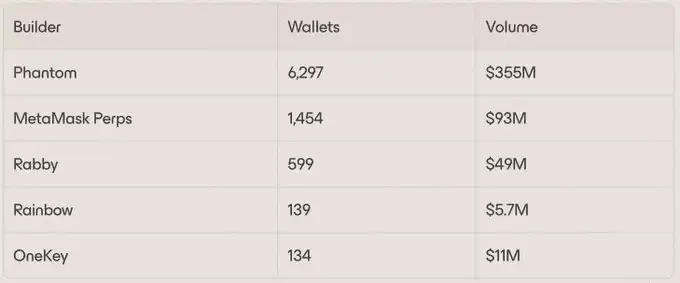
Embedded Builders are perpetual contract interfaces integrated within consumer-grade wallets. Since early 2026, this type of integration has become one of the largest sources of retail order flow on HIP-3. This group includes @phantom, @MetaMask, @Rabby_io, @rainbowdotme, and @OneKeyHQ. Their median transaction volume per wallet ranges between 1,000 to 3,000 dollars, consistent with a retail audience that values usability over marginal builder fees.
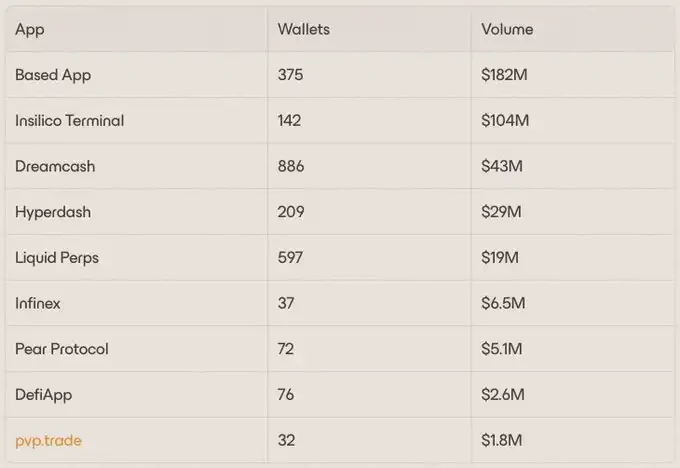
Application Builders are independent perpetual frontends and integrated products: offerings aimed at traders, providing specialized workflows that serve users who find wallet plugins insufficient, requiring better order placing, charting, position management, and execution tools. This group has fewer wallets than embedded builders, but each wallet has higher transaction volume, aligning with a more advanced user base that prioritizes depth of functionality over plug-and-play convenience. Such products include @InsilicoTrading terminal, @liquidtrading, @hypurrdash, @BasedOneX, @Dreamcash, @infinex, @pear_protocol, @defiapp, @pvp_dot_trade.
@InsilicoTrading growth lead @0xVKTR (the team behind Insilico terminal) describes, "At Insilico, we view the HIP-3 market as the next step in opening real-world exposure to crypto tracks. Traders want not just another frontend. They want fast execution, clean market access, and the ability to seamlessly switch between crypto and macro assets without leaving their existing workflows. Trade.xyz is one of the clearest examples of this demand. The order flow routed through Insilico demonstrates that when a trading venue has depth, products are useful, and the trading experience is designed for serious participants, on-chain perpetuals can indeed have a real base of advanced users."
Who are the Largest Market Makers on Trade.xyz?
The market-making landscape across Trade.xyz is highly concentrated. The top 5 market makers account for 50% of market-making volume, the top 13 for 80%, and the top 21 for 90%. A handful of market-making platforms support the vast majority of the exchange's market-making ledger.
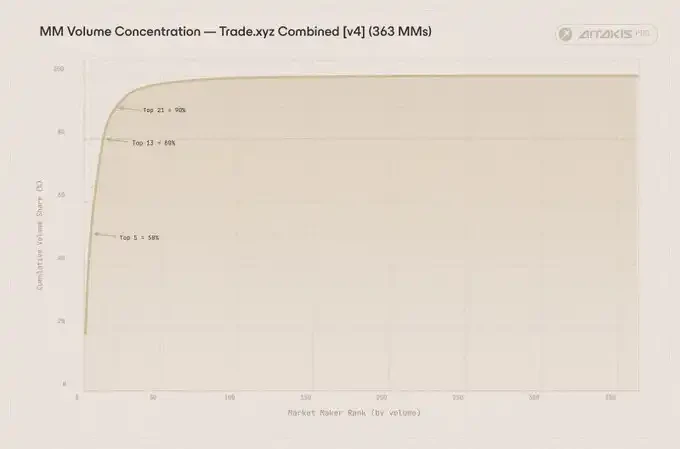
Cumulative share of market-making volume ranked by wallets. The top 5 market-making platforms account for 50% of the total market-making flow, the top 13 for 80%, and the top 21 for 90%.
The second-largest market maker has the most interesting wallet among the entire sample. 0xc926ddba…98d3 has a trading volume of 4.39 billion dollars, an execution rate of 0.52%, which is a textbook example of a maker profile. Arkham marks this address as "Powell" on Polymarket. One of the largest market makers on Trade.xyz is surprisingly a Polymarket user operating across multiple markets on HIP-3.
Other noteworthy market-making platforms:
Jump Crypto operated two wallets with a combined volume of 3.15 billion dollars, funded by 0xf584…d621, a wallet clustered by Arkham as Jump's treasury, holding over 160 million dollars in diversified inventory covering LINK, LIT, EIGEN, BNB, ETH, USDC, and USDT.
Selini Capital operated three wallets: two pure maker quotes (0x44a3e1…35dd, 0x76987c…4480) and one purely aggressive order-taking (0x427be6…d1d9), all running on API. Selini totaled 1.03 billion dollars. It is Hyperliquid's own order flow label that differentiates Selini's market-making wallets from its HFT wallets, with the same market-making platform handling both sides of the book.
Wintermute operated one market-making wallet, totaling 229.6 million dollars (0xecb63caa…2b00), smaller than either Jump or Selini. The funding source is @okx.
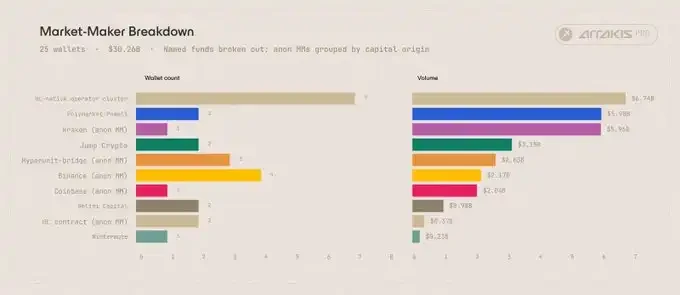
Top market makers on Trade.xyz ranked by trading volume. Powell, Jump Crypto, Selini Capital, and Wintermute occupy the portion of the ledger with visible attribution.
Besides these named market-making platforms, most market-making volume comes from wallets without entity attribution but with clean funding sources: @krakenfx, @binance, @coinbase, @unitxyz bridging, or HL native funds. Their behavior characteristics belong to market-making, but the operators have never interacted with any labelable services that can be pieced back to identity by Arkham.
The median order-to-execution ratio for market makers is 19.4, meaning that for every transaction, about 18 orders were posted and subsequently withdrawn as part of bilateral quotes. The same top 5 market makers appearing repeatedly across the four xyz markets indicate that these are cross-market quoting platforms rather than four separate businesses.
During the window period, market makers had a liquidation rate of 19.2%, nearly on par with retail's 20.4%. Market makers on Trade.xyz assume directional exposure when quotes are taken: A sell order matched with a bid turns the market-making platform into a long; a buy order hitting an ask turns it into a short. During the wild swings in crude oil in March, the speed at which accumulated inventory in the ledger moved in the opposite direction exceeded the speed at which market-making platforms hedged, resulting in one-fifth of market makers experiencing at least one liquidation.
Statistical Arbitrage Order-Taking / Mid-Frequency Trading Robots
SAT acts as the counterparty to the market-making ledger. These wallets operate with over 90% IOC (Immediate or Cancel) order combinations, purely aggressive order-takers specifically aimed at consuming quotes posted by market makers.
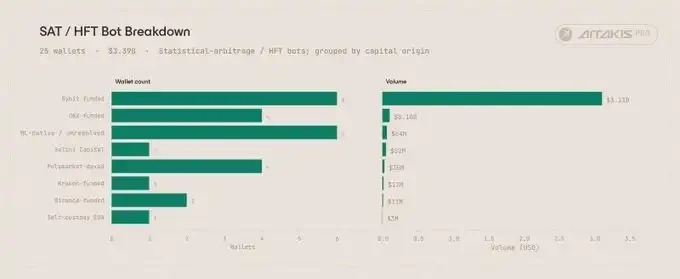
Top SAT/HFT robots ranked by trading volume. The top 4 wallets account for 89% of the SAT ledger, with funding sources concentrated on Bybit.
Of the 3.5 billion dollars in the SAT ledger, the top four SATs account for 3.1 billion dollars, with a concentration of 89%. Two of these operate 100% IOC, meaning their every order is "immediate or cancel," with no maker intent at all.
Funding source clustering points toward @Bybit_Official as the primary SAT profile. Most of the trading volume from top SATs can be traced back to wallets funded by Bybit, aligning with a single robot operating entity or a small circle of robot operators.
Three SATs are associated with Polymarket accounts: loracles (trading volume of 15.5 million dollars, HL cumulative profit +25.7 million dollars), Conduit (5.3 million dollars), and ChadwickLongman (3.7 million dollars). Polymarket appears here for the same reason it dominates in the retail section below; the prediction market community is the most common cross-platform identity on Trade.xyz.
During the window period, SAT’s liquidation rate is 8.1%, about half that of market makers and retail. This group has the tightest risk management in the ledger, hedging their external positions and almost never triggering margin calls.
Retail Group Highly Overlaps with Polymarket
We conducted an in-depth analysis of the 400 highest trading volume retail wallets, excluding the aforementioned algorithm products (Tread.fi, Planemo Trading, and the broader algorithm builder community) routed through Hyperliquid UI and embedded wallet frontend routing orders.
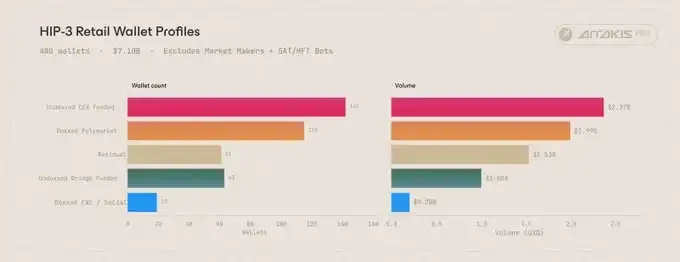
The top 400 trading volume retail wallets classified by attribution. Polymarket real-name wallets dominate in the identified portion, contributing 1.63 billion dollars in trading volume for this group.
Polymarket: Polymarket accounts identifiable through the Arkham on-chain labeling system.
@ensdomains / social identity: Accounts with an ENS name or other social graph identifiers but cannot be traced back to Polymarket.
CEX deposits: Funds sourced from anonymous wallets of centralized exchanges.
Bridging deposits: Anonymous wallets funded through cross-chain bridges.
Others: Self-custody EOAs, contract infrastructure, airdrop address activities.
Most notably is the proportion of Polymarket. Among the top 400 retail wallets, 94, or 22%, of the top retail trading volume (1.63 billion dollars) comes from verifiable Polymarket users. This is the largest identifiable single group within the retail segment. Adding the Polymarket market maker (Powell, 4.39 billion dollars) and three Polymarket-associated SATs (24 million dollars) together, Polymarket's total footprint on Trade.xyz amounts to about 6 billion dollars.
Among the top 15 retail wallets ranked by trading volume, some selected Polymarket wallets include:
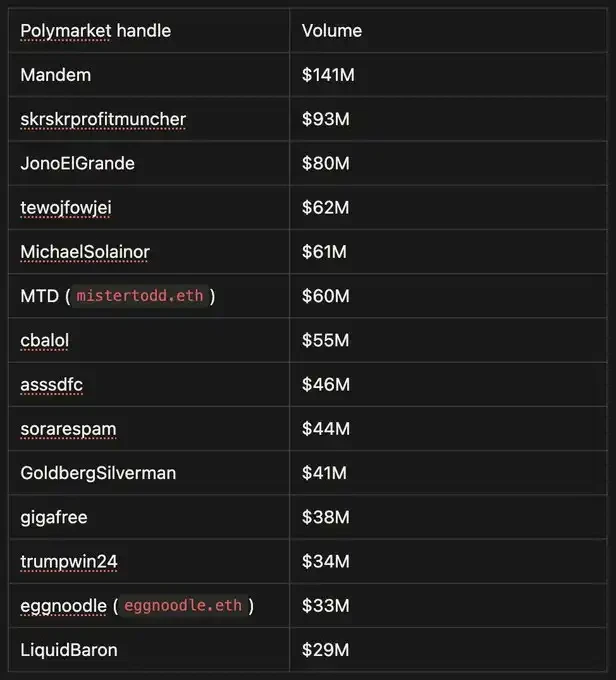
This overlap is reasonable. Polymarket and Trade.xyz provide exposure to real-world outcomes through two distinct market structures, prediction markets and perpetual futures, catering to crypto-native users. Wallet-level data indicates it is the same group of individuals operating between the two ledgers from the same EVM address.
ENS holders also contributed 26 retail wallets, totaling about 400 million dollars. Noteworthy wallets include caydenb.eth (33 million dollars), eggnoodle.eth (33 million dollars), ethmerg.eth (19 million dollars), baitf1sh.eth (16 million dollars), wanyekest69.eth (6.8 million dollars, cumulative profit +17.6 million dollars).
Anonymous wallets breakdown by funding sources:
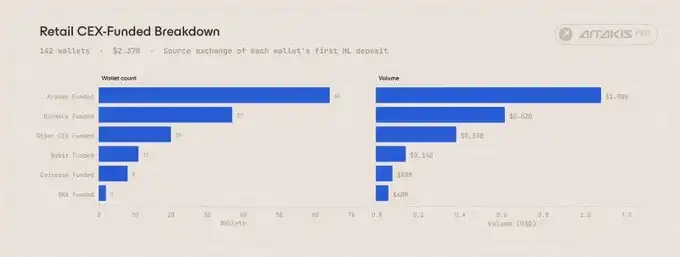
Breakdown of CEX deposit retail wallets by source exchange. Kraken leads the anonymous CEX deposit group by a large margin.
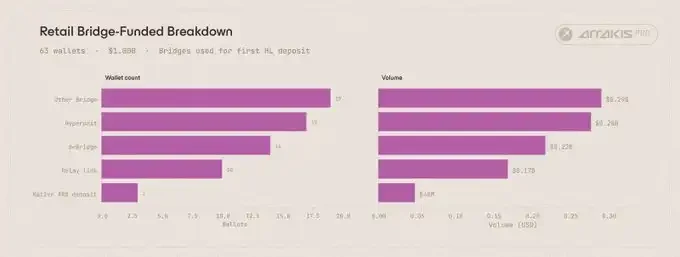
Breakdown of bridging deposit retail wallets by source bridging. Hyperunit and deBridge dominate the bridging deposit group, with Stargate and long-tail covering the rest.
@krakenfx dominates within the CEX deposit group. Hyperunit and @debridge dominate the bridging deposit group, with @StargateFinance and a long list of other bridges covering the remainder. In other words, the retail participants truly driving the Trade.xyz order book are three types of individuals: Polymarket cross-platform traders, independent traders depositing via Kraken, and DeFi natives entering through Hyperunit or deBridge.
When merging the three groups of market makers, SAT, and retail again, we arrive at a compact portrait of the Trade.xyz participant base, having stripped away the so-called witch layer we will discuss next.
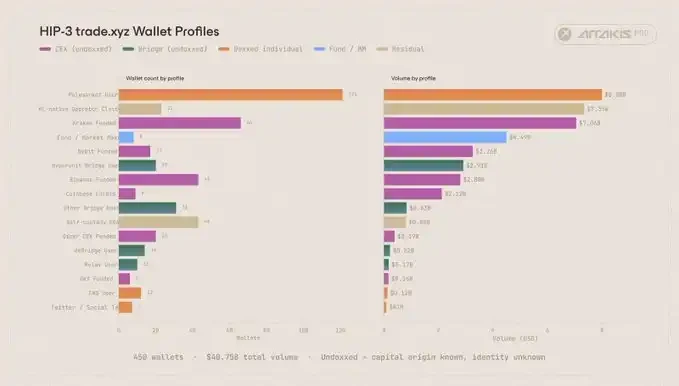
The participant base after stripping away the witch layer. A handful of professional market makers quote a few robot teams, plus a long tail consisting of Polymarket veterans and independent traders depositing through CEXs, who place directed bets through Hyperliquid UI.
A handful of professional market makers quote a few robot teams, plus a long tail consisting of Polymarket veterans and independent traders who deposit through CEXs, placing directed bets via Hyperliquid UI; this is the merged view of the Trade.xyz ledger.
Conclusion
Recent discussions surrounding Trade.xyz have focused on one question: is the participation real, or is this exchange actually dominated by witches targeting an anticipated TGE? The analysis provides a layered answer.
Like any DeFi market before a TGE, Trade.xyz indeed has a witch layer, a typical example being an operator employing a "relay baton" style of witching across tens of thousands of wallets. However, what the witch layer supports is the number of wallets, not the dollar trading volume.
We found no evidence of an independent wash trading operation constructed for inflating dollar trading volume. The parts of the data that appear to be point generation are mostly run through retail market-making robots: wallets place orders on both sides, adding depth to the order book rather than consuming it.
The real trading volume comes from identifiable ledgers. A substantial portion of the top retail wallets carries Polymarket accounts, ENS records, or social graph identifiers, while the largest crypto liquidity market-making platforms (Jump Crypto, Selini Capital, Wintermute) have left clearly visible footprints alongside directional fund Abraxas Capital. The high overlap between the retail group and Polymarket is unusual, considering that the latter is designed around the same speculative preferences.
The inflated number of wallets is predictable behavior before a TGE, but this does not extend to dollar trading volume or to recognizable groups that support this volume.
Special thanks to HyperTracker and numerous contributors for their assistance with data availability.
For the complete methodology, please visit our blog.
Written by: @web3_pastel; Designed and Edited by: @oxillustration, @mchammond; Special thanks to @0xArchiveIO, @HyperTracker (provided by @Coinmarketman), and @stacy_muur for their contributions to this research. This article is for reference and educational purposes only and does not constitute investment advice. Arrakis has made reasonable efforts to verify the accuracy of the data contained herein but does not guarantee that all information is accurate, complete, or timely.
免责声明:本文章仅代表作者个人观点,不代表本平台的立场和观点。本文章仅供信息分享,不构成对任何人的任何投资建议。用户与作者之间的任何争议,与本平台无关。如网页中刊载的文章或图片涉及侵权,请提供相关的权利证明和身份证明发送邮件到support@aicoin.com,本平台相关工作人员将会进行核查。


