Original | Odaily Planet Daily (@OdailyChina)
Author|Azuma (@azuma_eth)

The heavily discussed "Kelp Theft, Aave Bad Debt" incident has taken a new turn.
Just when everyone thought the fundraising was complete and the loophole was about to be fully patched (see The Final Repair Plan is Out, Aave's Bad Debt Crisis is Finally Coming to an End), a law firm has unexpectedly targeted the real funds used to fill this loophole with a restraining order that the entire cryptocurrency community had not anticipated.
On May 2, PaperImperium, head of MegaETH, disclosed an official document from the Federal Court for the Southern District of New York on X. The document shows that a law firm named Gerstein-Harrow has submitted a restraining order application to the court, requesting that Arbitrum DAO not transfer the approximately 71 million USD in ETH assets frozen in the Kelp hacking incident, citing that "these funds should be used to execute unpaid judgment compensations related to North Korea's involvement in terrorism, kidnapping, and other cases over the years."
- Odaily Note: The source document of the restraining order can be viewed here.
Gerstein-Harrow has applied to serve legal notice to Arbitrum DAO by alternative delivery methods, considering it an accountable organization — Arbitrum DAO has a Security Council governed by ARB holders and is capable of taking action in emergencies, hence if relevant members refuse to cooperate, they may face legal consequences such as contempt of court.
Who is Gerstein-Harrow?
Public information shows that Gerstein-Harrow is a law firm based in Washington, D.C., with offices in New York, Los Angeles, and Phoenix, and its partners are Charlie Gerstein and Jason Harrow.
After PaperImperium made its statement, well-known on-chain investigator ZachXBT promptly followed up, stating: "Gerstein-Harrow is a predatory law firm, and their strategy can be considered very malicious."
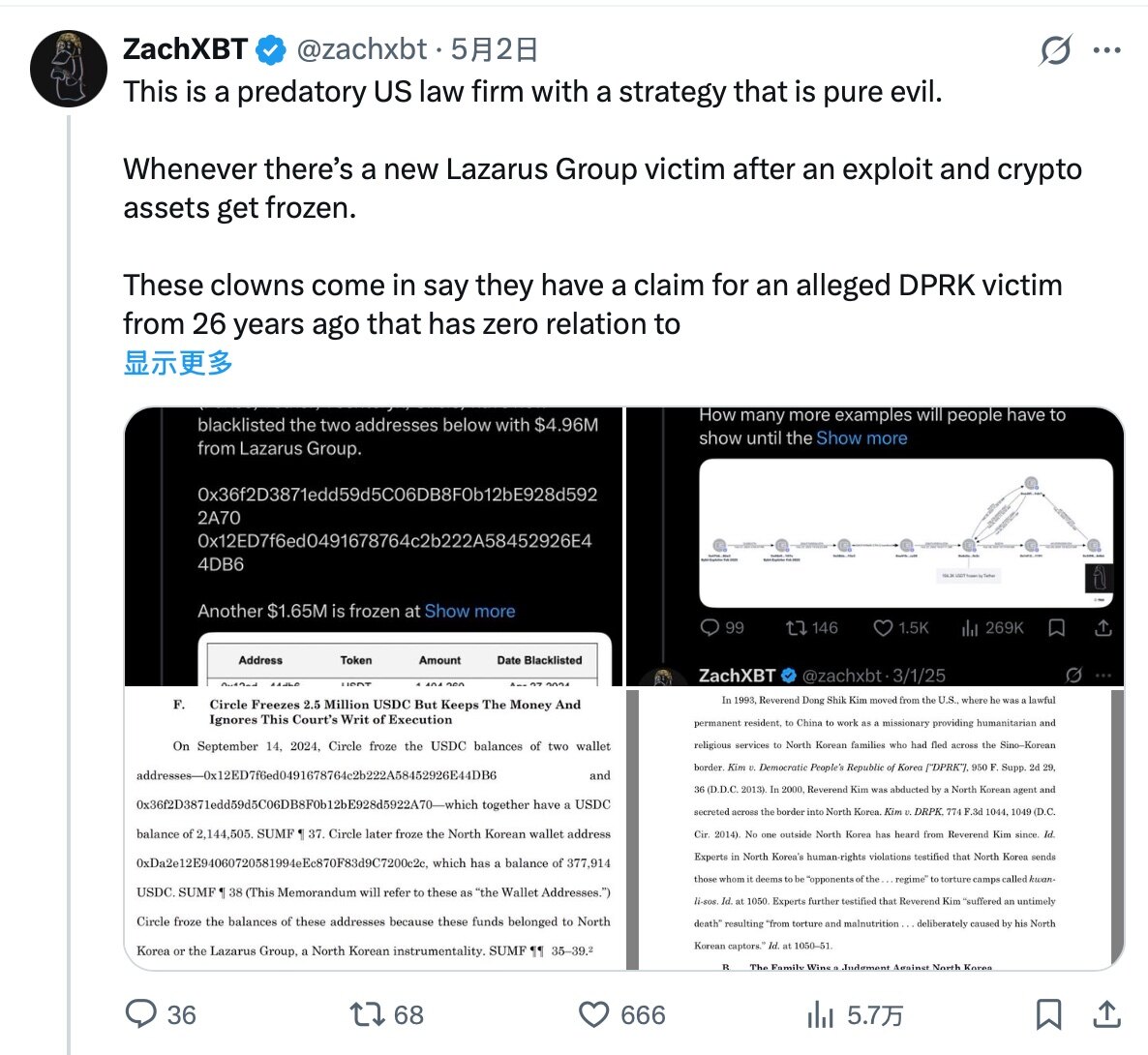
ZachXBT mentioned that whenever there is a new North Korean hacking incident (Lazarus Group) and cryptocurrency assets are frozen, this law firm pops up, claiming to represent a case related to North Korea that occurred 26 years ago, asserting the right to claim against North Korea for the victims... However, it is clear that this case has absolutely no relation to the cryptocurrency industry, exploitations, or hacker attacks.
Apart from this Kelp theft incident, Gerstein-Harrow has attempted similar actions in hacking incidents involving Harmony, Bybit, and others. What’s even more absurd is that Gerstein-Harrow does not actively investigate cases but directly utilizes the investigative results of industry security experts like ZachXBT to apply for freezes, playing the “yellow bird behind.”
The basis of the restraining application is actually a 26-year-old old case
Including the current restraining order application, Gerstein-Harrow's application basis is a case it represents from 26 years ago.
The incident occurred in 2000, when "defector" Dong Shik Kim went missing and was never heard from again. Clues indicate that Dong Shik Kim was likely kidnapped by North Korean agents and secretly brought back to North Korea. Subsequently, in 2009, Dong Shik Kim's family filed a lawsuit against the North Korean government in the U.S. for this reason, with Gerstein-Harrow as the代理律所 of the victim's family.
On April 9, 2015, the U.S. court ruled on this case, recognizing that Dong Shik Kim was kidnapped by North Korean agents and likely died after suffering torture in a North Korean prison camp, ordering the North Korean government to compensate Dong Shik Kim’s family 330 million USD.
It sounds quite absurd that a U.S. law firm sentenced the North Korean government to pay money... Therefore, at that time, media reported: "It is expected that North Korea will not pay the compensation, but the lawyer will seek to confiscate North Korea's assets, such as bank accounts and company shares."
Note this statement "the lawyer will seek to confiscate North Korea's assets," which is the "basis" asserted by Gerstein-Harrow. In simple terms, Gerstein-Harrow's strategy is to take a very old court ruling that they have already won to pursue North Korean-related assets that have appeared or been discovered only now.
And in the current sanction environment, where is the easiest place to find so-called "North Korean assets"? Naturally, it is in the frequently hacked cryptocurrency industry, which has become accustomed to “shifting the blame” onto North Korean hackers — whether these events are actually related to North Korean hackers is still unknown...
Thus, whenever new North Korean-related funds are frozen in the industry, or other identifiable on-chain assets related to North Korea appear, Gerstein-Harrow pops up, claiming "this money should be used to execute the judgment from back then."
This is similar to A winning a lawsuit over a decade ago, with the court ordering B to pay 1 million in damages, but B dragging not paying it. Until now, the police suddenly seized a fund related to B, and A jumps in, saying, "This money belongs to me; I have a prior judgment," but the issue is, this money might have just been obtained by B from C, who is the direct relevant victim...
Will this operation succeed?
Regarding the restraining application submitted by Gerstein-Harrow, and whether it will affect the DeFi patching process, industry professionals have also provided their analyses and judgments.
PaperImperium stated that he does not think Gerstein-Harrow has a high chance of winning in this dispute, but it is also difficult to let them leave empty-handed — considering the current urgency in the DeFi industry for patching vulnerabilities, Gerstein-Harrow may take this opportunity to hard-ball a "piece of meat."
A cryptocurrency user who is also a lawyer, @lex_node, stated that this restraining order has the legal effect of asset freezing in form, and its basis is not fabricated from thin air, but is built on the existing judgment enforcement system in the U.S. Unless certain jurisdiction points prevail, otherwise before the asset stripping hearing, Arbitrum DAO currently cannot utilize the frozen funds — even if they ultimately win the right to retain the funds, they should fight for it through litigation, not decide how to handle it themselves. Although it sounds exaggerated, that is indeed the situation...
In summary, there seems to be a gaming space within the scope allowed by the system. Gerstein-Harrow's claims seem absurd, but they are built on the existing judgment enforcement system as a "legal tool" — even if they ultimately cannot truly take this money, it is enough to materially interfere with the repair process of DeFi projects like Kelp and Aave through freezing and delays. The issue is that the DeFi repair is highly time-sensitive; the sooner the repair is completed, the sooner the protocol can resume normal operations, Gerstein-Harrow may have recognized this point and chose to "hit the wall" accordingly.
As the Gerstein-Harrow restraining order incident intensifies, industry insiders like ZachXBT have begun calling for the establishment of a DAO organization focused on judicial litigation to respond to such unscrupulous law firms' malicious extortion. This may become a lesson that the industry has to learn — as on-chain funds begin to frequently enter the realm of real judicial practices, relying solely on code and consensus is no longer sufficient to build a complete defense line. For all practitioners, how to build the capability to counter off-chain legal risks is becoming a new proposition as important as security and liquidity.
免责声明:本文章仅代表作者个人观点,不代表本平台的立场和观点。本文章仅供信息分享,不构成对任何人的任何投资建议。用户与作者之间的任何争议,与本平台无关。如网页中刊载的文章或图片涉及侵权,请提供相关的权利证明和身份证明发送邮件到support@aicoin.com,本平台相关工作人员将会进行核查。