In K-line technical analysis, the flat top is one of the most basic and easily recognizable bearish reversal patterns, its core function is to "signal the exhaustion of upward momentum," helping traders avoid high-risk situations in a timely manner and seize exit opportunities. Unlike complex composite patterns, the flat top structure is simple and has clear signals, which can be quickly mastered and applied in practice by both beginners and experienced traders.
Today we will break down the core logic, identification points, and practical application of the flat top - remember, technical patterns are not "prediction tools," but "probability signals." Learning to recognize them allows for greater composure in the market.
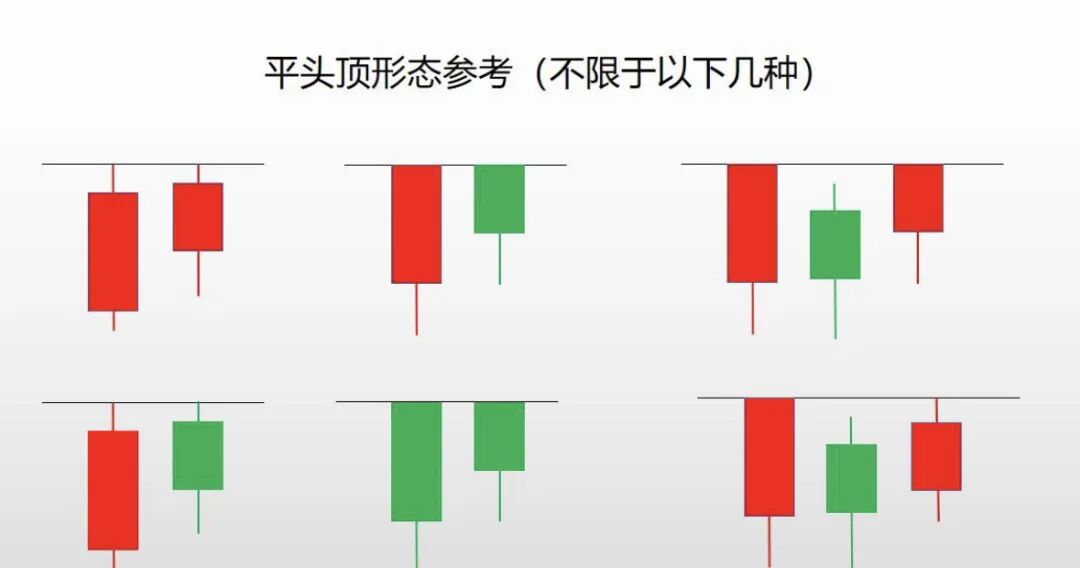
1. What is a flat top pattern?
A flat top, as the name suggests, refers to a situation where the market, nearing the end of an upward trend, tests the same high point twice (or multiple times) without being able to break through, ultimately forming a "flat top" K-line combination, essentially signaling that the buying power in the market has been exhausted and the selling side is starting to counterattack.
In simple terms: the market has stopped rising, if it fails to surpass the same high point after two attempts, it is like climbing a mountain and reaching halfway; failing twice to reach the summit means it is highly likely to start moving downwards - this is the core signal that the flat top conveys.
Core characteristics (must remember): Two (or more) highs are almost at the same horizontal level, the highs can be separated by one or more K-lines, regardless of whether there is fluctuation or minor pullback in between, ultimately failing to break through this common high, forming a "flat top" pattern.
2. Three key identification points of a flat top
Many beginners easily misjudge "two coincidental highs" as a flat top; in fact, there are clear identification standards. Only by meeting these three points does the signal have more reference value, and none can be missing.
1. Position: Must appear at the end of an upward trend
This is the most fundamental premise - a flat top only carries bearish significance if it appears "after a sustained rise." If two equal high points occur during a downward trend or sideways fluctuation, it does not count as a flat top, and has no reference value for reversal signals.
For example: If the market rises continuously from a low level, with an increase of over 30%, and there are two failed attempts to break the same high point, the effectiveness of the flat top signal is greatly enhanced; conversely, if two equal highs appear after half a month of sideways movement, it is highly likely just a consolidation, not a reversal.
2. High points: Heights must be consistent, the smaller the error the better
The prices of the two (or more) high points are nearly identical, allowing for minor errors (generally not exceeding 0.5%-1%), but must not differ too greatly. For instance, if the first high point is 79000 and the second is 79100, that is within a reasonable error; but if the first is 79000 and the second is 80000, it does not count as a flat top.
It's important to note: focus on the "highest point" (the top of the upper shadow), not the closing price. Even if the closing prices of the two highs are different, as long as the tops of the upper shadows are aligned, it can still be considered a flat top.
3. Trading volume: Coupled with shrinking volume makes it more reliable
The effectiveness of the flat top is dependent on trading volume. Ideally, when testing the high point the second time, the trading volume should significantly decline compared to the first. This indicates that the buyers no longer have sufficient strength to push the market higher, the upward momentum has exhausted, and the sellers are beginning to gain the upper hand.
If the trading volume increases during the second attempt at the high, yet it still fails to break through, it suggests that the main force may be inducing buying, and the probability of a subsequent decline is higher (the buying power is overextended, and there is no strength to support future increases).
3. Practical application of the flat top
After recognizing a flat top, the key is to clarify "what to do" - it is not a signal for "inevitable decline," but a "risk warning." In practice, it should be combined with position management and risk control, responding flexibly to avoid blind operations.
1. Holders: Timely reduce positions/exiting to avoid pullback risks
If you hold long positions and detect a flat top pattern satisfying the above three identification points, it is advisable to timely reduce positions or even close all positions.
The core logic: The upward momentum has exhausted, and a pullback is likely to occur soon; exiting at this moment can lock in existing profits and avoid profit erosion. Even if the market continues to rise thereafter (low probability), do not be greedy - the core of technical patterns is "probability advantage." What we need to do is seize high-probability opportunities while avoiding high-probability risks.
2. Non-holders: Do not blindly chase higher, wait for pullback opportunities
For those not currently invested, a flat top is a clear signal of "do not chase higher." Entering long positions at this moment carries a risk far greater than the potential reward because the market is likely to pull back, and chasing higher may result in getting trapped at high levels.
If looking to place short positions, it is recommended to wait for a "confirmation signal": consider entering when the market drops below the lowest point (support level) between the two high points; at this point, the reversal signal is clearer, and the win rate is higher.
3. Risk control points: Set stop losses to avoid misjudgment
Any technical pattern has the possibility of "misjudgment," and the flat top is no exception. If the market breaks through the common high of the flat top, it indicates the pattern has failed; at this point, timely stop losses should be set (stop loss for shorts, reevaluate trends for longs).
Stop loss setting: Use the highest point of the flat top as the stop loss line. Once the price effectively breaks through this high point, it signifies that the upward trend is still continuing, and the previous reversal signal has failed. Exit in a timely manner to avoid greater losses.
4. Two pitfalls that beginners are most likely to fall into
Pitfall 1: Misjudging "aligned highs in fluctuation" as a flat top
Many beginners see two aligned highs and determine it to be a flat top, neglecting the core premise of "end of an upward trend." For instance, during sideways fluctuations, multiple instances of equal highs are simply the market’s consolidation, not reversal signals; blindly shorting at this time can easily lead to being trapped in a fluctuating market.
Pitfall 2: Only looking at the pattern, ignoring trading volume
A flat top without accompanying trading volume significantly reduces the effectiveness of the signal. For example, if two high points are aligned but the trading volume continues to increase, it indicates that buyers remain strong, and this may just be temporary fluctuation, with a possibility of future breakouts; blindly exiting now could lead to missing subsequent upward movements.
5. Summary: The core logic of the flat top
The essence of a flat top is "a signal of exhausted upward momentum," indicating that the buying side can no longer drive the market higher, the selling side begins to counterattack, and the probability of a subsequent pullback exceeds that of an upward move.
But remember: the core of technical analysis is "probability," not "absolutes." A flat top does not equate to "inevitable decline the moment it appears," but rather that "after it appears, the probability of decline is higher." In practice, it is essential to combine position, trading volume, and stop losses, applying flexibly, avoiding blind faith in patterns, and not taking chances.
For beginners, first learn to "identify," then "apply." Starting with simple patterns and gradually accumulating practical experience can help stabilize footing amid complex market conditions.
Kind reminder: This article is for educating about K-line technical patterns and does not constitute any investment reference or operational advice. The market is highly volatile; trading carries risks, so it is crucial to approach with rationality, strictly control positioning and risk.
For timely interpretation and practical thought exchanges, or to inquire about super member services, you can like and follow, and apply to join the free 🐧 group: 746191163
免责声明:本文章仅代表作者个人观点,不代表本平台的立场和观点。本文章仅供信息分享,不构成对任何人的任何投资建议。用户与作者之间的任何争议,与本平台无关。如网页中刊载的文章或图片涉及侵权,请提供相关的权利证明和身份证明发送邮件到support@aicoin.com,本平台相关工作人员将会进行核查。