The reopening of the "Maritime Freedom Initiative" proposed by the Trump administration and the new plan to ensure freedom of navigation in the Strait of Hormuz
The United States has sent an internal cable from the State Department, approved by Secretary of State Marco Rubio, on April 28. It instructs embassies abroad to pressure allies to join. Countries can participate as diplomatic or military partners.
The cable emphasizes that this is the first step in a post-war maritime security framework and requires confidentiality regarding U.S. adversaries like China and Russia.
This plan is not merely a military operation but a hybrid model of diplomacy, intelligence, and sanctions, similar to Trump's previous "Hormuz Escort Alliance" but with a greater focus on a long-term post-war framework. European countries are currently discussing similar maritime security plans separately, and the U.S. hopes to complement them while maintaining U.S. leadership.
The initiative has just been sent out via cable, requiring verbal notifications to partner countries by May 1, with further developments dependent on allies' responses. Trump has consistently emphasized that Iran cannot be allowed to threaten the U.S.
In plain language, it means Trump can no longer endure rising oil prices and hopes to quickly and maximally open the Strait of Hormuz without engaging in conflict with Iran.
The U.S. is leading the formation of a multinational international alliance to ensure freedom of navigation in the Strait of Hormuz through intelligence sharing, diplomatic coordination, and joint sanctions, allowing merchant ships to pass safely while establishing a long-term maritime security framework in the post-war Middle East.
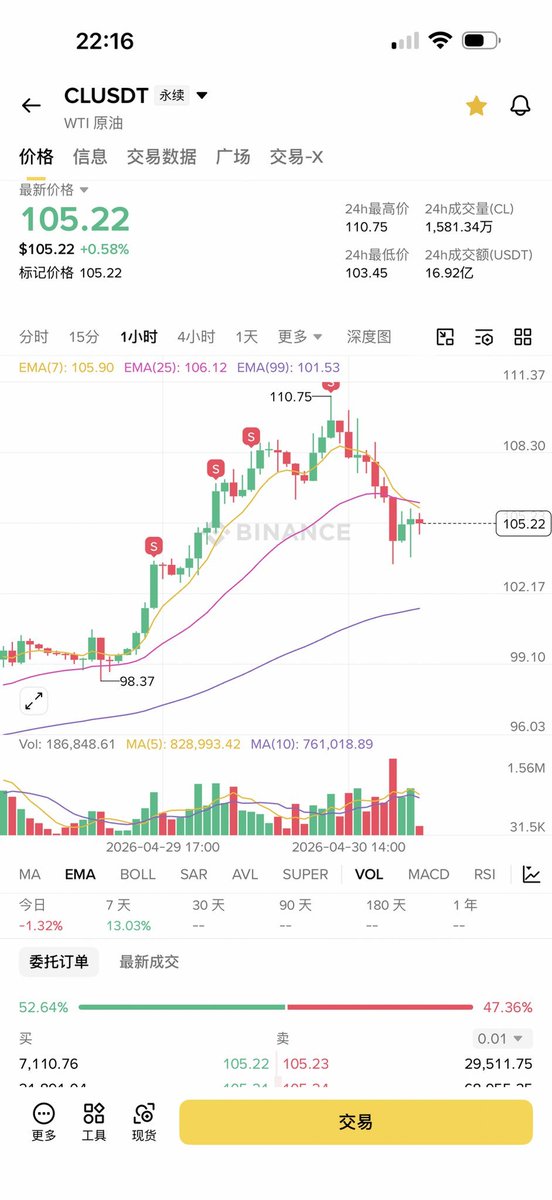
I personally continue to maintain a high position on shorting WTI and ensure the liquidation price is above $120. If WTI exceeds $115, I will set my liquidation price at $150.
免责声明:本文章仅代表作者个人观点,不代表本平台的立场和观点。本文章仅供信息分享,不构成对任何人的任何投资建议。用户与作者之间的任何争议,与本平台无关。如网页中刊载的文章或图片涉及侵权,请提供相关的权利证明和身份证明发送邮件到support@aicoin.com,本平台相关工作人员将会进行核查。


