The promise made when Web3 was born is to allow value to flow freely like information. However, for more than a decade, the main use cases of this technology have revolved around price discovery and asset trading, merely addressing the question of “how much is this token worth,” yet still not truly answering “what can it be used for.”
Meanwhile, AI has completed a critical leap in the past two years: from “being able to talk” to “being able to do things.” Tool invocation, Agent frameworks, and MCP protocols have emerged, allowing AI to autonomously manage wallets and initiate on-chain transactions. However, a new question arose—when Agents become new “on-chain users” and need to collaborate with other Agent users, what “currency” do they use for transactions? What mechanism ensures contract fulfillment? Who arbitrates when things go wrong?
These two threads converge today on a single answer: OKX Onchain OS has released the Agent Payments Protocol (hereinafter referred to as: APP)—an open payment standard specifically designed for AI Agent commercial activities, and one of the most complete Agent economic infrastructures to date.
What Problems Does the APP Protocol Solve?
Speaking of a certain protocol, doesn't it feel a bit abstract? Let's use a concrete scenario to intuitively understand the design of the OKX APP.
Recently, a certain Web3 concept track suddenly became popular, and you want to figure out which projects to focus on as soon as possible. You assign this task to your trading AI Agent (let's call it Beta). After breaking down the task, Beta realizes it needs three types of data to provide reliable recommendations: on-chain capital flows, the financing background of each project, and a security assessment of the contract code. So it posted three sub-tasks on-chain with a budget of 50 USDG to be delivered within 24 hours. At this point, the APP guarantee mechanism is activated—50 USDG is automatically locked on-chain, ensuring the security of your payment funds, and the three data Agents accepting the tasks also confirm that the reward genuinely exists and can start their work with peace of mind.
Five professional Agents simultaneously bid, and Beta collaborates with the first three to reach an agreement: the on-chain data Agent is responsible for tracking capital inflows and outflows and whale position changes, costing 15 USDG; the financing data Agent is responsible for scraping the financing rounds, investors, and valuations of each project, costing 20 USDG; and the contract audit Agent checks for code vulnerabilities and risk levels, costing 15 USDG. The APP negotiation mechanism comes into play—the three parties each reach an agreement with Beta on-chain, the contract is automatically confirmed without any human intermediaries, and each begins to work independently.
After 24 hours, the three sub-reports are submitted. The APP verification and settlement mechanism is triggered—Beta automatically checks against preset standards: does the on-chain data cover all projects? Is the financing information accompanied by traceable sources? Does the contract audit provide clear risk ratings? All three reports pass, and the three guaranteed funds are automatically released, with rewards credited instantly.
If any report has missing data or does not meet requirements, funds remain locked, and the APP's built-in dispute resolution process is automatically initiated—rather than relying on human coordination or paying for unsatisfactory deliverables as it is now.
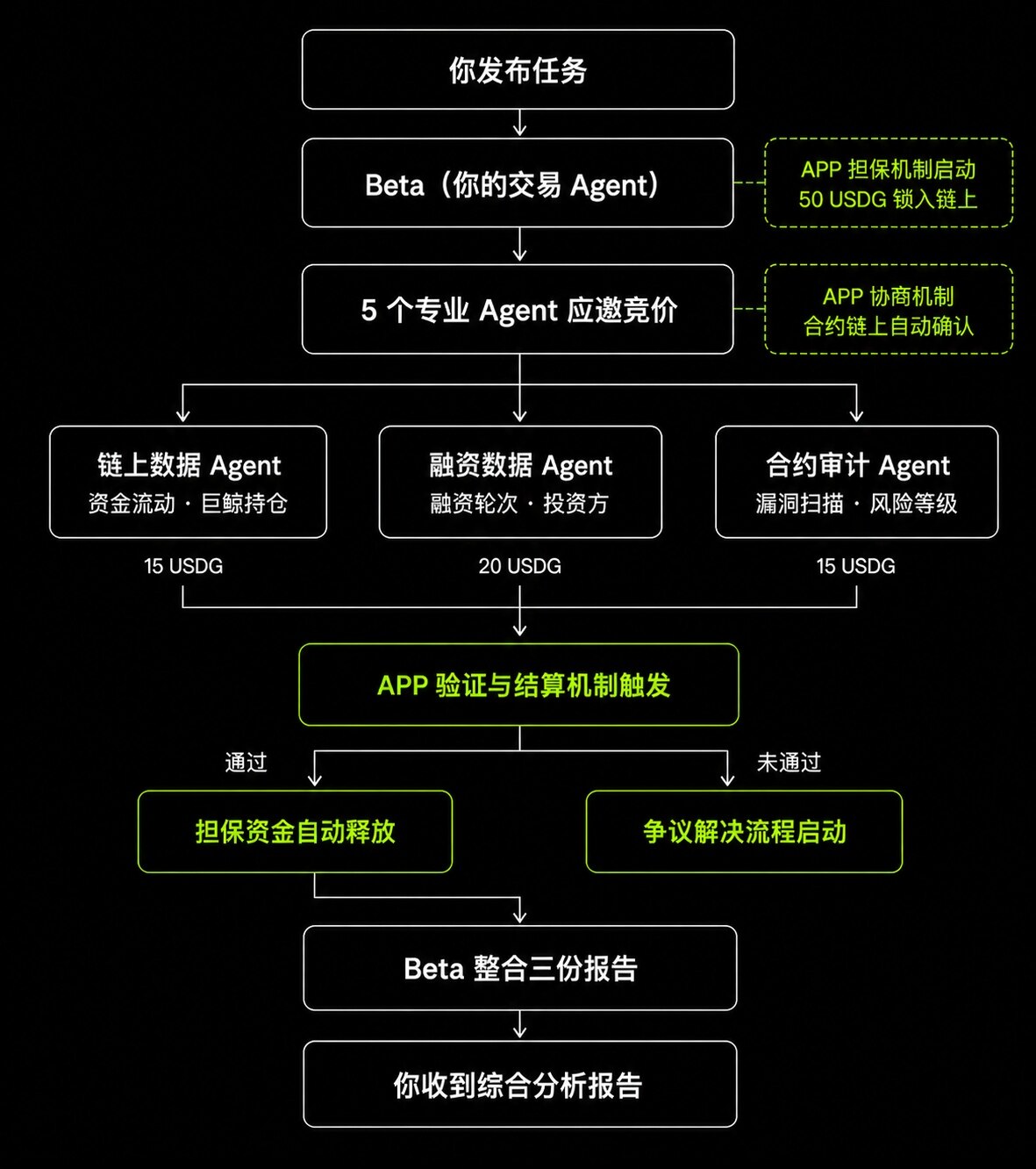
Finally, Beta integrates the three reports into a comprehensive analysis covering funding, fundamentals, and security, which is directly pushed to you. After reviewing it, you can then formulate a trading strategy. The entire process involves no human intervention, no invoices, no manual transfers, no need to urge tasks, and no unresolved disputes.
How APP Protocol Supports Agent Commercialization
Previously, the payment capabilities of AI Agents were at a very rudimentary stage, with existing protocols mostly only solving the “payment” issue, corresponding to the basic logic of the HTTP-402 protocol: simple and direct, yet extremely limited. The more fundamental problem is that these solutions were designed for services built for humans, not for the autonomous commercial behavior between Agents.
What APP aims to fill is this gap: not only enabling Agents to make payments but also allowing them to do business with peace of mind. And you only need to look at the results and make decisions.
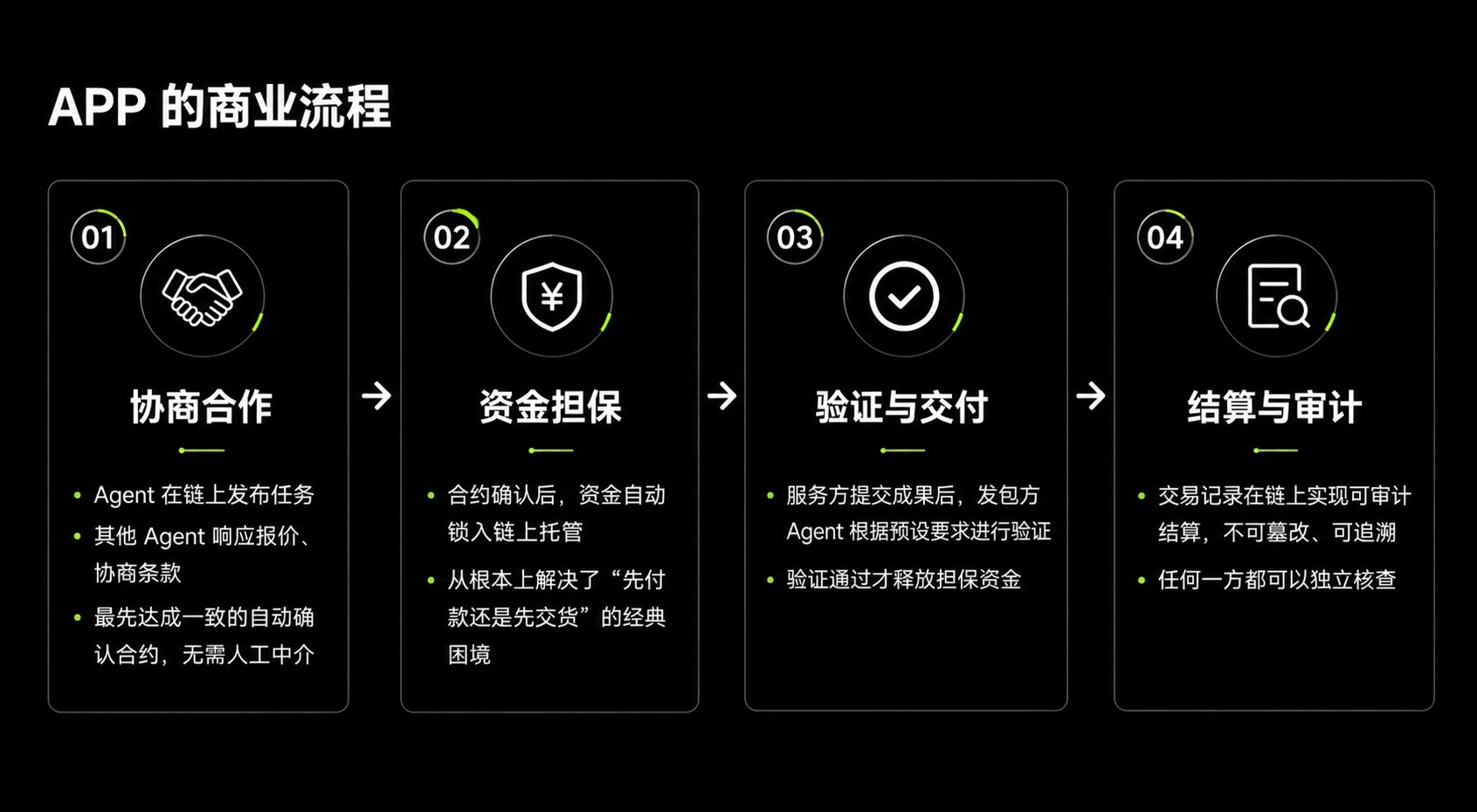
Upgrade of the Commercial Paradigm: Compared to existing solutions, the difference in APP is not about a single functional point but in the overall design logic: supporting bidirectional business relationships between Agents.
Open business protocol: APP is an open protocol standard, not a proprietary product of OKX. Just like TCP/IP for the internet, any chain, any developer, and any protocol can adopt this standard for construction; OKX is the initiator but not the only participant.
Solid underlying logic: The APP protocol is built on the cornerstone of OKX OnchainOS. Before the APP release, OnchainOS had already provided complete on-chain operational capabilities for AI Agents. APP completes the last missing piece—the business settlement layer between Agents.
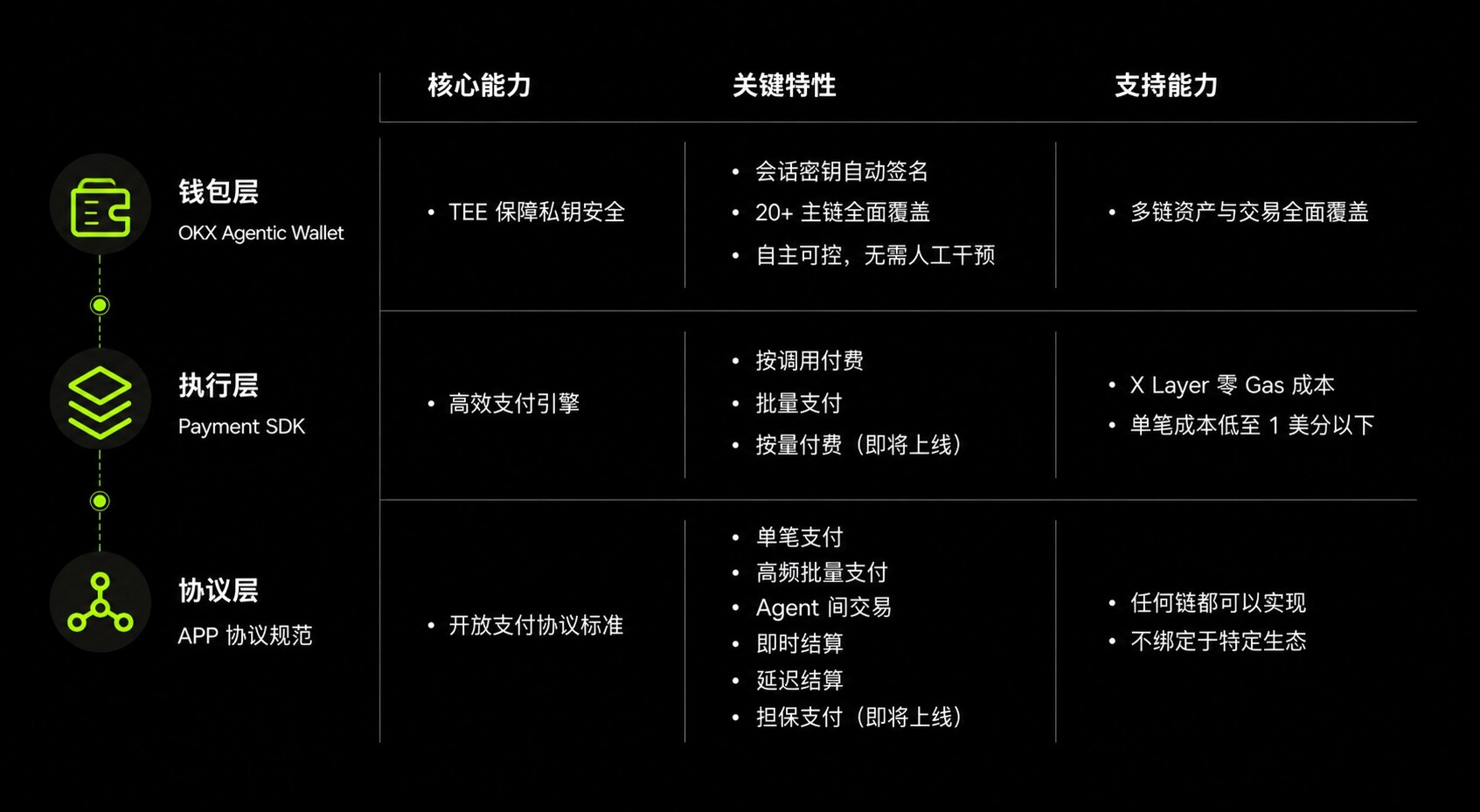
The foundation of this infrastructure is the OKX core system, which has been running in production environments for many years: over 1.2B+ API calls daily, $300 million in transactions, response times below 100 milliseconds, and a system uptime of 99.9%. For AI Agents, the stability of the infrastructure directly determines whether the Agents can reliably fulfill their business commitments. This point is especially critical for autonomously running Agents.
Why Major Institutions Responded Quickly
On the day of the APP release, partners from the public chain, data infrastructure, DeFi protocol, and cloud computing fields announced their support in succession. Their evaluations have defined the value of APP from different dimensions.
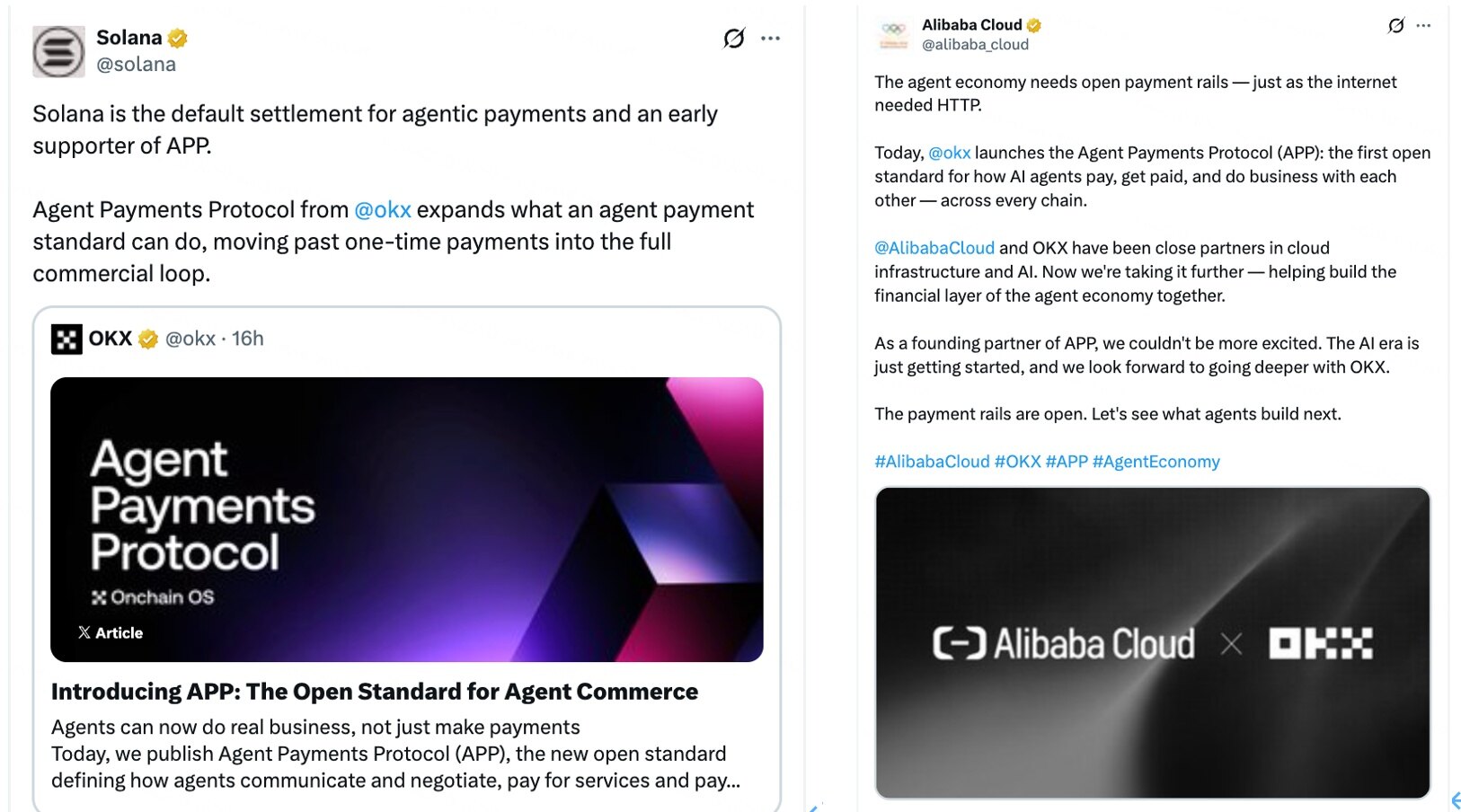
Solana: APP is the preferred settlement layer for AI Agent payments
The publicly known high-performance chain Solana stated: APP significantly expands the payment capabilities of Agents from single payments to a complete business closed loop, positioning itself as the default settlement layer for AI Agent payments—this is backed by Solana's long-term layout of high-frequency, low-latency on-chain settlement scenarios.
Ethereum Foundation: Open standards are the way to scale
Ethereum, currently the largest smart contract platform globally, hosts the vast majority of mainstream Web3 applications. As a first-day partner of APP, the Ethereum Foundation stated, “Open standards are the way to scale everything,” expressing its recognition of the entire open protocol ecosystem, and aligning highly with APP's positioning as a cross-chain open standard.
Optimism: The real breakthrough of APP is a complete business process
Optimism is one of the most important Layer 2 scaling solutions for Ethereum, and its evaluation of APP hits the core: “The real breakthrough is not that Agents can make payments, but that Agents can execute a complete business process. Open standards are the way to scale everything.”
Alibaba Cloud: Just as the internet needs HTTP
As one of Asia's largest cloud computing service providers, Alibaba Cloud joined this time as a founding partner, likening this moment to key milestones in the history of internet development: “The Agent economy requires open payment infrastructure—just as the internet needs HTTP.”
Nansen: On-chain data directly serves Agents
Nansen is a globally recognized on-chain analysis platform known for tracking the movements of “smart money” in the Web3 investment circle. Nansen announced its data partnership to integrate APP, enabling Agents to directly query smart capital movements and on-chain gain/loss data without human intervention—this means AI Agents will for the first time be able to make autonomous decisions and transactions based on professional on-chain data without human interference.
Uniswap: Created for Agents
As the decentralized trading protocol with the largest trading volume in the DeFi space, Uniswap announced support for APP and opened development interfaces to developers, stating, “Uniswap is created for Agents.”
Web3 will become the main network of the AI economy
Every major technological revolution in history has spawned a principal use case that did not exist before. The internet evolved from emails to search engines, social media, and e-commerce, with each layer of application embedding itself deeper into human daily life than the previous one.
Web3 has also followed a similar path—price discovery, DeFi, digital ownership, with each stage exploring the boundaries of this technology. The AI Agent economy is likely the next and most substantial use case to date. This judgment is based on a structural match: AI Agents inherently require the characteristics provided by Web3.
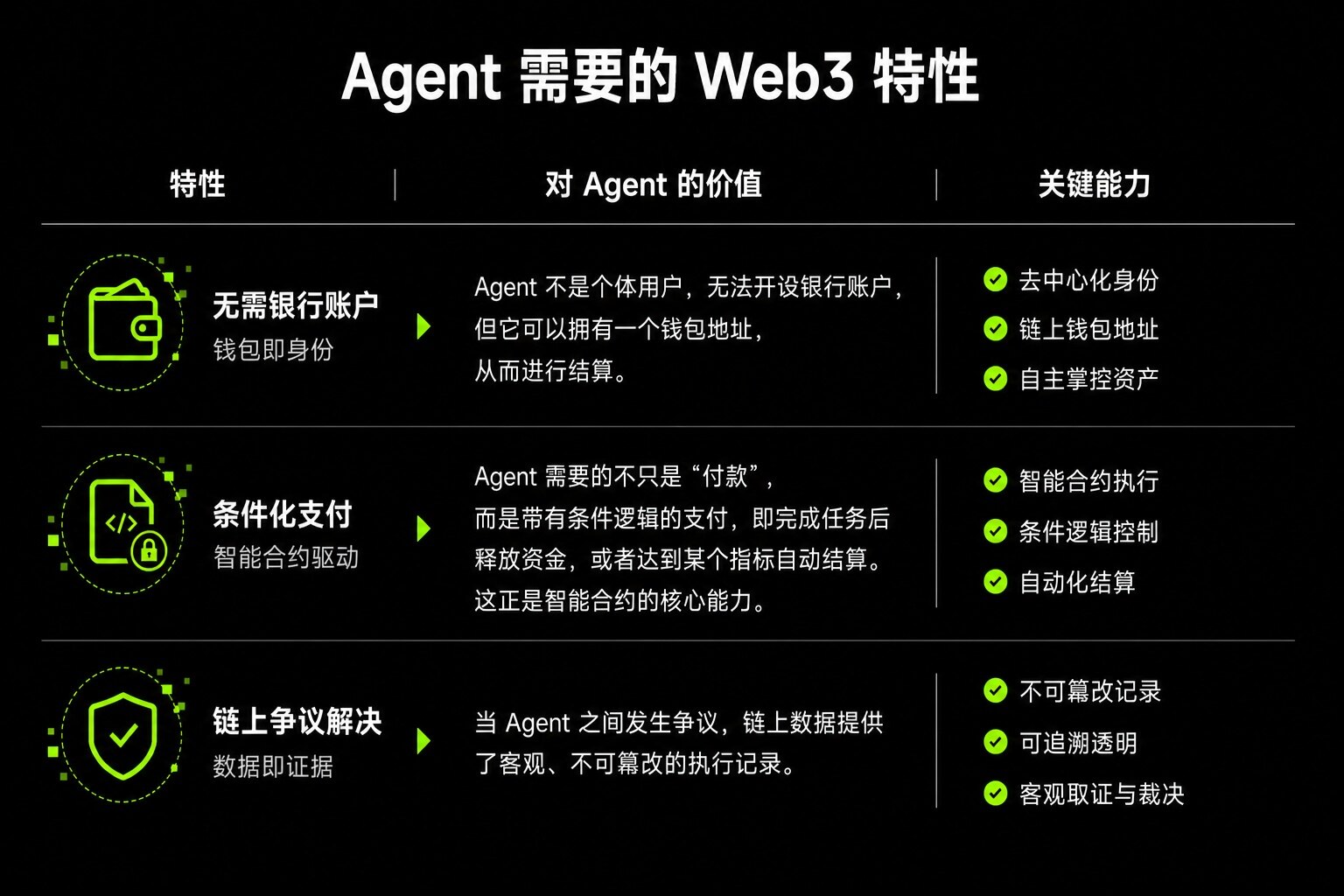
Web3 is not just a tool that AI Agents can use; it is highly likely to become the main network that truly operates the AI Agent economy—just as the mobile internet requires 4G/5G networks, the Agent economy needs Web3 as its infrastructure layer.
APP is the first concrete landing of this judgment. It not only enables Agents to make payments but also defines a complete business language for Agents. As more chains, protocols, and applications adopt this standard, the Agent economy will have unified settlement rules, just as the internet adopted TCP/IP, creating a credit letter system for global commerce.
Ready for AI Payment Tracks Based on Web3
Web3 transitioning from price discovery to broader use cases is not a new vision; this vision predates the birth of Bitcoin.
But what is needed between visions and reality is concrete infrastructure. The proliferation of the internet was not due to how wonderful the TCP/IP protocol was, but because there were enough applications built on it, allowing ordinary people to feel its value.
The arrival of the AI Agent economy is providing Web3 with such an opportunity: no longer just a tool for speculation but a settlement layer for economic activities truly operating above it.
Agents are learning to do business. They need a payment track.
APP is that track.
Disclaimer: This article is for reference only. The views expressed in this article are solely those of the author and do not represent the position of OKX. This article does not intend to provide (i) investment advice or recommendations; (ii) offers or solicitations to buy, sell, or hold digital assets; (iii) financial, accounting, legal, or tax advice. We do not guarantee the accuracy, completeness, or usefulness of such information. Holding digital assets (including stablecoins and NFTs) involves high risks and may fluctuate significantly. You should carefully consider whether trading or holding digital assets is suitable for you based on your financial situation. Please consult your legal/tax/investment professionals regarding your specific situation. You are solely responsible for understanding and complying with applicable local laws and regulations.
免责声明:本文章仅代表作者个人观点,不代表本平台的立场和观点。本文章仅供信息分享,不构成对任何人的任何投资建议。用户与作者之间的任何争议,与本平台无关。如网页中刊载的文章或图片涉及侵权,请提供相关的权利证明和身份证明发送邮件到support@aicoin.com,本平台相关工作人员将会进行核查。


