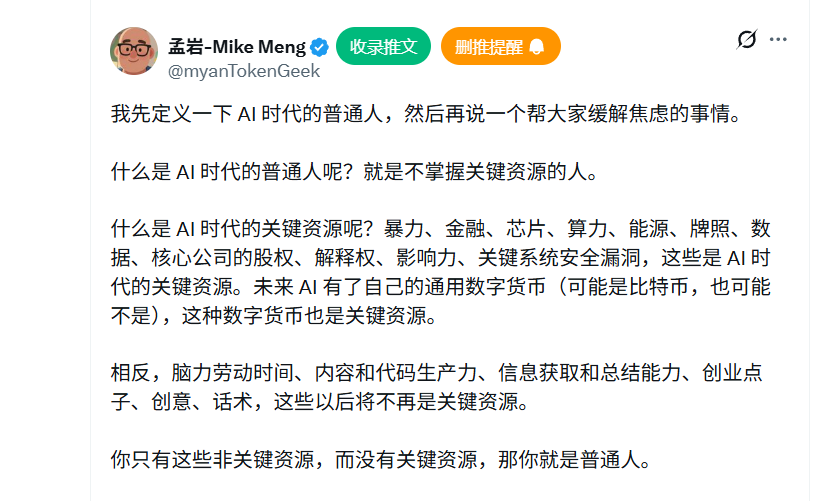
From Teacher Meng Yan's analysis of AI resource structure, we can summarize a clear main axis (four levels).
Physical level: Energy supply rights, chip manufacturing capabilities, computing power infrastructure
Institutional level: Financial licenses, data monopoly rights
Discursive power level: Core company equity, social influence, interpretative power
Monetary level: Issuance and settlement network of universal currency
Understanding these four layers is an important foundation for analyzing AI projects.
For example, the current mainstream narrative in the market views GPU computing power as the core bottleneck of AI development, which is certainly not wrong. However, if we dig one layer deeper, we find that the expansion of GPUs is constrained by energy supply.
This is not a guess, but a physical constraint.
The energy consumption cost of data centers accounts for 40%–60% of operating expenses
The stable operation of GPU clusters relies on industrial-grade power supply
Chips rely on computing power, and computing power relies on energy.
Energy is at the very bottom of the entire supply chain.
It is based on this insight that RAX Finance's positioning becomes particularly clear.
RAX is not just a computing power leasing platform; it is building an "asset market for AI vertical stack."
The so-called "vertical stack" refers to RAX covering the complete chain from GPU chipsets to power supply and tokenizing it.
This allows ordinary investors to indirectly hold core resources of the AI era.
Finally, congratulations to RAX for surpassing 250,000 transactions on the BSC mainnet.
This is not just a milestone in operational data.
免责声明:本文章仅代表作者个人观点,不代表本平台的立场和观点。本文章仅供信息分享,不构成对任何人的任何投资建议。用户与作者之间的任何争议,与本平台无关。如网页中刊载的文章或图片涉及侵权,请提供相关的权利证明和身份证明发送邮件到support@aicoin.com,本平台相关工作人员将会进行核查。


