Written by: Uncle Rust who doesn't understand the classics
In the past two years, perhaps the biggest misunderstanding about AI is that people think it will quickly clarify the future or that it will soon fade away, like a bubble.
Many believe that by 2027, 2028, or 2029, answers will emerge. Whether AGI will be realized will have an answer. Whether AI will massively replace jobs will have an answer. Whether the computational power bubble will burst will have an answer. Whether AI will reshape war, education, companies, and individual destinies will also have an answer.
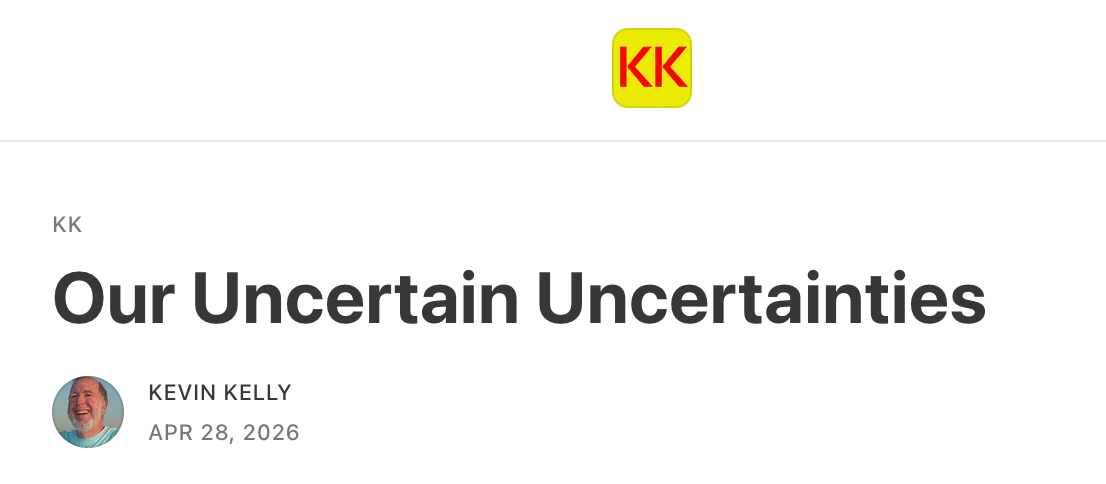
However, Silicon Valley thought leader Kevin Kelly recently published an article titled "Our Uncertain Uncertainties," which proposes a somewhat pessimistic possibility: for the next three years, we may still not have answers. AI may continue to advance, but each progress does not answer old questions; it only creates new ones. He writes, “AI continues to advance, but the new stuff doesn’t answer the old questions, it only expands our ignorance because the new is new in a new way.” AI continues to evolve, but new things do not answer old questions, only amplifying ignorance, because these “new” things are appearing in an unprecedented way.
This is the true brutality of the AI era. The more advanced technology becomes, the less clear the world may be. The more abundant the information, the less certainty there may be. The more powerful the models, the more likely humans are to find themselves asking the wrong questions altogether.
The trouble in the future is no longer just the absence of answers, but the questions themselves are also drifting.
Will AI continue to expand? Has productivity actually increased or decreased? Is employment being destroyed or restructured? Will US-China relations become a cold war, a cold peace, or a new relationship we have never seen before? Can the media still reproduce credible facts? Can traditional institutions restore their credibility?
What Kevin Kelly truly sees is a shared climate behind these questions. AI not only brings new tools, but it is rewriting our ways of measurement. The definition of employment is changing, the definition of the economy is changing, the definition of truth is changing, and even the default premise of "how one should plan their life" is changing. New changes won’t answer old questions; they will only expand our ignorance as they constantly emerge in new ways.
Thus, uncertainty is no longer an event but begins to become a climate.
Weather will pass. Climate will rewrite how people live, how they plant, how they store, and how they migrate. Today's uncertainties are like this as well. They permeate originally seemingly scattered fields like work, marriage, investment, state relations, media trust, and identity. People hesitate to commit, capital raises its thresholds, institutions lose credibility, and the public is increasingly unwilling to bind themselves to a long path.
The deepest layer of infrastructure in modern society, many think, is the power grid, ports, the internet, or credit.
In fact, it is predictability.
Why can a mortgage be signed for thirty years? Because it assumes your income will fluctuate over the next thirty years but not lose its basic shape. Why can education operate? Because it assumes the abilities you learn today will still generally have value in five or ten years. Why does the international order have binding power?
Because it assumes everyone at least acknowledges the same set of rules, even if some people occasionally break them. Why can investment models exist? Because it assumes that while the future is unknown, the unknown still generally falls within a range that can be valued, backtested, and diversified.
What is truly cracking today is this layer of predictability.
To prepare for long-term turbulence, the familiar world has already ended
“Father of the Black Swan”: The World We Live In Today
Coincidentally, British geopolitical scholar Mark Leonard recently published an article titled "The Age of Global Un-Order," which elaborates on this change from a more macro perspective. Mark Leonard is a co-founder of the European Council on Foreign Relations and has long observed how the international order has been hollowed out by new forces.
The most critical distinction in his article is that disorder and un-order are not the same thing.
The former indicates that rules still exist, but someone is violating them. The latter is more serious. The latter means that the rules themselves have lost the ability to organize reality. It’s not just that someone occasionally crosses the line; everyone no longer shares the same understanding of where the lines are, why they should be kept, and whether keeping them still makes sense.
This distinction is very important.
Because many still use outdated language to understand today's world. They say the international order is under shock, that the multilateral system is temporarily failing, and that once a certain war ends, a certain leader steps down, or a certain institution is repaired, order will gradually return.
Mark Leonard's judgment is colder: there is no going back. What we face is not temporary chaos, but a deeper disorder. The old frameworks are still there, but they are increasingly like empty shells. Meetings continue to be held, documents continue to be written, and rules continue to be cited, but reality is increasingly following another logic.
This is also why he proposes the concept of "polycrisis," which refers to compound crises or multiple crises. It is not one crisis after another, but multiple crises interlocking simultaneously.
The Iran war is superficially a Middle Eastern conflict, but in reality, it simultaneously involves energy shocks, nuclear proliferation threats, regional security instability, global economic turbulence, and transatlantic fractures. You can’t just focus on missiles and tankers because the next impact will rapidly appear in food prices, European interest rates, electoral sentiments, supply chain costs, and alliance politics.
At this time, the difficulty in judging the world is no longer just a lack of information, but that the variables are nested with each other; any single-point judgment may be rapidly rewritten by chain reactions.
Mark Leonard also proposed a framework with more visual impact than "polycrisis": architects and craftsmen.
Architects believe in blueprints. They first design a structure and then construct reality according to the plans. The international order, governance, career planning of the past few decades, and even the life templates of the middle class essentially carry the qualities of architects. Choose the right major, enter a good company, accumulate a linear resume, buy a set of assets, and wait for compounding. The same goes for the national level: build institutions, set rules, establish long-term contracts, and maintain confidence through stability.
Craftsmen are different. Craftsmen know that materials will deform, the weather will change, clients will change their minds, and tools will break, so their core ability is not to design correctly at once but to continually repair, adjust, and leave room.
Mark Leonard believes that in an age of disorder, the states that truly gain an advantage are those of a craftsman nature. They do not blindly worship grand order but are better at mending, reorganizing, leveraging resources, and pivoting in fragmented realities. Iran's actions in the Strait of Hormuz represent an extreme version of this mindset: since direct confrontation cannot be won, rewrite the battleground and turn the conflict from a military issue into an economic endurance issue.
This is not just a survival tactic for nations; it is also for individuals.
In the past, the world rewarded architects because the main structure was relatively stable. Today, the world begins to reward craftsmen because the main structure itself is loosening.
It has become clear: AI is not about equalization; it is the final battle between capital and labor. The richer one is, the faster one runs.
Why do 64% of people get stuck at the fourth layer of contemporary wealth's six-tier ladder?
If Kevin Kelly writes about cognitive climate change, and Mark Leonard writes about structural instability in order, then Harvard economist Richard Zeckhauser provides a way to respond to the collapse of paradigms at the decision-making level.
Zeckhauser has a famous paper titled "Investing in the Unknown and Unknowable." His real contribution is not teaching you how to bet in uncertainty but forcing you to acknowledge that many of the most critical and high-return decisions in the real world do not happen in environments where probabilities are clear, variables are defined, and can be backtested or optimized.
He distinguishes three levels. The first level is risk. You know what will happen and have a rough idea of its probability. The second level is uncertainty. You know what possible outcomes there may be, but probabilities are fuzzy. The third level, which is more troublesome, is ignorance, or the unknown and unknowable. You cannot clearly articulate what states will appear in the future, let alone assign probabilities to them.
Traditional financial theory is very useful at the first level. At the third level, many tools begin to malfunction.
This is not just an issue in the investment world. Increasingly, ordinary people's lives are also slipping into the third level.
You think you are making career plans, but you are actually facing a fundamentally unstable job definition. You think you are allocating assets, but you are actually dealing with simultaneous rearrangements of technology, war, policy, currency, and demographic structures. You think you are selecting a future industry, but you are actually choosing an entry point that may be radically rewritten by the next wave of media forms.
At this time, many people instinctively elevate "judgment" even higher. They believe that as long as I am smarter than others, can see further, gather more information, and build more complex models, I can still find the right answers as before.
This is precisely a misunderstanding.
Judgment is certainly still important, but its premise is that the map is relatively stable. What judgment truly excels at is identifying strengths and weaknesses, ranking options, and betting on the future within a relatively fixed coordinate system. However, once the coordinate system itself begins to drift, the value of judgment will rapidly diminish. It’s not that you are not looking closely enough; it’s that the object you want to see clearly is deforming. It’s not that you can’t analyze; it’s that the boundary conditions on which your analysis relies are no longer reliable.
This is the most deserving thing to be renamed today: the most valuable ability is no longer judgment but optionality.
The familiar internet is being ended by AI, along with the underlying logic of making money online.
Human civilization is collectively reversing; a new cycle is slowly rising.
The optionality here is not defined by the financial term classroom definition. It is closer to a methodology of survival.
Optionality means maintaining the capability of reserving the right to pivot, access, error test, and withdraw in an age of long-term unknowns. It doesn’t require you to initially see everything correctly; it requires you to still have paths to take when changing your mind in the future; when old answers fail, there are still new entry points; when others become locked in, you still retain upward exposure and downward buffer.
Judgment deals with answers.
Optionality deals with leeway.
These two abilities can be compatible in stable times. However, once you enter the “uncertainty of uncertainty” that Kevin Kelly speaks of, or enter the “un-order” that Mark Leonard describes, the prices of judgment and optionality begin to differentiate. Because judgment assumes the world is measurable, while optionality assumes the world will deform.
This is also why today, many who seem to be working the hardest, the most rational, and the best planners are becoming increasingly passive. It’s not that they are not smart; it’s that they are so adept at making optimal solutions on old maps. They are accustomed to thinking through problems first, making decisions, and executing long-term. The problem is that significant changes won’t wait for you to think through everything. By the time you are certain, the options have disappeared, and the odds have been taken by others.
Therefore, today's most dangerous asset is not necessarily stocks, houses, or cash; it might also be your self-planning that seems particularly clear, particularly stable, and particularly linear.
The earlier you define yourself rigidly, the easier it will be for the future to discount you.
So how can ordinary people establish their optionality?
First, stop locking yourself into a single identity; understand yourself as a combination of transferable skills.
In the past, society liked to ask, "What do you do?" This question assumes one’s value can be summarized with a stable label: programmer, analyst, lawyer, product manager, researcher. The clearer the labels, the clearer the paths.
Today, this logic is starting to break down. Job titles may still exist, but job content has already been hollowed out by half. What is truly more durable is not a specific job title, but your ability to transfer skills in different contexts. Expression, sales, writing, organization, deciding boundaries, building trust, integrating resources, quick learning—these abilities often have a much longer shelf life than a specific process.
Second, make fewer one-time big bets; make more low-cost small positions.
Many people misunderstand optionality as procrastination or indecision. On the contrary, truly optional people are often more action-oriented; they just don’t take actions that lock themselves in permanently. They start a side project, try a new channel, take on a cross-border collaboration, learn a skill adjacent to their main job but not perfectly overlapping, or enter circles that may not immediately monetize but are worth observing in the long term.
These moves may seem small in the short term, but in the long term, they are creating future entry points for themselves.
Third, prioritize accumulating reversibility and reducing rigid constraints in life.
This is something many easily overlook. The era of judgment values "making significant choices as quickly as possible." The era of optionality values not merely welding yourself to high-fixed-cost structures lightly. Where to live, who to collaborate with, whether to take on early high leverage, whether a career has only one monetization path, whether income sources are overly singular—these may seem like trivial life choices, but they are all issues of whether you still have space to pivot.
Sometimes, true security is not stability but the ability to withdraw.
Fourth, learn to “hitch a ride.”
Zeckhauser discusses sidecar investment in his paper, meaning traveling alongside those with complementary abilities and who are trustworthy. Many big opportunities do not belong to the most calculating people but to those who are the best at identifying who is worth following. On an individual level, this ability has often been undervalued. You don’t necessarily have to be the first to understand what the future holds, but you should be able to recognize who is doing something worth observing, participating in, or betting on.
In an age of uncertainty, being right alone is increasingly difficult. A high-quality relational network is itself a part of optionality.
Fifth, use stable value anchors to support flexible paths.
This is also the most easily overlooked yet most important point in Kevin Kelly's article. He says that in an age of extreme uncertainty, people are even more in need of some virtues that don’t change easily, such as honesty, generosity, and trustworthiness. Many people hear “flexibility” and slide to another side, thinking that trying everything, doing anything, and making no commitments means high adaptability. That is not optionality; that is floating.
True optionality relies on stable values to support flexible paths. Otherwise, every additional choice only adds to the confusion.
Big things are happening, but the vast majority of people have not yet realized it.
Peak Report: What Kind of Wealth Shift is Stablecoins?
As I write this, the entire line becomes very clear.
Kevin Kelly tells us that the problem in the future is no longer just the lack of answers, but that the questions themselves are also drifting. Mark Leonard tells us that the world is not short-term chaos, but that the old order has lost the ability to organize reality. Zeckhauser tells us that when you enter a world of unknown and unknowable, the traditional methods relying on probabilities, models, and linear judgments will quickly fail.
To condense these three things into one sentence:
Judgment is the heroic ability in a stable world, while optionality is the survival ability in a disordered world.
In the past few decades, we believed that those who could see more clearly would win.
In the coming world, it is more likely to belong to those who do not sentence themselves prematurely. They may not be the first to declare they understand the future, nor will they always provide the most complete, certain, or beautiful answers. They are more like craftsmen, always leaving a bit of material in hand, a bit of buffer, and a bit of alternative paths. They know the old blueprints are no longer sufficient, so they do not blindly worship the idea of perfectly designing one’s life in one go. They cultivate a simpler, yet more difficult ability: the world has changed, and I can still move forward.
True freedom is becoming something more concrete than in the past.
It is not about what you see clearly. It is about whether you still have a second path after changing your mind about the future. 【Understood】
免责声明:本文章仅代表作者个人观点,不代表本平台的立场和观点。本文章仅供信息分享,不构成对任何人的任何投资建议。用户与作者之间的任何争议,与本平台无关。如网页中刊载的文章或图片涉及侵权,请提供相关的权利证明和身份证明发送邮件到support@aicoin.com,本平台相关工作人员将会进行核查。


