In a rental house in the Gangnam district of Seoul, a 27-year-old programmer stares at his computer screen late at night.
He is not playing games. The screen displays the position page of Hyperliquid, showing a long position in an ETH perpetual contract, with 20x leverage, using his three months of savings as margin. He has calculated another account: considering Seoul's current housing prices, with his salary level, it would take about thirty years of saving without eating or drinking to buy an ordinary apartment. But thirty years later, he will be fifty-seven.
He is not alone; he represents a generation.
By early 2025, over 16.2 million South Koreans held cryptocurrency accounts, accounting for about 32% of the national population, surpassing the number of stock account holders. Within weeks of Trump’s victory, more than 500,000 South Koreans opened new cryptocurrency trading accounts. An observation about this demographic describes them as follows: young people in Seoul are acting with concentrated bets and high leverage, with hundreds of thousands of accounts moving in roughly synchronized rhythms, creating market impacts that no single institutional investor can match.
You could call it gambling culture, but it is also desperate rationality.
A similar story is playing out on the other side of the globe in a different language.
Lagos, the purchasing power of the Naira is visibly evaporating. In March 2025, after a sudden currency devaluation, the on-chain trading volume in sub-Saharan Africa soared to nearly $25 billion in a month, amidst a general decline in other global regions. About one-third of adult Nigerians own or use cryptocurrency, making it the country with the highest adoption rate in the world. For many Nigerians, this is not speculation. It is the only trusted means of storing value in a country where owning a bank account is difficult.
Mumbai, the participation rate of retail investors in the derivatives market soared from 2% in 2018 to 41% in 2025. The number of trading accounts skyrocketed from 36 million to 154 million in five years. A study by SEBI on nearly ten million personal stock derivatives traders revealed that more than 40% are under 30 years old, and over three-quarters have annual incomes below the equivalent of 50,000 yuan, using extremely limited incomes as a cushion for high-leverage trading, and they cannot stop regardless of how regulators warn them.
Seoul, Lagos, Mumbai, are also microcosms of the world. Contemporary youths, are gathering around the same tool: perpetual contracts.
This is not just a story about the cryptocurrency industry; it is a collective action driven by structural inequality, where young people globally are using leveraged tools to fight against the pressures of modern life.
A genius idea, waiting thirty years
The perpetual contract (Perpetual Contract, commonly referred to as Perp) is not an invention of the cryptocurrency industry.
In 1993, Nobel laureate Robert Shiller officially proposed this concept. In his design, it is a cash settlement tool with no expiration date capable of tracking the long-term value of illiquid assets, initially designed to hedge against real estate price risks.
However, this design was ahead of its time; the traditional financial machinery was too heavy. Wall Street built a massive system around fixed expiration dates, batch settlements, and centralized clearing. That old machine driven by paper documents and intermediaries naturally rejected the flexibility of "never settling". Shiller’s concept slept in academic journals for over twenty years, as no one had the capability or motivation to realize it.
Until 2016, when Arthur Hayes of BitMEX introduced perpetual contracts to cryptocurrency.
In those two years, BitMEX quickly rose from the margins to become a dominant player in the industry thanks to perpetual contracts.
The secret does not lie in Bitcoin itself but in how perpetual contracts liberated the most ancient human impulse—the directional bet with leverage. No expiration date, no Greek letters, no rollovers, no exercising. Just one judgment: up or down, by how much.
a16z investment partner Jay Drain defined the essence of this matter in a recent widely discussed report: "Perpetual contracts strip away all the complexities of options; there’s no need to choose strike prices, manage expiration dates, or worry about time decay swallowing an accurate directional judgment. It retains only one thing: a pure bet on price movements. The explosive growth of 0DTE options has already proven the scale of this demand."
The 0DTE he mentioned refers to another rapidly growing type in the U.S. stock market—zero-day-to-expiration options. In 2025, daily trading volume for 0DTE SPX reached 2.3 million contracts, up 51% year on year, accounting for 59% of the total volume of S&P 500 options. Retail investors accounted for 50% to 60% of this trading volume.
No need to wait, no complexity, just now, give me leverage.
Perp merely takes this demand to the extreme.
The numbers are the most honest footnotes of this evolution. In 2025, the total trading volume of perpetual contracts on centralized exchanges reached $86.2 trillion, a year-on-year increase of 47%; and the growth rate for on-chain DEX perpetual contracts was even more astonishing, with annual trading volumes reaching $6.7 trillion, up 346% year on year. Perpetual contracts currently account for over 70% of total centralized crypto trading volume, and about 78% of all crypto derivatives trading volume.
The nominal trading volume of Bitcoin perpetual contracts exceeds the spot trading volume of Bitcoin by about six times.
This "derivatives-dominated pricing" market structure has never occurred in any traditional asset class, such as gold, crude oil, or the S&P 500.
Dopamine, tribes, and PNL: trading becomes a lifestyle
The frantic spring of 2021 was the starting point for understanding all this.
Robinhood simplified complex financial games into a sliding game on mobile phones with its colorful interface and commission-free slogan. This product design collided with the historical vacuum created by global lockdowns: tens of millions of young people, armed with government relief checks, lost traditional gambling venues like sports events, casinos, and bars, and the stock market became the largest and only arena that never closed.
Retail investors on the Reddit forum WallStreetBets discovered hedge fund Melvin Capital's reckless short position on GME and rallied through social media, lifting the stock price dozens of times with call options, forcing Wall Street's top hedge funds into liquidation.
The GME incident announced one thing to the world: retail investors realized that, through leveraged derivatives, they could directly rewrite pricing logic.
But GME was just a trigger; a deeper thing had already taken shape.
Modern trading apps are increasingly designed like games: real-time flashing numbers, blinking red and green colors, alert sounds during transactions. This is essentially a high-frequency feedback dopamine system. In the past, trading required opening a computer, reading reports; now you can place a bet while riding the subway, on the toilet, or waiting in line for coffee. When the barrier to trading drops low enough, it becomes a fragmented pastime like scrolling through short videos or playing mobile games.
PNL (Profit and Loss chart) has become a new business card. Screenshots of profits earned are proof of "strength," while self-deprecation when losing money serves as "genuine" social currency. In Discord channels or on X, these real-time financial fluctuations have more impact than any static life photo. People buying the same Meme coin naturally form communities of interest, and the emotional bonds of "making money together" or "going to zero together" are much sturdier than mere hobbies.
Thus, trading has become a daily social and lifestyle activity for a new generation of young people.
Among all trading tools, perpetual contracts are the most perfect dopamine carriers.
They have no complexity of options and no expiration anxiety of futures. They only have positions, only leverage, and only unrealized profits and losses that can be seen at any time. They resonate perfectly with this generation's sense of time—not holding for three years, not quarterly reviews, but right now, tonight, in the next two hours.
Traditional financial derivatives tools designed for risk management are being used by a new generation of retail investors as weapons for directional bets. Perp, with its extremely minimalist design and "fast, refreshing, fierce" trading pace, perfectly matches this demand.
A class barrier hidden for two hundred years
However, the significance of perpetual contracts goes far beyond "lower threshold gambling."
It is breaking down an older wall.
For a long time, the restricted trading hours of traditional stock markets have served as a hidden class barrier. Academic studies have revealed a shocking fact: under the so-called "overnight drift" effect, a disproportionate portion of long-term returns in U.S. stocks arises outside of regular trading hours. Earnings reports and major news events typically deliberately avoid opening times, locking retail investors into the 9-to-5 window, helplessly watching prices jump at the opening second during off-hours—profits that originally belonged to them have long been divided among institutions with access to extended hours.
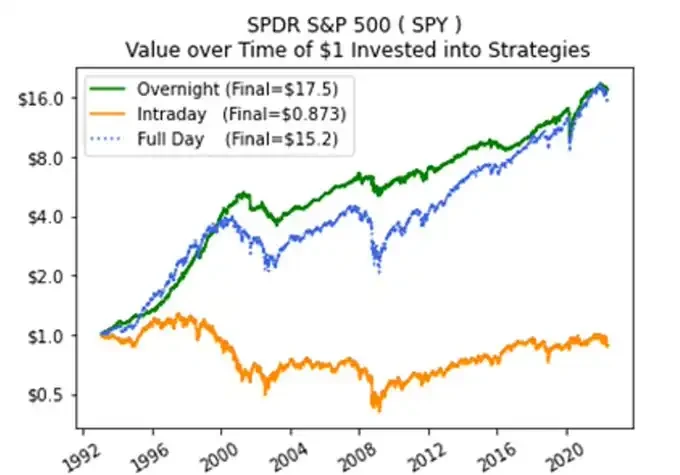
Data coldly confirms this point. If you bought the highly volatile retail darling AMC at market open every day from 2019 to 2022 and sold at market close, your principal would nearly reach zero, with losses of up to 99.6%; but if you only held it overnight, the concurrent return would reach 30,000%.
This is not a story about luck. This is about the structural unequal distribution of information rights, time rights, and pricing rights—and this imbalance has existed for two hundred years.
On-chain perpetual contract platforms may currently be the only infrastructure that can truly break this barrier.
This is no longer a theoretical idea. In March of this year, during a panic weekend following the Iran attack, major global exchanges were closed, and retail investors could only anxiously scroll social media, while Hyperliquid's oil perpetual contracts traded $1 billion within 24 hours.
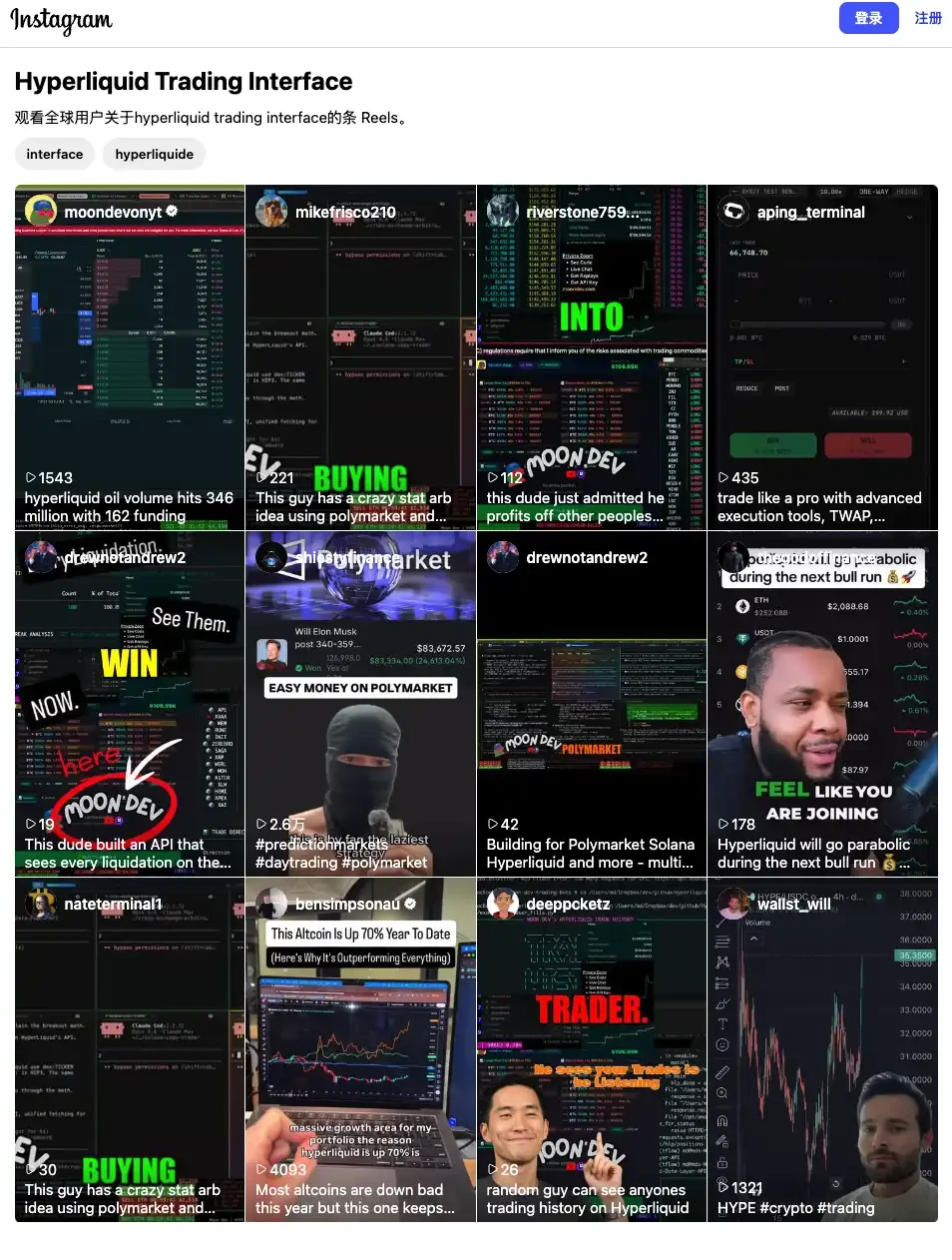
Hyperliquid is highly favored by the new generation of traders on Instagram
Meanwhile, Intercontinental Exchange (ICE), Chicago Mercantile Exchange (CME), and Nasdaq announced their plans to launch 24/7 trading services one after another. The trading hour barrier that has stood for two hundred years is simultaneously being dismantled from both sides.
The endgame of RWA: everything can become Perp
In the past, perp traders only bet on crypto assets—BTC, ETH, SOL, and a long list of altcoins.
This boundary is disappearing.
Starting in the second half of 2025, although the overall crypto market enters a downward cycle, RWA (Real World Assets) perpetual contracts rise against the trend. Several DEX platforms have already launched contracts for commodities, stocks, and indices, with tradable assets expanded to NVIDIA, Samsung, SpaceX, and commodities like silver and palladium.
Recently, RWA assets briefly accounted for Hyperliquid's total trading volume at 44%, consistently being the highest-earning trading pair on the platform. Every weekend when traditional markets are closed, Hyperliquid's on-chain oil perpetual contracts become the only operating oil pricing machinery in the world.
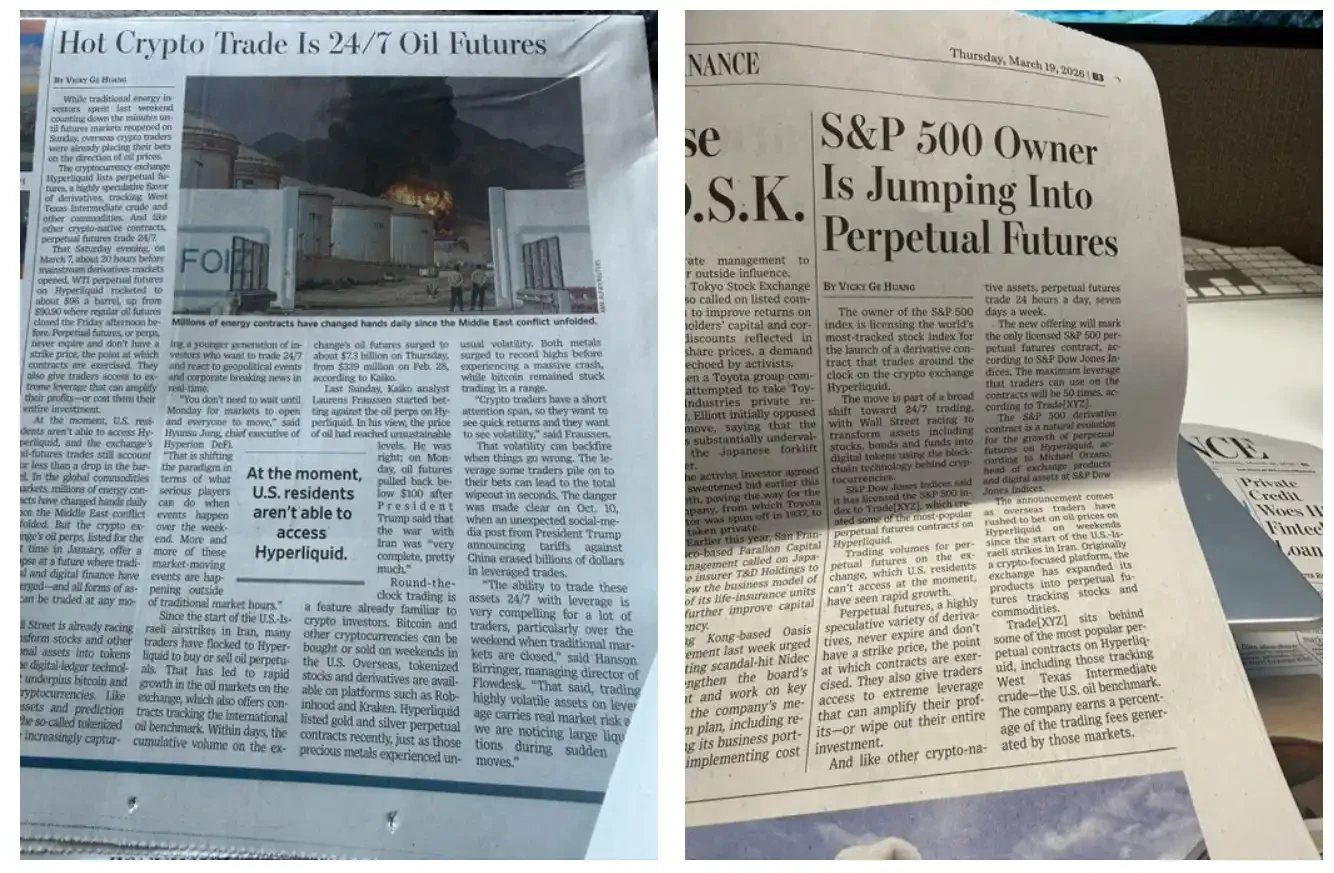
The Wall Street Journal reported on Hyperliquid and TradeXYZ twice
This is a paradigm shift that is happening.
a16z explicitly stated in its latest outlook report: synthetic products (like perpetual contracts) provide deeper liquidity and are a more crypto-native solution for RWA than simple tokenization. Essentially, this is a historical choice between "perpetual contracts vs. tokenization," and the answer is becoming clear.
Coinbase's institutional research is even more direct: with the long-term trend of global retail participation in U.S. stocks continuing, stock perpetual contracts are likely to become the preferred tool for the next generation of retail traders, offering both 24/7 access and capital efficiency.
Capital has sniffed this direction.
On April 28, 2026, crypto derivatives platform Liquid announced the completion of $18 million Series A funding, led by Neo and Left Lane Capital, with participation from Haun Ventures, K5 Global, SV Angel, and others. Prior to this, the company completed a $7.6 million seed round led by Paradigm, with a total funding amount reaching $25.6 million.
Liquid was founded by Franklyn Wang, a former quantitative researcher at Two Sigma and a Harvard graduate. He is 25 years old this year. This company started as a perpetual contract aggregator, integrating Hyperliquid, Lighter, Ostium, and other on-chain derivatives exchanges into a single interface. Now, it has expanded to stocks, forex, commodities, and prediction markets, supporting over 500 trading assets, with Polymarket positions also tradable on it, with leverage up to 200 times.
There are hundreds of millions of young people around the world waiting for a sufficiently simple tool that allows them to bet on the direction of the world with minimal friction.
Meanwhile, the top talents in traditional finance are all moving toward Perp.
Regulation opens wide, on-chain will never go dark
In April 2026, CFTC Chair Michael Selig announced in a public speech that regulators will establish a comprehensive regulatory framework for perpetual contracts in the U.S. "in the near future."
His exact words were: "The previous administration failed to create a path for these markets to exist domestically. Under my leadership, the CFTC will use all available tools to bring perpetual contracts and other new derivatives onshore, enabling them to thrive in both centralized and decentralized markets."
This is almost a public declaration of war.
Global exchanges have already started to race. Kraken's parent company acquired Bitnomial, which holds perpetual contract qualifications, for up to $550 million; Coinbase launched long-term futures products close to perpetual contract designs; Robinhood announced it was introducing perp for U.S. users; Polymarket and Kalshi announced their entry into the perpetual contract field one after another. Even the prediction market Robinhood saw its product line trade 11 billion contracts throughout 2025, with over a million active users—this is the fastest-growing revenue line in the platform's history.
Prior to this, perp's main market was on offshore platforms outside the U.S., where young people from Seoul, Lagos, Mumbai, Hanoi, and São Paulo used leverage obtained through fears of currency devaluation to bet on the direction of the world.
The formal opening of the U.S. market means that the deepest liquidity pools in the world and the most engaging financial instruments of this era will meet on the same stage.
An on-chain trading platform Hyperliquid, founded in 2022, is now able to challenge the world's top centralized exchanges in daily trading volume. A perpetual contract aggregator, Liquid, which only went live in August 2025, has processed $3 billion in trading volume within eight months and just completed Series A funding led by top venture capital firms.
They are all built on the same principle: Generation Z does not want to wait for the market to open, does not want to fill out account opening documents, does not want to pay for the layers of barriers traditional finance has set up to "protect" them. What they want is for this moment, is leverage, is any story-laden asset in any timezone.
In late 18th century New York, anyone could become a stockbroker; there were no price boards or fixed trading places. Transactions often took place under a tree on Wall Street, where brokers and merchants bought and sold stocks and government bonds. The trading time was simply "when everyone was there." When it got dark, they dispersed, and trading stopped.
Today, this tree has grown on-chain, and it will never go dark.
免责声明:本文章仅代表作者个人观点,不代表本平台的立场和观点。本文章仅供信息分享,不构成对任何人的任何投资建议。用户与作者之间的任何争议,与本平台无关。如网页中刊载的文章或图片涉及侵权,请提供相关的权利证明和身份证明发送邮件到support@aicoin.com,本平台相关工作人员将会进行核查。


