Original author: Sleepy.md
April 28, 2026, Federal Court of Oakland, California.
There were no table-thumping outbursts like in Hollywood legal dramas, only a cold list of evidence, sharply dressed top lawyers, and a stifling sense of oppression.
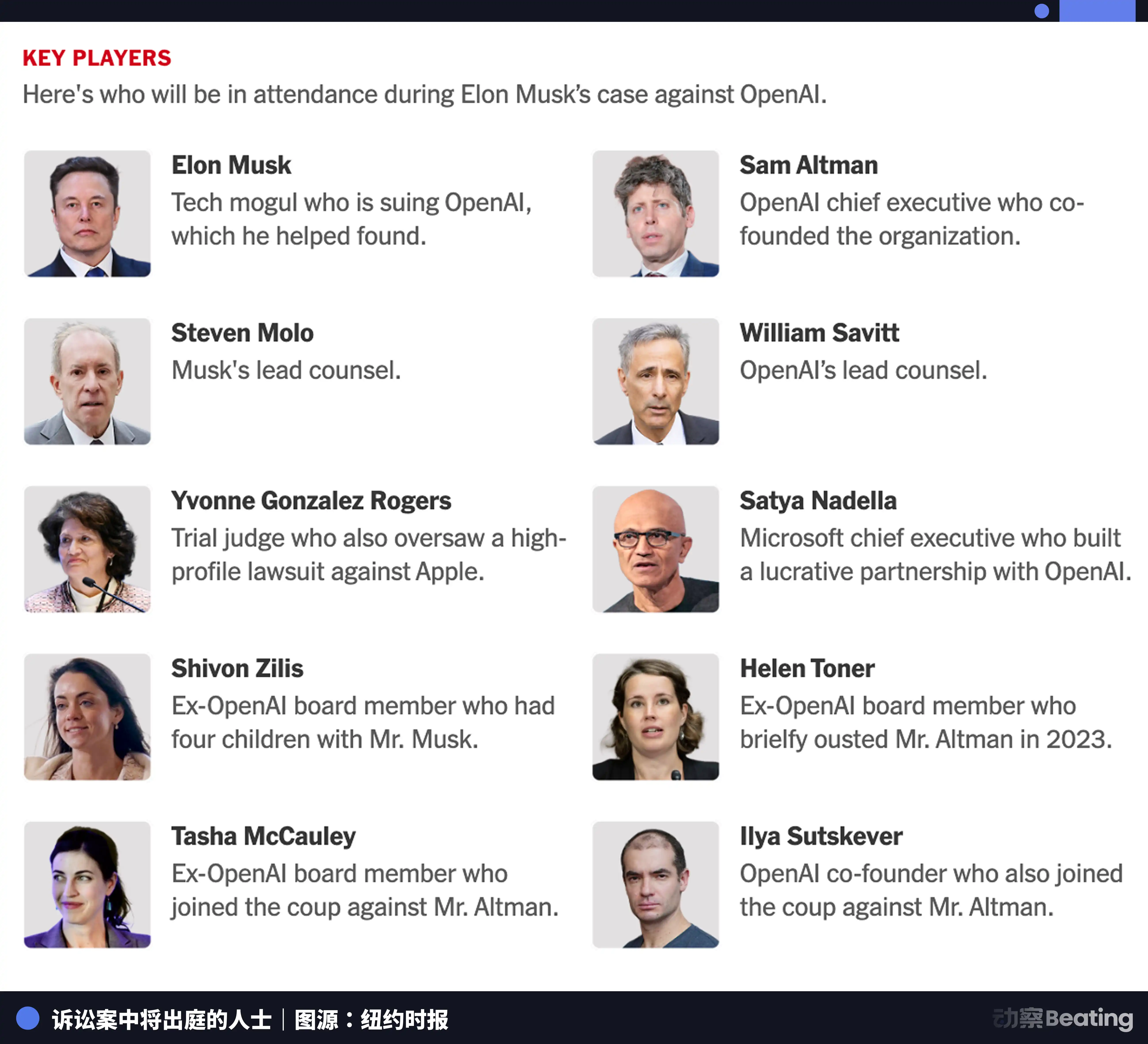
Tesla CEO Elon Musk and OpenAI CEO Sam Altman sat on opposite sides of the courtroom. Musk sat beside the central table, gritting his teeth with his tongue pressed against the inside of his mouth, flipping through his notes. Altman, with arms crossed and a serious expression, sat in the front row of the spectator area, whispering to his lawyer.
This is the richest man in the world trying to use legal means to destroy the largest AI unicorn in the world.
The trial's curtain rose with the jury selection the day before.
In the tech-dense area of East Bay, San Francisco, finding nine ordinary people who could remain absolutely neutral toward Musk and ChatGPT was no small feat.
Candidates were questioned one by one: "Do you often use ChatGPT?" "Do you follow Musk on X?" "Have you bought shares in Tesla or SpaceX?"
After a long tug-of-war lasting five hours, both sides exhausted their five peremptory challenges. Presiding Judge Yvonne Gonzalez Rogers even remarked candidly in court, "The reality is, a lot of people don't like Musk."
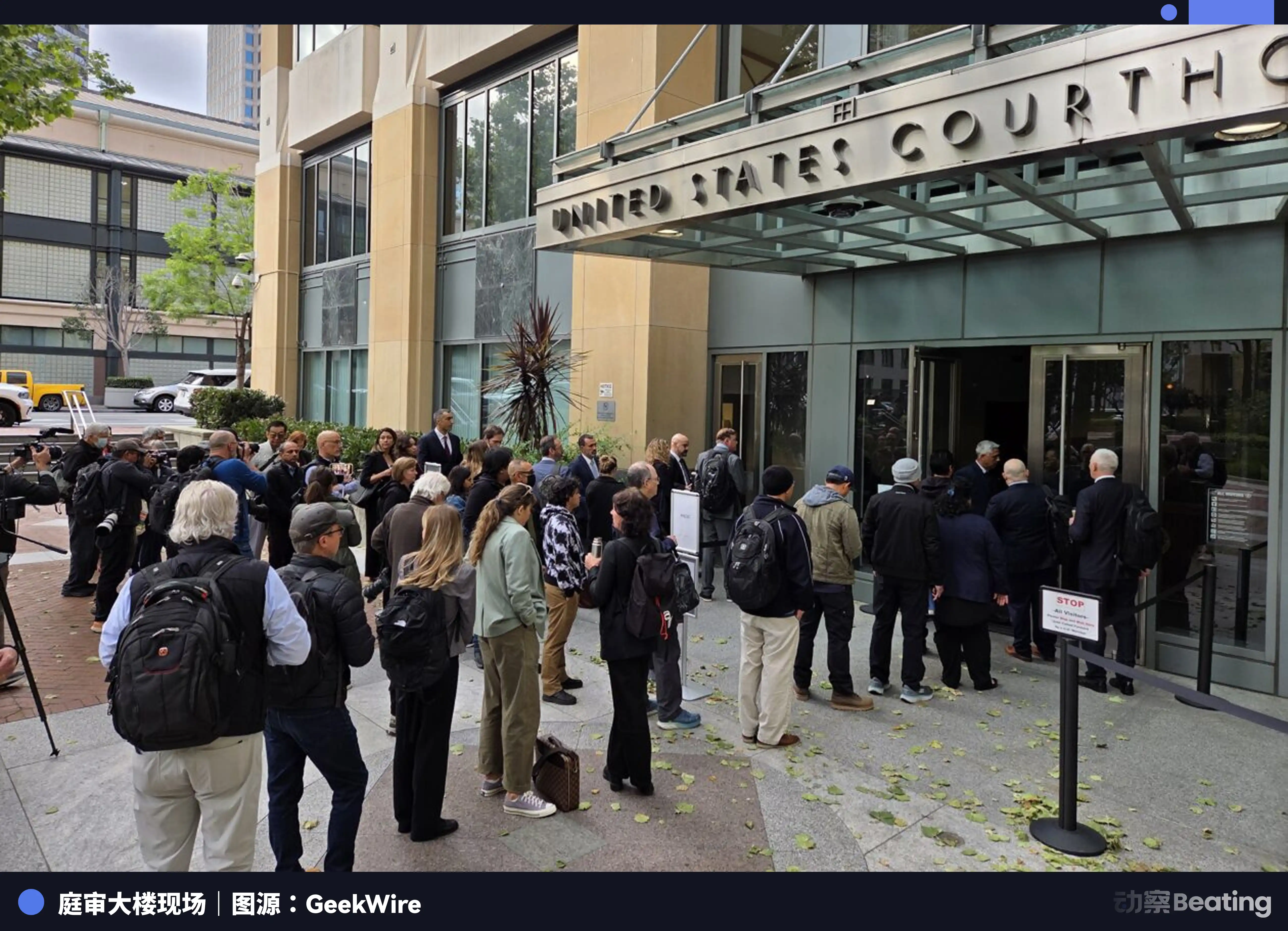
This lawsuit, labeled by the media as the "trial of the century," superficially appears to be a legal battle over a hundred billion dollar claim and the classification of a nonprofit organization. But beneath these dry legal terms lies a more core question.
When an open-source project that once proudly flew the flag of "for the benefit of all humanity" transforms into a commercial empire valued at $852 billion, did those initial idealists part ways out of moral purism or out of embarrassment from losing a power struggle? Is this a delayed quest for justice, or a temper tantrum from a capital predator unable to reach the grapes?
Two Narratives
Once the trial officially began, the opening statements from the chief lawyers of both sides presented two completely opposite scripts to the jury.
In the narrative of Musk's chief lawyer, Steven Moore, this was a tale of "the noble knight versus the greedy warlord."
Moore deliberately avoided all obscure technical terms, quoting OpenAI's founding charter from 2015, repeatedly reinforcing one concept: OpenAI's original intention was "for the benefit of all humanity," and it "is not a tool for making money."
In his accusations, Moore stated that Altman and President Greg Brockman "stole a charitable organization." He pointed his finger directly at Microsoft's cumulative $13 billion investment in OpenAI, arguing that this point completely tore apart OpenAI's commitments to Musk and the world.
To prove their innocence, Musk's side even promised that if they won the lawsuit and received the hundred billion dollar claim, all the money would be allocated to OpenAI's nonprofit foundation, and Musk would not take a single cent.
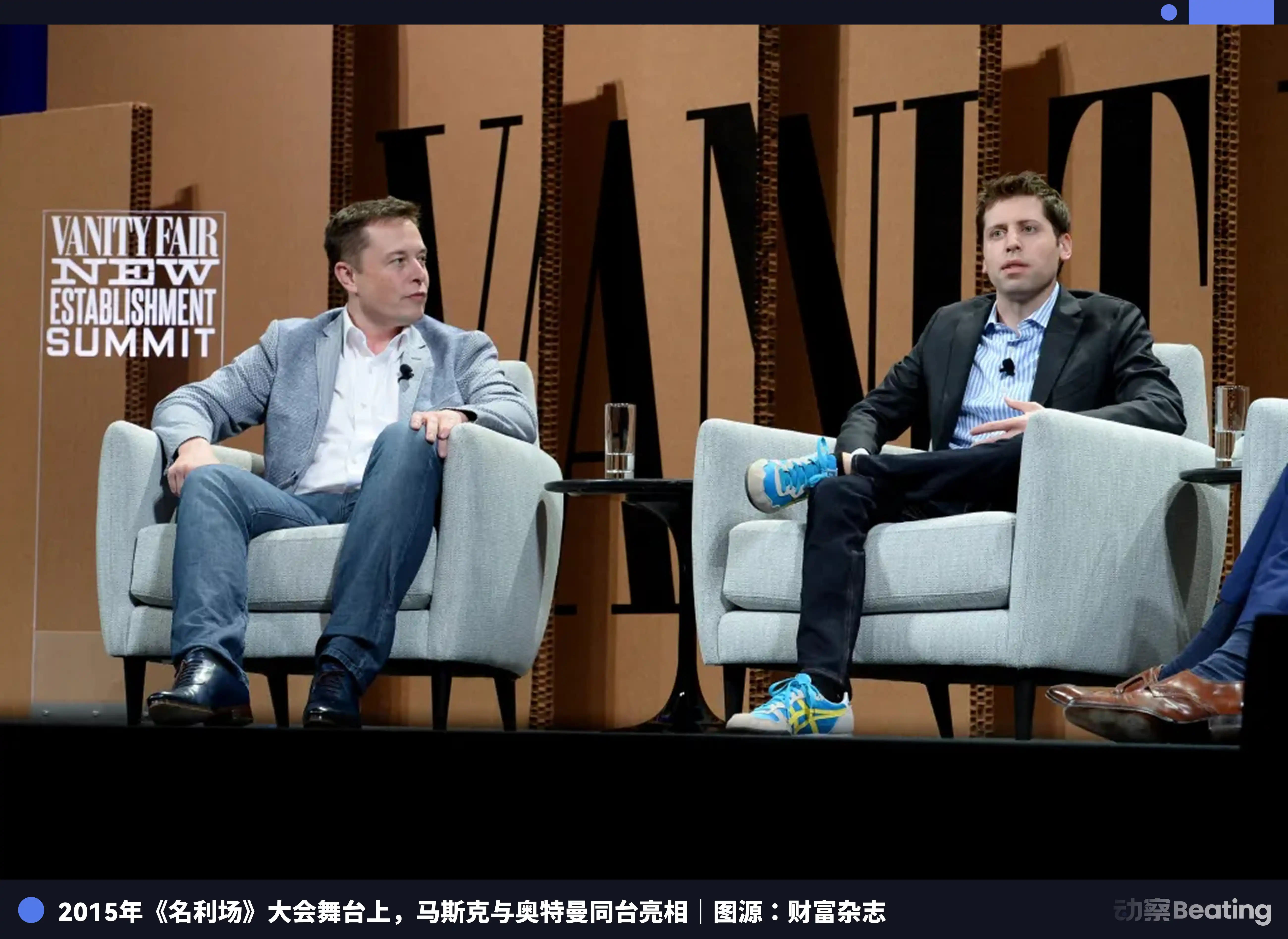
However, Bill Savitt, the chief lawyer for OpenAI, painted a completely different story. This was no longer a moral defense battle but a blatant act of commercial revenge after a "warrior’s failed coup."
"We are here because Musk didn’t get his way," Savitt pointedly remarked.
He told the jury that Musk was the one who truly smelled the scent of AI's commercial value and tried to lay claim to it. Back then, Musk not only demanded absolute control over OpenAI but even suggested merging OpenAI directly into Tesla.
Savitt dismantled Musk's "AI safety guardian" persona. He pointed out that AI safety had never been Musk's real priority; Musk even mocked those employees who were overly concerned about AI safety. In Savitt's view, Musk only decided to sue OpenAI after founding his profit-oriented AI company xAI in 2023, purely out of business competition.
"My client has continued to thrive and succeed after separating from him. Musk has no right to initiate a malicious lawsuit even if he feels dissatisfied," Savitt argued.
Interestingly, Microsoft, a third party, adopted a subtle attitude. Microsoft's lawyer, Russell Cohen, vigorously distanced the company from any wrongdoing, asserting that Microsoft had always been "a responsible partner at every step."
However, just before the trial, OpenAI suddenly announced an update to its partnership terms with Microsoft. Microsoft would no longer have exclusive rights, and OpenAI's products could be deployed on other cloud platforms. This was not merely a self-protective measure against antitrust investigations but rather a carefully orchestrated public relations show, with OpenAI attempting to demonstrate in court that it was by no means a puppet of Microsoft.
Under the banner of morality, both sides concealed deep, bottomless business calculations.
Musk's Testimony
As the first heavyweight witness to take the stand, Musk sat on the witness stand for a full two hours.
In this era of rising anti-elite sentiment, Musk was very aware of how to establish empathy with ordinary jurors. He did not jump right into discussing obscure AGI but instead spent nearly half an hour reviewing his "grassroots" struggle. He recounted leaving South Africa at age 17 to work as a lumberjack in Canada, doing hard labor on farms; he emphasized that he still works 80 to 100 hours a week without a vacation home or yacht.
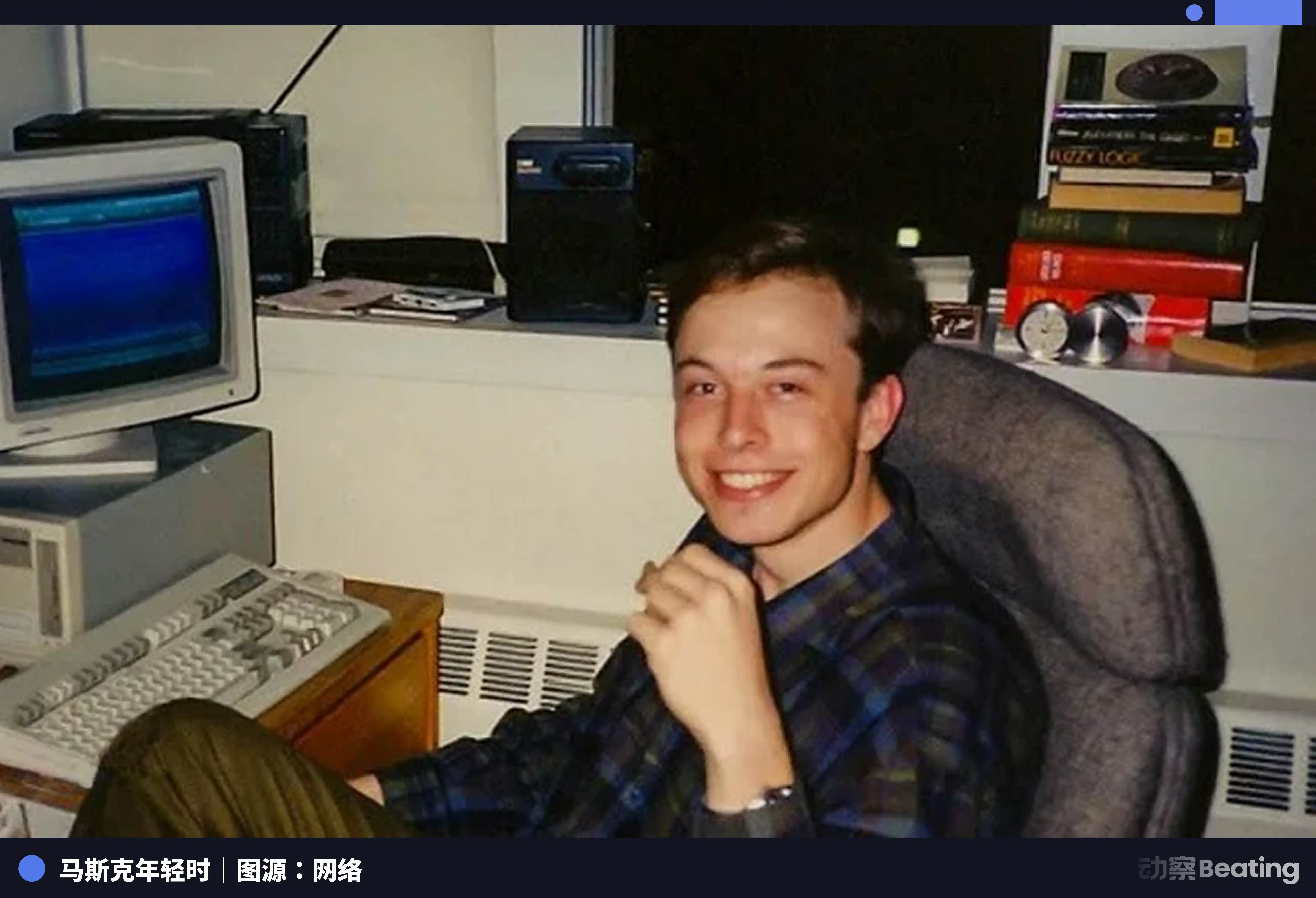
"I love working, and I enjoy solving problems that make people's lives better," Musk tried to shape an image of a hardworking, pragmatic, and unpretentious doer.
Then, he shifted the topic to the chilling AI crisis.
Musk predicted that as early as next year, AI would surpass human intelligence. He compared the development of AI to raising "a very smart child"; once the child grows up, you can no longer control them, only pray that the values you instilled in them take effect.
"We do not wish to see a Terminator outcome," Musk warned, his tone serious.
To prove that his original intention in founding OpenAI was absolutely pure, Musk shared the story of his fallout with Google co-founder Larry Page.
Musk recalled that they had once been very close friends, often discussing the future of AI. But during one exchange, Musk discovered that Page was completely unconcerned about the risks of AI going out of control. When Musk insisted that human survival must take priority, Page even retorted, accusing Musk of being a "speciesist."
This term is extremely stinging in the context of Silicon Valley. It implies that in the eyes of tech fanatics like Page, silicon-based AI life and carbon-based human life are equal, with the former even representing a higher direction of evolution.
Musk told the jury that at that moment, he thought Page was a madman. It was precisely this extreme fear of Google potentially monopolizing and abusing AI technology that prompted him to decide to fund the founding of OpenAI as "a counterforce against Google."
This narrative logic is internally consistent and tragic, but it is not without flaws.
Musk sternly declared in court, "If we allow them to steal a charitable organization, the entire foundation of charitable donations in the U.S. will be destroyed." But his Musk Foundation has been reported to fail to meet the IRS-mandated minimum charitable donation rate of 5% for four consecutive years, with a funding gap of $421 million in just the year 2023.
Even more contradictory is that a person who is deeply fearful of AI destroying humanity rushed to form a fully profit-oriented xAI in 2023 and tied it closely to his business empire.
Musk's claim of "for the benefit of all humanity" - is it a pure belief or a perfect excuse for suppressing competitors? What do those private diaries and emails presented in court reveal about the inner world of Silicon Valley moguls?
Diaries, Text Messages, and Silicon Valley Darkness
If the opening statements were the meticulously arranged press releases of both sides, then the internal communications presented as evidence directly tore apart Silicon Valley's facade.
The trump card thrown out by Musk's side was a private diary written by OpenAI President Greg Brockman in 2017. The diary clearly states, "Our plan: It would be great if we could make that money. We've been thinking that maybe we should switch directly to profit."
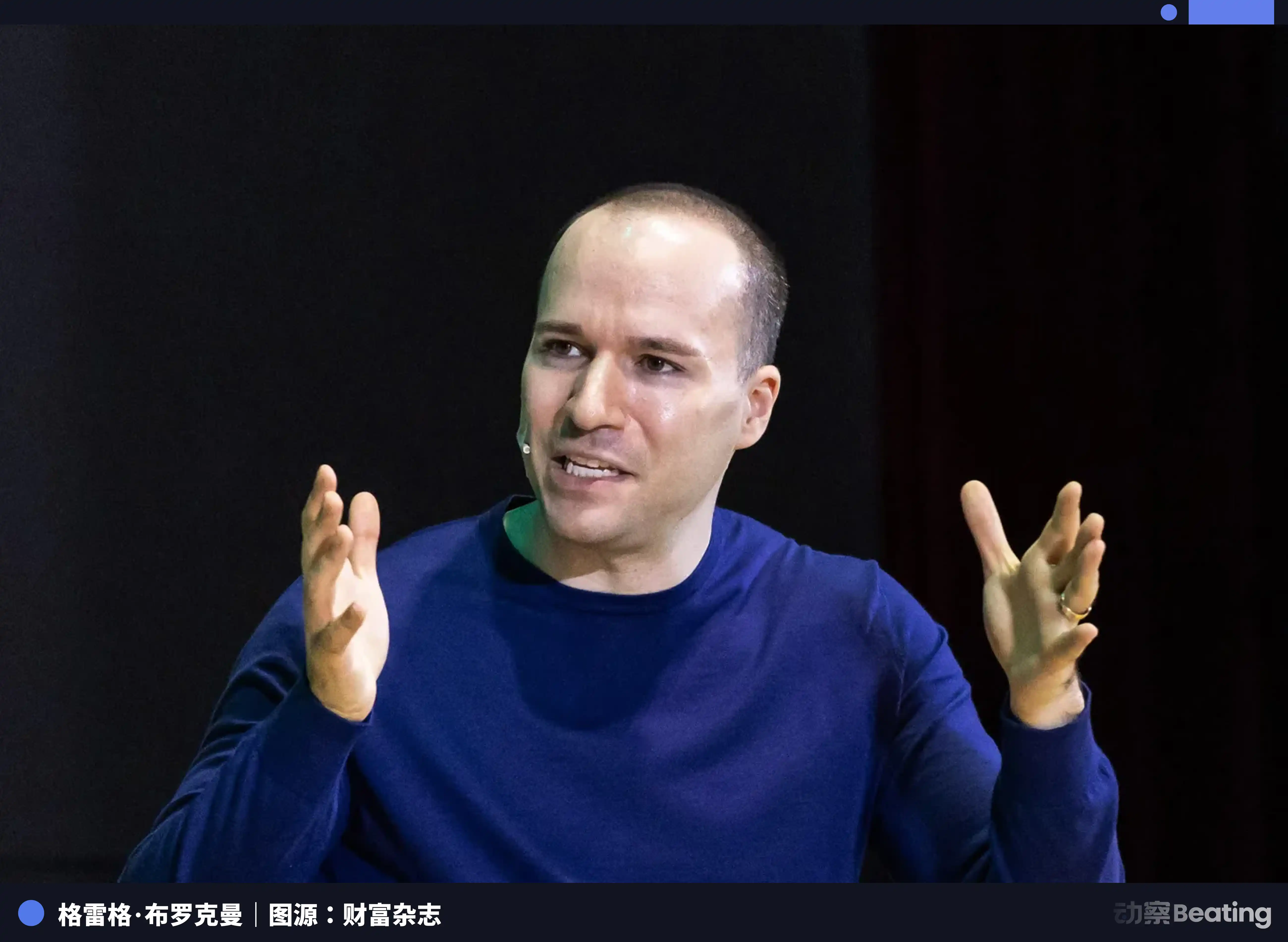
And an even more naked question: "What can make me earn a billion dollars financially?"
These records in black and white instantaneously shattered OpenAI's early carefully cultivated "pure research, no return" nonprofit halo. They proved that five years before the rise of ChatGPT, OpenAI's core management had already been calculating how to monetize technology and how to join the billionaire club.
The counters from OpenAI were equally lethal. They produced emails showing Musk demanding absolute control in 2017. The records reveal that Musk was not merely a generous donor who provided funds without involvement; he demanded absolute control over any potential profit-oriented OpenAI.
When Altman and Brockman refused to relinquish control, Musk's attitude underwent a 180-degree turnaround. In a 2018 email, Musk pessimistically declared that the probability of OpenAI's success was zero. He then stormed out, not only resigning from the board but also stopping further financial support.
OpenAI’s lawyers attempted to use this evidence to explain to the jury that Musk's departure was not due to any moral purism or ideological disagreement, but purely because he felt the project was doomed, and he couldn't obtain control, thus cutting his losses.
In this mutual exposé of mutual harm, a special name surfaced: Shivon Zilis.
She was a former board member of OpenAI and an executive at Musk's brain-computer interface company Neuralink, and also the mother of Musk's three children. In the text message records disclosed during the trial, Zilis had proactively asked Musk if she needed to stay within OpenAI to maintain information flow. OpenAI thus accused her of being an insider inserted by Musk during her tenure as a board member.
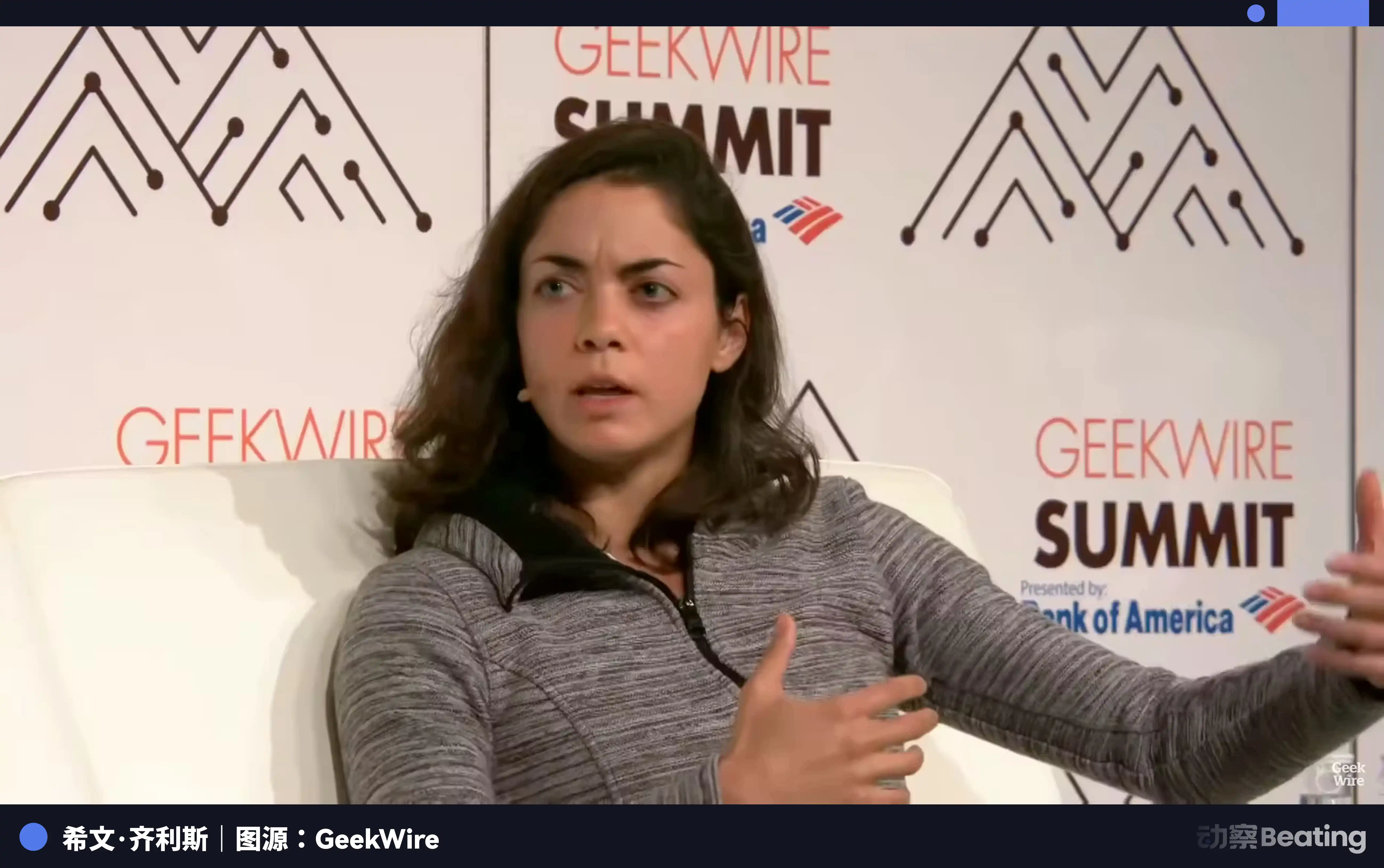
This intricate web of interests, personnel infiltration, and emotional entanglement surged beneath those lofty slogans that changed the world, revealing a desire for money, power, and control.
As the idealistic shell is peeled away layer by layer by the court's evidence, will the outcome of this lawsuit truly change the direction of the AI industry?
Suspense for the Future
No matter how the judge ultimately rules, there will be no real winner in this trial.
If Musk wins, forcing OpenAI to dismantle its complex "profit cap" structure and revert to being a pure nonprofit organization, then its whopping $852 billion valuation and the IPO plan slated for late 2026 will instantly vanish. But this would not stop capital from continuing to flood into the AI sector, and Musk's xAI would actually be left with one less formidable opponent.
If OpenAI wins, the legal loophole for nonprofits transitioning to for-profit status will be thoroughly ripped open. This means that future tech entrepreneurs can completely use the guise of "nonprofit" to attract top talent and early funding at low cost, taking advantage of tax-exempt policies and the public's moral halo; once technological breakthroughs occur, they can privatize and commercialize through complex equity designs.
Putting this trial in the context of the historical timeline of technological revolution, it is merely another footnote of commercial competition. Just like the late 19th-century battle between Edison and Tesla over alternating versus direct current, or the browser wars between Microsoft and Netscape at the end of the 20th century. The giants sparring in court are vying for the current rules of profit distribution.
The outcomes in court won't change the objective laws of technological evolution. What truly determines humanity’s fate is not the meticulously prepared arguments of lawyers, but those GPU clusters that are distributed across global datacenters, roaring day and night, voraciously consuming power and data.
Returning to the courtroom in Oakland. During the trial, the courtroom microphones and screens suddenly suffered a brief technical failure. Judge Rogers jokingly remarked, "What can I say? We are federally funded."
Amidst a burst of laughter, this self-mocking interlude starkly contrasted with the Silicon Valley moguls who often discuss hundred billion dollar claims, human survival, and the Terminator crisis. In this surreal reality, the wheels of AI mercilessly grind over the old business ethics and legal boundaries, driving toward a future that even the creators cannot predict.
免责声明:本文章仅代表作者个人观点,不代表本平台的立场和观点。本文章仅供信息分享,不构成对任何人的任何投资建议。用户与作者之间的任何争议,与本平台无关。如网页中刊载的文章或图片涉及侵权,请提供相关的权利证明和身份证明发送邮件到support@aicoin.com,本平台相关工作人员将会进行核查。


