The jury sat in Courtroom 9 of the Federal Court in Oakland, California yesterday, where nine people were positioned as a "consulting jury" to listen to a trial expected to last four weeks, ultimately providing a recommendation to Judge Rogers. Today is Tuesday, and opening statements are about to commence.
Just yesterday, on the same day that jury selection was taking place, OpenAI announced a newly revised agreement with Microsoft. This agreement eliminated one thing: Microsoft's exclusive licensing of OpenAI's intellectual property is gone. This was exactly the last lock OpenAI put on itself when it transitioned to a "capped-profit" structure in 2019.
What exactly is Musk suing for?
Reuters reported and CNBC's courtroom diary sorted through a list of charges two weeks before the trial. Initially, Musk filed 26 charges in 2024, ranging from securities fraud and racketeering (RICO) to antitrust issues. By the time the trial commenced today, only two charges remained: unjust enrichment and breach of charitable trust.
The remaining 24 charges were either dismissed by the judge at the motion stage or withdrawn by Musk himself. Just days before the trial, he voluntarily withdrew some charges related to "fraud," focusing the case on the core and simplest statement: "OpenAI promised me it would always be non-profit," and now it is not.
For this statement, Musk's claim could be as high as $134 billion. According to his complaint, all compensation is to be returned to the non-profit part of OpenAI, but he demands the removal of Altman and Brockman and the cancellation of the entire profit-making conversion. This is the "true core" of this lawsuit. The subject matter is not stock distribution; it is about who ultimately owns OpenAI.
Judge Gonzalez Rogers divided the trial into two phases. First, the liability determination must be completed before mid-May. If liability is established, damages will be addressed later. The jury will only participate in the first phase and will serve merely as consultants. The final judgment lies with the judge. This means that for Musk, winning the "narrative battle" is more crucial than winning "damages." Convincing the jury that "this company made a commitment to donors and then systematically dismantled that commitment" is vital. As long as these nine people agree, the judge will take care of the rest of the puzzle.
The strategy from OpenAI's side is almost a mirror image. They aim to convince the jury that Musk's true motivation for the lawsuit is competitive jealousy, unrelated to the breach of trust. On the day of jury selection, OpenAI's official account fired the first shot: "We can't wait to showcase our evidence in court; the truth and the law are on our side. This lawsuit has always been an unfounded, jealousy-driven competitive suppression... We finally have the opportunity to have Musk testify before a California jury."
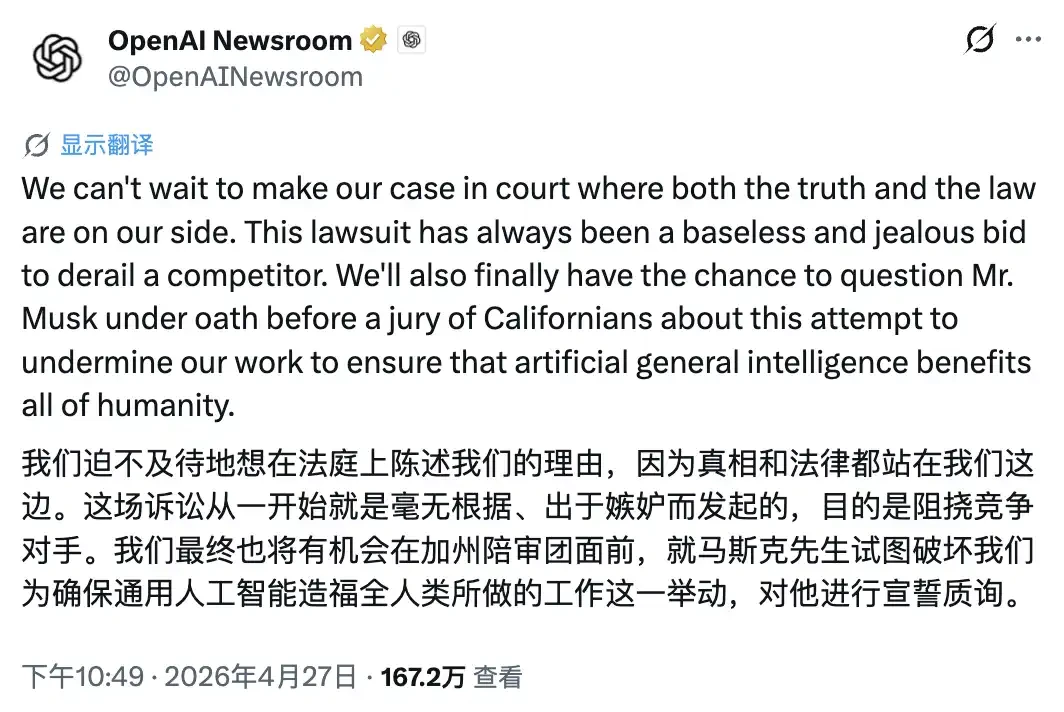
Note the phrase "have Musk testify." This is strategy; what OpenAI truly wants is to shape Musk into the "founder of xAI who lost to OpenAI" in this public court called X. Convincing the judge is secondary. This way, the ordinary California residents on the jury will enter the courtroom with this filter in mind.
How was OpenAI's "lock" dismantled?
To understand why Musk is so angry, one must first grasp the three locks that OpenAI set for itself in 2019, each with a clear design intention.
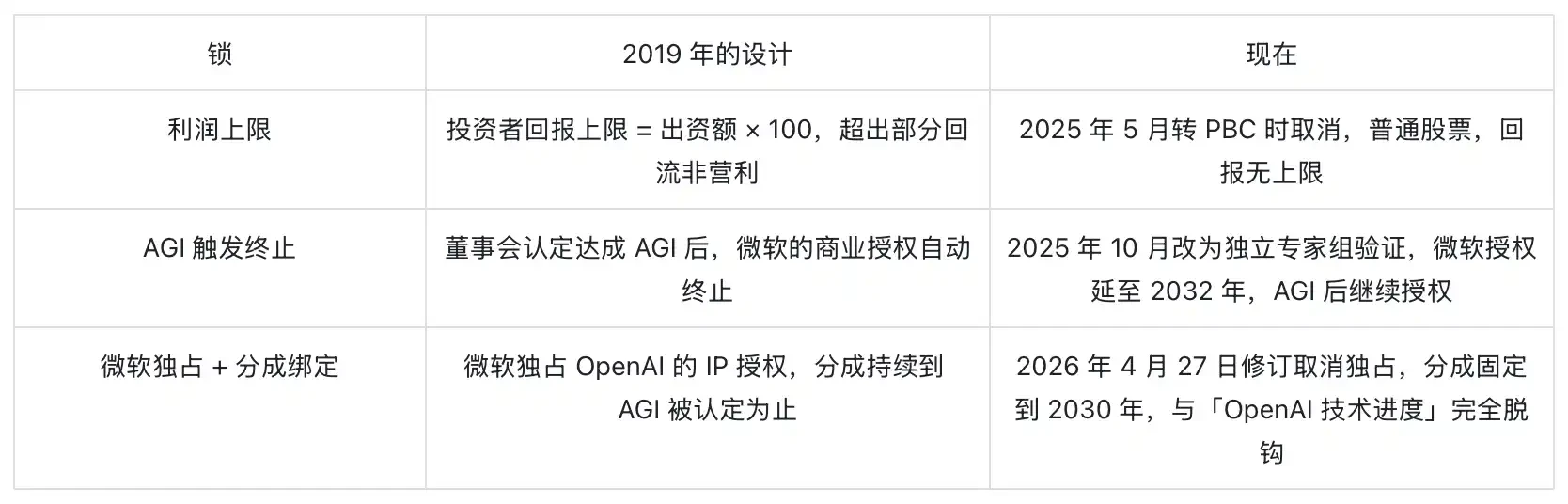
You will notice one thing. OpenAI in 2019 was proving to donors that "even if we want to make money, there are limits to how much we can earn, and at a certain point, we must stop." OpenAI on April 27, 2026, is proving to investors that "we have no brakes whatsoever."
The explanation for the profit cap is the most direct. In a 2025 employee letter, Altman wrote, "The 'capped-profit' structure makes sense in a world with only one AGI company, but it is no longer applicable when there are multiple competitors." In simple terms: now that there are rivals, I must be able to earn more.
The dismantling of the AGI trigger clause is the most subtle. Originally, "Achieving AGI means terminating the commercial license with Microsoft," signifying that AGI belongs to the public, and OpenAI would not privatize it. After revision, AGI is to be assessed by an "independent expert group," with Microsoft's license extended to 2032, explicitly covering models after AGI, and Microsoft is permitted to independently pursue AGI. This is a version where even the key defining "who is AGI" has been replaced.
The last lock is the exclusive license. Its dismantling occurred the moment Musk's jury was seated. Disconnecting from "OpenAI's technological progress" means that even if OpenAI announces it has achieved AGI tomorrow, no commercial terms will trigger any changes.
Musk's side will argue in court that this is a deliberate dismantling of protective mechanisms. OpenAI's side will argue that this is a necessary adjustment in a competitive environment. But one thing both sides will not refute is that the "self-restraint checklist" from 2019 has now been completely erased.
"Scam Altman," why do so many people dislike Altman?
On the day of jury selection, the activity on X was much livelier than in the courtroom. Two hours after OpenAI's official account fired the first shot, Musk posted seven tweets in rapid succession. The pace was fast, the wording heavy, and the rhythm dense. A typical Musk-style barrage. He gave Altman a nickname: Scam Altman.
He also retweeted a video clip of former OpenAI board member Helen Toner, who stated word-for-word in this podcast, "Sam is a liar."
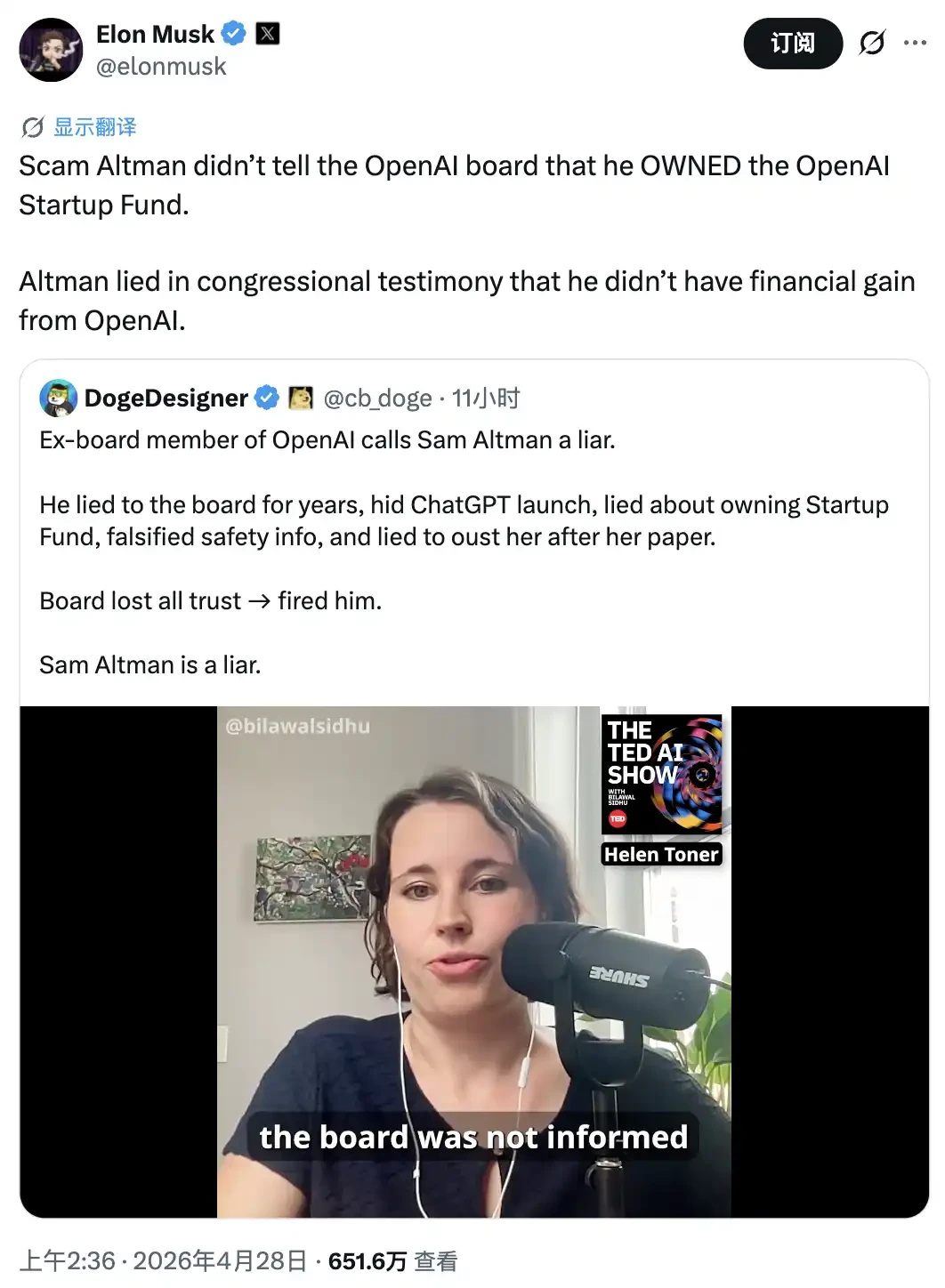
"Sam is a liar" was not something Musk said first. Former OpenAI CTO Mira Murati mentioned it upon her departure, Ilya Sutskever said it during the "failed coup" that led to Altman's dismissal, and Jan Leike also publicly stated it when he resigned with the entire super alignment team.
Those who dislike Sam Altman can actually be categorized into three groups, with varying reasons.
The first group consists of the former board of OpenAI. Their hallmark event was the five-day firing storm in November 2023. The board used the wording "was not always honest in communications with the board."
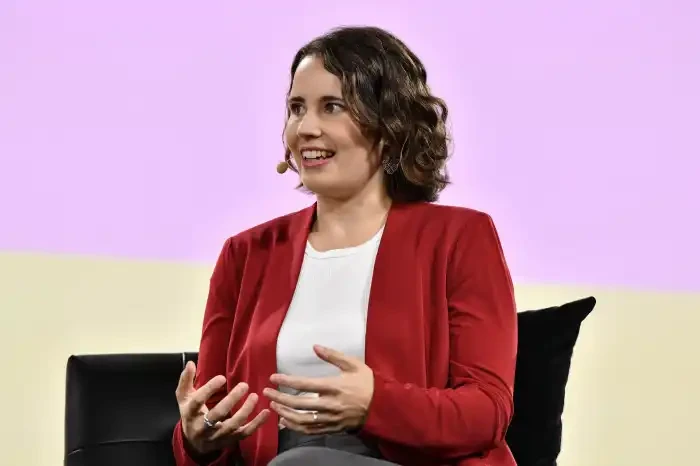
What did they specifically catch? In May 2024, Helen Toner publicly stated the board learned via Twitter that their company had released a product that would reshape the global AI industry. She claimed Altman concealed his financial interest in the OpenAI Startup Fund, repeatedly stating, "I have no financial interest in the company," until he was forced to admit it in April 2024.
There were instances of providing inaccurate information to the board in safety processes. Two executives reported Altman’s "emotional abuse" to the board and provided screenshot evidence of "lying and manipulation." After Toner published a research paper that OpenAI disliked, Altman attempted to push her off the board.
The second group comprises the security faction of old OpenAI.
In May 2024, OpenAI's "super alignment team" almost completely collapsed overnight. Leading the resignations was Jan Leike, one of OpenAI's most senior AI safety researchers. The resignation letter he posted on X was one of the sharpest in the English AI community that year, stating that "the safety culture and processes have given way to glossy products."
Next was Ilya Sutskever, co-founder and chief scientist of OpenAI, one of the key initiators of that failed coup. Soon after, CTO Mira Murati (who temporarily took over during Altman's dismissal), chief research officer Bob McGrew, and vice president of research Barret Zoph all resigned within the same week. The "non-disparagement agreement" scandal broke out afterward, where departing employees were required to sign confidentiality agreements or forfeit their equity.
The third group consists of the contract faction of old Silicon Valley, which is the hardest to define and the largest.
This group includes early donors like Musk from 2015, early OpenAI employees who genuinely believed in the "non-profit mission," many angel investors who gambled on early startups in Silicon Valley, and a substantial number of neutral observers who view OpenAI as "a common good for humanity."
The commonality among these individuals is that they have paid non-monetary costs for OpenAI’s commitments—reputation, time, trust, social capital. What they cannot forgive Altman for is quite specific: every time OpenAI dismantled its "locks," Altman said, "This is for the mission."
When the profit cap was removed, he said, "to allow OpenAI to continue investing in AGI research"; when the AGI trigger clause was rewritten, he said, "to allow OpenAI to still fulfill its mission after AGI"; when the Microsoft exclusivity was canceled, he said, "to allow OpenAI to move towards a broader cooperative ecosystem."
This is also why a section of people in Silicon Valley might reluctantly stand by Musk in this lawsuit.
The weight of promises made in Silicon Valley will be revealed in four weeks
By this point, you probably see clearly. They are not fighting over money.
Money is OpenAI's concern. Altman in 2026, as CEO of a private AI company estimated to be worth over $500 billion, does not lack resources. Musk, in 2026 with xAI, has already entered the Grok 5 era, with Anthropic as his goal and OpenAI to surpass; he also does not lack resources.
What they are contending over is something that only a few long-term participants in Silicon Valley care about. Can a non-profit organization that solicits funds from society in the name of "human common interest," accumulates ethical capital, recruits talent, and obtains regulatory exemptions, rewrite itself into an ordinary profit-making company jointly controlled by a CEO and VC within ten years?
If this can be done, then every AI startup in the future can do the same. "Non-profit" will become a cheap early narrative tool used to grab headlines, navigate regulations, recruit employees, and quietly dismantle when the valuation is large enough.
If Musk wins, Silicon Valley may experience a long-lost sense of embarrassment. What you said in 2015 might be quoted word-for-word in 2026 to make you testify in the federal court in California. If OpenAI wins, the world will still operate as it has over the past decade in Silicon Valley: early narrative, later scale, and in the middle, dismantling the contracts that tie the narrative and scale together.
In four weeks, there will be answers. But the words "Scam Altman" have already been etched on social media, and regardless of how the verdict goes, they will remain. The reason Altman is disliked by so many stems from his actions making those who believed in him feel deceived. How much money is made is secondary.
And the matter of being deceived cannot be undone by a verdict.
免责声明:本文章仅代表作者个人观点,不代表本平台的立场和观点。本文章仅供信息分享,不构成对任何人的任何投资建议。用户与作者之间的任何争议,与本平台无关。如网页中刊载的文章或图片涉及侵权,请提供相关的权利证明和身份证明发送邮件到support@aicoin.com,本平台相关工作人员将会进行核查。


