Original | Odaily Planet Daily (@OdailyChina)
Author | Asher (@Asher_ 0210)

The expansion of prediction markets in the United States is facing increasingly dense regulatory resistance.
In the past, platforms like Polymarket and Kalshi quickly gained traction by leveraging sports, elections, macroeconomics, crypto assets, and social events, packaging "trading future outcomes" as a new form of information market and financial market. However, as the user base and types of trades expanded, several states in the U.S. began to provide completely different definitions: this is not an innovative financial product, but unlicensed online gambling.
From Arizona, Connecticut, Illinois, to New York, Massachusetts, Michigan, Washington, Nevada, and other states, prediction markets are facing lawsuits, bans, cease-and-desist orders, and regulatory investigations. More critically, the CFTC (U.S. Commodity Futures Trading Commission) has personally intervened, suing several states in an attempt to confirm its exclusive regulatory authority over the event contract market. In other words, the controversy over prediction markets is no longer just about whether a platform is compliant or not, but a direct conflict between federal regulation and state-level gambling regulation.
Multi-state lawsuits, prediction markets under regulatory scrutiny
On the surface, regulatory actions in various states of the U.S. target different platforms. Some states focus on Kalshi, others on Polymarket, and some include Crypto.com, Robinhood, Coinbase, Gemini, etc. However, looking at these cases together reveals a highly consistent core concern from regulators: prediction markets are using the shell of "event contracts" to circumvent the regulatory frameworks originally established by states for gambling, betting, and consumer protection.
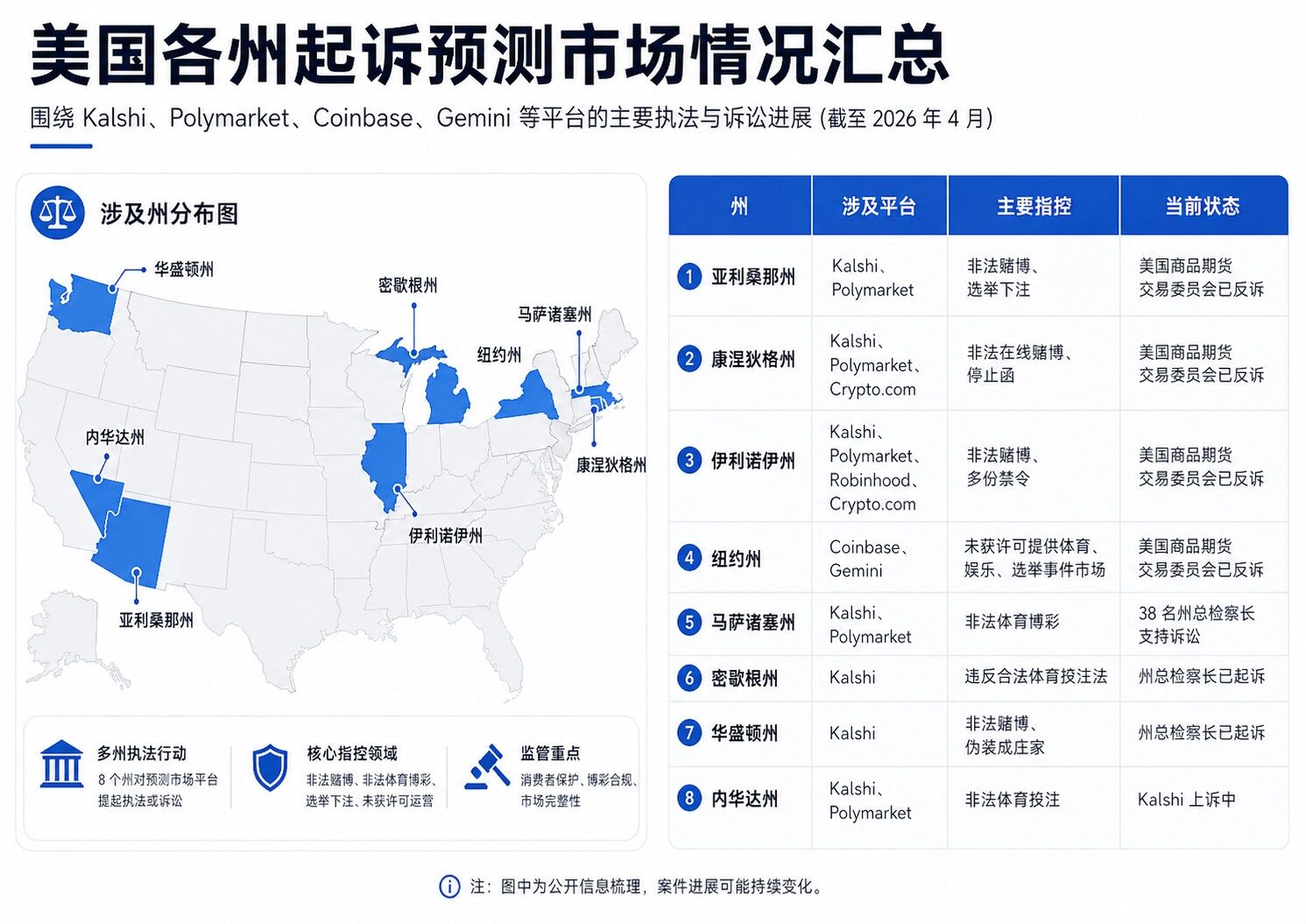
Arizona, Connecticut, and Illinois are the first three states to provoke federal counter-suits. These three states had previously taken regulatory actions against platforms like Kalshi, Polymarket, Crypto.com, and Robinhood, believing that the event contracts they provided might violate state gambling laws. Arizona even filed criminal charges against Kalshi, alleging that it facilitated illegal gambling and violated the state's restrictions on election betting. Subsequently, the CFTC sued these three states, arguing that state governments cannot use local gambling laws to interfere with the federally regulated national derivatives market.
New York has further escalated this regulatory conflict. New York Attorney General Letitia James sued Coinbase Financial Markets and Gemini Titan, claiming that their prediction market operations amount to unlicensed gambling. New York emphasized that these platforms did not obtain licenses from the New York State Gaming Commission, yet allowed users to trade around the outcomes of sports, elections, and other events; at the same time, the platforms allowed users aged 18 to 20 to participate, while the minimum age requirement for mobile sports betting in New York is 21.
These cases share a commonality: state governments are not opposing "prediction" itself, but believe that platforms are packaging betting behavior as financial transactions, thereby circumventing gambling licenses, age restrictions, tax rules, and consumer protection requirements. From the perspective of state governments, many event contracts and traditional gambling do not have clear boundaries. Users betting on whether a team wins, betting on the point spread of a game, betting on whether a candidate gets elected, or betting on whether a political or entertainment event occurs are essentially betting on external outcomes beyond user control. Although the platforms use terms like "contract," "market," and "trade," what state governments see is users putting in funds, betting on outcomes, winning returns if correct, and losing principal if wrong.
Sports-related events are the most concentrated area of regulatory conflict. Massachusetts had previously sued Kalshi, claiming it offered sports betting services without a license. Recently, 38 state attorneys general joined an amicus brief supporting Massachusetts's lawsuit, opposing Kalshi's claims of packaging sports predictions as financial instruments. The logic from states like Michigan, Washington, and Wisconsin is generally similar. They are concerned not with whether prediction markets can enhance information efficiency, but whether the platforms are providing sports or other event betting services to residents of their states without obtaining gambling licenses.
This means that the pressure on prediction markets is no longer solely on native platforms like Polymarket and Kalshi. When mainstream trading platforms like Coinbase, Gemini, Robinhood, and Crypto.com also become involved, the issue transforms into a compliance question for the entire industry. Prediction markets are no longer just a vertical track but have also become a new regulatory variable shared by exchanges, brokers, and crypto platforms.
Platforms strike back: We are not casinos, but federally regulated financial markets
In response to lawsuits from various states, the core counterargument from platforms like Kalshi and Polymarket is clear: they believe they are not casinos, but are providing a market for event contracts under CFTC regulation.
The key to this logic lies in "regulatory jurisdiction." If event contracts are viewed as financial derivatives, then they should be regulated uniformly by federal regulatory agencies, and states cannot use local gambling laws to impose individual restrictions; if event contracts are considered gambling products, then platforms must face fragmented state gambling licenses, age thresholds, tax systems, and market entry rules.
This is also the bottom line that platforms like Kalshi and Polymarket must uphold. For them, the greatest commercial value of prediction markets is their ability to expand nationally in a manner akin to financial markets. If entering each state requires reapplying for gambling licenses, complying with local sports betting rules, and undergoing scrutiny by local gambling regulators, the efficiency of prediction market expansion will significantly decrease, and many products may no longer be able to launch.
Additionally, platform operators may also emphasize that prediction markets are not just entertainment betting, but can provide price discovery functions for the real world. Elections, interest rates, inflation, sports, policies, geopolitical conflicts, and crypto events are essentially uncertainties; prediction markets incentivize participants to express judgments with real funds, forming a tradable and observable probability price.
CFTC personally intervenes, conflict escalates
The true escalation of this conflict began with the CFTC's direct lawsuit against state governments.
The CFTC has sued Arizona, Connecticut, and Illinois to stop these states from regulating prediction markets using gambling laws. Its core argument is that event contracts belong to a federally regulated market, and state governments cannot use local enforcement actions to undermine the national derivatives regulatory framework. Recently, the agency also sued New York, claiming that New York's enforcement actions against prediction markets infringe upon its exclusive regulatory authority.
This has made the regulatory dispute over prediction markets even more complicated. In the past, external observers saw the conflict between state governments and platforms; now, the actual confrontation is between state governments and federal regulatory agencies. One side believes it has the right to protect its residents from illegal gambling, while the other believes state governments are interfering with federal financial market regulation. Prediction markets are just the trigger; the deeper issue is the struggle over power boundaries within the U.S. regulatory system.
The New York case is particularly representative. After the New York Attorney General sued Coinbase and Gemini, the CFTC quickly took legal action against New York State. New York State believes that state gambling laws must apply to these platforms because "gambling under a different name is still gambling"; while the federal regulatory agency asserts that state governments cannot redefine federally regulated event contract markets as local gambling activities.
Platforms are not without victories, but risks are still increasing
Despite the dense regulatory actions from various states, platform operators are not facing pressure alone; the New Jersey case is a key turning point. The Third Circuit Court of Appeals recently supported Kalshi, stating that New Jersey cannot regulate Kalshi's prediction market operations, which is seen as an important victory for platforms regarding the "federal supremacy" issue.
This ruling sends a signal to the prediction market industry—at least in the eyes of some courts, state governments cannot easily reintegrate federally regulated prediction markets into their state gambling regulatory systems. For platforms like Kalshi, this is not just a victory in a single-state lawsuit but also important support for their narrative of national expansion.
However, this does not mean that platforms are secure; different judgments may still arise across different states, courts, and product types. The regulatory risks faced by sports contracts, election contracts, crypto asset-related contracts, and macroeconomic contracts are not the same. For platforms, the real difficulty lies in proving they belong to the financial market while also explaining why certain products that are highly similar to sports betting or political betting should not be considered gambling.
The regulatory pressure on prediction markets does not only stem from license issues. As the variety of trades continues to expand, platforms are entering some naturally high-sensitivity areas, including sports, elections, wars, diplomacy, and judicial events. Sports contracts may easily collide with gambling laws, election contracts may run into political ethics, and war and diplomatic events could touch upon insider information and national security.
From growth story to compliance showdown
In the past, prediction markets told a growth story. Polymarket leveraged political and crypto events to gain traction, while Kalshi expanded event contracts under its compliant exchange identity, and platforms like Coinbase, Gemini, and Robinhood began to enter this track. The industry narrative was clear: all future uncertainties can be priced, traded, and financialized.
But now, prediction markets are forced into another phase. They no longer just need to prove that users are willing to trade events, but must also demonstrate that this trading will not turn into more efficient gambling; they no longer just need to show that market prices hold informational value, but must also prove that insiders, candidates, athletes, government officials, and the platforms themselves will not abuse information advantages; they no longer only need to face user growth issues but also must address the complex conflicts among federal regulation, state-level gambling regulation, and consumer protection.
This is also the true signal released by the wave of state lawsuits. U.S. regulators are not simply denying prediction markets; rather, they are forcing the industry to answer a fundamental question: when sports, elections, wars, macroeconomics, and crypto events can all be bet upon, is it a financial market or an online casino?
If the CFTC ultimately wins the regulatory jurisdiction battle, prediction markets may embrace a clearer path to federal compliance, accelerating the financialization and platformization of the industry. But if states gain the upper hand in key cases, the pace of prediction market expansion will be reshaped. Different states may impose varying restrictions on sports, election, entertainment, and political events, and platforms will face higher compliance costs and a more fragmented market structure.
Now, all states in the U.S., the U.S. Commodity Futures Trading Commission, courts, and platforms have entered the fray; the regulatory battle surrounding prediction markets has just begun.
Related Content
Polymarket stuck: the true test after the traffic dividend has arrived
免责声明:本文章仅代表作者个人观点,不代表本平台的立场和观点。本文章仅供信息分享,不构成对任何人的任何投资建议。用户与作者之间的任何争议,与本平台无关。如网页中刊载的文章或图片涉及侵权,请提供相关的权利证明和身份证明发送邮件到support@aicoin.com,本平台相关工作人员将会进行核查。


