Source: Bitfire Day·2026 Hong Kong Institutional Digital Wealth Management Summit Forum
Content organized by: Techub News
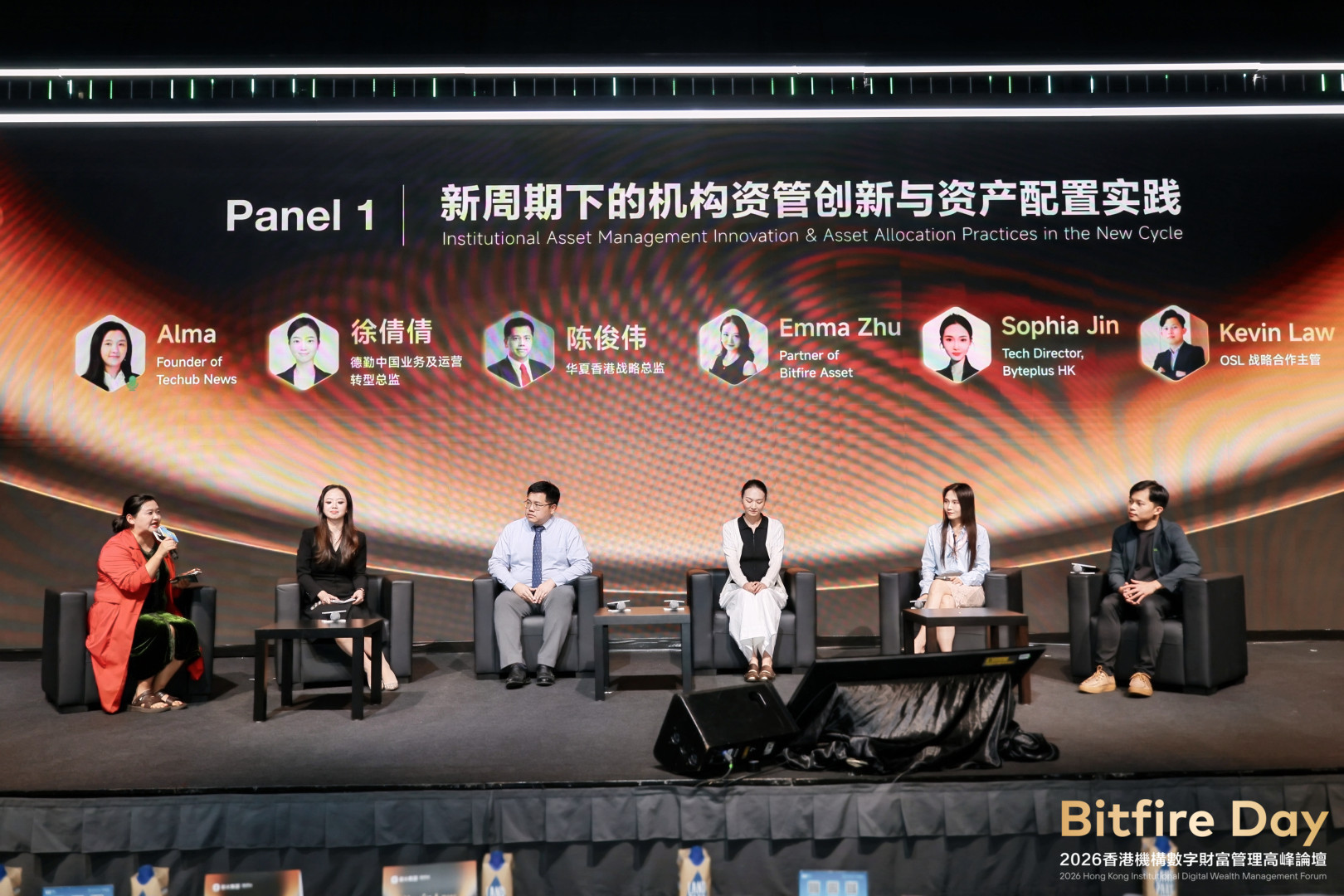
On April 23, 2026, the "Bitfire Day·2026 Hong Kong Institutional Digital Wealth Management Summit Forum," hosted by Bitfire Group, was held at the Hong Kong Convention and Exhibition Centre. The roundtable forum focused on the theme of "Institutional Asset Management Innovation and Asset Allocation Practices under the New Cycle," bringing together diverse perspectives from the industry to discuss how traditional institutions can allocate digital assets within a compliance framework, the integration path between traditional finance and crypto-native institutions, and the empowerment of AI technology in future asset allocation.
Host: Alma, Founder of Techub News
Roundtable Guests:
- Kevin Law, Head of Strategic Partnerships at OSL
- Xu Qianqian, Director of Business and Operations Transformation at Deloitte China
- Emma Zhu, Partner at Bitfire Asset Management
- Chen Junwei, Strategic Director at Huaxia Fund Hong Kong
- Sophia Jin, Tech Director at Byteplus HK
Host Alma pointed out that the guests covered multiple dimensions, including trading platforms, asset management institutions, traditional finance, and technology services, aiming to jointly dismantle the key paths for traditional institutions to enter the digital asset market.
Under the New Cycle: How Can Traditional Institutions Build a Compliant and Professional Digital Asset Allocation System?
Xu Qianqian from Deloitte China first approached the topic from the global regulatory environment. She observed that under the new cycle, regulation is becoming more deepened, detailed, and clarified, compounded by macroeconomic uncertainty, upgraded customer demands, and technological iteration.
She proposed three key recommendations:
- Build a Comprehensive Compliance Governance Framework: Digital assets involve multiple aspects such as custody, taxation, accounting, financial reporting, information disclosure, and KYC, necessitating clear compliance boundaries and risk control management systems.
- Incorporate Digital Assets into the Overall Product Management System: They should not be seen as isolated innovative products but should be integrated into the complete product lifecycle.
- Prioritize Middle and Back Office Capabilities: Capabilities in risk control, data governance, cybersecurity, and operational models determine the sustainability of front office allocations.
Kevin Law from OSL shared his experience in serving traditional institutions. Institutions are most concerned about compliance, safety, and credibility. OSL provides a regulated trading environment, US dollar insurance protection, and a mature risk control layer, helping institutions apply blockchain technology amid complex business operations while effectively reducing risks. Many institutions start from business opportunities but prioritize evaluating regulatory compliance and controllable risks.
Chen Junwei from Huaxia Fund emphasized from practice that compliance is the "lifeline" and starting point for all digital asset businesses. Huaxia has cooperated with licensed platforms like OSL to launch the first batch of spot Bitcoin/Ethereum ETFs in the Hong Kong market, with a particular focus on investor protection (such as insurance mechanisms). When traditional institutions allocate digital assets, they usually extend from existing capabilities rather than building anew; back-end compliance training and system construction are especially important.
Emma Zhu, partner at Bitfire Asset Management, pointed out that based on her traditional finance background and industry experience, compliance is a threshold that must be crossed early when choosing a compliance path. The biggest challenges aretime costs (license applications may take months to two years), and the gap between the business models under the license and market demands. However, Hong Kong's regulation is moving from strict to open, with compliance space gradually expanding. Crypto-native institutions are also seeking compliance routes globally, while traditional institutions are adding blockchain asset classes within their existing frameworks, and both types of institutions are learning from each other, gradually narrowing the gap.
Traditional Institutions vs Crypto-Native Asset Management Institutions: Differences, Integration, and Complementarity
Chen Junwei from Huaxia Fund shared that on-chain investors pursue high efficiency and innovative experiences, while off-chain institutions focus on compliance and stability. Huaxia's issuance of digital asset funds priced in Hong Kong dollars, US dollars, and Renminbi has successfully attracted both types of investors, achieving on-chain and off-chain complementarity. In product design, different investor needs are prioritized, providing on-chain experiences through product mapping.
Emma Zhu from Bitfire Asset Management believes that the Bitfire Group team combines traditional finance and crypto-native backgrounds, playing the role of "translators" connecting both sides. Personnel with traditional backgrounds are regulated but sometimes lack innovative imagination; crypto-native personnel have strong entrepreneurial spirit and execution but need to adapt to institutional requirements of safety, stability, and auditability. Industry strategies have shifted from early subjective high leverage to neutral strategies (annualized around 4%-10%), with institutions favoring value investment in major coins and demanding stable yield products. Both sides are blending: crypto-native is moving towards compliance, while traditional institutions are learning innovation.
Kevin Law from OSL noted that there are differences in demand when serving the two types of institutions. Traditional institutions wish to introduce new services (such as index products) within familiar compliance frameworks and enhance trust through insurance and collateral financing; crypto-native institutions seek to integrate on-chain assets into financial systems and realize settlement assistance. Both sides must collaboratively promote standardization of accounting, financial reporting, and other processes within the industry.
AI Era: Future Trends in Asset Allocation and Product Imagination
Emma Zhu from Bitfire Asset Management is optimistic about the direction of tokenization. The United States is about to achieve on-chain 24/7 trading of stocks T+0, and in the future, if liquidity for basic assets such as funds and complex derivatives is sufficient, on-chain markets and diverse strategies can form. Bitfire Group launched Hong Kong's first compliant digital asset management service and introduced relevant experts, focusing on the first year of integrating crypto into traditional asset allocation frameworks. The threshold for ordinary investors will be lowered, investment targets will be more open, and liquidity and asset categories will expand significantly. Ten years from now, this market will be as seamless as today’s stock trading.
Compliance, Professionalism, Integration, and Innovation Drive the New Cycle
The roundtable forum concluded successfully amidst enthusiastic discussions. The guests unanimously agreed that the core of institutional asset management innovation under the new cycle lies inthe compliance bottom line + professional middle and back office + technological empowerment, and that traditional and crypto-native institutions need to complement each other's strengths and bridge communication. AI and tokenization will reshape asset allocation forms, providing more inclusive and diverse choices.
From compliance entry to asset allocation practice, from technological fundamentals to product design, the insights offered by the guests provide multidimensional thinking for institutional digital wealth management. As emphasized in the dialogue, this year marks an important milestone for the integration of crypto into traditional asset allocation frameworks. Hong Kong, as an international financial hub, will continue to lead the deep integration of digital assets and traditional wealth management under a compliance framework, creating new opportunities for global institutional investors.
免责声明:本文章仅代表作者个人观点,不代表本平台的立场和观点。本文章仅供信息分享,不构成对任何人的任何投资建议。用户与作者之间的任何争议,与本平台无关。如网页中刊载的文章或图片涉及侵权,请提供相关的权利证明和身份证明发送邮件到support@aicoin.com,本平台相关工作人员将会进行核查。


