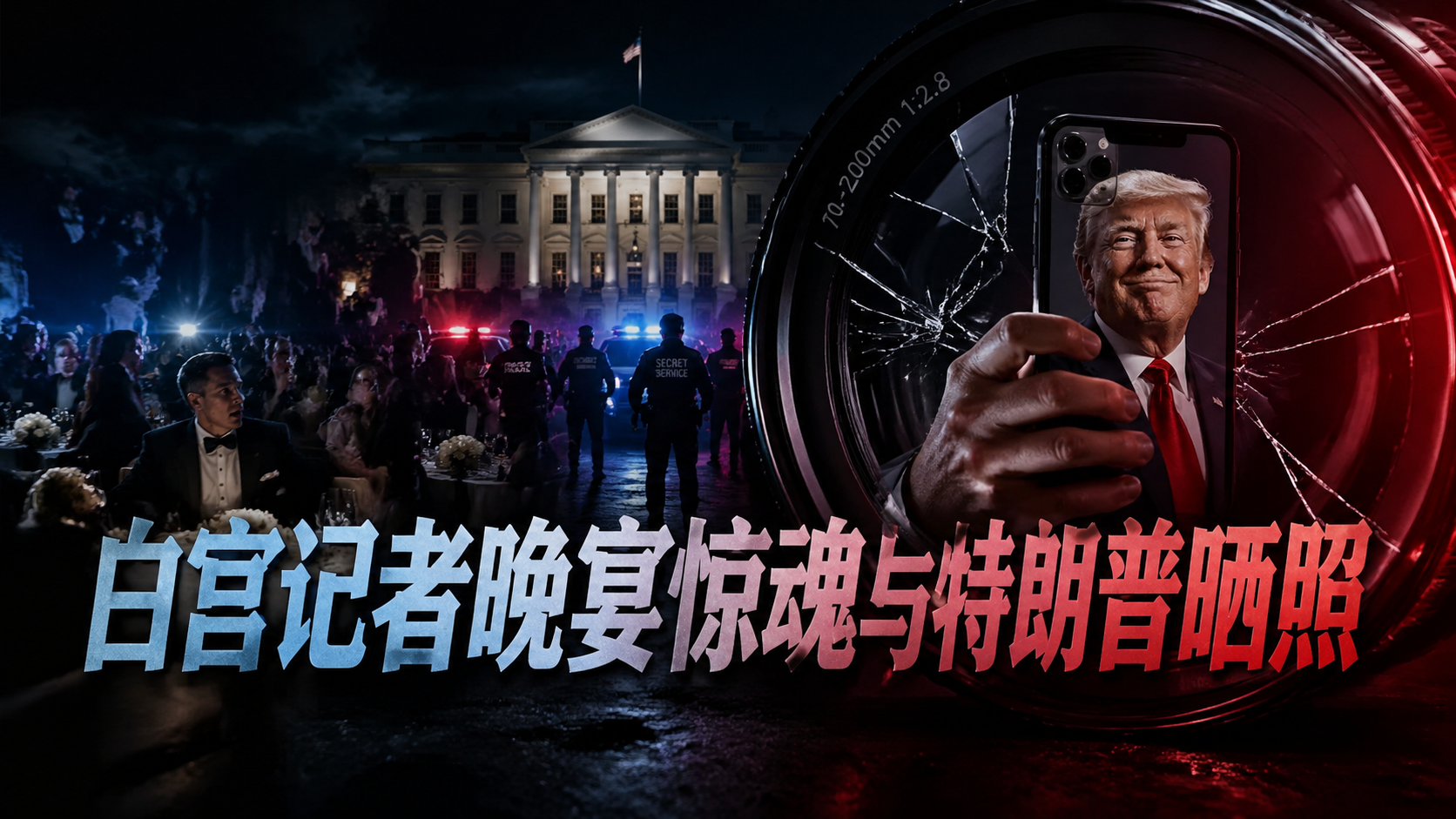
That night was supposed to be a familiar script for Washington: lights, gowns, laughter, the White House Correspondents' Association dinner was once again being held in the capital. This gathering, viewed as a hallmark social event of the year, customarily featured a speech by the President of the United States, delivering a humorous and self-deprecating address to add a layer of lightheartedness to the tense political and media relations of the past year.
The script was abruptly interrupted. During the dinner, a firearm-related security incident pierced the ceremonial atmosphere of the event—news quickly spread from table to table, the air filled first with a brief shock, followed by palpable tension. For those present, the biggest suspense was singular: Was the President safe?
The Secret Service and other law enforcement agencies swiftly intervened and arrested the suspect involved. Almost simultaneously, key information emerging to the outside world was that Trump had been confirmed safe and sound. He later took to social media to describe the evening as an “unusual situation in Washington, D.C.” and publicly praised the Secret Service and law enforcement for their “swift and brave” actions, mentioning that he suggested the event continue but would ultimately defer to law enforcement’s arrangements.
What firmly placed this dinner under the public lens, however, was not the gunfire itself but the decision that followed soon after—with uncertainty still surrounding whether the threat had been entirely eliminated, the public stance was: the dinner would continue. The gowns did not disperse, the ceremony did not go offline, and the instinct to maintain safety collided with the notion that “the event must continue,” creating a tension between the still-lingering terror and a public ritual that symbolized the normal functioning of the institution. This sense of contradiction became a shared starting point for the later debate over “why the ritual prevailed over fear.”
Gunman Arrested, White House Correspondents' Dinner Falls Silent
This was originally Washington's annual “official talk show.” The tradition of the White House Correspondents' Association dinner is to bring power into the spotlight and use humor and self-deprecation to dismantle the air of mystery surrounding high positions—the President cracking jokes on stage, reporters bantering among themselves, media and politicians performing a group drama of “institutional confidence” around the same round table. Until that moment, the night’s script was still familiar: punchlines, applause, clinking glasses, all proceeding in order.
The script was interrupted by a cold term—the “firearm security incident.” During the dinner, the Secret Service and law enforcement swiftly intervened, a gunman was arrested, and President Trump was confirmed safe. For those present, this series of official statements ultimately converged into a singular intuition: the atmosphere was no longer simple. Laughter seemed muted, and both the audience and the stage realized that a certain danger not listed in the program had barged in.
What truly magnified the discomfort was not the gunman who had been apprehended, but the ensuing information vacuum. The publicly reported facts were few: an incident involving a firearm did occur, the gunman had been arrested, and the President was unharmed. Beyond that, almost all key details remained unknown—who the gunman was, why he was there, what he intended to do, and precisely where the incident occurred in the venue remained a mystery. Even whether there were other casualties or if anyone had paid an unseen price during this interruption was not disclosed by officials.
In this void of information, the only clearly communicated message was: the dinner would continue. For the attendees in the venue and the viewers beyond the screen, this created a torn image—on one side, the alert of “gunfire” still lingered in their ears, while on the other, the scheduled speeches and jokes requested continued as planned. The absence of information allowed for speculation, which in turn amplified fear: people did not know if the threat had been completely eradicated but were told the ceremony could not be halted.
Between “completely halting” and “striving to maintain order,” the organizers and authorities chose the latter. Shortly after the incident, Trump posted on social media, stating that an “unusual situation” had occurred that evening in Washington, publicly praising the Secret Service and law enforcement for their “swift and brave” performance, and stated that he suggested the event continue but would ultimately defer to law enforcement's arrangements. This statement draped the decision to “let the dinner proceed” in the guise of deferring to professional judgment and maintaining public normalcy, yet it also sowed the seeds for future disputes—when safety and ritual conflict, who gets to decide which takes priority, and who bears the weight of that decision.
Trump Posts: Even a Tough Leader Has Moments of Compliance
Almost as soon as the gunman was arrested and the atmosphere in the venue had not yet calmed, Trump posted his version on social media. He wrote that an “unusual situation” had occurred that night in Washington, once again naming the Secret Service and law enforcement, emphasizing their “swift and brave” actions, and added that “the gunman has been arrested.” In this brief message, he shifted the focus away from the fear itself, re-centering it on his familiar narrative—safety, discipline, and “law and order.”
It is noteworthy that this was not a simple expression of gratitude. In the same breath, he included, “I suggest the event continue.” This “suggestion” illustrated a stance of not being defeated by fear: even when the dinner was halfway through, and news of gunfire had just come out, he would “choose to continue,” using the continuation of the ritual to counter potential threats. It pointed not at details but at an attitude—showing that the leader must appear calm, more confident than anyone that order would eventually be restored.
But immediately after, he tempered his tone: he would ultimately completely defer to law enforcement's arrangements. The first sentence was “I suggest,” while the second was “I comply.” Between these two statements, he set up a carefully balanced narrative: on one hand, preserving the image of a “tough leader” willing to publicly state that the dinner should continue even at the moment the gunman had just been controlled; on the other hand, he returned the final decision-making power to the Secret Service and other law enforcement agencies, showing respect for professional judgment and, in a subtle way, leaving room for possible future inquiries—if that night was deemed “dangerous,” he could say he followed professional advice; if viewed as “decisive,” he could emphasize the “suggestion to continue.”
This wording does not stray from the public image he has long crafted. Trump constantly reiterates “safety,” “toughness,” and “law and order” on the political stage, and this post merely applied the same narrative template to a new scenario: first, highlighting the swift reaction of the Secret Service and law enforcement, portraying the national machinery as being on standby; then placing himself in a position that was both assertive and compliant—both daring to call for the continuation of the ritual in “extraordinary times” and asserting complete compliance with arrangements at critical moments.
The timing of the post closely matched the incident itself, making this text the first window for the outside world to glimpse the atmosphere surrounding the decision that night. For him, this was both an immediate response to the scene and a calculated crisis management move: between the arrest of the gunman and the continuation of the dinner, he used a single post to rearrange fear, power, professionalism, and responsibility, leaving a convenient snippet for future political narratives—on that night, amid the “unusual situation,” he was both the one insisting on the ritual's continuation and the one claiming to defer to professional judgment.
Secret Service and Law Enforcement: A Public Examination of On-the-Spot Response
If there were aspects of that night where nearly everyone agreed, it was that the gunman was arrested, Trump was unharmed, and the Secret Service and law enforcement “responded quickly.” In the absence of a unified narrative and obscured details, this is one of the few “consensus statements” that could be simultaneously cited by all parties. Whether it was Trump himself describing them on social media as “outstanding,” “quick,” and “brave,” or subsequent recollections from those present, this team responsible for protecting the President and other senior officials indeed fulfilled its core duty in that moment: compressing a potential disaster into a single arrest outcome.
However, precisely because the results were “clean and tidy,” it resembled a forced public examination. The current political environment in the United States is highly polarized, and security for public events is no longer merely a technical back-end task, but a front-stage political issue. Any misstep, even merely an information gap, would be amplified as evidence of “systemic failure.” In this event, the public information did not provide specific details about security deployments or whether there were any intelligence gaps; the outside world could only grasp those key points afterward: gunman, arrest, President unharmed, dinner continues.
Within such an information framework, the professionalism and response speed of the Secret Service and law enforcement were forced to undergo evaluation in the most rudimentary manner—not through public processes and transparent reports, but through politicians' praises, media reports, and the public’s intuitive feelings about the “results.” A statement like “they did well” can stabilize emotions in a crisis, but afterward, it is hard to become evidence proving system reliability. Especially in a context where trust is already scarce, merely relying on endorsements from power entities is unlikely to dispel doubts: was it just luck this time, or was the system itself indeed strong enough?
Thus, a tricky question was brought to the forefront: under the circumstances where it is impossible to disclose security details fully, how can the public be made to trust this system? Over-disclosure would expose technical methods and weaknesses; under-disclosure would make the “quick and brave” assessments feel hollow. The Secret Service and law enforcement had to walk a tightrope in their subsequent communications—maintaining the confidentiality of operational methods while, to some extent, explaining “what we saw, what we did, and what we learned,” otherwise, any future incidents would be traced back to this “murky” precedent.
More covert is their need to constantly engage in dual assessments. On one hand, the primary mission of these agencies is to protect leaders' safety and maintain order at all times; on the other hand, public ceremonies like the White House Correspondents' Association dinner are viewed as collective symbols of political openness and media oversight. Once a security threat arises, every decision they make—whether to clear the venue, suspend, or allow the ritual to continue—is both a technical judgment and a political statement. That night, the gunman was arrested, the President was unharmed, and the dinner continued; this series of established facts firmly anchored the Secret Service and law enforcement's on-the-spot responses in the public eye: they were not only behind-the-scenes people responsible for “preventing tragedy” but also the ones publicly deciding “whether the ritual should be interrupted.”
The Media Feast Cast in Shadow: The Collision of Microphone and Gunfire
For years, the White House Correspondents' Association dinner has been packaged as one of the few “ceasefire moments” in Washington: reporters and the President in the same hall, using microphones as props, temporarily setting aside their defenses with self-deprecation and jokes. By tradition, the President would deliver a speech filled with humor and self-mockery on stage, while media professionals applauded, heckled, and recorded below, treating the evening's lightheartedness as a symbolic easing of the year-long tense relations.
This time, suddenly beside the microphone stood a gunman swiftly controlled and arrested by the Secret Service and law enforcement. Even though public information has yet to disclose his identity and motives, this firearm-related security incident was enough to cast a shadow over the banquet, originally regarded as a “safe space.” People had always thought this was one of Washington's most “controllable” public venues: with strict guest lists, layered security measures, and processes rehearsed countless times—but when the possibility of gunfire intruded, the previously taken-for-granted sense of safety began to feel fragile.
For media professionals, this acted as an intuitive demonstration of risk: those seated at the round table included not only reporters but also those in the power centers whom they routinely supervised, questioned, and criticized. In such moments, they had to reevaluate the cost of “appearing”—that microphone was no longer just a tool for asking questions; it could also become a marker of exposing their positions and identities. Similarly, for political figures: attending this dinner once symbolized a gesture of goodwill toward the media, showcasing humor and approachability; now, each step into the venue felt more like an option on a security assessment form.
Research briefs have long indicated that the current relationship between politics and media in the United States is at a highly sensitive stage, and security concerns for public events are already scrutinized under a magnifying glass. Against this backdrop, the gunman incident occurring right at the White House Correspondents' Association dinner—a symbolic ceremony seen as communication and “easing tensions” between media and government—makes it difficult to view it simply as a “security accident” and naturally leads to an interpretation of it as a symbol: some see it as a wake-up call about the “shared space of media and power,” while others read it as a metaphorical critique of the existing security system and political environment.
When the news of “the dinner continues” and the gunman’s arrest spread simultaneously, this originally designed event to showcase humor and distance was forcibly injected with a dual narrative of security and politics. From that moment on, the White House Correspondents' Dinner transformed from a fixed ceremonial event on the calendar into a sample for public debate: should public rituals halt in the face of a security threat? Is continuing an act of courage, stubbornness, or a trivialization of risk?
It is foreseeable that future White House Correspondents' Dinners and similar events will likely not completely follow past imaginations and templates. Whether to reduce the scale, streamline the process, increase security, or redefine alert areas, all participants are forced to recalculate costs in light of the psychological shadow left by this incident. This media feast interrupted by gunfire yet declared “to proceed as usual” has quietly rewritten the rules of engagement: the microphone remains, laughter may continue, but everyone knows that the layer of safety once taken for granted has been torn once.
After the Crisis: Can American Public Rituals Be Secure Again?
As the noise of that night dissipated, a question lingered in the air of Washington—one that is difficult to answer simply: in a world where threats have not truly receded, should such public rituals continue moving forward, or should they hit the brakes on scaling down? The announcement that the White House Correspondents' Association dinner would proceed after the arrest of the gunman and confirmation of the President's safety has, in itself, become a part of the story—it can be interpreted as both a refusal to concede to intimidation and as a collective dullness to risk.
Looking at the specific facts, the script of that night was written with enough tension: the firearm suspect was swiftly controlled by the Secret Service and law enforcement, the President was safe, and the banquet program was allowed to continue as planned. Formally, everything was maintained on a “normal track”; psychologically, everyone understood that what was truly being tested was America’s obsession with public life—against the backdrop of danger not proven to have disappeared, what great safety price does this obsession require.
Trump’s public statements during this crisis provide a complex example. He emphasized afterward via social media that an “unusual situation” had occurred that night, highly praising the Secret Service and law enforcement for their “swift and brave” performances while also clearly indicating his suggestion for the event to continue but that he would ultimately defer to law enforcement arrangements. For future voters and observers, this represents a series of signals worth pondering: on one hand, he displays a desire for public rituals not to be easily interrupted; on the other, he relinquishes final decision-making authority to the security professional system. This oscillation between toughness and compliance may well find its way into long-term footnotes on his leadership style—some may interpret it as “calm in the face of crisis,” while others will remember the insistence of “persisting in known risks.”
For America, every incident involving the safety of the highest leaders leaves traces at both technical and psychological levels. Historical experiences suggest that whenever similar shocks occur, security checks, alert ranges, and response plans about the President and large public events are often quietly strengthened afterward; meanwhile, the openness of public spaces and the interaction distances between media and power become tightened again. Currently, research briefs have already indicated that the relationship between politics and media in the United States is indeed at a highly sensitive period; the security capabilities for public activities will be scrutinized under a magnifying glass in the aftermath of this incident, which is both expected and difficult to reverse.
There are currently no signs indicating that this night directly led to a large-scale cancellation of public events in America, but security vigilance has rapidly ignited, and discussions about “should rituals continue in the face of threats” and “how to balance freedom and safety” have swiftly secured a place in the public discourse. The White House Correspondents' Association dinner symbolizes not only an annual social occasion but also an institutional stage for “public dialogue between power and media under the spotlight”; when this stage was briefly overshadowed by gunfire, the symbolic meaning it carried was recalibrated.
Years later, when people reflect on this phase of American public life, the night of “gunman arrested, dinner uninterrupted” will likely be frequently mentioned—marking a new dividing line: from that point on, every time the President enters a public venue and every time media and power create laughter under the same roof, people will silently ask in their hearts—can we still enjoy rituals without distraction in such a world, or must we maintain a “proceeding as usual” performance amidst heightened security checks and lingering unease?
Join our community to discuss and become stronger together!
Official Telegram group: https://t.me/aicoincn
AiCoin Chinese Twitter: https://x.com/AiCoinzh
OKX福利群: https://aicoin.com/link/chat?cid=l61eM4owQ
Binance福利群: https://aicoin.com/link/chat?cid=ynr7d1P6Z
免责声明:本文章仅代表作者个人观点,不代表本平台的立场和观点。本文章仅供信息分享,不构成对任何人的任何投资建议。用户与作者之间的任何争议,与本平台无关。如网页中刊载的文章或图片涉及侵权,请提供相关的权利证明和身份证明发送邮件到support@aicoin.com,本平台相关工作人员将会进行核查。