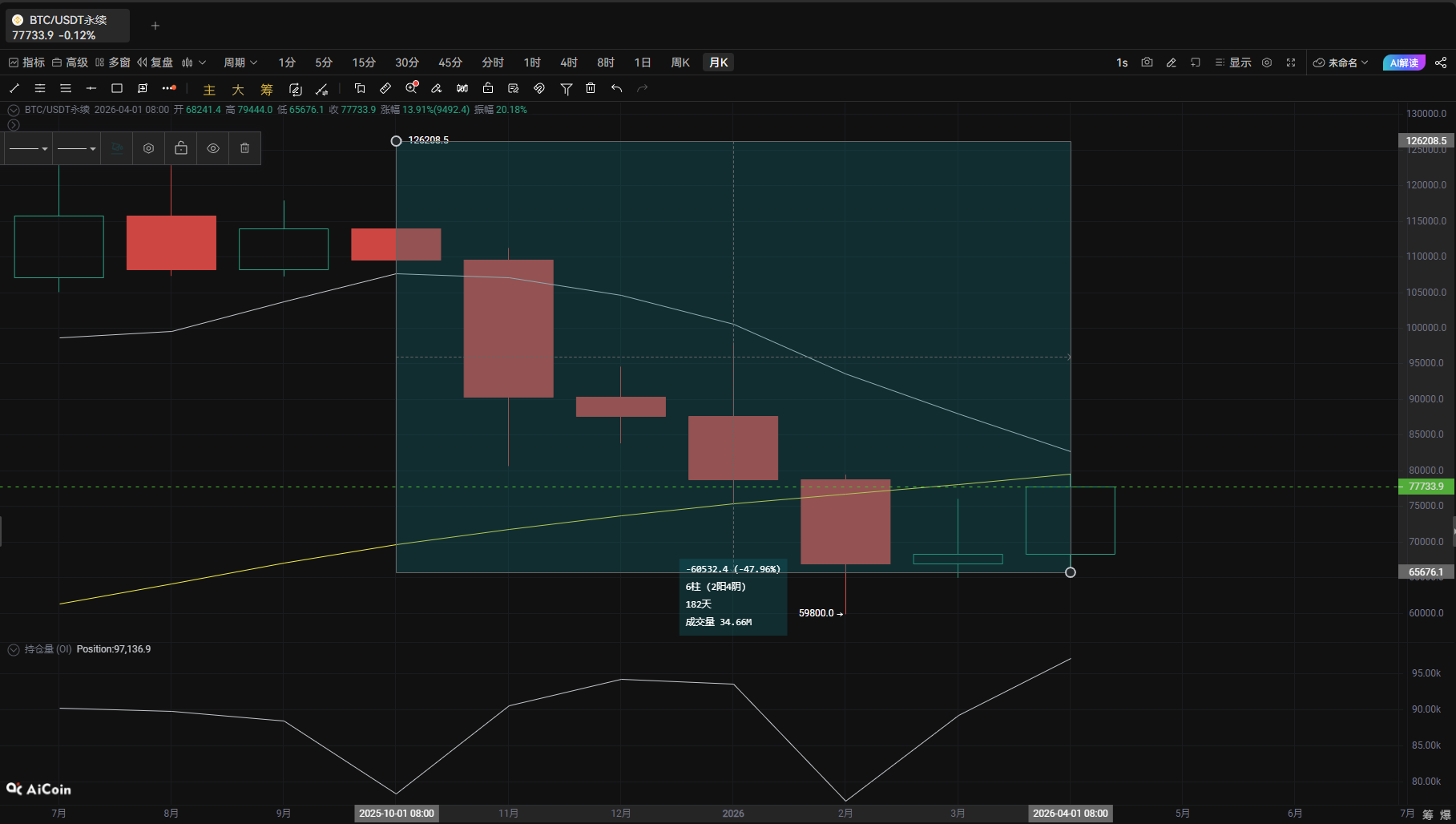
In the past 24 hours, the cryptocurrency derivatives market has entered a typical high-leverage fluctuation period: as of the statistics on April 24, the total liquidation amount across the network is approximately $171 million, including long positions of about $101 million and short positions of about $70.44 million. Approximately 82,120 traders were liquidated, with both long and short positions concentrated under pressure. The liquidation related to BTC is approximately $2.07 million, while the liquidation related to ETH is approximately $1.71 million, indicating that this round is not merely a single asset crash, but a unified deleveraging across the entire leverage system amidst the fluctuations.
In this round of liquidations amounting to $171 million, one of the risk focal points appeared in Hyperliquid. The largest single liquidation during the statistical period comes from the BTC-USD trading pair on Hyperliquid, with a single value of approximately $3.58 million, ranking high on the overall liquidation list, directly exposing the platform's capacity to carry funds and risk exposure in high-leverage trading.
More critically, on-chain and derivatives data show that the internal funding attitude on Hyperliquid is highly differentiated. Glassnode pointed out around April 24 that over the past two months, huge long positions held by whales on Hyperliquid have continuously increased. These large perpetual contract traders have been betting on long breakout trends; meanwhile, whale address @0x58bro deposited 2,791 ETH, valued at approximately $6.64 million, into Binance within 24 hours around April 23, cumulatively depositing 3,811 ETH worth about $9.03 million. Only about 0.5 ETH remained on-chain, yet they are still maintaining a 25x leveraged short on ETH and a 40x leveraged short on BTC on Hyperliquid, with total profits of about $33 million, illustrating a typical high-leverage bearish position that remains open. On the other side, the newly created address 0x0b8a first sold 75 ETH on Hyperliquid, cashing out approximately $174,000, and then went long on around 9.19 million APE at 5x leverage, nominally valued at about $1.03 million. New funds choose to gamble on long-tail assets with high leverage.
In this structure of long whale accumulation, high-leverage shorts maintained by whale funds, and new wallets heavily betting on APE, Hyperliquid's trading activity has become sufficiently intense to influence broader market sentiment. Artemis data shows that during the same statistical window, Ethereum network's 24-hour transaction fee revenue was approximately $2.7 million, while Hyperliquid accounted for about $1.7 million, with the latter's daily transaction fee scale approaching mainstream public chain levels. Combining its largest single liquidation and highly differentiated funding positions, Hyperliquid is becoming one of the core battlegrounds for this round of longs and shorts mix-up and risk release.
The $171 million Liquidation Storm Points to HL
From the data of the past 24 hours recorded on April 24, the total liquidation in the contract market across the network amounted to approximately $171 million, including long positions of about $101 million and short positions of about $70.44 million, exhibiting a typical pattern of simultaneous clear-out of longs and shorts. Both sides were caught in "deleveraging," indicating that the market is not merely experiencing one-sided runs but, under the widespread presence of high leverage, price fluctuations within a range can trigger a large number of positions with insufficient margin. During this period, the liquidation amount related to BTC is about $2.07 million, while the liquidation amount related to ETH is about $1.71 million, showing that mainstream coin contracts remain the main battleground for liquidations. A total of about 82,120 traders experienced liquidations in this round of volatility, demonstrating the penetration range of leverage usage.
Among the total of $171 million, the most notable single liquidation occurred on Hyperliquid: its BTC-USD trading pair recorded a single liquidation of approximately $3.58 million, which is the largest single clear-out amount of the day, far exceeding the average individual liquidation amount across the network when distributed by the number of people. In other words, on Hyperliquid, the concentration of individual leverage positions is significantly higher, where a single account can stack contract positions with nominal values of several million dollars on one trading pair. Once triggered for forced liquidation, it can form a prominent single-point risk event within that platform.
Such large-scale forced liquidations happening in an environment where prices are still fluctuating within a range pose significant impacts on Hyperliquid's own liquidity and order book structure. On one hand, the passive liquidation of approximately $3.58 million will strike the order book in a manner close to market price in a short time, testing the market making capital's capacity to pick up the orders; if buying depth is insufficient at that time, it can easily amplify the instantaneous slippage, widen the spread in a short time, and even trigger additional liquidations of other leveraged positions that are already close to the liquidation line. On the other hand, in the context of simultaneous liquidations of longs and shorts, Hyperliquid is not only the place where liquidations occur but also the main area where liquidity is rapidly “withdrawn and returned,” and short-term trading and fee increases are likely to amplify price fluctuations within the platform.
From the perspective of funding sentiment, Glassnode's observations over the past two months indicate that whale accounts on Hyperliquid have continuously increased their long positions, preferring to bet on breakout trends. In this wave of turmoil, the largest single liquidation occurred on this platform's BTC-USD contract, indicating that some large leveraged longs have already been cleaned out within the range, which may weaken the willingness of such funds to continue increasing leverage in the short term. At the same time, it cannot be ruled out that surviving long and short funds may utilize the liquidity and volatility mismatch following liquidations to amplify leveraged bets again on Hyperliquid. For the entire market, such concentrated liquidation events occurring in a fluctuating market will amplify volatility locally on a particular platform, and then, through the diffusion of sentiment and price expectations, influence subsequent cross-platform volatility structures.
Whale Longs Increase Bets: HL on the Line
Glassnode repeatedly highlighted around April 24 that over the past two months, large perpetual contract accounts on Hyperliquid have continued to increase their positions along the lines of "betting on the breakout of a long range":
● These accounts' long positions have continuously increased over the two months, with position directions clearly pointing to contracts on Hyperliquid rather than spot allocations;
● The holding structure reflects a typical trend bet — rather than switching back and forth between longs and shorts in the short term, they have patiently accumulated longs, waiting for prices to break out of the current fluctuating range;
● Glassnode categorizes these groups as "large perpetual contract traders," indicating that this wave of funds themselves have substantial size and continuity, with strong bullish sentiment that has persisted for a long time.
Whales choosing to continuously increase longs within a fluctuating range may logically stem from several considerations (all of which are speculative in nature):
● Betting on a trend breakout:
During a phase where prices remain in a range for a long time, larger funds with longer capital cycles are often more willing to be "friends of time." Such accounts may believe that the current range is merely a retracement within a larger trend, choosing to gradually increase leveraged long exposure during repeated pullbacks while waiting for a significant breakout that could offer a favorable risk-reward ratio.
● Utilizing advantages in funding costs and risk control:
Accounts of larger size usually have advantages regarding funding costs, margin replenishment efficiency, algorithm execution, etc., allowing them to endure prolonged floating losses and repeated liquidations. Provided that funding rates do not fluctuate drastically, continuously rolling long positions may be an acceptable "holding cost" for them, while for retail investors, it may easily turn into an untenable "wear and tear."
● Relative preference for exchange structure:
Glassnode specifically points out that these longs are concentrated in Hyperliquid's contracts rather than dispersed across multiple platforms, likely indicating that this batch of funds has a relative preference for the platform's matching, depth, risk control parameters, or counterpart structures. Concentrating main long positions in a single derivatives venue for institutional funds is not uncommon due to considerations of execution efficiency and predictability of counterpart behaviors.
The issue is that, in the current liquidation environment, this "concentrated long" choice itself can amplify the potential intensity of the liquidation chain.
As of April 24, the last 24 hours of statistics reveal that the total liquidation across the network has reached approximately $171 million, including long positions of about $101 million and short positions of about $70.44 million. About 82,120 people experienced liquidations, with the largest single liquidation occurring on Hyperliquid's BTC-USD trading pair, valued at approximately $3.58 million. This indicates that the liquidation pressures associated with high leverage exposure have already manifested most directly on this platform in this round.
In this context, when a large amount of long leverage is concentrated on Hyperliquid, any sharp price fluctuations that deviate from expectations may amplify the liquidation chain through several means:
● Concentrated triggering:
If the lower edge of the range is effectively breached, the long margin ranges of whales and following funds will overlap significantly, possibly triggering mass liquidations at similar price levels, creating a "one-way selling flow" on the platform for a time.
● Chain reaction slippage:
Forced liquidation orders are typically executed at market price or near market price. When local depth is insufficient, it significantly amplifies short-term slippage. This further pushes prices down, causing more high-leverage longs to hit their maintenance margin thresholds, resulting in secondary and tertiary chain liquidations.
● Cross-platform sentiment spillover:
The current total liquidation data across the network, amounting to $171 million itself indicates that leverage risks are in a relatively tight state. If a new round of concentrated liquidations occurs on Hyperliquid, it will not only amplify price fluctuations within the platform but may also trigger deleveraging or migration of long positions on other platforms through sentiment and expectation transmission, thus amplifying local risks into broader volatility.
In accordance, Hyperliquid's fee revenue of about $1.7 million over the past 24 hours indicates that its contract trading activity indeed resonates with the narrative of "whales continuously increasing positions": on one side, there’s a steady rise in long positions over the past two months, and on the other side, the combination of recent liquidations and high turnover has placed this batch of funds originally betting on range breakthroughs at a crossroads of either facing concentrated liquidations or guiding the next trend.
Longtime Bear Whales Realize Gains but Remain Bearish
Unlike the large whales that have continuously increased longs on Hyperliquid over the past two months, the longtime address @0x58bro's actions clearly lean towards a "realizing gains + bearish" combination approach.
Around April 23, on-chain monitoring indicated that @0x58bro concentrated deposited 2,791 ETH into Binance within 24 hours, which, at the time's price, was about $6.64 million; cumulatively, 3,811 ETH were deposited, corresponding to an approximate size of $9.03 million. After completing this transfer, the address retained only about 0.5 ETH on-chain, effectively moving most of its ETH holdings to centralized exchange, nearly clearing its on-chain positions.
However, on the derivatives side, this longtime whale has not "cashed out" but continues to maintain a high leveraged bearish exposure: it still holds a 25x leveraged short on ETH and a 40x leveraged short on BTC on Hyperliquid, currently with total profits of approximately $33 million. The large transfer on the spot side, combined with continued high leveraged shorting on the futures side and tens of millions of dollars in book profits, clearly directs its overall position — betting on continued price declines, creating a stark contrast with the batch of long whales that have been "betting on breakout trends" on Hyperliquid for two consecutive months.
This "first transport the spot to the exchange while keeping high leveraged shorts" structure presents a typical asymmetric profit character in the current environment of simultaneous explosions of longs and shorts:
● If the market continues to decline, the short positions will continue to amplify profits under high leverage, while the large amount of ETH transferred to Binance can be used at any time to cover margins or sell at opportune moments, achieving a more thorough bearish allocation;
● If prices unexpectedly rebound after continuous liquidations, high leveraged shorts will face significant retracements, or even passive reductions in positions, with this retracement typically occurring much faster than gains on the spot side. Once the on-chain positions are cleared, with funds concentrated in the market, this implies that these longtime shorts are more deeply exposed to the risks of "reflexivity" and short-term short squeezes.
Against the backdrop of $171 million worth of liquidations across the network, this longtime whale chooses to combine high leveraged shorts with concentrated spot entries, not conforming to the mainstream whales' bullish path but rather betting on the opposite result: if the market continues to release leverage downwards, it will be one of the main beneficiaries; once the trend reverses, it could become a significant source of chips in the next round of liquidation statistics.
New Wallet's All-In Bet on APE
In contrast to the longtime whale that reduced its positions in spot and maintains high leveraged shorts, the newly created address 0x0b8a took another extreme path in the same period: consolidating its chips on a high-leverage long on a long-tail asset.
Lookonchain's monitoring shows that this new wallet first sold 75 ETH on Hyperliquid, cashing out approximately $174,000. This step can nearly be seen as a dedicated "fundraising" trade: converting funds originally held in ETH into cash positions usable as margin, thereby freeing up space for subsequent derivatives operations.
Immediately following that, 0x0b8a opened a 5x leveraged long contract on Hyperliquid, targeting APE, with a contract size of about 9.19 million APE, corresponding to a nominal value of about $1.03 million. From the perspective of funding efficiency, this trade mobilized over $1 million in long positions using approximately $174,000 as margin, clearly indicating a highly concentrated risk preference: using a single source of principal to seek amplified returns in one direction.
This operational logic is essentially a "go all-in" leveraging approach:
● On one hand, after rapidly realizing 75 ETH, it did not diversify into multiple assets or build positions in batches but concentrated its bets on APE, a long-tail asset;
● On the other hand, directly overlaying 5x leverage on the long-tail asset means that every price movement of the asset will magnify its effect on the account's net value.
In the current market environment, the vulnerability of such positions is further amplified. Statistics show that as of April 24, the total liquidation across the network is approximately $171 million, including long positions of about $101 million and short positions of about $70.44 million, with approximately 82,120 traders being liquidated, and the largest single liquidation occurring on Hyperliquid's BTC-USD trading pair. In this window where both longs and shorts are heavily hedged and severe fluctuations are frequent, any concentrated bets in either direction are more likely to be "swept away" by short-term reverse movements in the market.
Compared to leading assets like BTC and ETH, high leveraged bets on long-tail assets such as APE additionally face challenges posed by liquidity contraction and insufficient depth of order book: larger price slippage and wider instant fluctuation ranges lead to more pronounced changes in margin utilization and floating losses. For a 5x leveraged long like 0x0b8a, encountering a rapid drop during intense market fluctuations may trigger forced liquidation by the clearing engine, wiping this "all-in" bet clean even if the price quickly recovers thereafter.
From the perspective that the outcome remains uncertain, the actions of 0x0b8a are just a microcosm amid many high-leverage participants: while whales are using tens of times leverage in a longer-term directional bet on BTC and ETH, new wallets are amplifying short-term volatility on long-tail assets with 5x leverage. In this round of $171 million level dual explosions of longs and shorts on April 24, this kind of “using several hundred thousand dollars to leverage million-dollar positions” new funds is not only an important source of Hyperliquid's transaction fees and volume but also one of the most easily involved links in the next round of chain liquidations.
Risks Behind Fees and Positions
From Glassnode's revelation of long whales, like the whale @0x58bro maintaining a 25x short on ETH and a 40x short on BTC on Hyperliquid, to the new address 0x0b8a betting about $1.03 million in nominal value on APE with 5x leverage, we can see that the funding's risk preference on Hyperliquid has clearly torn apart: on one side, there are whales that have persistently increased longs for two months, betting on breakout ranges; on the other, there are high multiples of bearish counterparts against BTC and ETH, further compounded by high leveraged speculation on long-tail assets, representing an extreme gamble between new and old funds on the same platform.
This rupture is also directly reflected in fee and liquidation data. Artemis shows that Ethereum network's 24-hour fee revenue is about $2.7 million, while Hyperliquid reaches approximately $1.7 million, nearing revenue scales at the level of mainstream public chains. For a derivatives platform to reach this level outside of spot public chains strongly indicates that it is accommodating a substantial amount of high-frequency, high-leverage trading demands. Meanwhile, during the same statistical window, the network-wide $171 million liquidation and the largest single liquidation of approximately $3.58 million appearing on Hyperliquid's BTC-USD trading pair further suggests that this platform has likely become one of the significant carriers of this round's leverage risks.
In this environment, we need to closely monitor several variables to determine whether risks are still accumulating or gradually releasing:
● First, whether Hyperliquid will continue to experience individual liquidations at the level of millions of dollars. If similar $3.58 million clearances gradually increase, and are concentrated in high-leverage varieties, it means that the leverage chain is still tightening; conversely, a contraction in individual liquidation amounts may signify one of the signals of passive deleveraging.
● Second, whether a reversal appears in the net leverage direction of whales tracked by Glassnode. If the long whales that have been continuously increasing positions over the past two months begin to reduce their holdings or turn neutral, while high-leverage bear whales like @0x58bro also simultaneously reduce leverage, it suggests that extreme bets on both sides are cooling down; conversely, if longs continue to increase leverage while shorts remain inactive, it indicates that the intensity of betting is rising.
● Third, changes in platform-level fees and long-short ratios. The fee sequence provided by Artemis can reflect overall trading activity, combining CoinGlass liquidation statistics and the changes in long-short positions on Hyperliquid to help identify whether fees and liquidations are rising simultaneously (risk concentration release) or if fees remain high while liquidations and extreme long-short values decline (leverage being partially digested amid high-frequency turnover).
If CoinGlass liquidation data, Glassnode whale position data, and Artemis fee data evolve in the same direction based on the above dimensions, it will provide relatively clear signals for judging whether leverage risks on Hyperliquid are accumulating again or have entered a stage of orderly clearing. In the pattern of whale long-short divergence and new wallets heavily betting on long-tail assets, these subtle changes on-chain and on the platform side may reveal the rhythm of the next round of chain liquidations even more quickly than prices themselves.
Join our community to discuss together and become stronger together!
Official Telegram community: https://t.me/aicoincn
AiCoin Chinese Twitter: https://x.com/AiCoinzh
OKX benefit group: https://aicoin.com/link/chat?cid=l61eM4owQ
Binance benefit group: https://aicoin.com/link/chat?cid=ynr7d1P6Z
免责声明:本文章仅代表作者个人观点,不代表本平台的立场和观点。本文章仅供信息分享,不构成对任何人的任何投资建议。用户与作者之间的任何争议,与本平台无关。如网页中刊载的文章或图片涉及侵权,请提供相关的权利证明和身份证明发送邮件到support@aicoin.com,本平台相关工作人员将会进行核查。