A vibrant city always attracts ambitious people, and Shenzhen is such a city.
Forty years ago, Shenzhen was just a rice field and a few fishing villages on the eastern shore of the Pearl River Delta. But over the following four decades, it turned Huaqiangbei into the largest distribution center for electronic components in the world, made Dafen Village into a global oil painting factory, and became the birthplace of Huawei, Tencent, DJI, and BYD. In this city, there are many individuals who have monetized price differences through information, liquidity, and regulatory asymmetries.
Arez is a typical person from Shenzhen.
In his early thirties, he and his friends opened a "毛工作室" in an office building in Nanshan, and he made a lot of money for his team in the 2023 airdrops of Arbitrum, Starknet, and LayerZero. At his peak, he managed over a thousand on-chain addresses, running scripts, IP proxies, KYC resources, and fund rotations.
A year ago, when Rhythm BlockBeats interviewed Arez for the article "As anti-arbitrage intensifies, clever arbitrageurs still earn tens of thousands a month?", although his arbitrage studio had set up a small group for IPOs in the Hong Kong stock market, the main focus remained on cryptocurrency arbitrage.
But starting in the second half of the year, Arez's arbitrage studio decided to completely shift focus to IPOs in the Hong Kong stock market.
Hong Kong IPOs: From "Small Spring" to "Great Bull Market"
To understand why Arez's arbitrage studio changed its direction, we need to talk about how appealing today's "Hong Kong IPOs" are.
Since the start of 2026, over 80% of newly listed stocks in the Hong Kong market achieved price increases on their first trading day, with an average first-day increase of more than 38% overall.
By the end of the first quarter, Hong Kong had completed the listing of 40 new stocks in a single quarter, raising a total of 109.9 billion Hong Kong dollars, surpassing NASDAQ (21 stocks), the New York Stock Exchange (15 stocks), and other major global exchanges, ranking first in the world for new stock financing in the first quarter of 2026.
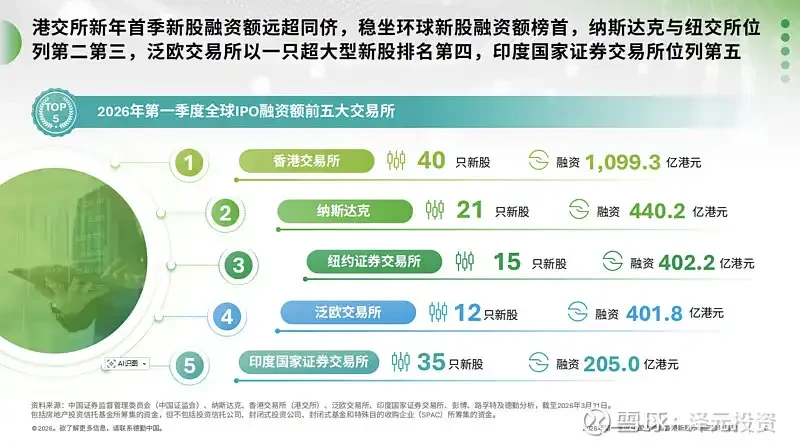
Image Source: Xueqiu
The leading stocks are almost all in hard technology. On January 2nd, on the very first day of the new year, SiGe Technology became the first domestic GPU company listed on the Hong Kong stock market, with an offering price of 19.6 Hong Kong dollars, and was oversubscribed 2346.5 times in the public offering, rising 75.82% on the first day. On January 9th, MiniMax saw a 109.1% rise on its listing day, with a market value exceeding one hundred billion. On February 13th, Haizhi Technology Group soared 242.20% on its first trading day.
Then, what impressed Arez the most were the three craziest days in April. New stocks listed since April have been even more outrageous, rising across the board with none breaking below their offering prices.
On April 16th, SiGe Technology officially listed. The startup team from Huawei focused on distributed energy storage, growing revenue from 58 million to 9 billion in two years, and doubled its stock price on the first day. A maximum profit of over 34,000 Hong Kong dollars could be made by winning a single allotment. The entry fee was 32,700 Hong Kong dollars, which meant recouping the investment within a day. The entire IPO circle in Shenzhen was buzzing that night. The very next day, on April 17th, Qunhe Technology and Changguang Chenxin were both presented. Qunhe Technology was the first IPO from the "Hangzhou Six Young Dragons," soaring 144% on its first day, with a cumulative increase approaching four times over two trading days. Changguang Chenxin debuted the same day, rising 75% on its first day, with the highest price more than 145% above the issue price a few days later.
In three days, three new stocks, each one made the allotment winners jump for joy.
According to LiveReport's big data statistics, since 2026, if you purchase one allotment of each Hong Kong IPO and sell all at the opening price, the return from Hong Kong IPOs in 2026 (excluding transaction fees) has already exceeded 128,000 Hong Kong dollars.
This is no longer the "small spring" for Hong Kong IPOs, but rather a "great bull market" for Hong Kong IPOs.
The Arbitrageurs of Shenzhen Have All Focused on Hong Kong IPOs
Arez revealed that it's not just his arbitrage studio; several arbitrage offices he knows have either always had Hong Kong IPOs as part of their business or have shifted most of their attention to Hong Kong IPOs since the second half of 2025.
"We mainly have two types of plays," Arez told Rhythm BlockBeats: "One is to create an account matrix to subscribe to new stocks for allotment profits, and the other is a strategy we learned and are still practicing this year, collaborating with some mainland distributors and Hong Kong tour groups to bring in new customers for banks and brokerages, earning CPA commission per head."
Net Profit of One Million in April
Let’s review Arez’s operations using the craziest week in mid-April 2026.
When subscribing on his own, Arez mainly analyzes new stocks from several aspects: strong fundamentals, high market interest, large caps, low issuance valuations, and high subscription multiples.
"Take the recent example of SiGe Technology; it perfectly fulfills every criterion." The energy storage sector that SiGe Technology belongs to has strong fundamentals; the startup team from Huawei has market interest and a compelling narrative; and the 4.4 billion Hong Kong dollars raised makes it a large-cap stock.
"Moreover, most importantly, the entry fee for SiGe Technology is very high, with an issue price of 324.2 Hong Kong dollars and a required subscription of 100 shares, amounting to 32,700 Hong Kong dollars for one allotment. A high entry fee means fewer retail investors participating and a higher allotment rate," Arez analyzed.
On April 8th, the subscription for SiGe Technology began. That morning, Arez and his partners held a meeting, all expressing strong support for this IPO, and decided to maximize subscriptions on all accounts, taking full advantage of financing leverage.
In the following days, Arez’s team got busy, "but when the allocation results were announced, our luck was quite good."
On April 15th, from 16:15 to 18:30, the dark market opened, with SiGe Technology's dark market soaring over 81%, resulting in a paper profit of 26,000 Hong Kong dollars for each winning allotment. Arez cleared most of his positions in the dark market, locking in the first wave of profits. The next day, SiGe Technology opened at 581 Hong Kong dollars, and all remaining positions were sold within half an hour after the opening. Soon after, on April 17th, Qunhe Technology and Changguang Chenxin were a "double whammy."
Arez's studio earned nearly one million Hong Kong dollars in less than half a month.
In comparison to the Arbitrum project in 2023, the profits allocated to the studio were of similar magnitude, but the ARB project took a full 14 months from initial interaction to token issuance.
A typical arbitrage project takes an average of 12 to 18 months from the initial interaction to token issuance. During this period, funds are frozen; Ethereum may halve in value; and project parties may also delay.
But the Hong Kong IPO market presents a completely opposite signal: short cycles, quick feedback, and high certainty. The entire process from the subscription phase to listing takes only 7 to 10 days.
Turning Account Opening into a Flow Business
By searching "Changqiao Cashback," "Futu Invitation Code," "Tiger Channel Rebate" on V2EX, Zhihu, Xiaohongshu, Xianyu, and Telegram, you will find a CPA distribution market that is more mature than that of Taobao affiliate marketing.
"Generally, brokers provide a minimum rebate of 500 Hong Kong dollars to their channels, and our rebates online generally split 250 Hong Kong dollars to the customer, with the rest being our net profit as intermediaries," Arez said, treating the new subscription as his main business, with earning rebates being a passive side venture.
Arez also revealed to Rhythm BlockBeats that a stable channel intermediary can achieve a comprehensive revenue of 1,500-3,000 Hong Kong dollars for bringing in one customer.
Data shows that in the first quarter of 2024, HSBC Hong Kong added 130,000 new personal clients; by the first quarter of 2025, this figure skyrocketed to 300,000. This wave of account openings has spawned a vast ecosystem of agency services. For example, the service price for Hong Kong accounts processed in Hong Kong is 1,200 yuan, whereas the price for processing in mainland China is 2,500 yuan.
Arez's studio also established a "Hong Kong Card + Brokerage Account Opening" group at the beginning of 2026, with low pricing, and charging 2,000-3,500 yuan per complete client package (2 Hong Kong cards + 3 brokerage accounts). The gross profit for one customer is around 3,000-5,000 Hong Kong dollars.
"The process is just like a tour group, gathering at designated spots in Shenzhen, crossing the border together, providing full accompaniment, executing the process according to the plan, and visiting bank branches in Central, Yuen Long, and Tsuen Wan in turns," Arez told Rhythm BlockBeats.
They even collaborated with some tour groups to include sightseeing at Victoria Harbour and Tsim Sha Tsui in the itinerary. If they manage 5 clients in a month, that could provide a steady cash flow of around 100,000 Hong Kong dollars.
This amount isn't large. But compared to the uncertainty of arbitrage like "waiting a year and a half for token issuance," the stable monthly cash flow is one of the reasons why arbitrage studios are genuinely willing to transition.
On-Chain Hong Kong IPOs: The Next Trend
Recently, while chatting with friends, Rhythm BlockBeats discovered a new trend—on-chain Hong Kong IPOs.
As long as users have a wallet, deposit USDT/USDC, and complete KYC, they can directly buy and sell Hong Kong stocks on-chain, including participating in Hong Kong IPOs. StableStock is such a project.
By partnering with a licensed broker called HabitTrade, StableStock secures the underlying trading channel and places real shares of US and Hong Kong stocks in 1:1 custody with institutions like Coinbase Institution and SafeHeron, and then issues corresponding tokenized stock assets on-chain. This has also spread spontaneously within the social circles of seasoned on-chain players.
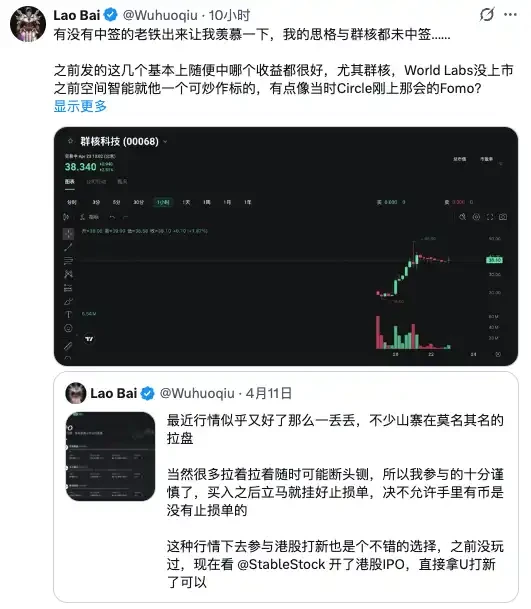
In February 2026, the platform’s trading volume increased by 206% compared to the previous month, approximately three times the trading volume in January, surpassing the total of the previous three months. The steep slope of this curve indicates that a significant portion of the driving force comes from on-chain arbitrage players like Arez, who have been attracted by the Hong Kong IPOs.
As the enthusiasm for Hong Kong IPOs continues to rise, the sector of "on-chain Hong Kong IPOs" will become increasingly bustling.
免责声明:本文章仅代表作者个人观点,不代表本平台的立场和观点。本文章仅供信息分享,不构成对任何人的任何投资建议。用户与作者之间的任何争议,与本平台无关。如网页中刊载的文章或图片涉及侵权,请提供相关的权利证明和身份证明发送邮件到support@aicoin.com,本平台相关工作人员将会进行核查。