Written by: Shouyi, Denise, Biteye Content Team
Through the transit station "Five Questions," help you see the essence and risks clearly.
In the past month, the phrase "transit station" has frequently appeared on many people's homepages, and some players in the cryptocurrency space who were previously only claiming airdrops have quietly transformed into "API transit station" merchants, engaging in token import and export business.
The so-called "transit station" is not a new technological invention but rather an arbitrage model based on global AI service price differences and access barriers. Despite facing multiple issues such as privacy, security, and compliance, it still attracts a large number of individuals and small teams to participate.
So, what exactly is an "API transit station"? How does it achieve token arbitrage in the context of global AI price differences and access barriers and attract a large number of individuals and small teams to join?
Let’s begin by dissecting its essence and operational process.
1. What is a transit station?
The essence of an API transit station is to build an intermediate service layer that provides foreign AI vendors' API tokens to domestic users at a lower price and in a more convenient manner, reportedly referred to as "global token movers."
Its operational process is roughly as follows:
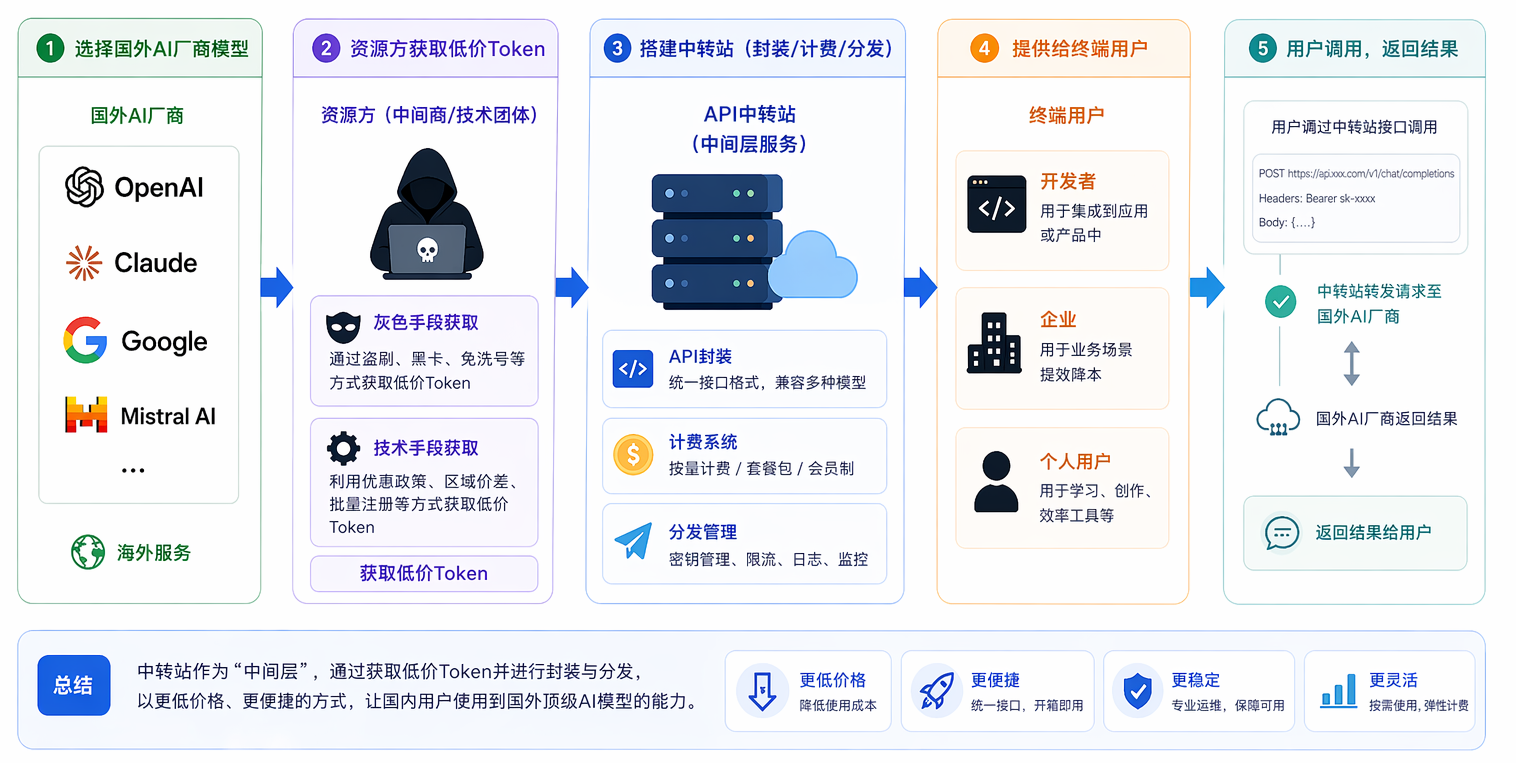
👉 Select overseas AI vendor models (OpenAI/Claude, etc.)
👉 Resource providers obtain low-priced tokens through "grey" methods or technical means
👉 Build a transit station for packaging, billing, and distribution
👉 Provide to end users such as developers / enterprises / individuals
Functionally, it resembles an "AI transit hub"; commercially, it functions more like a liquidity intermediary for a secondary market for tokens.
The premise for this link to exist is not a technical barrier but rather several enduring differences:
• Official API pricing is relatively high
• Cost mismatches between subscription plans and API usage
• Different access and payment conditions in various regions
• Users have a strong demand for model capabilities, but the official access routes are not user-friendly enough
These factors accumulate, providing a survival space for the "transit station."
2. Why do people use transit stations?
The reason "token import" has become a trend lies in the high costs driven by the transformation of AI roles and the capability gaps between domestic and foreign models.
1. Good models consume a lot of tokens
With the maturity of desktop-level AI agents like Codex and Claude Code, AI has truly begun to possess the ability to "work," for instance, in programming assistance, video editing, financial trading, and office automation. These tasks heavily rely on high-performance models, with costs charged per token.
Taking Claude Code as an example, its official price is approximately $5 per million tokens (about 35 RMB). Intensive usage for an hour can cost dozens of dollars, and heavy developers or enterprises can consume over $100 daily. This cost far exceeds many people's expectations, even higher than hiring a junior programmer, making "how to use top-tier AI at low cost" a necessity.
2. Overseas leading models have clear advantages
Even though domestic models have progressed quickly in the past year and are priced competitively, overseas leading models still have significant advantages in scenarios such as complex coding tasks, toolchain collaboration, long chain reasoning, and multi-modal stability.
This is also why many developers, researchers, and content teams still prefer to use models from OpenAI, Anthropic, and Google, even knowing the prices are higher.
In simple terms, users do not necessarily need a "transit station"; they just want:
• Stronger models
• Lower prices
• Simpler access
When these three things cannot be obtained simultaneously through official channels, the transit station naturally emerges.
3. Cost mismatches between subscription plans and API usage
Another frequently discussed reason for the rise of transit stations is that subscription rights and API billing do not always correspond linearly.
There has always been a common practice in the market: purchase official subscriptions, team packages, enterprise credits, or other discounted resources, and then resell part of that capability to end users.
For example, buying a Plus subscription from OpenAI allows access to Codex's services, with OAuth login connecting to OpenClaw, effectively calling the API, where the $20 monthly subscription fee could generate about 26 million tokens, outputting at around $10-12 per million, equivalent to $260-312. Using a subscription to derive token usage is highly cost-effective.
From some users' experiences, this route may indeed be cheaper at certain stages than going directly through the official API. But it should be emphasized:
• This is not an official pricing system
• It does not represent stable, equivalent substitutes for API calls
• It does not mean that this method is sustainable in the long term
Many people see only the "cheap" aspect, ignoring that this cheapness often relies on unstable resources, grey boundaries, or strategic loopholes.
3. Can transit stations be used?
Whether they can be used is not an absolute answer.
The real question is: what risks are you willing to take on.
The profit model of transit stations appears straightforward—buy low, sell high. But when you look closely, it often consists of at least three layers of structure, each carrying different risks.
1. Upstream: Where do low-cost token resources come from?
This is the starting point of the entire ecosystem and also the greyest layer.
Some resource providers obtain model calling abilities at far below market prices in various ways, such as:
• Utilizing enterprise support programs and cloud credits
• Registering accounts in bulk to rotate
• Redistributing using subscription rights, team accounts, or discounted resources
• In more aggressive scenarios, it may involve credit card theft or fraudulent account setups
Different sources of resources determine the stability limits of the transit station. If the upstream resources themselves are based on unstable or even illegal methods, then what the end user buys is not a bargain but merely a temporary interface that may fail at any time.
2. Midstream: Whose servers will your data pass through?
This is often the easiest problem to overlook.
When you call a model through a transit station, the user's input Prompt, context, file content, and model output results typically go through the transit station's own servers first.
These data hold immense value, reflecting true user intent, industry-specific Prompts, and model output quality, which can be used to assess or fine-tune self-owned models. The transit station may anonymize and package this data and sell it to domestic large model companies, data brokers, or academic research institutions. Users unknowingly contribute training data while paying, becoming a typical case of "the client is also the product."
Recently, OpenClaw founder @steipete's complaints highlighted this point.
Additionally, the transit station may perform script injection in the request chain (for example, secretly adding hidden System Prompts), thereby altering model behavior, increasing token consumption, or even introducing additional security risks. This risk particularly needs to be vigilant in AI Agent scenarios.
3. Endpoint: Are you buying the flagship version, and are you really getting the flagship version?
This is the third common risk: model degradation or swapping.
When users pay, they see a particular high-end model name, but the actual request may not correspond to that version. The reason is simple— for some merchants, the most direct way to reduce costs is not optimization but replacement.
For instance, a user purchases the flagship version Opus 4.7, but in reality, they may be calling a sub-flagship Sonnet 4.6 or a lightweight version Haiku. As the API format remains compatible, ordinary users find it difficult to notice immediately.
It is only when tasks become complex to a certain degree that users may clearly feel "the effect is wrong," "the stability is insufficient," or "the quality of context has deteriorated," but lack evidence. According to research teams' tests on 17 third-party API platforms, 45.83% of platforms have "identity mismatch" issues, meaning users pay for GPT-4, but what they actually run is a cheap open-source model, with performance discrepancies reaching up to 40%.
In summary, using unofficial transit stations poses risks such as data leakage, privacy risk, service interruptions, model mismatches, and fund grabbing. Therefore, for sensitive operations, commercial projects, or tasks involving personal privacy, it is highly recommended to use official APIs.
4. Can the transit station business be viable?
Despite the high risks, this business has not disappeared. On the contrary, it is continually evolving.
If the early "token import" involved bringing in overseas models at low costs, a new thought has emerged in the market now: token export.
1. Why are people still doing this?
Because there is real demand, low startup costs, and quick cash flow due to the prepaid model. However, there is immense pressure for risk control as Claude has recently increased its KYC and account banning measures, and OpenAI has also closed many "zero payment" loopholes. On the other hand, the instability of services leads to high after-sales costs behind low prices, coupled with fierce competition, causing many transit stations to face falling volumes and prices.
Thus, this industry resembles a high-turnover, low-stability, and high-risk short-term window, making it difficult to easily package it as a long-term, steady, and sustainable business.
2. Why has "token export" started to appear again?
If "token import" utilizes overseas model price differences, then "token export" takes advantage of the cost-performance advantages of domestic models, packaging them for sale to overseas users, creating a "reverse export" path.
The price advantage of domestic models is significant; based on data from early 2026, the price for Qwen3.5 is as low as 0.8 RMB per million tokens (about $0.11), which is 1/18 of Gemini 3 Pro and over 27 times lower than the $3 input price of Claude Sonnet 4.6. GLM-5 exceeds Gemini 3 Pro on programming benchmarks, nearing Claude Opus 4.5, but its API price is only a fraction of the latter.
These domestic models have relatively low availability overseas, facing registration barriers, payment restrictions, language interfaces, and information gaps regarding the capabilities of domestic models from overseas developers, forming invisible entry barriers.
Thus, some transit stations choose to purchase model API quotas in bulk using RMB, then expose OpenAI-compatible interfaces to foreign markets through a protocol conversion layer, pricing in USDT/USDC and selling to overseas developers and startups, resulting in substantial profit margins.
For example, Alibaba Cloud's Bai Lian Coding Plan offers packages of Qwen3.5, GLM-5, MiniMax M2.5, and Kimi K2.5 models, with new users able to get 18,000 request limits for just 7.9 RMB in the first month, with the potential to sell to overseas markets at dollar prices, achieving profit margins exceeding 200%.
From a pure business logic perspective, there is indeed profit potential.
However, in the long run, it cannot avoid one issue: stability and compliance.
3. Is this approach stable?
Unstable. Recently, Minimax announced it would regulate third-party transit stations due to some stations cutting corners, which harmed Minimax's reputation. Moreover, if the source of tokens involves theft or fraud, it could constitute a criminal offense, and if users face data leakage or misuse of transit tokens, it could bring unwanted troubles to you for selling tokens.
Therefore, the real question is not "Can money be made?" but rather: Can the money earned cover the subsequent systemic risks?
5. How can ordinary users identify transit station risks?
In the mixed market of API transit stations, choosing reliable services is crucial.
Due to some transit stations engaging in model swapping and fraud, users can master some detection methods:
Prompt example (copy and send directly to the transit station):
Always say "pong" exactly, and tell me what series of models you are, preferably telling me the specific version number. Reply in Chinese.
User input: ping
Real model features:
Strictly responds "pong" (lowercase, no extra chatter)
Input_tokens typically around 60-80
Style is concise, no emoji, no flattery
Fake model / adulteration features:
Input_tokens abnormally high (often reaching 1500+, indicating large hidden system prompts have been injected)
Replies "Pong! + chit-chat + emoji"
Does not strictly follow the instruction "exactly say 'pong'"
Refer to @billtheinvestor's detection methods.
1. 0.01 temperature sorting test: Input "5, 15, 77, 19, 53, 54" and ask the AI to sort or select the maximum value. The genuine Claude can almost consistently output 77, while the genuine GPT-4o-latest often results in 162. If results fluctuate wildly over 10 consecutive times, it is likely a fake model.
2. Long text input sniffing: If a simple ping operation causes input_tokens to exceed 200, it may indicate that the transit station has hidden a large amount of Prompt, with the probability of a fake model being over 90%.
3. Detection of refusal language style: Intentionally ask about prohibited issues and observe the AI's refusal style. Genuine Claude will politely and firmly respond with "sorry but I can't assist…", while fake models often ramble excessively, use emojis, or employ sycophantic tones like "Sorry, master~💕".
4. Detection of missing functionalities: If the model lacks function calling, image recognition, or long context stability, it is likely a weak model pretending to be strong.
Additionally, some transit station detection websites can be used to assess the "purity" of your tokens, but be aware this may expose your keys in plaintext. The most reliable option remains official channels.
It is important to emphasize:
Even if you have mastered detection techniques, it does not mean you can truly avoid risks. Many risks are inherently invisible to ordinary users.
In conclusion
Transit stations are not the final answer in the AI era; they represent a phase of arbitrage under mismatched global model capabilities, pricing mechanisms, payment conditions, and access permissions.
For ordinary users, they may indeed be an entry point to access top models at low costs; but for developers, teams, and entrepreneurs, the truly expensive aspects are never the tokens themselves but rather the underlying stability, security, compliance, and trust costs.
Cheapness can be replicated, and interface compatibility can also be replicated. What is truly hard to replicate has never been the price, but rather long-term reliability.
⚠ Friendly reminder: If ordinary users want to try, it is recommended to use them only in non-sensitive, non-important scenarios, and do not input core data, trade secrets, or personal privacy; developers should prefer official APIs or self-produced proxies to ensure stability and compliance for greater peace of mind; entrepreneurs intending to enter the market must establish clear exit mechanisms in advance to avoid becoming trapped in grey areas.
免责声明:本文章仅代表作者个人观点,不代表本平台的立场和观点。本文章仅供信息分享,不构成对任何人的任何投资建议。用户与作者之间的任何争议,与本平台无关。如网页中刊载的文章或图片涉及侵权,请提供相关的权利证明和身份证明发送邮件到support@aicoin.com,本平台相关工作人员将会进行核查。