Original Author / galaxy
Translation / Odaily Star Daily Golem(@web 3_golem)

As the agenda of the 119th Congress approaches, the legislation on the structure of the cryptocurrency market is also nearing its conclusion.
The CLARITY Act received strong bipartisan support in the House of Representatives in July 2025 (294 votes in favor, 134 votes against) and has been the focus of intensive discussions in the Senate since January of this year. The Senate Banking, Housing and Urban Affairs Committee is expected to announce this week that it will hold a hearing, likely in the last week of April.
The committee chair Tim Scott (Republican) stated that there are still three key issues unresolved: stablecoin yield provisions, DeFi provisions, and how to ensure the voting support of all Republican members of the committee. Additionally, there are several other outstanding issues, including how the Blockchain Regulatory Certainty Act handles non-custodial software developers, ethical clauses related to government officials holding cryptocurrency, and relevant issues with the SEC, which may complicate the legislative process in the future.
After the Senate Banking Committee reviews and approves the bill, it still needs to secure 60 votes in the full Senate and reconcile with the version from the Agriculture Committee and the bill passed by the House of Representatives, before being signed into law by the President. Each step requires time, while the legislative schedule is rapidly shrinking: the CLARITY Act must compete for limited Senate deliberation time against debates on military authorization for Iran, unresolved funding deadlocks for the Department of Homeland Security, and a backlog of nomination cases.
On Monday, Punchbowl reported that Thom Tillis, a key negotiating representative from the Senate Banking Committee and Republican Senator from North Carolina, has called for postponing the committee's review until May. If the review is delayed until after mid-May, the chances of the bill passing in 2026 will be significantly reduced. Republican Senator Cynthia Lummis from Wyoming warned that if it does not pass this year, market structure legislation could be delayed until 2030 or even later.
Galaxy believes the chance of the CLARITY Act being signed into law in 2026 is about 50%, or even lower. This uncertainty does not stem from any single issue, but from many unresolved issues that must be addressed in order under time pressure.

Treasury Secretary Scott Bessent (left) has called for a markup of the CLARITY Act. Senate Banking Committee Chairman Thom Tillis states that three major issues remain.
Review of CLARITY Act Progress
The Digital Asset Market Transparency Act of 2025 (referred to as the CLARITY Act) was passed in the House of Representatives on July 17, 2025, with 294 votes in favor and 134 votes against. All 216 voting Republican members voted in favor, with no opposition, and four abstained. On the Democratic side, 78 members switched to vote in favor, while 134 voted against.
The bill was introduced by French Hill (Republican, Arkansas), the chair of the House Financial Services Committee, on May 29, 2025, and was passed in a joint review meeting of the Financial Services Committee (47 votes in favor, 6 against) and the Agriculture Committee (32 votes in favor, 19 against) on June 10.
The overwhelming vote in the House reflects a widespread belief that a federal-level regulatory framework for digital assets is urgently needed: the bill clearly delineates the jurisdictional boundaries between the U.S. Securities and Exchange Commission (SEC) and the Commodity Futures Trading Commission (CFTC); establishes a "mature blockchain test" to determine whether certain cryptocurrencies qualify as securities. The bill creates a pathway for tokens to be classified as non-security assets after achieving sufficient decentralization; it also includes digital commodity intermediaries under the federal registration and anti-money laundering obligations for the first time. The Senate Banking Committee released its draft in July, and the bill was submitted to the Senate on September 18, and referred to the banking committee.
In the Senate, the review of the CLARITY Act has been proceeding in parallel. The Agriculture Committee released its discussion draft in November and submitted the Digital Commodity Intermediary Act, focusing mainly on the CFTC's regulatory authority over the digital commodity market (including the spot market), on January 29 for committee review.
Furthermore, on January 12, the Senate Banking Committee, chaired by Tim Scott and including Elizabeth Warren as the chief member, published a lengthy alternative amendment (ANS) of 278 pages as the basis for committee negotiations. This text goes far beyond the bill passed by the House, covering nine titles related to securities innovation, illicit finance, decentralized finance, banking, software developer protection (the Blockchain Regulatory Certainty Act, abbreviated as BRCA), protection of client property in bankruptcy, and other matters.
The bill was initially expected to be submitted for a full Senate vote in mid-January, but was delayed due to disagreements over stablecoin yield limits. A second attempt to vote was also canceled. Before the CLARITY Act is submitted for a full Senate vote, the versions from the banking committee and the agriculture committee must be reconciled, and the merged bill must also be coordinated with the version passed by the House of Representatives; all of this must ultimately be completed before submission to the President for signature.
Since January, the main obstacle to the bill's progress has been the dispute between banks and cryptocurrency companies over stablecoin rewards. (The GENIUS Act signed into law last year prohibits stablecoin issuers from directly sharing earnings with holders, but allows exchanges to pay rewards to users holding stablecoins on their platforms; banks want to prohibit such incentives.) On March 20, Senators Thom Tillis (Republican from North Carolina) and Angela Alsobrooks (Democrat from Maryland) announced they had reached a tentative agreement with the help of the White House. This agreement would prohibit earnings derived solely from holding stablecoins, but allow clearly defined rewards linked to activities such as payments, transfers, or platform usage.
Since David Sacks resigned in March, Patrick Witt, Executive Director of the President's Digital Asset Advisory Committee, has been the main person responsible in the White House for cryptocurrency legislation. He described this compromise as enduring and confirmed that several previously tricky issues have been resolved behind the scenes. Representatives from the cryptocurrency industry reviewed the text on March 23 and found the wording too restrictive; Coinbase initially opposed this, but on April 10, after Treasury Secretary Scott Bessent publicly called for amendments to the bill and the company's CEO Brian Armstrong expressed support, Coinbase changed its stance.
On April 8, the White House Council of Economic Advisers released a 21-page analysis report, stating that fully prohibiting stablecoin yields would only increase bank loans by $2.1 billion, which accounts for 0.02% of total outstanding loans, while consumer costs would rise by $800 million. This report undermined the banking industry's core argument that unrestricted stablecoin yields would pose a structural threat to deposits. As of this writing, Chairman Scott has not announced a date for the hearing.
On April 14, he told Fox Business that there are still three unresolved issues: the stablecoin yield provisions, DeFi provisions, and ensuring the voting support of all Republican members of the committee. Senator Tillis, responsible for releasing the revised yield text, stated last week that the text is unlikely to be released this week and called on delaying the review until May. The review cannot be scheduled until the text is released and the committee's specified 48-hour notice period has expired.
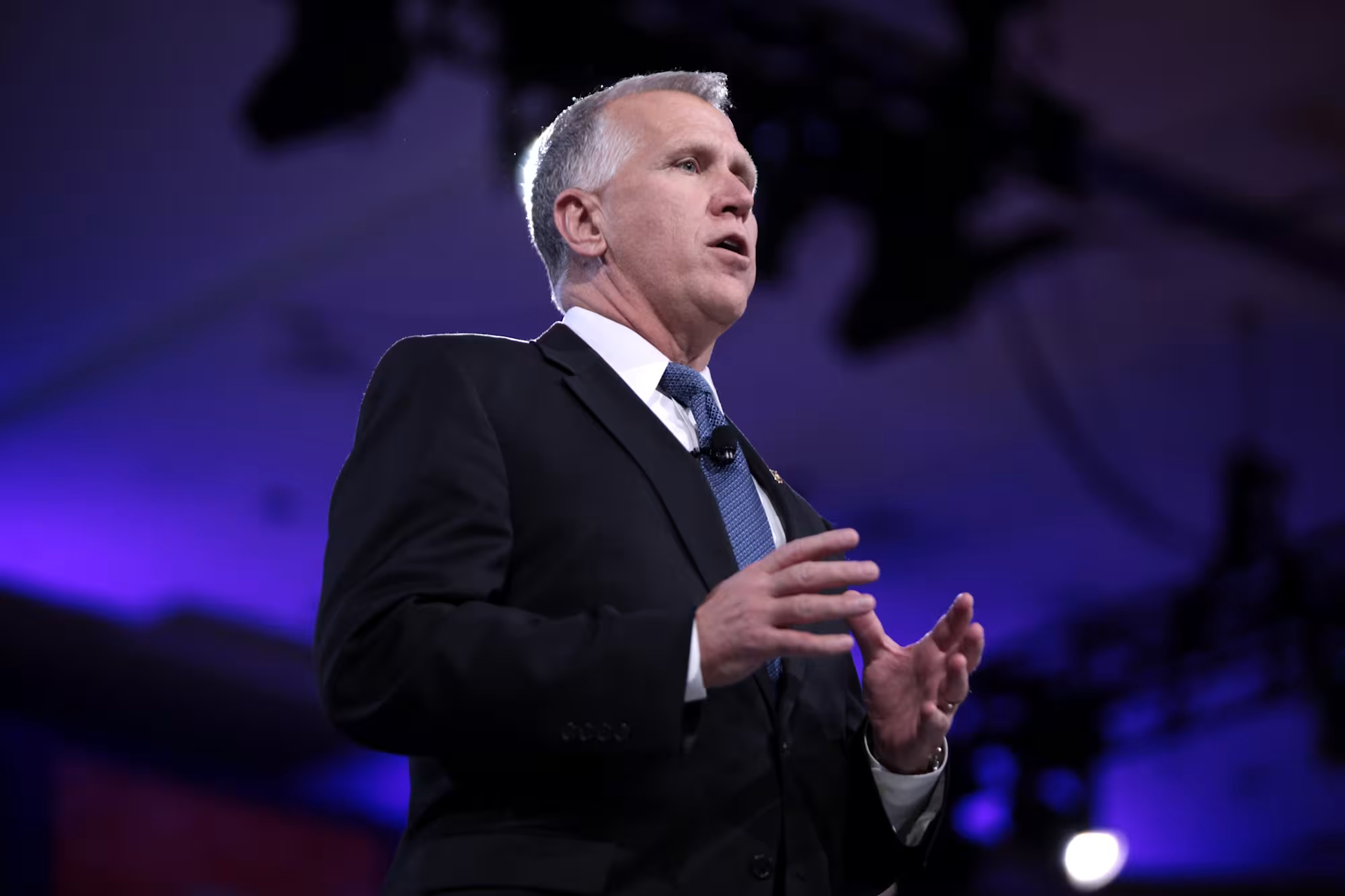
U.S. Senator Thom Tillis is a key negotiating representative on the Senate Banking Committee
The Importance of Passing the CLARITY Act Before the Midterm Elections
The CLARITY Act provides an important and lasting legislative foundation for the digital asset industry: categorizing different types of digital assets and their regulation; clarifying the jurisdiction of market regulators; protecting non-custodial developers; providing the Treasury Department with new powers to combat illegal finance; and more.
The bill provides the necessary legal and regulatory certainty to continue advancing the integration of the cryptocurrency market with traditional capital markets, creating the conditions for modernizing U.S. capital markets, and for the first time offers clear and substantive safeguards, information disclosure, and investor protection. It addresses many of the outstanding issues that previously hindered institutional capital and infrastructure from entering the market or prompted it to relocate overseas.
Overall, the CLARITY Act is a strong piece of legislation both technically and politically.
Given the power balance in the House and Senate (with the Republicans holding a slim majority), Galaxy believes it is crucial for the CLARITY Act to be passed and signed into law before the midterm elections in November. Although the bill has strong support from the Democrats (78 Democratic members of the House supported the CLARITY Act in 2025), the power balance in the 120th Congress (which will convene in January 2027) may shift, significantly reducing the likelihood of this legislation passing after November 2026.
If the Democrats hold the majority in both chambers, it would mean new committee chairs, new agenda priorities, and a potentially very different attitude towards cryptocurrency legislation. More specifically, it is highly unlikely that the current version of the CLARITY Act would pass out of a future Senate Banking Committee chaired by current senior members Elizabeth Warren or Sherrod Brown.
Sherrod Brown was the chair of the Senate Banking Committee in the 118th Congress but was defeated by Bernie Moreno in 2024. He is currently running in a special election in Ohio to be held in November against Republican candidate Jon Husted. Jon Husted was appointed by Governor Mike DeWine after JD Vance resigned to become Vice President, and the victor of this election will serve only until 2028, underscoring how unstable the Senate power structure is about to become.
Brown's previous term may give him precedence over Warren in obtaining the chair of the Senate Banking Committee, although this is not clear; historically, both senators have been adversarial towards the priorities of the digital asset industry.
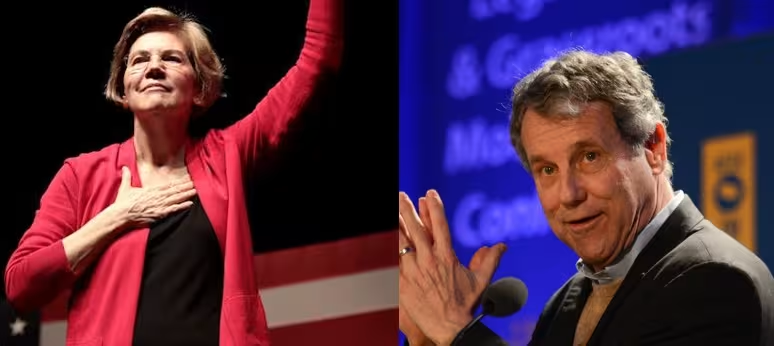
If chaired in the future by Elizabeth Warren or Sherrod Brown, the current version of the CLARITY Act is nearly impossible to pass.
The current bipartisan coalition was formed under specific conditions: a White House supportive of cryptocurrency, a Republican chair of the banking committee, the successful passage of the GENIUS Act (which demonstrated the feasibility of bipartisan cooperation), and the cryptocurrency industry actively lobbying and investing heavily to elect cryptocurrency-friendly members in the 2024 elections, converting previously skeptical members into supporters. These conditions may not persist in the future.
Senator Lummis has publicly warned that if the CLARITY Act does not pass this year, comprehensive market structure legislation may be delayed until 2030 or beyond, as the new Congress would need to restart the legislative process from scratch, and changes in committee composition and potentially divergent political motivations would impact the legislative process.
Even if the Republicans retain their majority, during a lame-duck session (Odaily note: referring to the period after the congressional elections but before the new Congress officially takes office) or in the early months of the new Congress, as leadership’s focus shifts to forming committees, confirming nominees, and establishing a new legislative agenda, the political momentum for complex financial regulation involving multiple stakeholders may also wane. Therefore, the current window of opportunity is extremely favorable and may not reappear soon.
Even without the CLARITY Act, a favorable regulatory environment for cryptocurrency may last only until the end of President Trump's term. Regulators have shown a willingness to advance the cryptocurrency industry through administrative relief, interpretive guidance, and formal rulemaking. These developments have prompted major banks, brokerages, and exchanges to take concrete steps to build blockchain infrastructure and provide digital asset services. The degree of integration achieved by traditional capital market participants in the next two and a half years may be sufficient to prevent significant setbacks in the cryptocurrency industry even if future governments adopt a hostile stance.
However, the key lies in the span of time and endurance. Thus far, the regulatory progress, including joint interpretive announcements from the SEC and CFTC, SEC no-action letters, and OCC guidance on bank cryptocurrency activities, exists outside statutory bounds, meaning future administrations could overturn these measures without Congressional approval.
Even if the CLARITY Act does not pass in 2026, the cryptocurrency industry may not be in crisis, but its time to survive may be shortened. In the long term, a comprehensive market structure bill is crucial for regulating the development of the digital asset industry for decades to come.
Issues in Ongoing Senate Negotiations
While the issue of "stablecoin rewards" has been the focus of major media headlines and is widely regarded as the (possibly sole) major obstacle to advancing the bill, several other key issues are also quietly at play. Here are the main sticking points:
Stablecoin Rewards
We are waiting for Senator Tillis to publicly disclose the compromise text he reached with Maryland Democratic Senator Alsobrooks.
According to Galaxy's understanding, the text still prohibits earning rewards "merely for holding" stablecoins, but allows clearly defined rewards linked to activities such as payments, transfers, or platform usage. If this is the case, it is essentially similar to the agreement Coinbase explicitly rejected in January.
However, we need to see the specific content of the text, but senators have remained tight-lipped about it. The report released by the White House Council of Economic Advisers (CEA) on April 8 indicated that an absolute ban on yield-generating cryptocurrencies would only increase bank loans by $2.1 billion (accounting for 0.02% of total outstanding loans), while consumer costs would increase by approximately $800 million, significantly weakening the banking industry’s argument about deposit outflows.
The American Bankers Association almost immediately rebuffed this, arguing that the CEA analysis was flawed itself as it only examined the impact on the current stablecoin market of approximately $300 billion, without simulating scenarios where yield-generating stablecoins could grow to a level sufficient to substantively compete with banks' $18 trillion deposit base. Significant differences in the framing of both arguments likely determine the final outcome.
Coinbase's CEO changed the company’s opposition to the bill on April 10, seemingly clearing what was once the largest hurdle facing the industry. The content of the bill's text may not have changed substantially from the version Coinbase rejected in January, but the political considerations have shifted: Secretary Bessent's public pressure, the CEA's report, and Coinbase's ongoing application for a national banking charter (which the company may face regardless of the bill's outcome) may have influenced Coinbase's change in attitude.
However, potential commercial tensions between exchanges and banks over stablecoin yields remain.
Blockchain Regulatory Certainty Act (BRCA)
The BRCA, as section 604 of the Senate Banking Committee's annual notification (ANS), clearly states that software developers and infrastructure providers that do not hold or control users' funds are not money transmission entities as defined by the Bank Secrecy Act.
The cryptocurrency industry sees this provision as a red line, believing it is crucial for ensuring that open source development remains within the U.S. This provision has faced opposition from law enforcement and is strongly opposed by both parties in the Senate Judiciary Committee. In January of this year, Judiciary Committee Chair Chuck Grassley (Republican, Iowa) and Chief Member Dick Durbin (Democrat, Illinois) jointly wrote to Senate Judiciary Committee Chair Scott and Chief Member Warren, opposing the inclusion of the BRCA in federal law.
They argued that the Banking Committee unilaterally modified Title 18 of the U.S. Code (specifically 18 U.S.C. § 1960, which prohibits unlicensed money transmission) without consulting the committee responsible for federal criminal law. They warned that this provision would create “blind spots” for state and local law enforcement agencies that rely on Financial Crimes Enforcement Network (FinCEN) registered information to trace the flow of funds when investigating potential money laundering, terrorism financing, as well as drug and human trafficking activities.
Additionally, former Nevada Attorney General and Banking Committee member Catherine Cortez Masto (Democrat, Nevada) has been pushing for amendments to address law enforcement's concerns. The National Sheriffs’ Association and the National District Attorneys Association have also voiced concerns, warning that provisions regarding decentralized finance (DeFi) in the Act may restrict prosecutors' ability to pursue financial crime cases.
The cryptocurrency industry counters that the BRCA does not amend the anti-money laundering laws stipulated in 18 U.S.C. §§ 1956 and 1957; does not limit prosecutions for fraud or sanctions evasion; only aligns FinCEN's guidance and the recent positions clarified by the Justice Department, stating that truly decentralized, non-custodial software does not constitute the transfer of funds.
Finding a way to meet the demands of Chuck Grassley and Catherine Cortez Masto without significantly weakening this provision is one of the trickiest negotiations in the bill.
Ethics Amendment
Democrats have been striving to include a clause in the bill that prohibits senior government officials, elected officials and their family members from holding or profiting from crypto assets during their tenures. This issue directly targets the various cryptocurrency projects involving the Trump family and has remained a priority for Democrats throughout the negotiation process.
This issue was not included in the Senate Banking Committee's annual resolution draft in January, but several Democratic senators have indicated they will push for the passage of the ethics amendment during the committee's review or in the full Senate. While this is unlikely to become a barrier to committee review, it may become a focal point in the floor debate since any senator can propose an amendment, and a Democratic majority is needed to reach the 60 votes.
SEC Waivers
The annual resolution draft of the Senate Banking Committee, section 505, pertains to the tokenization of securities and other real-world assets. Some market participants and former regulators believe this provision overly restricts the SEC's ability to utilize its waiver and no-action relief tools to foster innovation in the digital asset market.
In short, many are concerned that this provision would render the SEC's "Innovation Waiver" program unimplementable, and potentially even illegal, as it would impose rigid statutory requirements that limit the discretion the Commission has long enjoyed under laws such as Section 28 of the Securities Act and Section 36 of the Exchange Act.
Lawyers and compliance professionals involved in tokenization projects, as well as some Democrats, have expressed this concern, arguing that the provision overcorrects the SEC’s currently progressive stance towards cryptocurrencies. (Under Chairman Atkins, the SEC has actively leveraged no-action waivers and staff guidance to promote digital asset activities, whereas section 505 may restrict the flexibility the commission is currently exercising.)
SEC Quorum
The SEC currently has five commissioners, three of whom are appointed by Republicans: Chairman Paul Atkins, Commissioner Hester Peirce, and Mark Uyeda. Traditionally, no more than three members of the same political party may sit on the five-member commission, and it is anticipated that two vacant seats will be filled by Democrats.
Senate Minority Leader Chuck Schumer and President Trump failed to reach consensus on the candidate list. Should the CLARITY Act pass, Democrats might view these vacancies as negotiation chips and assurances for their own interests: confirming two Democratic commissioners would restore the bipartisan nature of the commission and give Democrats a voice in rulemaking following the CLARITY Act’s implementation.
Some Senate Democrats have at least informally suggested that progress on SEC nominations could pave the way for the CLARITY Act to pass in the Senate. This is more about political order than the text of the bill itself, but it is crucial for counting votes, as the CLARITY Act requires 60 votes to pass, thus needing strong support from Democrats.
Not all of these issues are seen as barriers or critical factors to the final agreement, but overall, they pose significant risks to the timeline of negotiations. Any one issue could cost days or even weeks of negotiation time, which the Senate cannot afford.
Timeline and Possibilities
There is widespread expectation that the Senate Banking Committee will announce this week its plan to conduct a hearing in the last week of April (next week). However, key committee member Thom Tillis, responsible for negotiating stablecoin rewards, stated on Monday that the committee should wait until May to schedule hearings.
The process of the bill from now until presidential signature includes five steps:
- Review and voting on the bill by the Senate Banking Committee;
- Full Senate passing the bill with 60 votes;
- Reconciling the banking committee's bill with the agriculture committee's version (i.e. the Digital Commodity Intermediary Act passed by committee review on January 29);
- Coordinating the merged Senate bill with the CLARITY Act passed by the House in July 2025;
- Presidential signature on the final bill.
Each step requires time and the legislative schedule is increasingly tight. The text of the bill will be made public shortly before the hearing, and once the hearing time is set, the committee must debate and vote on amendments before moving the bill forward. The full Senate vote requires not only 60 votes to initiate cloture but also needs time for debate and amendment votes, which could take a week or longer.
The Senate's working calendar is limited and competitive from now until the August recess. The Senate session will continue until the end of April, then recess until May 11, reconvene from May 11 to May 22, work for three weeks in June and July, and recess for two weeks around July 4 (the 250th anniversary of American independence), reconvene in the first week of August, and then recess for five weeks from August 10 (August recess).
During this period, the CLARITY Act must compete for floor time with several major issues: ongoing debates on military authorization for Iran, which have already consumed a significant amount of floor time and may escalate unpredictably; the unresolved budget deadlock for the Department of Homeland Security (the only unpassed budget for FY 2026); and a constant stream of judicial and executive nominations.
Senator Bernie Moreno has publicly stated that the bill must be submitted for Senate full consideration before May to avoid being encumbered by midterm election scheduling. Tennessee Republican Senator Bill Hagerty expressed confidence that the bill would pass through the banking committee's review in April and could be submitted for full Senate consideration by the end of the month.
However, Chairman Scott's statements on April 14 indicate that this timeline has been delayed. Chairman Scott currently holds the initiative, and as of the writing of this article, it is already the second to last week of April. With each week's delay, the time windows required for the various steps to ultimately submit the bill to the President for signing shrink. Even so, if the bill can be reviewed in early May, it does not mean it ultimately cannot pass, particularly if the committee votes overwhelmingly in favor, indicating viability for the bill in the full chamber.
Galaxy believes the most likely scenario is that the banking committee will conduct hearings in early or mid-May, followed by attempts for a full Senate vote at some point in May or June. If the review work is delayed until mid-May or later, the chances for passing the bill in 2026 will plummet: the remaining legislative schedule will struggle to accommodate the complete five-step process mentioned above, especially as the time frame tightens. Theoretically, a full vote in July is possible, but given the impending August recess and midterm election season, this would require extraordinary political will and coordination.

Senator Cynthia Lummis warns that if the CLARITY Act does not pass this year, comprehensive market structure legislation may be delayed until 2030 or later.
Therefore, the possibility of the CLARITY Act being signed into law in 2026 is about 50%, or even lower; Polymarket currently rates it at a 50% passing rate. The uncertainty does not stem from any single issue, but from many unresolved issues that must be sequentially addressed under time pressure.
The stablecoin rewards issue is likely to be resolved in the coming weeks, but the BRCA bill, the ethics amendment, SEC waivers, the SEC's quorum politics, DeFi provisions, and the fundamental challenge of securing 60 Senate votes for a novel and complex financial regulatory bill all remain variables. Any one factor could delay the process by days or even weeks, and time is tight, making it unmanageable.
Key imminent points to watch include:
- The release of Tillis' amended stablecoin rewards text, signaling that the Senate Banking Committee is about to conduct its review;
- Chairman Scott announcing the hearing date;
- The outcome of the committee vote and support rates;
- Whether Majority Leader John Thune will schedule floor meetings before the July 4 recess.
If the CLARITY Act passes through the banking committee with favorable bipartisan support, this would be a strong signal that subsequent steps can proceed smoothly. If the bill passes only along party lines or close to party lines, the difficulty of securing 60 votes in the Senate would increase significantly, greatly dimming the bill's prospects of passing in 2026.
免责声明:本文章仅代表作者个人观点,不代表本平台的立场和观点。本文章仅供信息分享,不构成对任何人的任何投资建议。用户与作者之间的任何争议,与本平台无关。如网页中刊载的文章或图片涉及侵权,请提供相关的权利证明和身份证明发送邮件到support@aicoin.com,本平台相关工作人员将会进行核查。


