Written by: RWA Research Institute
In October 2025, at a special press conference held by the National Data Bureau, the construction plans for seven pilot zones were unveiled for the first time, distilled into a list of 158 reform items covering seven major areas including data elements, infrastructure, and industrial innovation. On April 21, 2026, the Shanghai Municipal People's Government published the "Implementation Plan for the National Digital Economy Innovation and Development Pilot Zone (Shanghai)," document number Hufu Ban Fa [2026] No. 5, dated April 13, which condensed the seven pilot directions into 7 major tasks and 30 measures. With this, Shanghai became the third region, following Guangdong and Sichuan, to reveal a "national-level digital economy pilot plan."
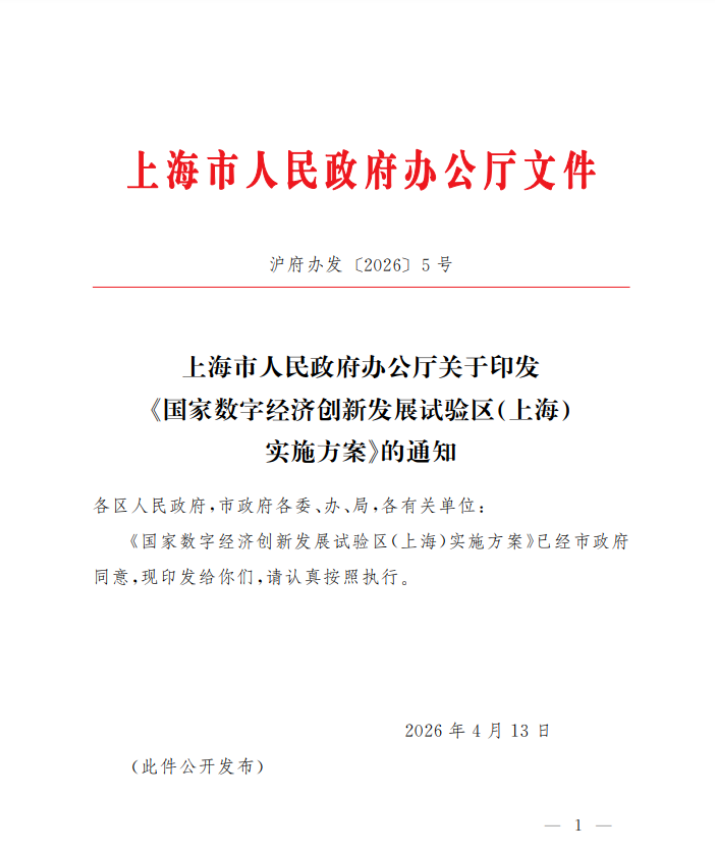
The 158 reform items, allocated to Shanghai, ultimately transformed into these 30 measures.
From 158 to 30, what happened between the press conference last fall and the implementation document this spring? What exactly does this document intend to assess?
I. The Digital Foundation of a City
To understand the weight of this plan, let’s look at a piece of the latest data. According to information released by the Shanghai Municipal Statistics Bureau, in 2025, the total scale of Shanghai's information transmission, software, and information technology service industries reached 1,729.7 billion yuan, with an added value of 713.9 billion yuan, a year-on-year increase of 15.3%, raising its share of the city's GDP to 12.6%, surpassing wholesale and retail to become Shanghai's third-largest industry. Additionally, public data indicates that the industry scale of 394 AI enterprises exceeds 637.0 billion yuan, showing a year-on-year increase of 39.5%.
When the scale of the software and information industry exceeds the wholesale and retail industries in a city founded on trade, the digital economy is no longer the business direction of a single department but the foundational substrate of a city. This "Implementation Plan" is designed to install the operating system for this substrate and define standard interfaces.
The metaphor of this substrate is not merely rhetorical. The plan itself provides a clear answer: data elements are the core, infrastructure is the foundation, and open cooperation defines the boundaries.
The solution to the digital economy is not found in any single technological breakthrough but in the synergistic triangle formed by institutions, infrastructure, and openness.
II. The Transition from "What Is Data" to "How to Allocate Data"
The most striking aspect of the plan is its systematic deployment of foundational data institutions. The seventh item clearly states: implement data property rights systems, formulate specific rules for data property rights allocation tailored for scenarios such as AI development, and provide guidelines for the application of data property rights systems in the judiciary and typical dispute cases in the data field.
This is not a set of principle statements floating in the air. It addresses a fundamental problem that has long plagued the industry: how to define data ownership rights? Who owns the property rights to the massive data scraped and used during AI training? If a copyright dispute arises, what will the court base its judgment on? Shanghai attempts to answer this through a complete chain from property rights rules to judicial linkage and typical cases. This logic seeks to bring the concept of "data property rights," which has been discussed for many years yet remains abstract, into practical reality step by step.
At the same time, the plan also proposes exploring the pricing mechanism for authorized operation of public data resources, promoting reasonable distribution of revenues, and researching to improve the data revenue distribution mechanism. This touches on another even more challenging issue: public data is not ownerless; how are the revenues generated from authorized use priced and distributed? What share does the government take, how much does the operator receive, and should data contributors be compensated? The circulation mechanism and revenue distribution rules for public data, which account for the largest share of societal data resources, remain in the exploratory phase. Shanghai attempts to gradually fill this gap with a complete institutional framework from property definition to pricing formation and then to revenue distribution. Without prior institution, marketization of data elements is empty talk.

For high-quality data set construction, the plan provides a similarly pragmatic route: focus on key industries such as healthcare and high-end manufacturing to create high-quality data sets, explore the establishment of open-source communities for high-quality data sets, and build a comprehensive, hub-like, strategic corpus infrastructure to support the development of large parameters and multi-modal foundational models. The competition for large models has already reached a fever pitch, and Shanghai hopes to provide underlying "nutrients" for AI development through this infrastructural layout of high-quality data sets.
In terms of integrating government, industry, academia, and research, the plan proposes to improve the operation mechanism of data innovation laboratories, conduct supply trials based on different scenarios in finance, healthcare, commerce, transportation, green low-carbon, and urban governance, and create benchmark application scenarios. This path of "from laboratory to pilot to commercialization" dissects the transition of data from static resources to dynamic valuable services into three operable stages. Notably, these scenarios almost cover the core areas of Shanghai's "five centers" construction, making the empowering radius of data elements evidently clear.
Every instance of institutional design faces the impact of new technologies and the interrogation of new scenarios, and each rollout is accompanied by controversy and compromise. But this is not in vain. It is precisely this repetitive trial and error that can truly leverage the mountain of data.
III. The Digital Skeleton from Ground to Sky
Infrastructure is one of the largest components of the plan. It outlines a complete picture that extends from the ground into the sky.
First, there is blockchain. The plan proposes to deeply promote the construction of the national blockchain network (Shanghai hub), strengthen basic capabilities such as distributed digital identity, privacy computing, and cross-chain services; promote the construction of credible data service centers on-chain in customs, taxation, maritime, and foreign exchange management, integrating critical data resources from national ministries. Each keyword here points to a common underlying logic: the prerequisite for data circulation is trust. Distributed digital identity addresses the question of "who you are," privacy computing addresses the issue of "data being usable but not visible," and cross-chain services resolve the problem of "how different systems communicate." Once points like customs, taxation, maritime, and foreign exchange management are successfully connected, it means that trusted data exchange will move from theory to operation.
Secondly, there is computing power. The plan proposes to enhance the core capabilities of Shanghai's computing power monitoring and scheduling platform and the interconnectivity platform for computing power in the Yangtze River Delta (Shanghai), exploring the formation of inter-regional computing resource scheduling mechanisms to promote interconnectivity and on-demand invocation of computing power; simultaneously upgrade and expand intelligent computing infrastructure and deploy high-performance domestically-produced computing clusters. Computing power is no longer simply about "how many servers to buy and how many data centers to build," but rather about how to pool computing resources within a region or even across regions, schedule them flexibly, and allocate them on demand. Particularly, the expression "deploy high-performance domestically-produced computing clusters" points to the autonomy and control over the computing power supply chain.

Thirdly, the boundaries of infrastructure extend into the sky. The plan proposes to accelerate the construction of the "Thousand Sails Satellite Constellation," promote commercial pilot projects for satellite internet businesses, and conduct pilot trials for satellite IoT operations; promote the construction and standardization of comprehensive low-altitude intelligent network systems in Shanghai, and build an IoT perception system for civil unmanned aerial vehicles. The "Thousand Sails Satellite Constellation" is a key low-orbit satellite internet project being pushed in the Songjiang District of Shanghai. The simultaneous inclusion of commercial satellites, low-altitude intelligent networks, and satellite IoT into a single digital economy implementation plan is rare in the country. The signal it conveys is: Shanghai’s understanding of digital infrastructure has expanded from ground facilities like fiber optics, 5G, and data centers to incorporate a three-dimensional network that includes satellites, low altitude, and IoT sensing.
Finally, the exploration of frontier technologies allows for evolutionary space in this skeleton. The plan proposes to accelerate pilot applications and productization of technologies like brain-computer interfaces, sixth-generation mobile communication (6G), and quantum computing; conduct research on the mechanisms for innovation experimental fields of the third generation of the internet (Web 3.0), and orderly carry out technological validation. It is important to note that the wording here is "experimental field mechanism research" and "technical validation," emphasizing the core focus on technology reserves and forward-looking layout rather than explicit signals for commercial promotion. Infrastructure construction is not a one-time project but a sustained evolution towards the future.
By overlaying the trustworthy capabilities of blockchain, the scheduling capabilities of computing power, the coverage capabilities of satellites, and the exploratory capabilities of frontier technologies, Shanghai aims to build a complete system that enables credible data circulation, on-demand invocation of computing power, and integrated networking across land and sky.
IV. The Shanghai Plan for Data Going Overseas
Among the seven pilot zones, Shanghai's plan has the strongest international flavor, driven by its urban positioning.
The plan offers several key levers in the realm of open cooperation. Under the premise of ensuring data security and compliance with the national cross-border movement regulatory framework, it innovates a "negative list + operational guidance" management model for cross-border data and promotes the expansion of the applicable scope of the outbound data negative list to encompass all of Shanghai. It orderly expands pilot projects for the opening of value-added telecommunications services. It supports the Lingang New Area in accelerating the establishment of an international data processing hub, developing new types of international data trade formats such as "data processing," initiating the construction of an international data comprehensive service and supervision platform, optimizing the layout of cross-border data infrastructure, and enhancing the convenience of cross-border data for companies going overseas within the region. A digital overseas service platform will be built to create a "single network" for digital overseas services and an overseas digital marketplace.
The term "data processing" is worth noting. It is not the traditional sense of manufacturing "processing of incoming materials," but refers to the cleansing, labeling, processing, and analysis of overseas data in Shanghai to form data products and services for re-export. In the manufacturing era, China's comparative advantage was labor costs; in the digital economy era, this comparative advantage is shifting from labor to data processing capabilities and institutional supply capabilities. With relatively well-developed data infrastructure and an emerging cross-border data compliance system, Shanghai hopes to turn "data processing" into a new business.
The cross-border flow of data is a frontline battlefield in the global competition for digital trade rules and a highly sensitive policy area. Currently, the applicable scope of the negative list, specific operational details, and the compliance boundaries of "data processing" are all in the exploratory and refining phases. Shanghai, using Lingang as a fulcrum, the negative list as a tool, "data processing" as the format, and the digital overseas service platform as a channel, presents a clear strategic intent: to secure the baseline of data safety while simultaneously opening up avenues for data circulation. Openness has never been a multiple-choice question; it is an imperative for the city of Shanghai.
V. From 30 Measures to Every Day
Returning to that list of 158 reform items. It was distilled by the National Data Bureau and covers seven major areas, including the marketization of data elements, infrastructure, and integration of industrial innovation. Each of the seven pilot zones has unfolded around this list, with Guangdong promoting the integration of navigation, guidance, and remote sensing relying on the Greater Bay Area, and Chongqing driving manufacturing upgrades through "four-side coordination," while Shanghai has submitted its answer sheet with 7 major directions and 30 measures.
Thirty measures are not an endpoint but a starting point. The real challenge has never been in how comprehensive the plan is—this document from Shanghai indeed lives up to the term "pilot zone" in its systemic design of institutions, the dimensionality of infrastructure, and the pioneering aspects of open exploration. But every measure on paper needs concrete implementation to give it substance.
The goal stated in the plan is "to strive by 2028," which is only about two years away. Two years is not long in terms of a city's institutional innovation cycle. The formulation of data property rights rules requires the refinement of legislative processes, the pricing formation for authorized operation of public data requires repeated negotiations among various stakeholders, the scheduling mechanism for computing power needs inter-regional and inter-departmental collaboration, and the negative list for cross-border data movement requires continuous iteration through practical application. Each of these cannot be solved by a single document. Moreover, the practical paths and landing effects in different pilot zones naturally differ, and institutional designs in key areas such as property rights and cross-border movement are still in the exploratory stage with their final forms awaiting time for validation.
It is easy to write into a document, but much harder to write into reality.
But someone must take that first step.
About 【RWA Research Institute】
The RWA Research Institute was jointly initiated by several senior financiers, Web3 practitioners, industrial innovators, and technical experts, and was officially launched in Hong Kong on June 25, 2024 (full name: RWA Research Institute, abbreviated as RWARI).
As one of the first professional research institutions for real-world assets (RWA) established internationally, the RWA Research Institute focuses on the field of real-world assets and is committed to promoting the integration of traditional financial assets with blockchain technology. Through in-depth research and practice, the institute provides innovative solutions for investors and enterprises, facilitates the digitization and tokenization of physical assets, and builds a bridge between traditional finance and digital assets.
The core mission of the RWA Research Institute is to combine policy research, standard formulation, and ecosystem co-construction to assist enterprises in achieving asset digital transformation, providing technical support and strategic coordination for global compliance development. In the future, the institute will continue to deepen the integration of digital technology and the real economy, jointly hold global industry summits with international institutions, explore multi-domain application scenarios, and inject new momentum into high-quality global development.
In May 2025, the RWA Research Institute, together with authoritative institutions such as China Search and the China Electronics Digital Scene Technology Research Institute, initiated the establishment of the "China RWA Industry Think Tank," focusing on the global compliance development in the asset digitization field. The think tank empowers the real economy through three core directions: first, leading the compilation of international cooperation norms such as the "RWA Project Evaluation Standards"; second, constructing a digital service chain for "asset on-chain to cross-border circulation to global trading," integrating blockchain and artificial intelligence technologies; third, building cross-border compliance channels centered on Hong Kong and Shenzhen, promoting green finance and cross-border investment and financing innovation. At the same time, the think tank reinforces technical autonomy and data security relying on the "dual-chain integration framework" (national-level alliance chain and cross-chain protocol collaborative mechanism), deepening cross-border collaboration and compliance governance.
免责声明:本文章仅代表作者个人观点,不代表本平台的立场和观点。本文章仅供信息分享,不构成对任何人的任何投资建议。用户与作者之间的任何争议,与本平台无关。如网页中刊载的文章或图片涉及侵权,请提供相关的权利证明和身份证明发送邮件到support@aicoin.com,本平台相关工作人员将会进行核查。


