Written by: Glendon, Techub News
While most L2s are still sharing the same set of technical frameworks, Base has taken its first independent step. In the early hours of today, Base announced that its first independent network upgrade, Azul, has gone live on the test net, with the goal of activating the main net on May 13. Behind this announcement is the most significant technological leap for Base since its main net launch in 2023. Azul is not only the first network-level upgrade for Base that departs from the OP Stack general framework, but it also makes specific and transparent commitments in three dimensions: security, performance, and developer experience. The launch of Base Azul also means that Base is beginning to write its own technical narrative.
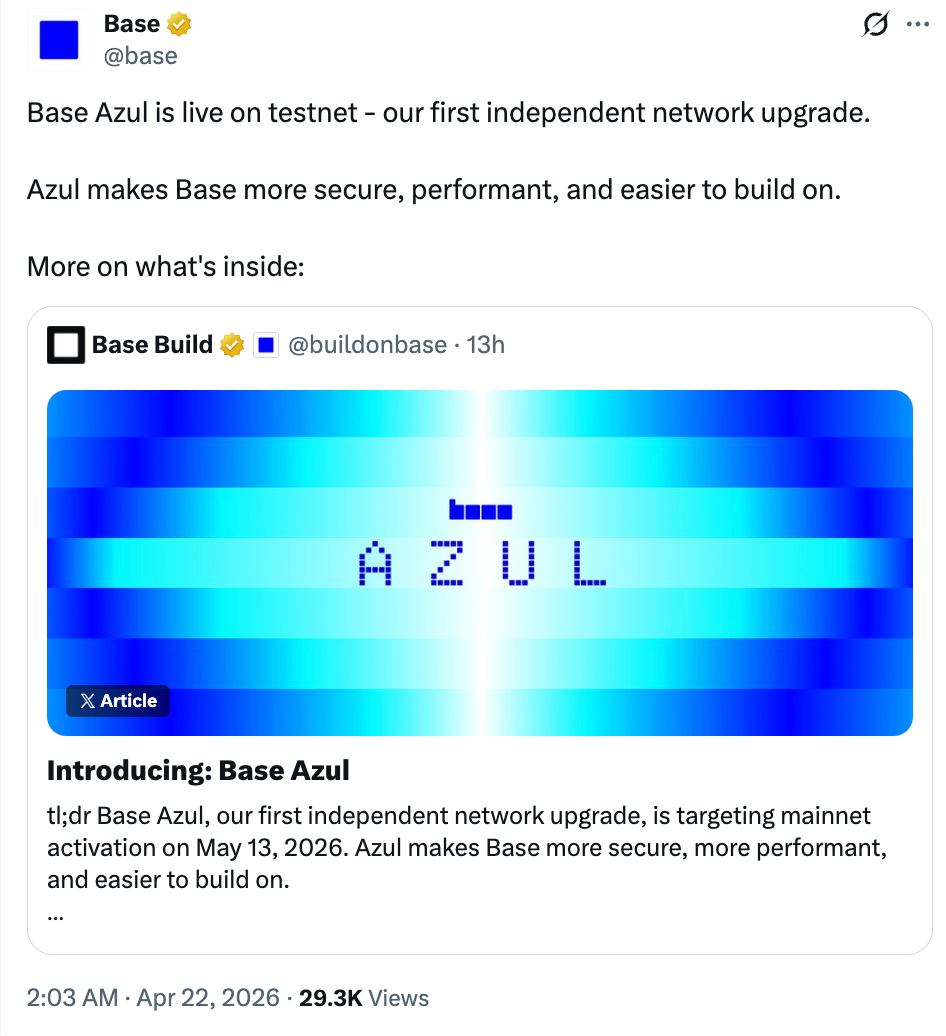
So, why is Base launching Azul? The fundamental reason is to eliminate complex external dependencies and build a brand new unified tech stack.
Base's Independent Technological Declaration
At the underlying technology level, Base has always faced limitations of its initial path. It quickly got started in the form of an OP Stack chain, leveraging external partners like Optimism, Flashbots, and Paradigm to cultivate numerous functionalities such as Flashblocks, achieving "a rapid leap by leveraging others." However, in this process, Base also introduced complex external dependencies, needing to share the common upgrade cycle of the OP Stack like other Layer 2s. In the long term, relying on external technology roadmaps also means ceding autonomy.
Therefore, as the network continues to upgrade, integration and simplification became the inevitable direction for Base's development. To eliminate external dependencies, simplify protocols, and accelerate delivery speed, Base must build a unified platform that integrates all dependencies and future innovative functions, achieving end-to-end autonomy over its tech stack, thereby more efficiently advancing its long-term goal of "guiding the next billion users into the on-chain economy."
The most prominent label of Azul is "the first independent network upgrade," which is a critical step for Base to shed external technological constraints and master its own pace of iteration. Moreover, the value of an independent stack is not just an empty slogan; it has already been reflected in the actual data from the past two months:
- Increased builder reliability: the number of empty blocks dropped from about 200 per day to about 2, a decrease of up to 99%.
- Increased on-chain throughput: withstand multiple bursts of 5000 TPS.
- Accelerated release speed: client release cycle shortened to once every two weeks, while new features were added and validator performance improved.
Behind these numbers is Base's engineering team's complete control over consensus clients and execution clients. No longer constrained by the general upgrade rhythm of the OP Stack, Base can perform targeted optimizations based on its own ecosystem (for example, the actual trading patterns of Coinbase users). For L2s, the ultimate goal of independence is not to stand out, but to gain end-to-end control and ecological autonomy, thus establishing its own iterative rhythm in the fiercely competitive Rollup track.
Multiple Proof Mechanisms and Performance Acceleration
In the official announcement, Base reiterated that security is its highest priority. The core change in this area for Azul is the activation of multiple proof mechanisms. Combining TEE (Trusted Execution Environment) proofs with ZK (Zero Knowledge) proofs into one system: either proof type can independently finalize a proposal, but when both agree, the final confirmation time for withdrawals can be shortened to as little as one day.
This design directly points to the key technical conditions for the decentralization of Rollup Stage 2, where the system can detect and address vulnerabilities in the proof system on-chain. If attackers want to achieve rapid withdrawals, they must simultaneously breach multiple independent proof systems rather than a single one. This "defense in depth" concept draws inspiration from Vitalik's L2 finality roadmap.
It is important to emphasize that multiple proofs are not the endgame for Base. The announcement describes it as "a stepping stone towards complete ZK proof + near-instant withdrawal finality." In the future, Base will also introduce more ZKVMs, invest in real-time proof performance, and gradually shorten finality time as technology matures. For average users, withdrawals from Base to the Ethereum main net will become faster as the multiple proof system matures.
On the performance side, the core strategy of Azul is the complete unification of the client stack: base-reth-node becomes the only execution client. Reth is one of the highest-performing clients in the Ethereum ecosystem, providing ample space for Base's scalability. Base-consensus is a new consensus client based on Kona. Apart from these two, Azul has abandoned support for all other consensus and execution clients.
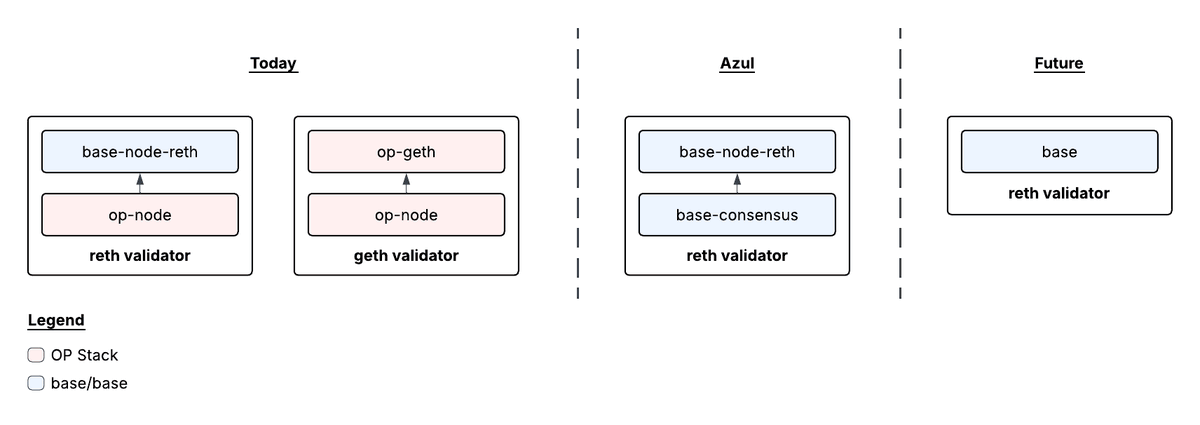
The goal of this strategy is very clear: accelerate the achievement of 1 Gigagas/s trading capacity. The unified client eliminates compatibility friction between multiple clients, allowing the engineering team to focus on optimizing execution paths. It should be noted that from a traditional decentralized perspective, Azul's move somewhat sacrifices client diversity. However, for Base, which is still in its growth phase, the priorities of performance and maintainability have clearly taken precedence.
In terms of developer experience, Azul continues to maintain close alignment with the Ethereum main net by adopting Ethereum's latest execution layer specification, Osaka. The main changes listed in the announcement involve MODEXP precompilation, super-large transactions, and Flashblocks WebSocket. For the vast majority of developers, most applications can continue to run without any modifications. This "compatibility-first" strategy greatly reduces the cost for developers to migrate from Ethereum to Base. Toolchains, debuggers, and indexing services on the Ethereum main net can work almost seamlessly on Base.
Additionally, Base will launch a public development network, Base Vibenet, for developers in mid-May, allowing developers to test upcoming features in a main net environment and provide feedback beforehand. Clearly, for Base, winning the long-term favor of developers has a more significant moat effect than simply reducing gas fees.
For average users, this upgrade requires no action. The complexity of the underlying protocol is encapsulated at the technical layer; users only need to transfer, interact, and use applications as usual. Meanwhile, Base has also announced preliminary plans for the next two upgrades:
- By the end of June (performance upgrade): built-in token standards, Flashblock access list, Glamsterdam EIPs, single client binary file, and further shortening of withdrawal times.
- By the end of August (user experience upgrade): focusing on native account abstraction.
It is worth mentioning that the impact of the Azul independent upgrade is far beyond Base itself and will also have multiple effects on the L2 competition. On one hand, it breaks the homogeneity of the OP Stack ecosystem, proving that member chains can move away from the generic suite to achieve autonomous customization, thus encouraging other L2s to shift from "packaged" solutions to independent innovation, motivating each chain to replace core components for underlying optimization. On the other hand, after independent upgrading, Base no longer relies on the OP Stack ecosystem for its technology direction. While Base's optimizations may feed back into that ecosystem, its independent success could also weaken Optimism's control over the Superchain ecosystem. In the future, more similar cases may emerge, and OP Stack may evolve from an operating system into a bootstrapping tool.
In summary, the intensified competition ultimately benefits end users. Base's independent upgrade forces other L2s to accelerate their iteration speed, enhance security and performance, and lower the barriers for developers. For developers, this means more choices, better toolchains, and lower multi-chain adaptation costs; for users, cross-chain experiences, withdrawal speed, and transaction fees will continue to improve.
Conclusion
The independent upgrade of Azul is the first milestone on Base's path to technological autonomy; it is a starting point rather than an endpoint. For the L2 ecosystem, true competition will return to who can iterate faster, more securely, and more independently. After the main net activation on May 13, whether Azul can fulfill its commitments to security and performance will be the first test for the market to assess the quality of Base's technology.
免责声明:本文章仅代表作者个人观点,不代表本平台的立场和观点。本文章仅供信息分享,不构成对任何人的任何投资建议。用户与作者之间的任何争议,与本平台无关。如网页中刊载的文章或图片涉及侵权,请提供相关的权利证明和身份证明发送邮件到support@aicoin.com,本平台相关工作人员将会进行核查。


