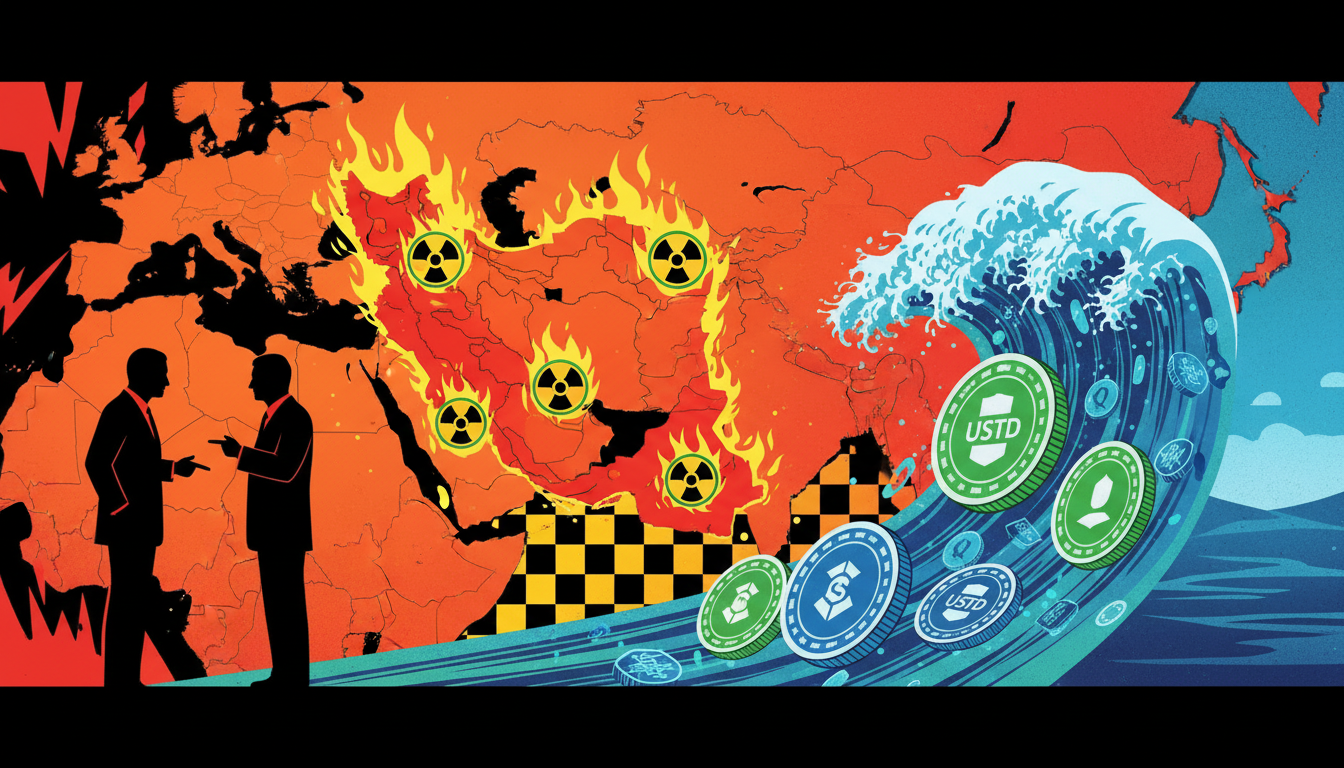
On April 18, 2026 (East 8 Time), technology, geopolitics, and local policies were overlaying in the same time window: on one side was the TRON integrated MCP cross-chain protocol, continuing to advance its multi-chain layout; on the other side was Trump's statement on Air Force One regarding the Strait of Hormuz, releasing signals of energy and geopolitical risks; at the same time, the Tokyo Metropolitan Government announced subsidies to support on-chain settlement projects priced in yen. These three seemingly independent clues, in conjunction with massive financing for AI+Web3 infrastructure like Cursor and over 1.99 million USDC five-times leveraged long positions on HyperLiquid, interweave into a dislocated resonance: funds are seeking more efficient liquidity paths on-chain, gamifying inflation expectations amid macro and geopolitical noise, and testing new scenarios in front of local compliance dividends. The following text will weave together multiple narratives of liquidity migration, amplified sentiment, and risk pricing, starting from the interplay of technology, policies, and geopolitical risks.
TRON Overlaying MCP: The Scale and Cost of Multi-Chain Liquidity
The integration of MCP by TRON is not a sudden isolated action, but a continuation of its cross-chain strategy since 2025. Previously, TRON had connected with cross-chain protocols such as Wormhole and gradually expanded itself from a single public chain to a multi-chain asset center by bridging mainstream assets on networks like Ethereum, attempting to improve its composability and capital utilization in DeFi and payment scenarios. Therefore, MCP is more like another puzzle piece along this route rather than a strategic pivot.
After the integration of MCP, it can be reasonably assumed that the cross-chain depth and path complexity of assets on TRON will significantly increase: more assets and routes will be included in a unified bridging network, theoretically shortening the jump path from Ethereum to TRON, and then to other chains, compressing slippage and time costs, while also freeing up space for cross-chain arbitrage and high-frequency market making. For cross-chain market makers, multi-protocol overlay means capturing price differences between more pools, but for ordinary users, the risks and costs hidden behind cross-chain paths are becoming increasingly difficult to intuitively judge.
Once multi-chain liquidity is amplified, the distribution and fee structure of funds between mainstream public chains like Ethereum and TRON will also be reshaped: when TRON undertakes assets that overflow from Ethereum with lower transaction costs and faster confirmation times, the interest rate systems of on-chain lending and DEX could diverge. The yield curves of the same asset on different chains will no longer be determined by a single ecology, but will be shaped by cross-chain bridge capacity, bridging costs, and counterparty depth, making "which chain holds which asset" a liquidity management issue rather than a simple ecological preference.
However, the flip side of finely-tuned liquidity allocation is the simultaneous amplification of system complexity and risk. Each newly added cross-chain channel introduces a set of smart contracts, oracle, and governance risk points, widening the avenues available to attackers. The "multi-layer bridging" formed by the overlay of MCP and existing protocols implies that a single audit oversight or permission misconfiguration may cascade and amplify between multiple chains, triggering liquidity runs and asset devaluation across ecosystems. Under the structure where cross-chain protocols stack and call each other, a single point of failure is no longer just a risk of a particular bridge, but may evolve into a systemic fragility of the entire multi-chain liquidity network.
Hormuz Will Not Charge Fees: The Cooling and Repricing of Energy Narrative
Similarly, on April 18, geopolitical narratives threw another clue to the market. US President Trump stated on Air Force One that it is "absolutely impossible to charge transit fees" for the Strait of Hormuz, while also mentioning that "the progress related to Iran in the Middle East seems to be going very smoothly." This combination of statements negates the idea of charging additional fees for transiting vessels and releases a political signal of positive negotiation atmosphere with Iran, cooling previous market concerns about potential friction, escalating sanctions, and rising transportation costs for the crucial chokepoint.
The Strait of Hormuz is one of the world's most critical chokepoints for crude oil and LNG transportation; for a long time, any news about its blockade, harassment, or charging fees is quickly translated by the market into changes in energy costs and inflation expectations. If transit through the strait remains stable and without additional fees, shipping insurance and transportation premiums will find it harder to rise systematically, partly alleviating upward pressure on oil and gas prices, which in turn would weaken extreme expectations of "high inflation persisting for a long time," dragging down the asset premiums that rely entirely on inflation-hedging narratives.
In the crypto field, energy-related assets and inflation hedging narratives are deeply intertwined: one type anchors directly to energy costs or outputs, while the other is packaged as "digital gold" or "fiat currency depreciation hedging tools." When the risks and price shocks of Hormuz transit are temporarily suppressed by political statements, market wagers on extreme inflation scenarios will naturally cool down, and funds may partially shift from assets centered around inflation to sectors with more intrinsic logic, such as technological growth and application expansion, lowering the volume of inflation narratives.
In this process, it is necessary to purposely avoid speculation at the level of military deployment or concrete actions, focusing solely on how the market interprets and prices in this political signal in advance. For traders, Trump's "will not charge tolls" acts more like a temporary stamp on the risks of transportation costs and supply disruptions, while "progress with Iran going smoothly" reduces the marginal expectations of sudden sanctions or conflicts. Prices have already digested these rumors repetitively before the announcement landed, now just adjusting from extreme scenarios to a gentler baseline; geopolitical premiums will not disappear with one statement but will be reallocated in pricing.
Tokyo's Financial Support: A Local Experimental Field of 200 Million Yen
In contrast to the global chokepoint of Hormuz, Tokyo chose a completely different path: building an experimental field for local on-chain settlement projects priced in yen with fiscal subsidies. According to public information, the Tokyo Metropolitan Government plans to support the advancement of related projects with a subsidy ratio of up to two-thirds and a maximum of 40 million yen per project, which is a first at the level of local自治体. Based on this upper limit, the potential total scale of the overall support plan could reach several billion to about 200 million yen, providing "traveler fees" for local enterprises, financial institutions, and development teams.
This local plan forms an intentional division of roles with the digital currency experiment currently being promoted by the Bank of Japan: the central bank's digital currency leans more towards the wholesale level, payment infrastructure and system stability verification, while Tokyo's local on-chain settlement projects focus on retail applications, merchant payments, and specific scenario pilots. The two are not replacements for each other, but complement one another through different experimental goals and governance boundaries—one tests the foundation of the monetary system, while the other tests the commercial viability and user acceptance within a compliance framework.
If we convert the individual project maximum 40 million yen, subsidy ratio 2/3 into typical seed and early financing scales, for local teams, it seems more like a "risk cushion": not enough to fully support a large ecosystem, but sufficient to cover key parts of compliance, auditing, system development, and initial operating costs. For small and medium enterprises and local exchanges, this marginal funding cushion enables them to be bolder in trying on-chain settlement products compliant with regulations, but for already globalized large trading platforms or leading DeFi protocols, this scale is more a signal of "entering Japan's regulatory sandbox," rather than decisive capital injection.
More importantly, how sovereign-led on-chain settlement development finds a balance between compliance, anti-money laundering, and open innovation is worth paying attention to. The subsidy itself indicates that the government is taking sides: funds will flow more towards structures verified by identity, with on-chain transactions being transparent and traceable, thus naturally suppressing schemes focused on privacy enhancement and strong anonymity. At the same time, Tokyo must also balance supervisory goals related to preventing money laundering and capital flight with attracting Web3 innovative enterprises and liquidity. Finding the balance point between KYC/AML requirements and composability at the "interface layer" will determine whether yen-priced on-chain assets can truly integrate into the global DeFi or be locked within a closed local payment system.
AI Plus Web3 Massive Financing: Centralization of Infrastructure Power
At the technology and capital level, news regarding Cursor adds a piece of infrastructure to this chessboard. Research reports indicate that Cursor plans to raise $2 billion, with a pre-money valuation of $50 billion; the source of the information is currently a single source and awaits further validation from more channels. But even assuming this scale as a hypothetical scenario, if the financing is successful, it would directly leap to being one of the highest-valued infrastructure companies in the AI+Web3 sector, wielding significant influence in computing power scheduling, smart contract generation, development tool chains, and even partial protocol governance.
If this high valuation and large financing comes to fruition, it will create a distinct signal effect: in the primary market, LPs and institutions will view it as a "model," reassessing the return expectations and acceptable valuation multiples in the intersectional field of AI+Web3, possibly shifting funds from traditional L1/L2 or purely DeFi protocols to projects with AI narratives and underlying tool and platform capabilities. In the secondary market, sectors related to AI computing power, developer tools, and on-chain data infrastructure will often amplify sentiment due to this news, increasing volatility in the short term.
However, the concentration of capital towards a few infrastructure platforms quietly generates tension with the decentralized ideals of the crypto world. On one hand, these platforms provide unprecedented productivity and usability by stacking computing power, data, and developer ecology through financing, lowering the entry barriers to Web3; on the other hand, controlling the access, tool chains, and part of the governance voting interfaces' power might rapidly centralize in these companies, creating a de facto "infrastructure oligopoly." The decentralization narrative is being redefined at this level: on-chain consensus remains open, but the development and operational pathways are being reconstructed by companies heavily backed by capital.
Leverage Long Positions Come In: Emotional Experiment on HyperLiquid
Apart from the on-chain and macro narratives, leverage has accelerated sentiment in the most direct way. Research reports show that at a certain point, HyperLiquid had approximately 1.99 million USDC in five-times leveraged long positions, with the information also coming from a single source. Such a sizable position is already quite substantial for a single user or a few accounts, and the opening action itself possesses elements of "behavioral signals": the market will naturally question whether this heavily loaded long position is betting on the further diffusion of cross-chain liquidity, betting on the continued easing of local and sovereign policies, or gambling on the retreat of macro risk premiums after the easing situation in Hormuz?
In a narrative-dense time window, high-leverage longs often become actively or passively bound to a particular story. Funds may believe that the TRON overlaying MCP will bring about an increase in on-chain activity and DeFi yield, or look forward to Tokyo's subsidies and infrastructure financing from Cursor elevating the overall valuation center of Web3 in a few months. It may also simply be a bet on the comprehensive environment of "geopolitical temporary easing + no apparent policy tightening," viewing this period as a relatively friendly window for risk assets. But regardless of the underlying motivation, this position's existence on-chain will create a demonstration effect on other traders.
The impact of a single large leveraged position on the market can be discussed along the "sentiment—capital—liquidation" chain:
● On the sentiment level, a sizable long position will be screenshot, spread, and interpreted as "smart money entering," triggering more follow-on capital to increase leverage in the same direction, amplifying market sensitivity to positive narratives.
● On the capital level, more leveraged long positions accumulate close to critical price levels, increasing the order book's unidirectional congestion; if prices move against them, the selling pressure from forced liquidations will quickly release like a spring.
● On the liquidation level, when prices trigger a batch of leveraged positions' margin thresholds, automatic liquidations will further drive prices away, forming short-term "cascade liquidation" risks that magnify what would originally be moderate adjustments into severe volatility.
It should be emphasized that this 1.99 million USDC, five-times leveraged long position is just a case from a single source, and it cannot simply infer the actual holding主体, capital costs, and hedging arrangements, nor can it be roughly extrapolated as a "comprehensive bull market signal." In a phase where narratives and leverage amplify, individual cases are often packaged as trends, while rational traders precisely need to maintain separation in such packaging, seeing its amplifying risks.
Technological Fast Forward and Political Slow Motion: The Variables of Crypto's Next Round of Liquidity
Returning to the time snapshot of April 18: TRON integrated MCP advances multi-chain liquidity, Hormuz-related statements phase-cool geopolitical premiums, Tokyo's subsidy plan sets up a local experimental field for on-chain settlement priced in yen, and Cursor's massive financing plan attempts to complete capital gathering at the AI+Web3 infrastructure level. These events, combined with large leverage positions on HyperLiquid, are not a simple coincidence; they result from technology, politics, and capital each stepping forward simultaneously in the same time window, projecting onto market pricing.
Geopolitics, local policies, and capital impulses are jointly shaping a new round of liquidity structure and asset pricing framework: the pricing of Hormuz risk affects inflation and energy cost expectations, thereby altering the overall exposure of funds to risk assets; the subsidies and experiments of local governments like Tokyo redraw the boundaries of compliant innovation, providing policy anchors for local and regional liquidity infusion; while technological cross-chain integration and AI infrastructure financing reconstruct the paths of fund migration and development cost structures at the bottom level, determining which tracks and asset types "new money" will preferentially flow into within the crypto world.
Looking ahead to the coming months, three threads are worth continuous tracking: one is whether cross-chain security incidents and audit events will expose systemic weaknesses in the aftermath of multi-protocol overlays, validating market concerns about "multi-chain meaning multi-risk"; second, how the gap between political statements and actual actions will re-fluctuate energy and inflation expectations if the situation around Hormuz exhibits volatility; third, the actual pace and scale of Tokyo's subsidy projects—whether to form a replicable template or remain merely symbolic—will directly influence whether other jurisdictions follow similar schemes.
In an environment where narrative din and high leverage temptations coexist, investors need to treat risk hedging and scenario drilling as routine actions rather than post-event remediations. For cross-chain and high-yield protocols, extreme security events must be assumed in advance, with emergency liquidity planning; for geopolitically related and inflation-related sectors, multiple scenario macro hypotheses should be established, rather than betting on a single political commitment lasting indefinitely; whilst seeing the halo of high valuation financing for AI+Web3 and local subsidies, one must also acknowledge that both capital and policies can abruptly tighten with shifts in sentiment. Technology is fast-forwarding, politics is in slow motion; those who can truly survive in this new chess game are often not the ones who bet correctly on a single narrative, but participants who maintain position flexibility and cognitive redundancy amid uncertainty.
Join our community, let’s discuss and become stronger together!
Official Telegram community: https://t.me/aicoincn
AiCoin Chinese Twitter: https://x.com/AiCoinzh
OKX welfare group: https://aicoin.com/link/chat?cid=l61eM4owQ
Binance welfare group: https://aicoin.com/link/chat?cid=ynr7d1P6Z
免责声明:本文章仅代表作者个人观点,不代表本平台的立场和观点。本文章仅供信息分享,不构成对任何人的任何投资建议。用户与作者之间的任何争议,与本平台无关。如网页中刊载的文章或图片涉及侵权,请提供相关的权利证明和身份证明发送邮件到support@aicoin.com,本平台相关工作人员将会进行核查。