Author: Stacy Muur
Translation: Baihua Blockchain
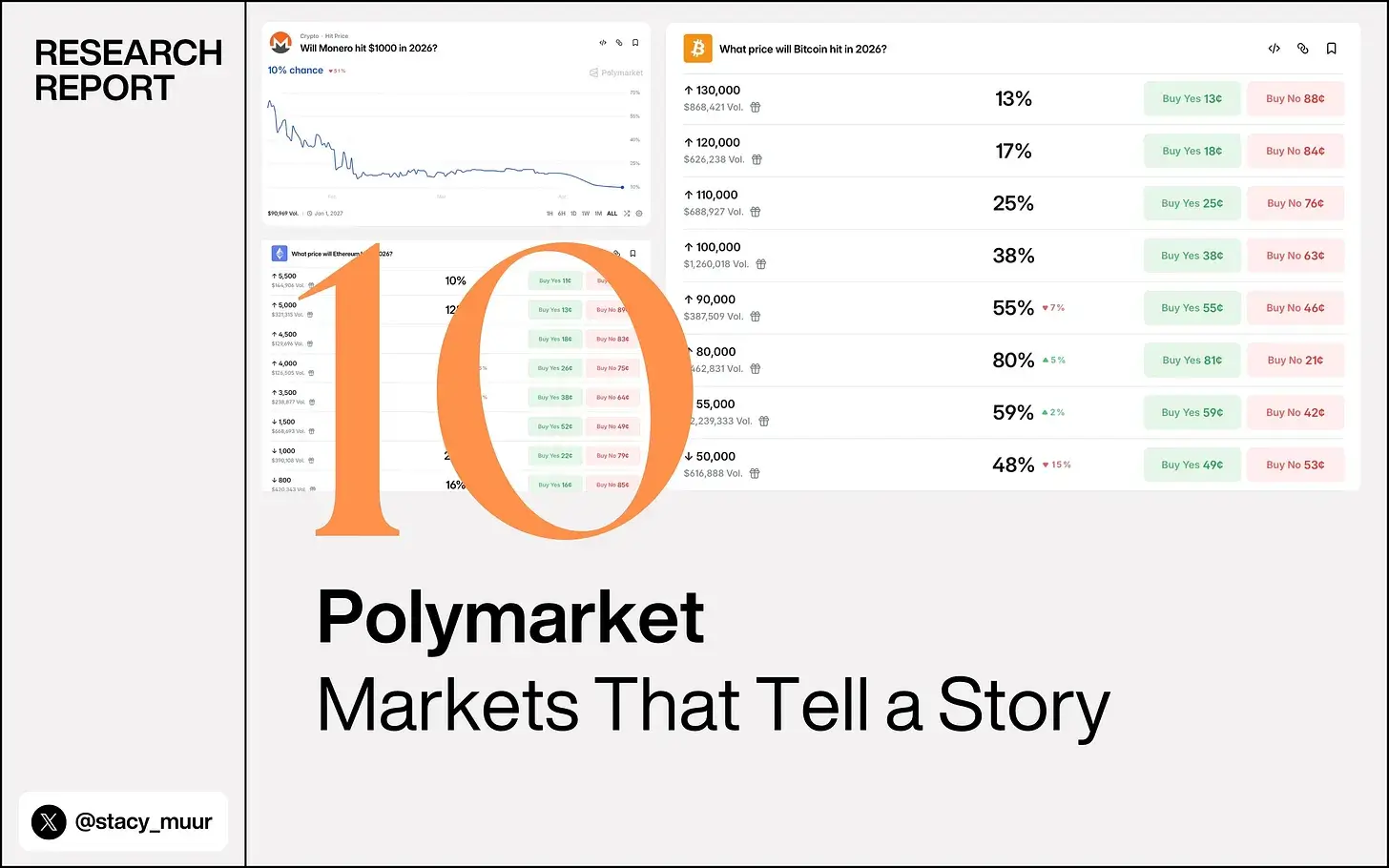
Everyone has their own opinions about the direction of cryptocurrency. But most opinions are free, which is precisely where their value lies.
The way Polymarket operates is different.
You cannot just casually express an opinion: you must bet money. Real money, real odds, and if you're wrong, you bear the consequences in real money. When over $30 million pours into a question like “What will the Bitcoin price be in 2026?”, the collective answer starts to have meaning.
Not because prediction markets are always correct, but because people can lie freely on Twitter but rarely lie with their own money.
This is where Polymarket's value as a sentiment tool lies. It is not in its accuracy, but in its honesty. The gap between the noisy discussions on Crypto Twitter (CT) and what the order books actually show is where the real interest lies.
I have organized the cryptocurrency-related markets on Polymarket and selected 10 that I believe best reflect the current views of real money: covering Bitcoin, altcoins, stablecoins, and macro risks. Some of these markets are highly liquid, while others are thin—both can tell you something.
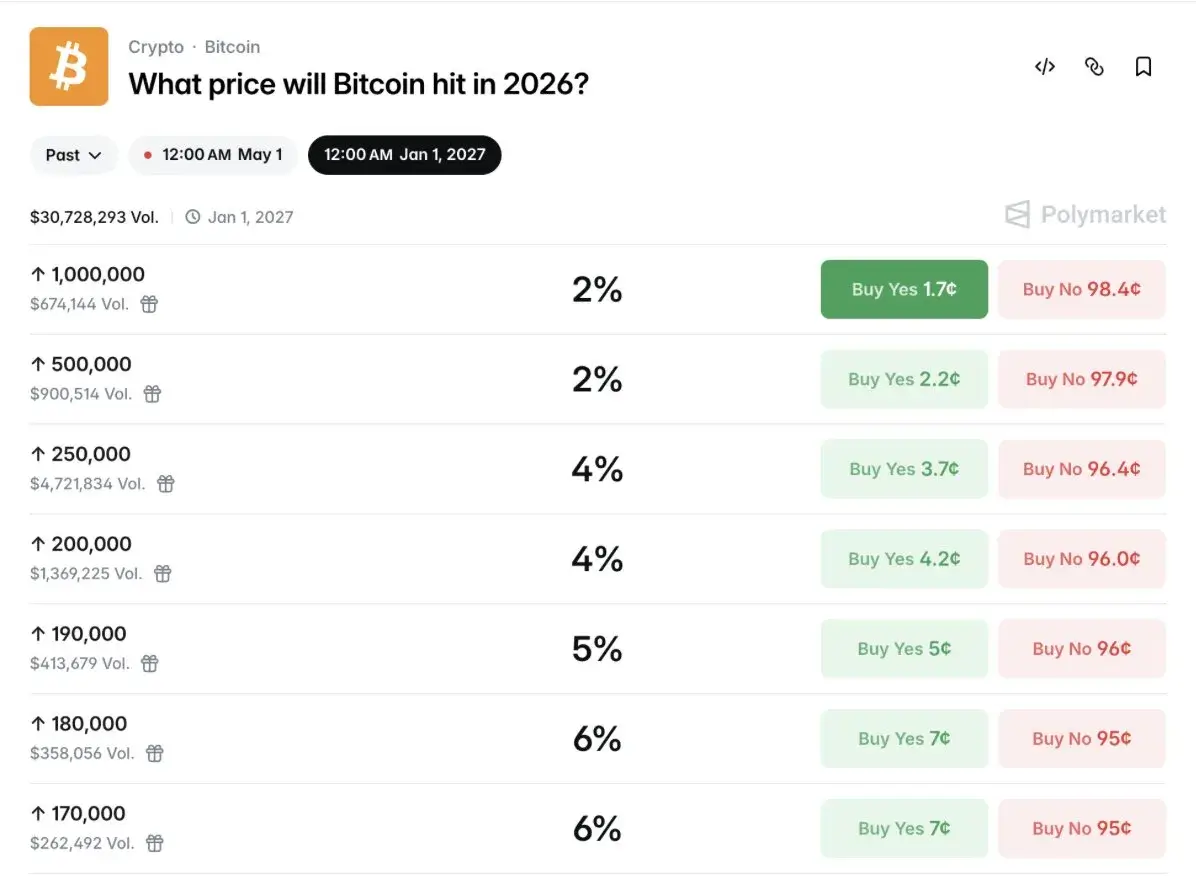
1. What will the Bitcoin price reach in 2026?
Volume: $30.7 million | End time: January 1, 2027 | Liquidity: High
Key probabilities:
↑ $75,000: 100%
↑ $90,000: 100%
↑ $100,000: 35%
↑ $110,000: 24%
↑ $150,000: 10%
↑ $250,000: 4%
↓ $55,000: 68%
↓ $35,000: 25%
A rise to $100,000 is at best a 50-50 chance.
Above $150,000 is basically regarded as noise by the market: the calls on CT for “$200,000 by year-end” have no real money backing.
But here is a part that most people overlook: the market believes there is a 68% chance Bitcoin will drop to $55,000 at some point. The baseline scenario is not “only up, no down,” but rather gradually rising within volatility. A wide range, restrained optimism, not fervor.
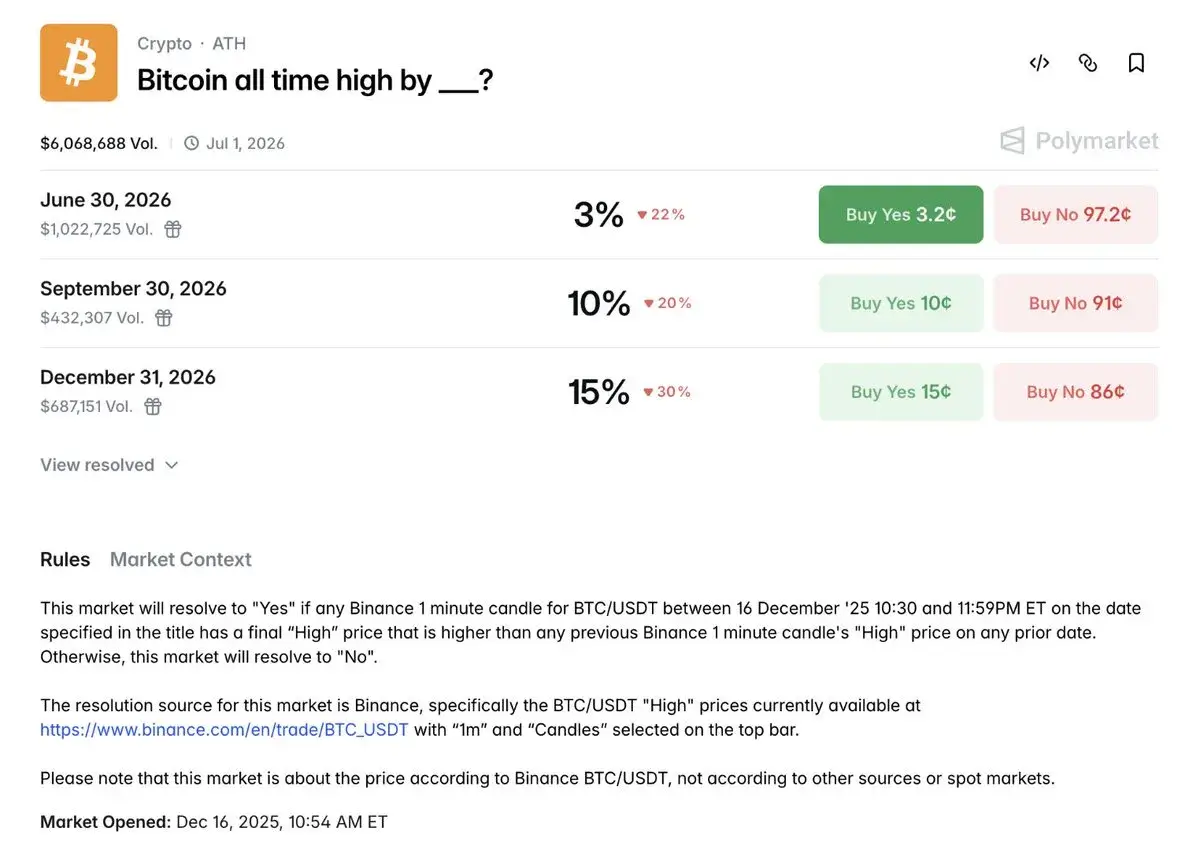
2. When will Bitcoin reach a new all-time high?
Volume: $6.07 million | End time: July 1, 2026 | Liquidity: Medium
Key probabilities:
Before June 30, 2026 — 3%
Before September 30, 2026 — 10%
Before December 31, 2026 — 15%
The probability of Bitcoin reaching a new all-time high by year-end is only 15%. For a market believed to be “just entering a new cycle,” this confidence is astonishingly low.
The recent probabilities are even more telling: only 3% before June. The market believes there are no catalysts that could bring a breakout in the short term. This directly contradicts the narrative dominating CT of “we are in the early stages of a bull market.” This market has $6.07 million in volume, indicating that it’s not just a few people betting — the money means either a new all-time high will wait until 2026 or will not occur at all within this time window.
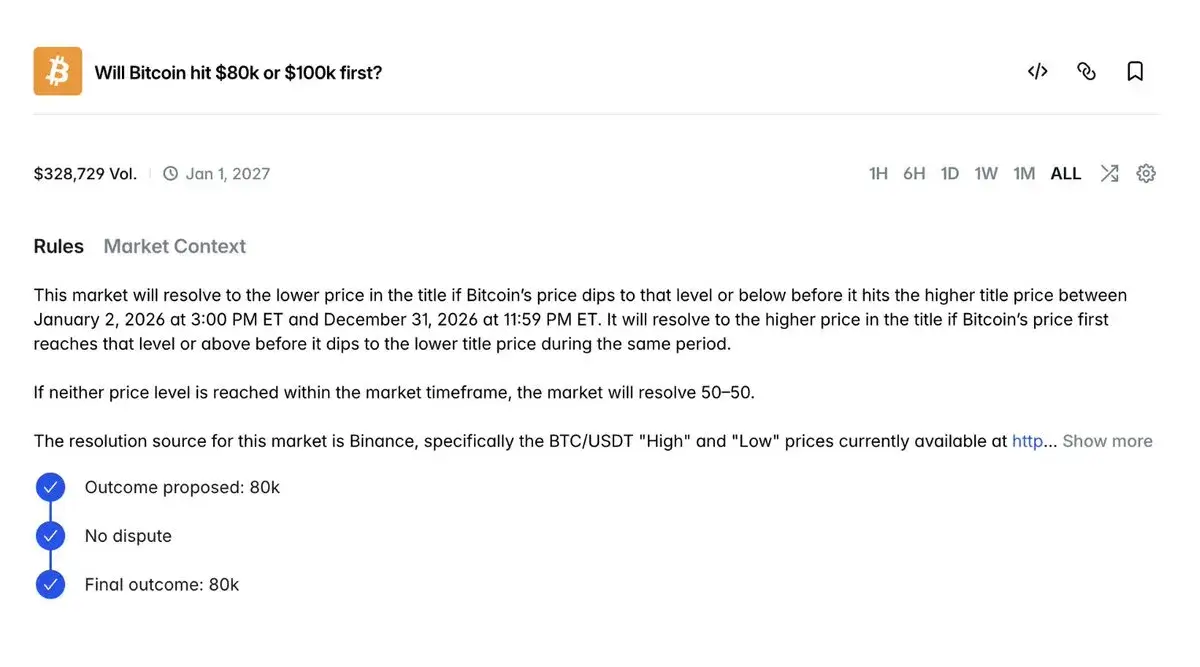
3. Will Bitcoin reach $80,000 first or $100,000 first?
Volume: $328,000 | Status: Revealed | Result: $80,000 (>99%)
This market has been revealed, and the answer is very clear. The market asked a simple question: will Bitcoin drop to $80,000 first or rise to $100,000 first? The result is unequivocal. The probability of reaching $80,000 first is nearly 100%.
Even if the market holds a broadly optimistic view towards Bitcoin’s overall upward trend by 2026, the funds consistently believe that downward movement will occur before upward movement. If you bet on reaching $100,000 first, you are standing against a >99% consensus. This aligns with Market #1 as well: the probability of dropping to $55,000 is 68%. The upward path is never a straight line.
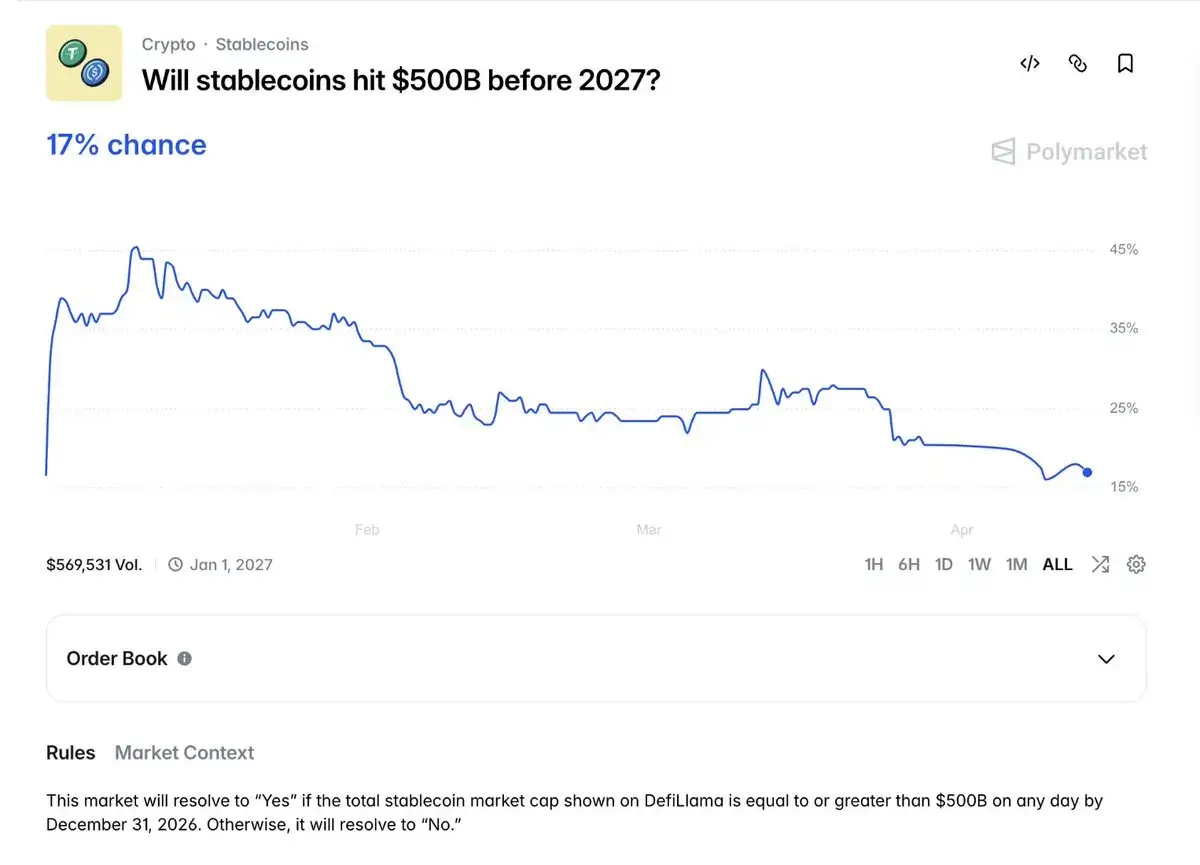
4. Will the total market capitalization of stablecoins reach $50 billion before 2027?
Volume: $569,000 | End time: January 1, 2027 | Liquidity: Low
Key probabilities:
Yes — 17%
No — 83%
The current total market capitalization of stablecoins is about $30 billion. Reaching $50 billion by year-end means almost doubling in less than 9 months.
Everyone talks about the adoption of stablecoins as if it is inevitable — Fidelity launching stablecoins, Western Union entering the market, Polymarket building its own stablecoin. There is indeed growth. But this market’s probability was 45% in January and has since fallen to 17%. People have observed the actual pace of development and subsequently lowered their expectations.
From $30 billion to $50 billion is not just a matter of more adoption. It requires a massive expansion of cryptocurrency trading volume or a wave of new issuances that have yet to materialize.
5. Bitcoin vs Gold vs S&P 500 in 2026
Volume: $738,000 | End time: December 31, 2026 | Liquidity: Medium
Key probabilities:
Gold — 57% (↑32%)
Bitcoin — 30% (↓19%)
S&P 500 — 14% (↓14%)
Gold is far ahead. 57% and still rising. Bitcoin was neck-and-neck with gold at the beginning of the year but has steadily weakened since March. The S&P 500 has basically been knocked out.
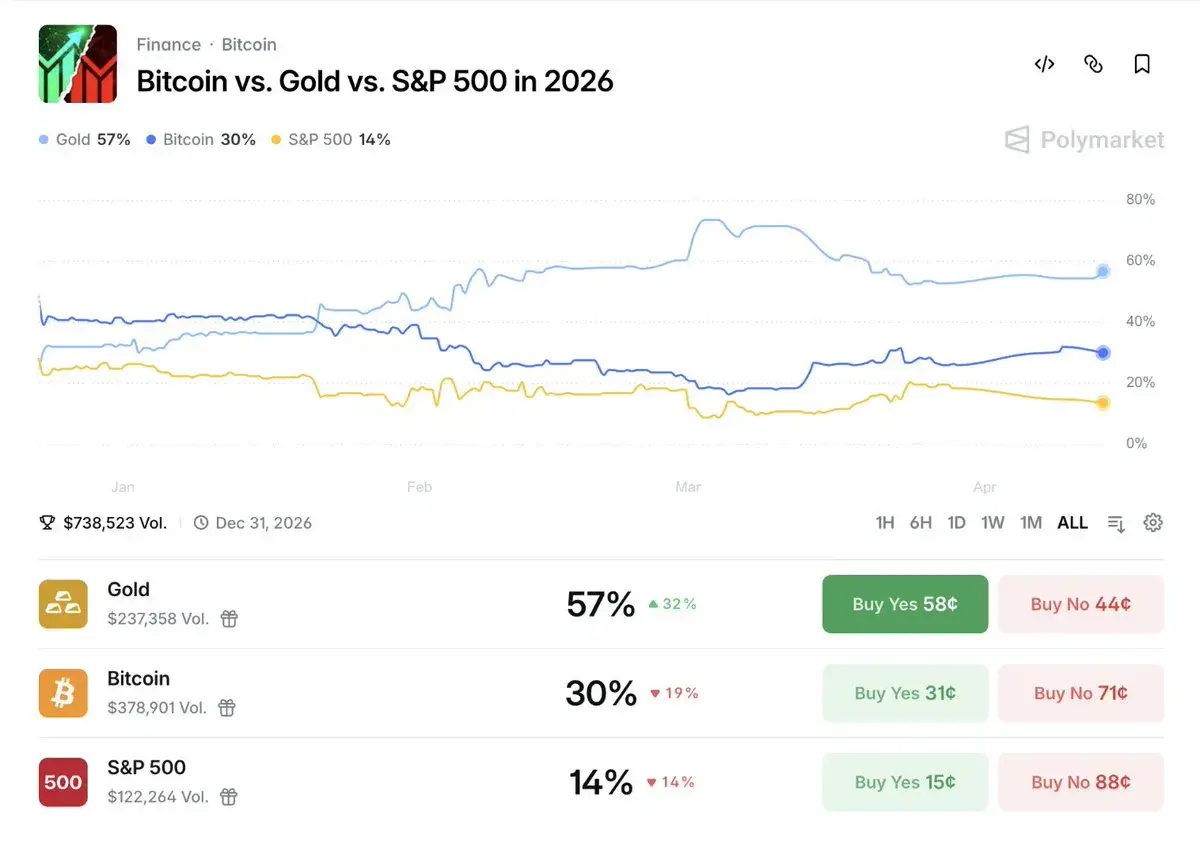
The trend chart of this market is worth a look.
Gold surged to nearly 80% in late February/early March and has maintained its dominance ever since. Bitcoin briefly led in January but was surpassed and has never caught up since.
Those who refer to Bitcoin as “digital gold” should reflect on this outcome. This market, based on real money bets, indicates that physical gold will outperform Bitcoin in 2026. Considering the trade war, geopolitical uncertainty, and central banks buying physical gold, this makes sense. But it is certainly not what anyone on CT wants to hear.
6. Will Monero increase to $1,000 by 2026?
Volume: $90,000 | End time: January 1, 2027 | Liquidity: Thin
Key probabilities:
Yes — 13% (↓48%)
No — 87%
This market began the year with a probability around 70% and then free-fell. Now it is only 13%. The market once briefly believed XMR could really reach $1,000 but then completely changed its view.
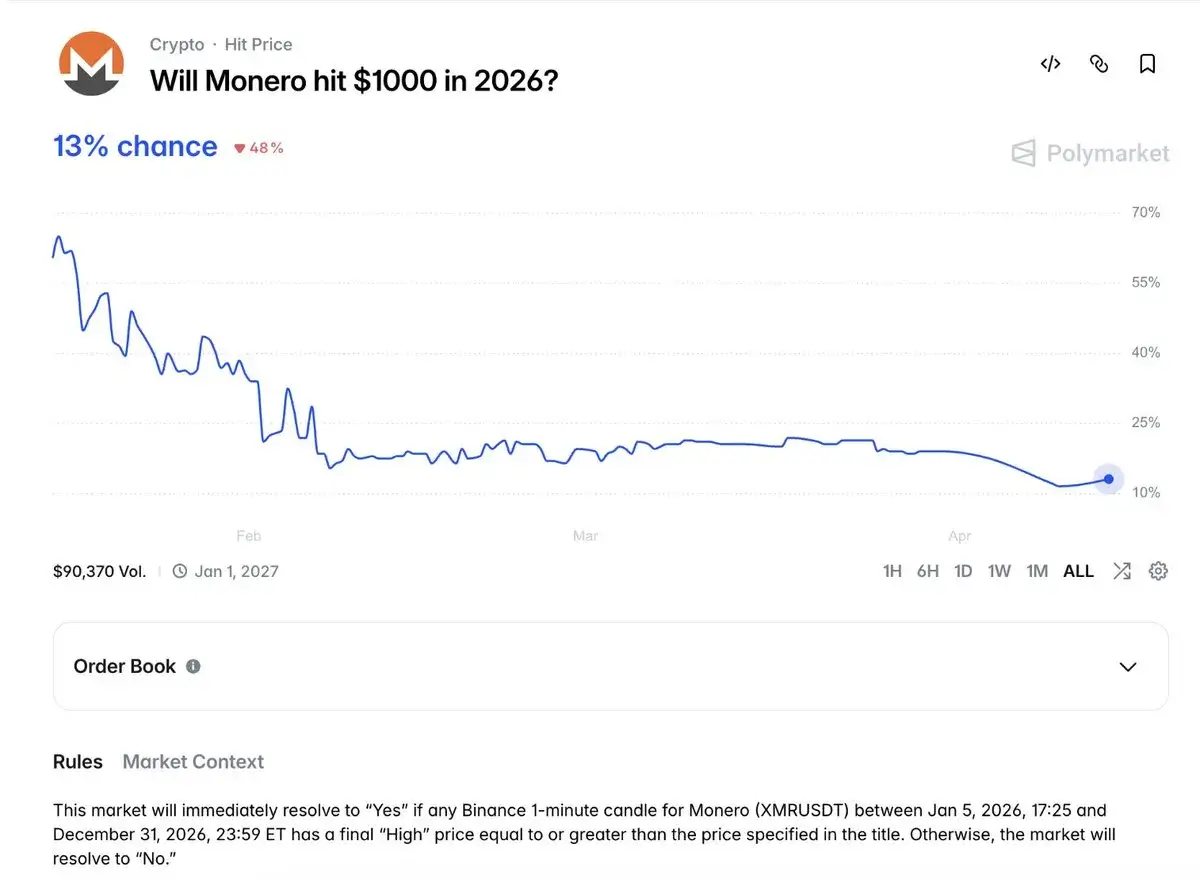
$90,000 in volume is thin, and in such a market, if someone makes an operational mistake or panic-sells, a “bad order” just 10-20 cents lower than the current price might get executed.
But even aside from the trading perspective, the signal is clear. Privacy coins get hyped on CT every few months — “anti-censorship currency,” “regulatory arbitrage,” “Monero is undervalued.” But the money does not agree. 13% and still declining.
7. What will the price of Hyperliquid ($HYPE) be in 2026?
Volume: $712,000 | End time: January 1, 2027 | Liquidity: Medium
Key probabilities (upside):
↑ $46 — 91%
↑ $54 — 61%
↑ $66 — 35%
↑ $80 — 20%
↑ $100 — 15%
Key probabilities (downside):
↓ $20 — 40%
↓ $16 — 27%
↓ $12 — 14%
↓ $8 — 10%
The market is quite confident that HYPE will reach over $50 this year. There is a 91% chance of hitting $46 and a 61% chance of hitting $54. Beyond that, the probabilities drop sharply, with a one-third chance for $66 and only a 15% slim chance for $100.
However, the downside is also interesting. There’s a 40% chance of hitting $20. This is not a low probability. The market sees HYPE as a token that can significantly rise but also has considerable downside risk.
If you have been following Hyperliquid's progress on priority fees and market structure, then this $712,000 in volume indicates that there are indeed people paying serious attention. This isn’t some dead-weight prediction for a junk coin; real money is at stake in two-way pricing.
8. Will Ethereum be overtaken in 2026 (lose the second position)?
Volume: $438,000 | End time: January 1, 2027 | Liquidity: Medium
Key probabilities:
Yes — 51% (↑34%)
Now, this is a 50-50 proposition. A 51% probability believes Ethereum will lose its second position in market cap at some point this year. It may not be overtaken by another L1 but rather by stablecoins or something else.
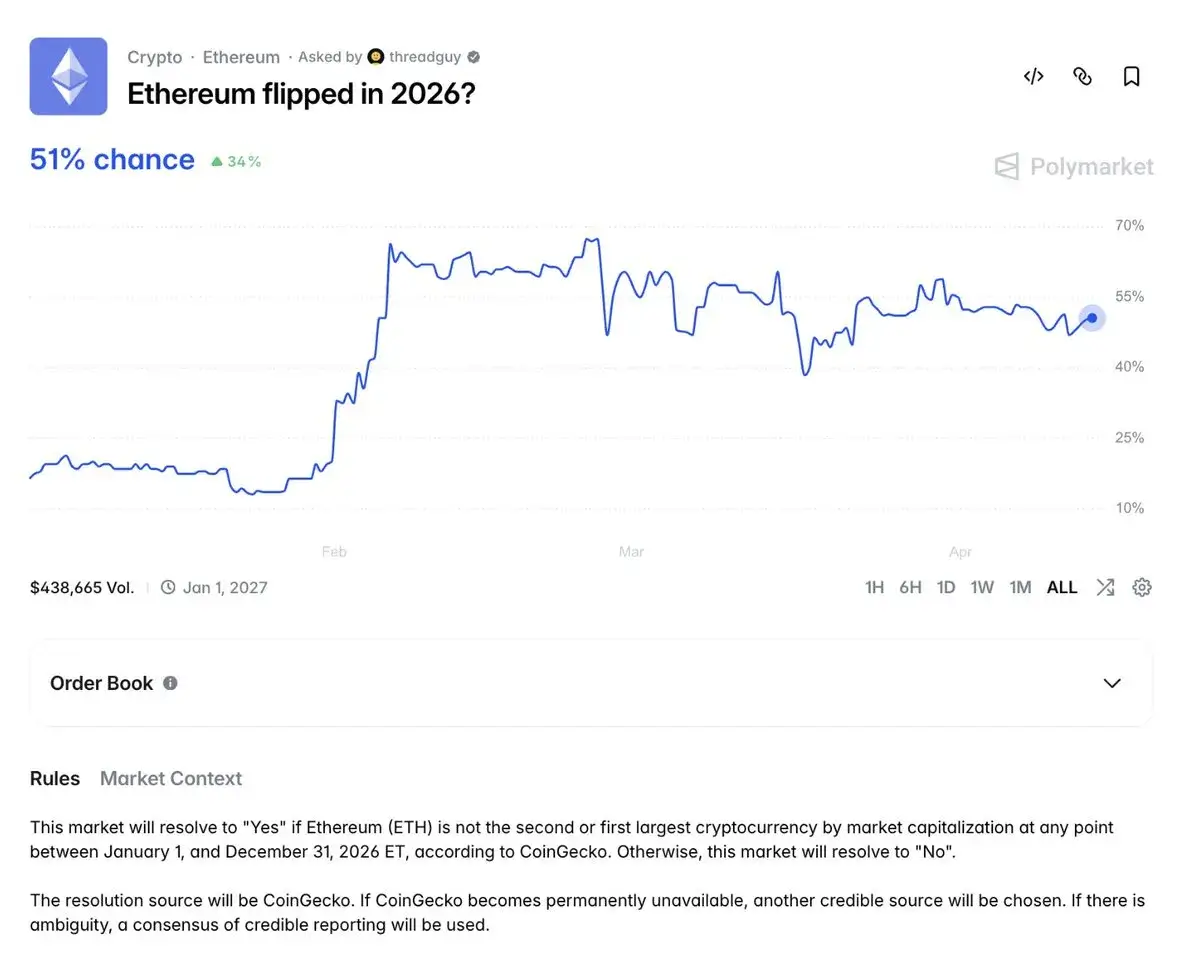
This trend chart is wild. The probability was only about 15% in January, surged to nearly 70% in early February, and has since hovered between 50-55%. The market has flipped from “impossible” to “very likely” in just weeks and hasn’t looked back.
If ETH drops out of the top two on CoinGecko at any time in 2026, this market resolves to “yes.” As USDT's market cap remains firm while ETH continues to bleed, this math equation gets closer every week. This market has $438,000 in volume and a probability of 51%, showing that this is not just a meme; real money believes this could genuinely happen.
9. Will Hyperliquid be listed on Binance in 2026?
Volume: $234,000 | End time: January 1, 2027 | Liquidity: Low
Key probabilities:
Yes — 32% (↓31%)
This market started the year with a probability around 65% but has significantly declined since then. Now it is only 32%. The market was initially optimistic about a Binance spot listing, but that notion has gradually been abandoned.
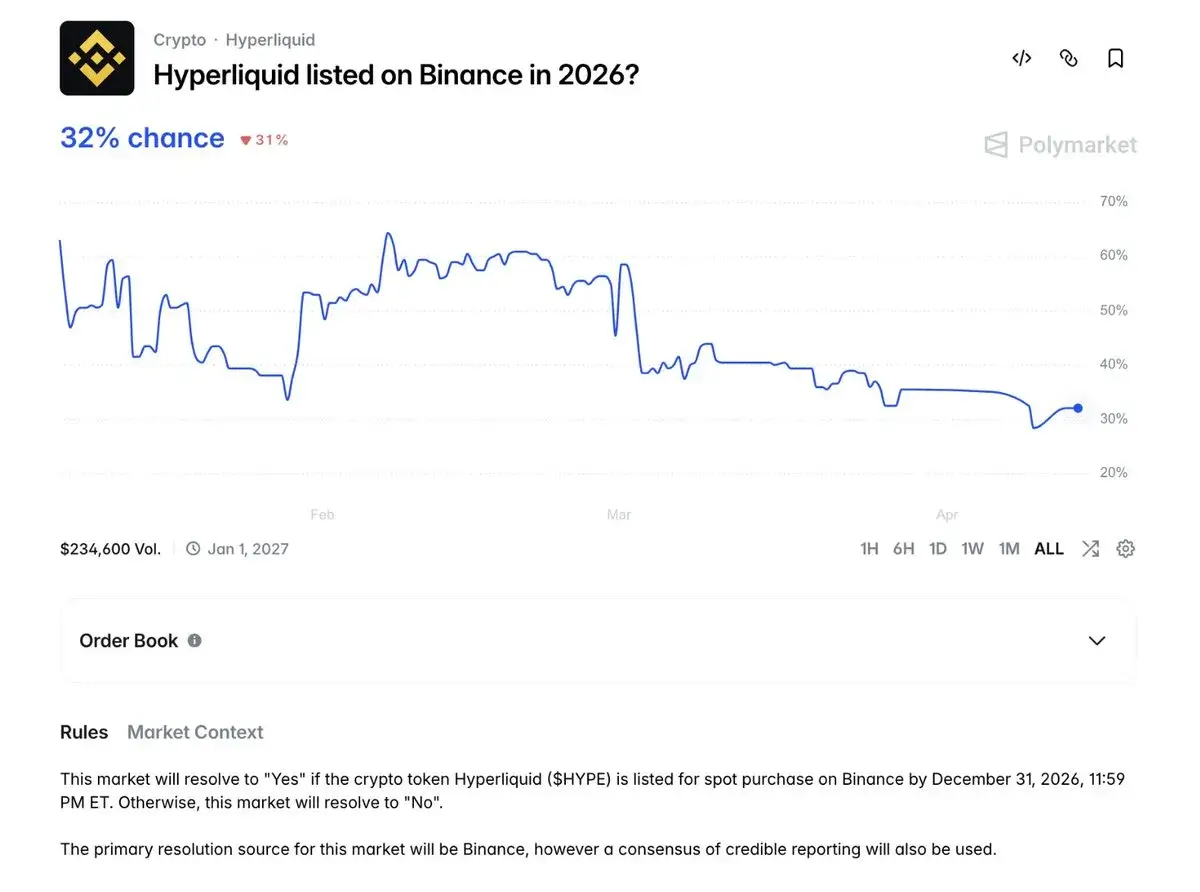
The trend chart says it all — it was close to 70% at the end of January, hovered around 50-60% in February, then steadily fell from March to April. There seems to have been some shift in market sentiment. Perhaps it’s due to the competitive relationship between the largest CEX and the largest perp DEX, or that Binance's listing strategy does not include fostering a direct competitor.
A Binance listing is likely the single biggest catalyst for HYPE's price. The market believes this is unlikely (32%), so if you’re long on HYPE, this signal is worth noting.
10. Will there be another cryptocurrency hack exceeding $100 million before December 31, 2026?
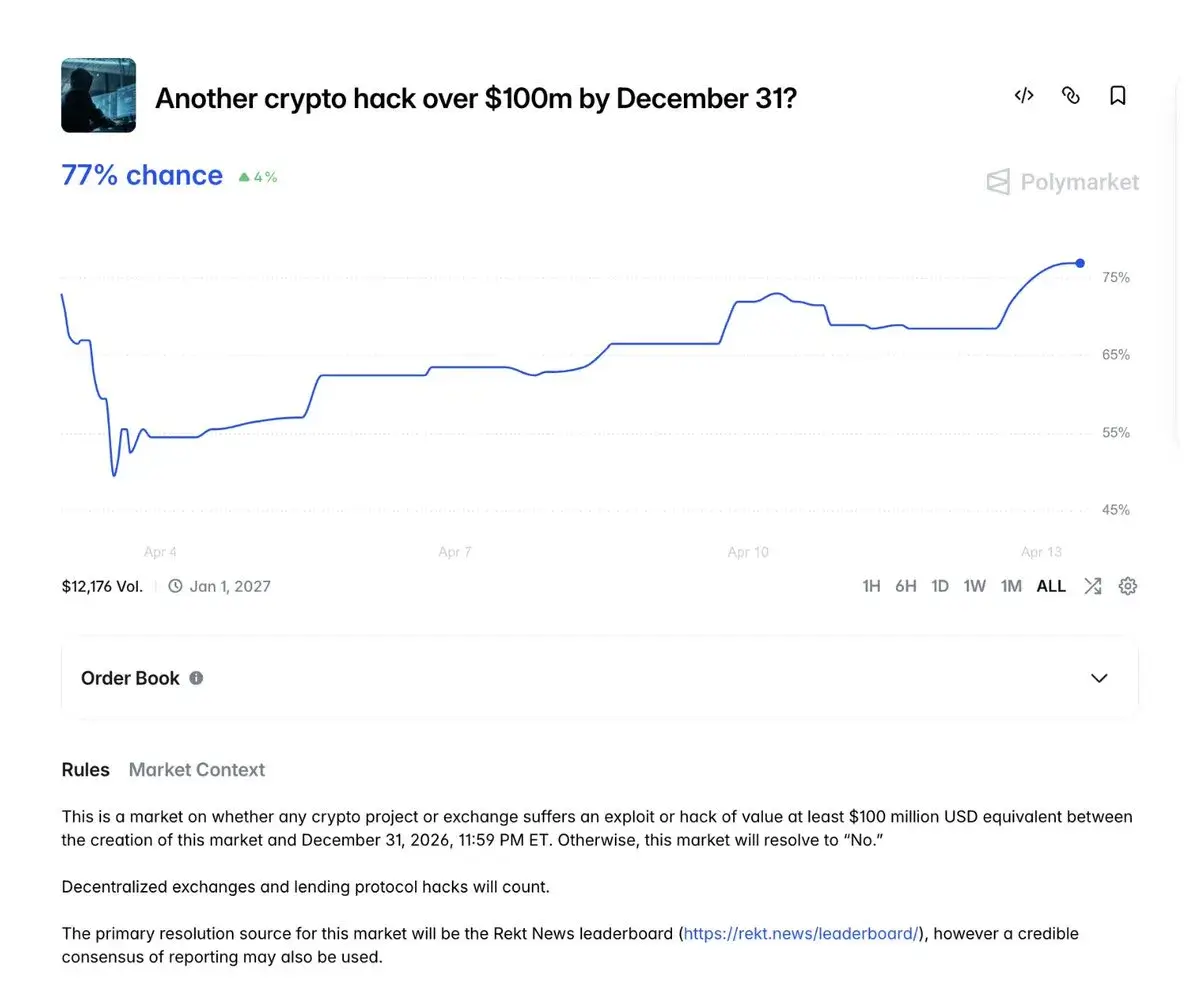
Volume: $12.1 million | End time: January 1, 2027 | Liquidity: Thin
Key probabilities:
Yes — 77% (↑4%)
77% and still rising. The market probability was about 55% in early April and has gradually climbed since then. This is essentially being priced in by the market as inevitable.
Following Bybit ($1.4 billion), Wormhole, Ronin, and the endless cross-chain bridge and substitute protocol vulnerabilities, this is no longer a prediction but pattern recognition. The determination of events comes from the leaderboard of Rekt News, which tracks every significant attack.
$12.1 million in volume is thin, but the direction has never wavered. No one has enough confidence to buy into the “no” side. The industry has consistently outpaced the speed of security hardening against code delivery, and the funds clearly know what consequences that will lead to.
All probability data is as of April 13, 2026, from Polymarket. Prediction markets are not gospel; thin markets may be influenced by a single whale, and the source of determination is also important.
However, when over $30 million is staked on a question, and the answer contradicts what you see in your information stream, it’s worth asking: who is more likely to be wrong?
Article link: https://www.hellobtc.com/kp/du/04/6291.html
Source: https://stacymuur.substack.com/p/terminal-of-truth-10-polymarket-markets
免责声明:本文章仅代表作者个人观点,不代表本平台的立场和观点。本文章仅供信息分享,不构成对任何人的任何投资建议。用户与作者之间的任何争议,与本平台无关。如网页中刊载的文章或图片涉及侵权,请提供相关的权利证明和身份证明发送邮件到support@aicoin.com,本平台相关工作人员将会进行核查。


