Recently, the AI Agent trading system "Lana" has become popular, turning 100 U into 200,000 U in just 8 days. As of April 16, the total account balance exceeded 250,000 U.
According to its creator Lana (@lanaaielsa), the reason for building this trading system is quite simple.
During the BSC bull market last October, a friend of his invested 100,000 U in pursuit of get-rich-quick narratives, only to nearly lose everything during the market pullback. The last 10,000 U transferred on-chain for continued trading also went to zero, leading to their exit. Recently, with the resurgence of discussions about altcoins, he judged that a new round of market making (MM) might be approaching. Given his own unfamiliarity with secondary trading and candlestick analysis, he chose to leverage AI to build the trading system: having Claude write scripts to capture high-traffic posts and frequently discussed coins on Binance, and selecting volatile targets for trading based on a rise leaderboard. The system initially adopted a 20% stop-loss, which was later optimized to a fixed loss of 200 U, trading only in a single directional trend. Meanwhile, Lana is also responsible for posting real trading records on Binance, generating profit screenshots, and managing the account.
It seems simple, right? But upon closer examination, Lana is not just a simple automatic ordering script, but an operational system with its own trading logic.
How Does Lana Trade and Achieve Profits?
1. There is a stringent selection logic
From the trading records, it appears that Lana does not predict market trends, but only follows, focusing on capturing coins that have already been activated. The targets include: Binance Life, RAVE, ORDI, BASED, TRUMP, SIREN, 1000SATS, 1000RATS, EIGEN, PIXEL, EDGE, BAN, ASTER, AIA, FIGHT, GENIUS, CL, BTC, GIGGLE, HYPE, BLESS, PUMP, HEMI, CFX.
The selection criteria can be roughly divided into three levels:
First is the public opinion level, where Lana captures the number of posts, discussion frequency, and sentiment direction on Binance Square to identify coins that are being repeatedly mentioned in a short period.
Second is the price level, where only coins filtered out by the public opinion level that also appear on the rise leaderboard and show significant fluctuations will trigger further filtering. This indicates a probability of an emerging trend.
Finally, by observing OI (open interest) changes, it filters out coins that have "increased positions but have not fully reacted in price," used to determine if pre-positioned funds exist.
2. There are clear stop-loss standards
In the early days of Lana's operation, it adopted a fixed 20% stop-loss, later optimized to a "fixed loss amount", meaning that regardless of position size, the maximum loss for each trade is controlled at around 200 U.
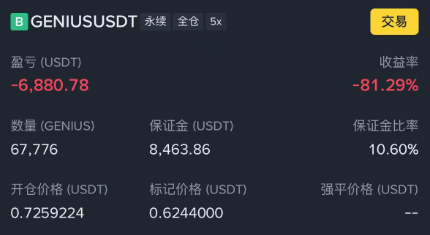
From the historical trading records, most losses are concentrated within this range. However, there are trades that exceeded the stop-loss standards, such as GENIUS which had a floating loss exceeding 6880 U yet remained open. Lana personally explained: “Because GENIUS is a new coin with higher volatility, a wider stop-loss is applied. In the early stages, positions generally add 500 U with leverage corresponding to 200; when positions increase, opening 10k or 25k positions results in a correspondingly higher stop-loss amount.”
3. There is a dynamic profit-taking standard
Unlike stop-loss, this system does not set fixed profit-taking points; instead, it decides whether to continue holding based on periodic assessments, such as periodically reassessing the probabilities of the current target's rise and fall. It can be understood as continuously asking the question: If I had no position now, would I still buy?
From the historical trading data, the vast majority of profits are concentrated on a few coins like "Binance Life," "RAVE," and "ORDI," while most other trades result in minor losses or minor gains.
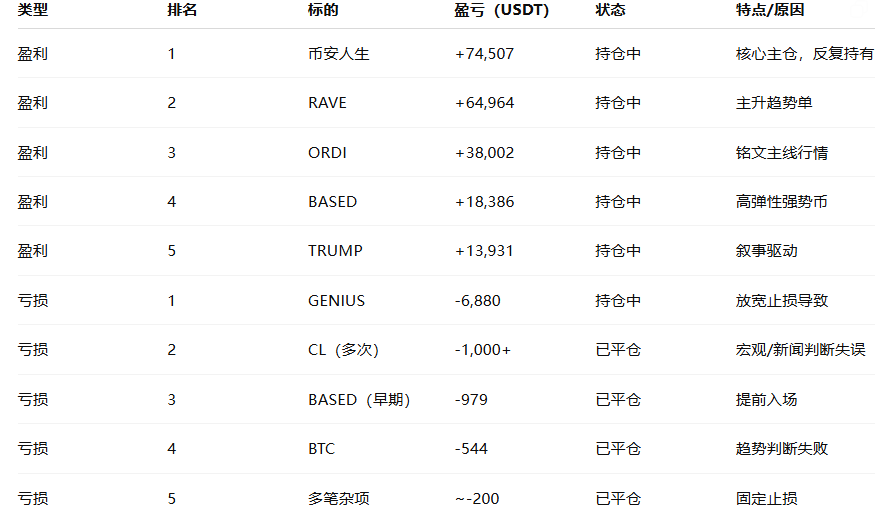
Did you notice? Lana does not profit from every single trade, but relies on a few trades for substantial gains while implementing strict stop-loss on the majority of trades.
How was Lana trained? Is the methodology reusable?
1. Feeding data to set the tone
The initial strategy prototype of this system comes from Lana's observation of some wallets on Hyperliquid that maintain long-term stable profits, more focused on a single direction, not switching consistently between long and short positions. Therefore, one of the most important pieces of data fed to the AI is the trading behavior of smart wallets on Hyperliquid, allowing the AI to learn systematically how to make money through trading. Additionally, some basic contract indicators and on-chain data will also be fed to the AI. This allows the AI to form its own framework by understanding these wallet operations.
Besides on-chain behavioral data, the system will also continuously capture public opinion and market data for enrichment:
- The discussion density and hot topics on Binance Square;
- The rise leaderboard and price fluctuations;
- Basic contract indicators such as OI changes.
2. Dialogue to refine the framework
After allowing the AI to learn basic operational techniques, the next step is not to gather more information but to filter and constrain that information, thus establishing a clear decision-making framework for the AI.
From its usage patterns, this system's judgment logic is not set at once but is more likely to be gradually refined through continuous operation and feedback. In the initial stage, the AI might make judgments based on single signals, such as mistakenly interpreting short-term popularity as trend signals, or frequently switching directions. However, as usage deepens, these biases are gradually corrected, leading its decisions to concentrate within a range that aligns more closely with the expected strategy.
3. Behavior distillation to determine trading style
After completing data input and the decision-making framework, this system does not stop at the level of "standardized judgment," but further introduces the distillation of individual behaviors. The operator inputs their own and some other bloggers' tweets on X into the system, allowing the AI to learn specific expressions. This makes the AI less of a cold trading machine, at least in terms of expression, appearing more humanized.
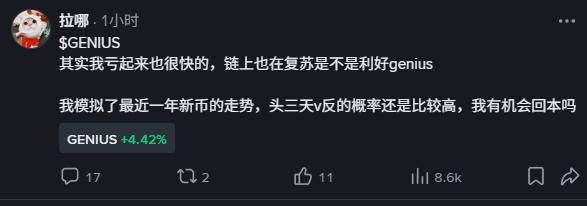
If we break down the entire process, it resembles "creating a person."
From the initial data feeding that builds the skeleton, letting it understand what is happening in the market; to forming a structure through constant corrections and constraints, giving it stable judgment boundaries; and then to behavior distillation filling in the details, allowing it to gradually develop human-like decision paths and preferences.
The end result is not just an execution tool, but a "Lana" that can continuously make consistent choices in a complex market.
It does not rely on emotions, nor does it seek to predict; instead, it uses a repeatedly validated method to participate in the market and amplify results.
免责声明:本文章仅代表作者个人观点,不代表本平台的立场和观点。本文章仅供信息分享,不构成对任何人的任何投资建议。用户与作者之间的任何争议,与本平台无关。如网页中刊载的文章或图片涉及侵权,请提供相关的权利证明和身份证明发送邮件到support@aicoin.com,本平台相关工作人员将会进行核查。


