Author: Deep Thought Circle
Why did the youngest vice president of DingTalk suddenly leave Alibaba in October last year, giving up a stable life as a senior executive in a large company to go all-in on an overseas KOC market that doesn’t seem very attractive? After I delved deeper into K2 Lab, this startup, I realized there was a larger judgment hidden behind it: the window of opportunity left for entrepreneurs in the AI era may only be 2 to 3 years; if you miss this time, everything will be settled.
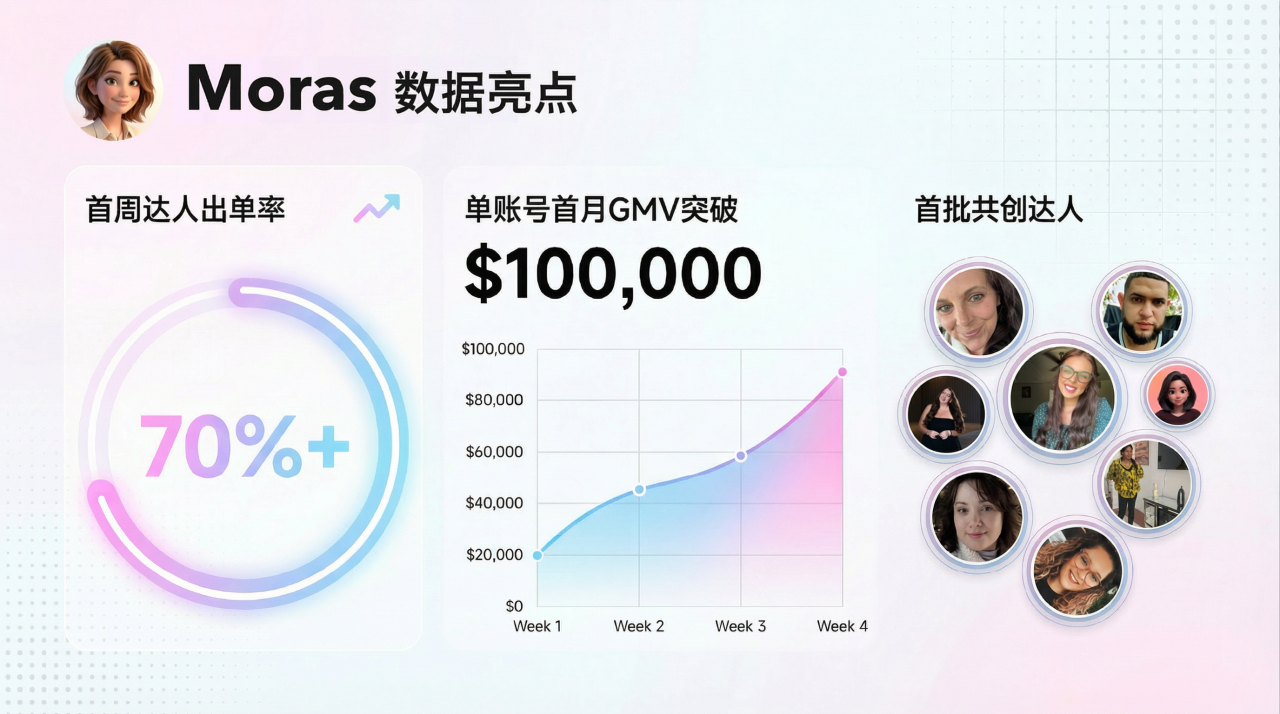
This is not an exaggeration, but a choice made by a group of top operators who have seen hundreds of AI startups and have been deeply involved in DingTalk's AI transformation. They founded K2 Lab, which completed nearly 100 million yuan in two rounds of financing within four months. The core product, Moras, achieved a first-week order rate of over 70% for overseas influencers, with top users reaching a monthly GMV of over 100,000 dollars. Behind these numbers is a complete reconstruction of the e-commerce logic of the AI-native era.
The Critical Window of the AI Era: Why Now?
I believe that to understand K2 Lab's entrepreneurial project, one must first understand their judgment of time. Founder Wang Ming repeatedly emphasizes a viewpoint in interviews: the competitive window of the AI era is only 2 to 3 years, far shorter than the 5 to 6 years of mobile internet, and even shorter than the 10 years of the internet era. This judgment sounds radical, but if you closely observe the evolution speed of AI technology, you will find it is not an exaggeration. It has been just over two years since the release of ChatGPT, and the capabilities of large models have undergone multiple leaps. OpenAI has iterated from GPT-3.5 to GPT-4, and now to the o1 series, each iteration redefines the boundaries of possibilities. Competitors like DeepSeek, Gemini, and Claude are also driving technological advances on a monthly basis.
What does this acceleration mean? It means that if you don't take action today, waiting until the model capabilities are fully mature and all ecological niches are occupied, it will be too late to enter. Wang Ming used a very vivid metaphor to explain this logic. He said that the giants left over from the mobile internet era were all companies that built bilateral ecosystems during that time, such as Meituan connecting merchants and consumers, Didi connecting drivers and passengers, and Douyin connecting creators and audiences. Those that only made tools, no matter how cool they seemed at the time, ultimately did not become true giants. The AI era will follow the same rules, except this time, in addition to the bilateral ecosystem, the data and vertical model flywheel will also be included. Whoever can successfully run these two flywheels during the window period will be able to establish a foothold in the segmented track.
Based on this judgment, Wang Ming and his co-founders made a seemingly crazy decision: to give up all the resources accumulated at DingTalk, to abandon the ToB market, to give up the domestic market, and to go all-in on the overseas ToC KOC track. This decision seems counterintuitive to many investors. Think about it: as DingTalk's youngest vice president, Wang Ming had been responsible for DingTalk's AI innovation products, ecosystem, and operations, holding a wealth of enterprise customer resources and government relationships. If he chose to pursue ToB AI solutions, it would be far easier than starting a ToC project from scratch, whether domestically or abroad. But they chose the hardest path.
Why? Because they see a more fundamental issue: if you want to become a first-tier AI application company, you must achieve first place in a sufficiently large track, and this track must be AI-native, rather than using AI to optimize traditional businesses. Although the ToB market seems stable, it is very hard for Chinese entrepreneurial teams to secure head customers in the overseas market. You can only start with small clients and slowly accumulate, but the window period of the AI era simply does not allow you this time. Companies like Sierra and Palantir, which are domestic ToB companies in the U.S., have social backgrounds and customer resources, allowing them to quickly secure orders worth tens of millions or even hundreds of millions of dollars, rapidly accumulating data and revenue, and then using this money to train vertical scene models. How can a Chinese team compete with them?
Therefore, the K2 Lab team made a convergence: firmly not doing ToB, firmly not doing the domestic market, firmly not making tools, and firmly not doing non-essential scenarios. They call this principle "May Fourth Youth" — four do's and five don'ts. This convergence is summarized from the blood and tears of looking at hundreds of AI startup projects. Those companies that make tools, no matter how cool the products are, ultimately face problems like low paid conversion rates and low renewal rates because users use them and leave, having little reason to stay. Companies that operate non-essential scenarios have growth curves that are very linear and find it hard to achieve exponential explosions. And those that only target the domestic market face problems related to insufficient payment awareness and the habit of users treating AI as a tool rather than a service.
Why the Overseas KOC Track?
Once they clarified "what not to do," the next question was: what to do? The K2 Lab team spent six months searching for an answer. They considered doing AI coding, deep research, and even an AI version of Douyin. But ultimately, they chose a track that seemed less attractive but harbored tremendous opportunity: the overseas content e-commerce KOC market.
There are several layers of logic behind this choice. The first layer is the logic of market potential. TikTok has over 2 billion monthly active users worldwide, and its traffic has surpassed Douyin, but its commercialization rate may be less than one-tenth of Douyin's. What does this mean? It means there is enormous untapped commercial value here. In China, Douyin e-commerce and Xiaohongshu e-commerce have been pushed to the extreme, with specialized MCN agencies, mature supply chains, and standardized sales processes making it very difficult for individual creators to break through. But overseas, content e-commerce is just beginning. Users in Europe and America are not as competitive as those in China; they want to live their lives after work, genuinely relax on vacation, and won't spend a lot of time learning how to choose products, write scripts, edit videos, and manage accounts. This "non-competitive" culture instead provides a significant space for AI to play a role.
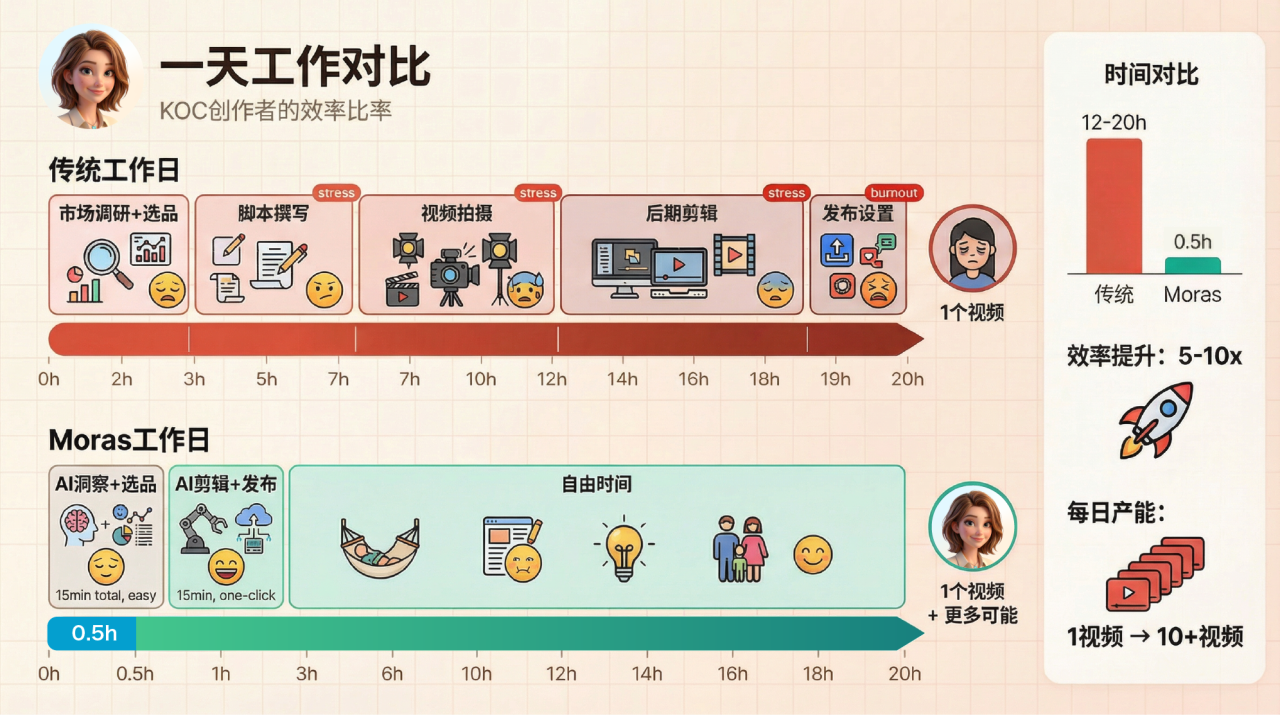
The second layer is the logic of AI capability matching. The content e-commerce chain is long: product selection, script writing, filming, editing, publishing, data analysis, optimization, and iteration. Each of these steps requires specialized knowledge and a significant time investment. An overseas influencer may need to spend months or even a year learning to achieve results in content e-commerce. But AI excels at replicating human top experts' capabilities to a moderate level and then combining these moderate abilities through engineering methods to form a complete solution. Wang Ming said that if what it takes today to do this well is a bunch of people who understand e-commerce, then they are doing it wrong. The entrepreneurial opportunities in the AI era should be those where AI can complete tasks end-to-end, with people only participating at crucial nodes.
The third layer is the logic of business models. From the very beginning, K2 Lab determined a performance-based payment model: users employ the AI influencer Moras, give it a base salary, and share in the profits once they earn money. This model is very easy for users to understand, requiring no explanations of token consumption or multi-agent collaboration. You just treat Moras like an employee you hired; it helps you make money, and you share the earnings — it’s that simple. This model is highly accepted among overseas users because they are already accustomed to hiring people to help them with tasks and have a strong willingness to pay. In contrast, domestically, whenever people are involved, users tend to see it as a tool rather than a service, which significantly reduces their willingness to pay.
The fourth layer, which I think is the most profound, is about the logic of trust. Wang Ming has a very forward-looking judgment: as AI-generated content becomes rampant, consumers will find it increasingly difficult to distinguish what is real and what is AI-forged. Many product detail pages and marketing videos you see now are already AI-generated. A major cross-border e-commerce platform used AI to generate product images for all its overseas market trials last year, saving tens of millions over the year. But this raises a problem: when all content is AI-generated, what can consumers trust? Wang Ming's answer is: humans. Only real people can serve as trust anchors to build genuine trust in a world flooded with AI. This is why they insist on doing KOC instead of directly pursuing pure AI sales. They believe that in the future, content e-commerce will transition from a sideline to a mainstream approach; A to A (consumer Agent directly connecting to product Agent) will solve standardized, low-priced products, while more non-standard, high-decision scenarios will require A to A to A (consumer Agent connecting KOC Agent, then connecting vendor Agent), with that intermediary person becoming the most scarcest resource.
Moras: Not a Tool, but an Agent OS
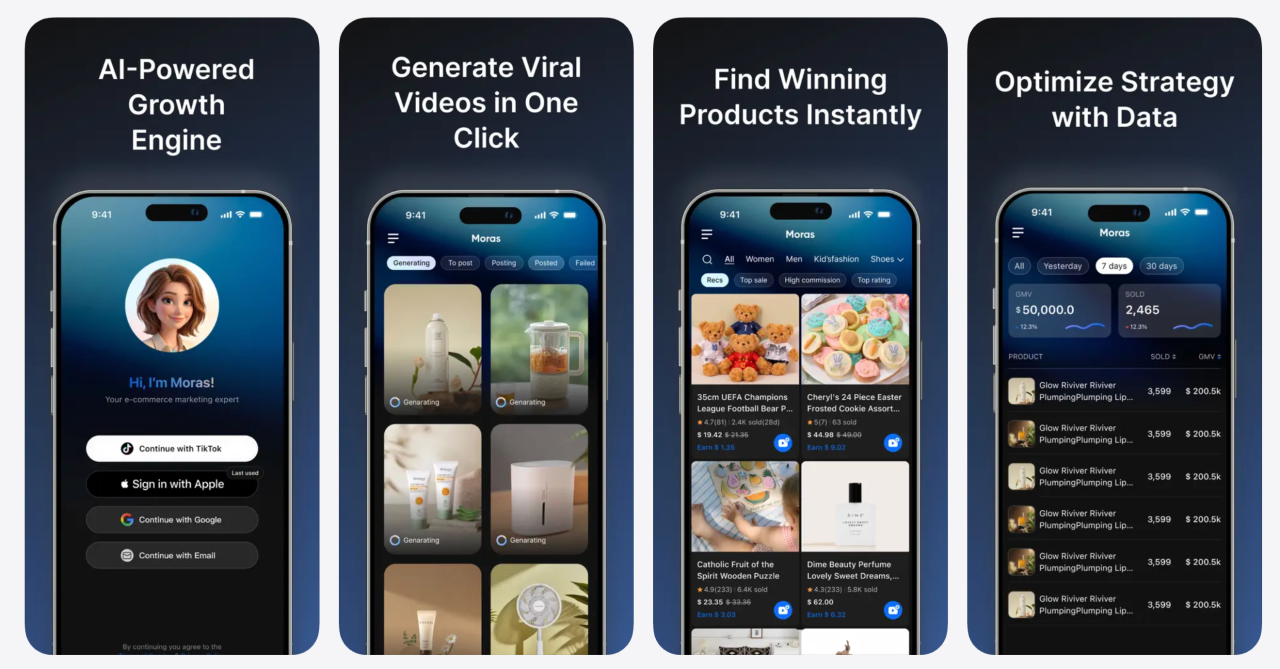
Understanding the logic of the selected track, let's take a look at what Moras actually is. Many people may initially think that Moras is just another AI video generation tool. However, this understanding completely underestimates Moras’s ambition. Moras's positioning is not as a tool but as a KOC Agent OS— a complete operating system.
What is an operating system? It doesn't just help you complete a single task, but manages the execution, decision-making, and evolution of the entire workflow. The core architecture of Moras includes nine major functional modules: market insights, product selection strategy, selling point refinement, storyboard scripting, viral hook creation, content generation, intelligent editing, compliance checking, and video publishing. These nine modules do not represent a simple linear process but rather a Multi-Agent collaborative system. Each module has dedicated Agents responsible for it, and these Agents exchange information, challenge each other, and validate one another before finally producing a video that complies with platform rules, aligns with user tone, and has viral potential.
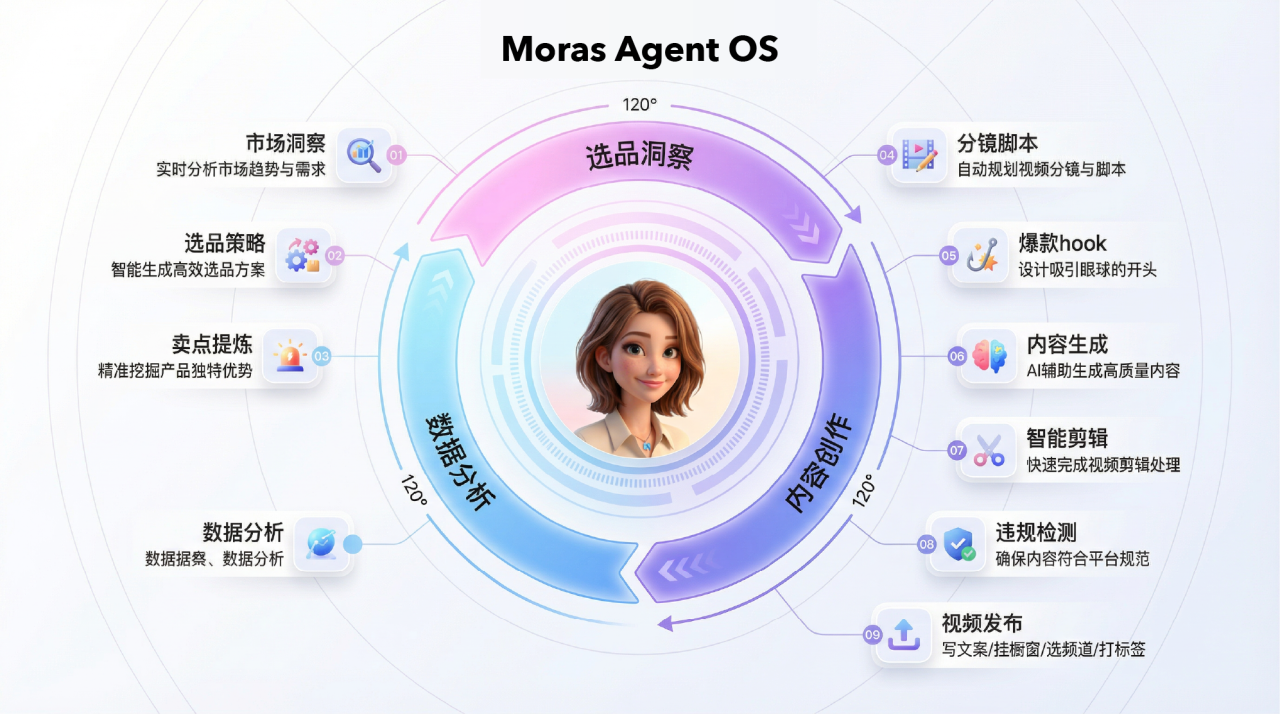
For a specific example, when an overseas influencer opens Moras, they only need to perform three actions: first, choose a product recommended by Moras; second, select the product's main image; third, click publish. Just these three steps. But behind these three steps, Moras's Multi-Agent system has already made dozens of complex decisions. First, the product selection Agent will filter out about 1,000 real-time trending products from nearly ten million options available on TikTok Shop, considering factors such as platform strategy, industry cycles, holiday trends, hot stories from movies and TV, weather changes, and merchant advertising situations, even eliminating categories that AI struggles to generate. The personalized recommendation Agent then reads the influencer's TikTok account data, further sorting the options based on audience demographics and content tone. Next is the script Agent, which generates a viral script by combining product features, influencer styles, and popular trends on the platform. Following that is the generation Agent, which calls upon multiple video generation models to complete content production. Finally, there’s the quality inspection Agent, which checks for frame errors, bad frames, product inconsistencies, and exaggerated claims.
This entire process would traditionally take 12 to 20 hours, whereas Moras only needs 0.5 hours to produce 3 to 5 videos. More critically, every decision made by Moras is not random; it is based on the experience of top human experts. The K2 Lab team includes a core leader from TikTok e-commerce who once managed nearly half of its global GMV at TikTok's peak. They have translated these experts’ product selection logic, content creation methodologies, and platform rule understanding into Few-shot samples for AI learning, continuously evolving and upgrading the Agents with human data labeling and outcome verification. This is why the content generated by Moras achieved a first-week order rate of 70% for its initial users — it learned not general knowledge from the internet but actual practical experience validated in the field.
Performance-Based Payment: Redefining the Business Model of AI Products
Another innovation of Moras lies in its business model. Wang Ming stated that they decided from day one to implement a performance-based payment model, which is quite rare in the AI startup space. Most AI products charge based on token consumption or through subscription fees. The logic of Moras is: you hire an AI to help with sales, give it a base salary, and share profits once you make money.
This model sounds simple but is very difficult to implement. Because it requires the AI's success rate to be sufficiently high; otherwise, companies will lose money. Imagine if your AI helps users generate 100 videos, but only 10 can lead to sales, who will bear the computational costs of the remaining 90? This demands that the team must achieve extreme optimization on the product. K2 Lab's approach is to ensure that every content generation maintains high quality and a high probability of orders through rigorous rules and quality control. They set a daily limit on the number of videos users can generate because they found that allowing unlimited generation leads to many users attempting to post dozens to hundreds a day, which results in the platform limiting their reach with no real effect, wasting computational resources instead. Hence, they focus their computational resources efficiently, ensuring every token generates results.
This business model also has a deeper meaning: it transforms the relationship between users and AI. In traditional AI tools, users operate software, needing to learn how to use it, adjust parameters, and optimize prompts. But Moras is different. The relationship between users and Moras resembles that of an employer and employee. You tell it what types of products you want to sell, and it makes decisions, executes, and optimizes independently. This positioning as "AI as a Service" rather than "AI as a Tool" truly aligns with the product format suited for the AI-native era.
From actual data, this model has already run successfully. K2 Lab completed co-creation tests with the first batch of over 30 influencers in March; these influencers are not major V's but mostly long-tail KOCs with follower counts between 5,000 and 50,000. This group generated 500,000 dollars in GMV in March. On average, each influencer reached nearly 10,000 dollars in monthly GMV, with top users achieving monthly GMV of 100,000 dollars. Even more astounding was the first-week order rate — over 70%. It’s important to note that a traditional overseas influencer, if knowledgeable about sales, typically takes two weeks to a month to stabilize their sales. However, influencers using Moras can see returns in the first week.
Everyone AI Coding: An Organizational Philosophy for an AI-Native Team
If Moras is the product K2 Lab delivers externally, then everyone AI coding is their internal organizational philosophy. Wang Ming mentioned that their company has a rule: all AI coding and consumption of AI products by employees are fully reimbursed, and they encourage everyone to use the best models. Not just developers are using Claude and GPT; even HR, finance, operations, and product managers are developing systems using AI coding.
This sounds a bit crazy, but the actual results are remarkable. Their HR management system, BI system, influencer contact system, email A/B testing system, automated customer service, product selection and data labeling system, were all developed not by the研发人员, but rather by HR using AI to create an HR system, by operations to create an operations tool, and by product managers to create a data analysis platform. They have even developed a batch of coding Agents specifically responsible for receiving requests, writing code, and running tests. Many requests are no longer directed to programmers but are instead sent directly to Agents, who then undergo testing approval before being handed over to研发人员 for final acceptance.
Wang Ming stated that their AI coding code rate has reached over 99%. This number was previously almost unimaginable in the industry. Moreover, their understanding of AI coding has evolved to a third stage. In the first stage, AI enhanced the productivity of small teams, while humans still needed to perform significant debugging and reinforcement work. The second stage introduced the Harness framework (rule system) to constrain AI behavior, preventing it from miswriting code and enabling the development of complex business systems. The third stage is now allowing Agents to develop, test, and optimize independently, with humans only responsible for the final acceptance.
This enhancement in organizational capability is directly reflected in the speed of product iteration. K2 Lab was founded in October last year, determined its direction in November, began validating results in December, simplified the product for mobile in January, started overseas user acquisitions in February, and completed the first batch of co-creation in March. Within four months, they achieved a complete commercial closed-loop from zero to one. This speed is unimaginable in traditional software development models. Additionally, their team quickly grew to over 30, covering crucial positions in financing, overseas marketing, influencer growth, content e-commerce, AI engineering, model algorithms, and AI interaction innovation, each post staffed with seasoned individuals who are versatile super individuals. Wang Ming said that the AI era requires large battles; there is no time to learn on the job.
A to A to A: A Bold Prediction About Future E-commerce Forms
At this point, we understand what K2 Lab is doing, why they are doing it, and how they are doing it. But Wang Ming and his team are clearly not satisfied with merely being a tool to help KOCs improve efficiency. Their true ambition is to build a content e-commerce platform that operates on an A to A to A model.
What is A to A to A? The first A is the consumer's Personal AI, which could be ChatGPT, or Longxia, or some future open-source framework. The second A is the digital avatar of the KOC supported by the Agent OS provided by Moras. The third A is the merchant’s supply chain Agent. These three Agents do not need to connect through traditional e-commerce platforms but can exchange information and facilitate transactions directly through agreements.
For example, one day in the future, a novice mother in the U.S. asks her Personal AI, "I just had a baby and need to buy a set of baby supplies, including clothes and bottles, can you recommend something?" Her Personal AI would use her purchase history, lifestyle habits, geographic location, etc., through Moras's routing system, to find the most suitable KOC digital avatar, such as Amy, a mother living on the East Coast of the U.S. who also has two kids and is of Mexican descent. Amy’s digital avatar would communicate one-on-one with this new mother, recommending products, answering questions, and ultimately completing the transaction. Throughout this process, the new mother might not even realize that Moras is providing the service; she simply knows that Amy, the trusted person, has solved her problem.
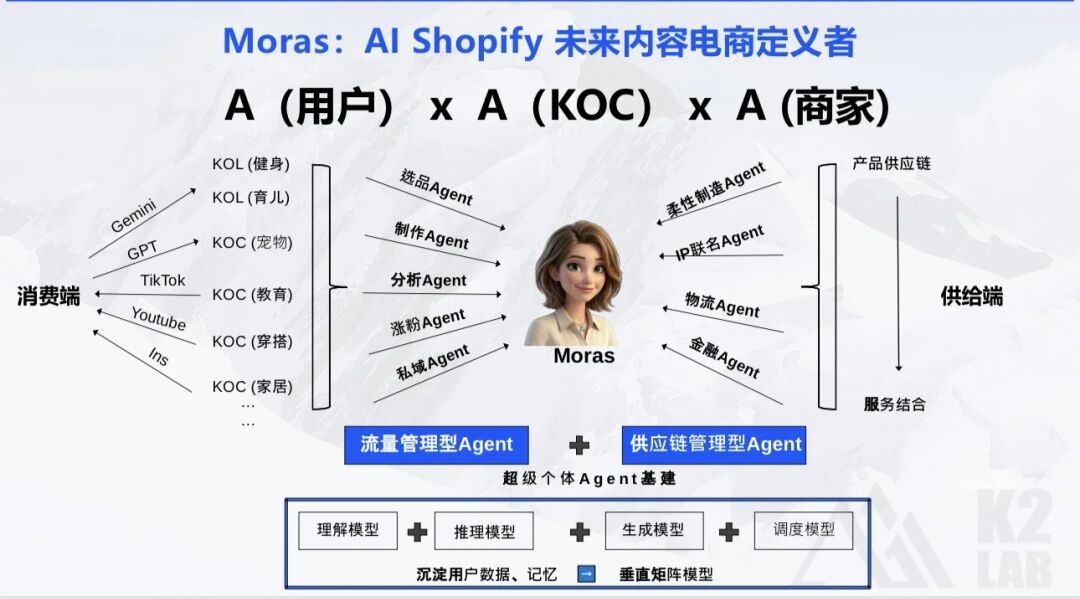
This vision may sound distant, but Wang Ming believes it will begin to happen this year. His judgment is based on two observations: first, centralized super Apps will gradually disappear in the AI era. There will no longer be an Amazon where everyone shops, nor an Instagram where everyone views content. Traffic will migrate from centralized access points to decentralized Agent OS entry points. Second, the value of humans as trust anchors will become increasingly significant. As AI-generated content floods the internet, only content backed by real people can establish genuine trust. Hence, content e-commerce will not vanish but will transition from a niche market to a mainstream form.
To realize this vision, K2 Lab is already making long-term plans. They are collaborating with Tsinghua University to develop multimodal understanding models specifically for two scenarios: first, enabling AI to conduct quality checks and determine whether videos have frame errors, bad frames, product inconsistencies, or exaggerated content; second, allowing models to learn the patterns of viral videos autonomously rather than solely relying on human experts for input. They believe that only by enabling AI to possess autonomous evolution capabilities can they rapidly capture the market during the window period and lead the A2A native e-commerce era.
免责声明:本文章仅代表作者个人观点,不代表本平台的立场和观点。本文章仅供信息分享,不构成对任何人的任何投资建议。用户与作者之间的任何争议,与本平台无关。如网页中刊载的文章或图片涉及侵权,请提供相关的权利证明和身份证明发送邮件到support@aicoin.com,本平台相关工作人员将会进行核查。