Original Title: The Bond Market Isn't Buying This Rally. Neither Am I.
Original Author: KURT S. ALTRICHTER, CRPS
Translation: Peggy, BlockBeats
Editor's Note: As the stock market quickly recovers from wartime declines and approaches historical highs, a narrative of "risk has cleared" is once again dominating. However, this article reminds us that if one looks only at the equity market, it is easy to misjudge the current real environment.
The signals from bonds and crude oil are not consistent: rising interest rates and high oil prices point to persistent inflation, limited policy space for the Federal Reserve, and geopolitical conflicts that have yet to truly settle. In contrast, the stock market is pricing in low inflation, a restart of interest rate cuts, manageable costs, and eased conflicts, which represents a highly idealized set of assumptions.
The author believes that this round of rebound is more driven by momentum than fundamentals. Driven by the trading behavior of "not wanting to miss the rise," prices can temporarily deviate from reality, but ultimately must return to ranges determined by macro variables.
When divergences occur between different asset classes, the real risk often lies not in who is right, but in how this divergence will be resolved. The current issue is not whether the market is optimistic, but whether this optimism has already outpaced the data.
Following is the original text:
"Rule Two: Excessive volatility in one direction often leads to excessive reversal in the opposite direction." — Bob Farrell
The S&P 500 Index has completely recovered all losses incurred during the U.S.-Iran conflict. As of yesterday, the index is up 1% from February 27th (the day before the first strikes on Iran), and is just a step away from its all-time high (less than 1%).
In just 10 trading days, the market has completed a full round trip.
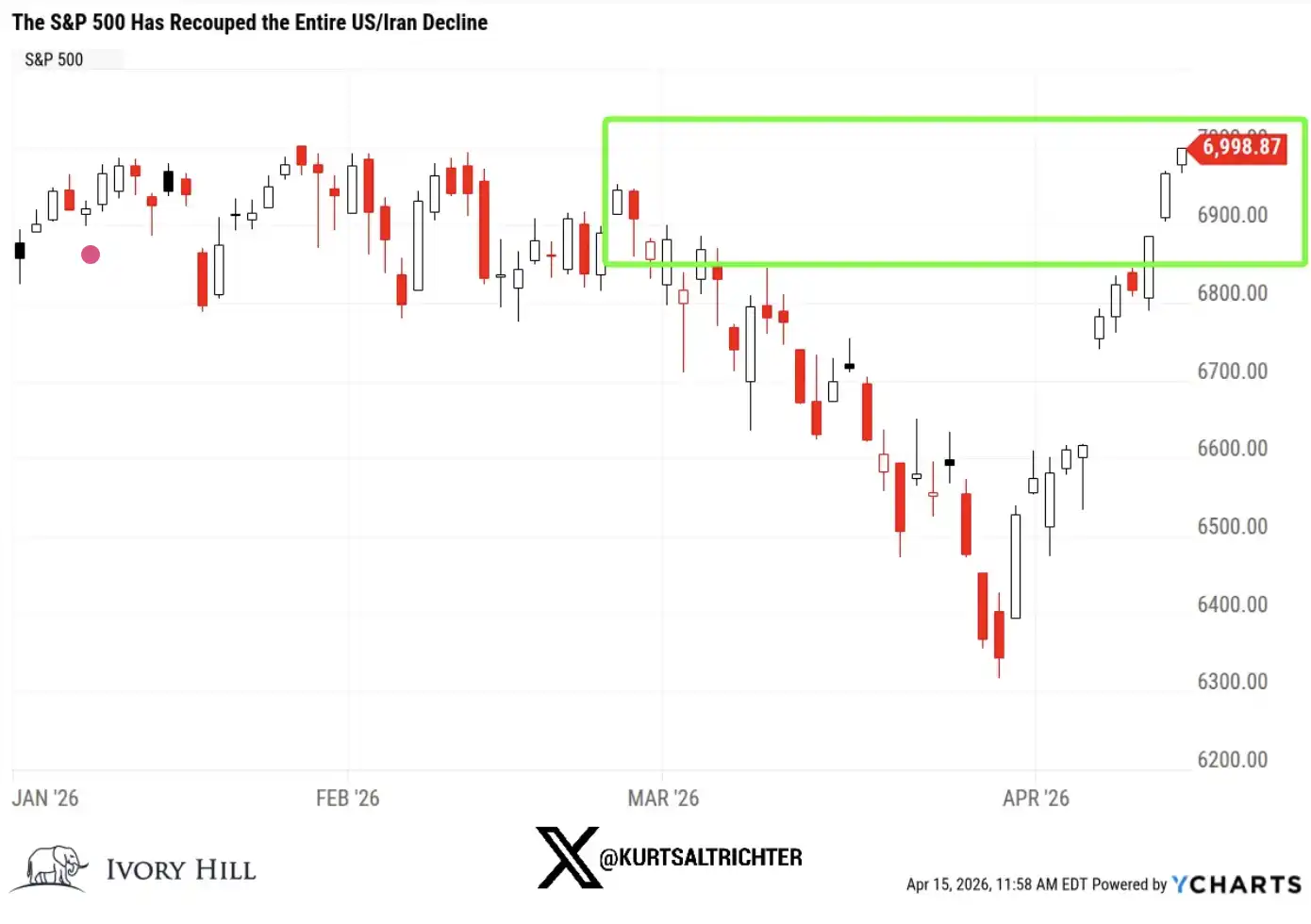
Let me be clear, if you are only looking at the stock market right now, everything seems to be "recovering healthily." War breaks out, the market drops, and then quickly rebounds, everything returns to normal, and everyone moves forward.
But if you widen your view, this is not the true situation occurring.
The bond market has not confirmed this round of increase.
The crude oil market has also not confirmed this round of increase.
When the two most important markets globally are telling a story that is different from the stock market, this is certainly a signal that cannot be ignored.
So, what exactly is the stock market pricing in?
For the S&P 500 to stand above pre-war levels, the market actually needs to simultaneously believe in the following things:
The current oil price is not enough to significantly dampen consumption.
The Federal Reserve will ignore hot inflation data and still choose to cut interest rates.
Higher raw material and transportation costs will not erode corporate profit margins.
The Middle East conflict will be close enough to resolution within six months, and will no longer pose a risk.
Maybe things will indeed develop this way. I'm not saying this is impossible. But this is a rather aggressive set of assumptions, and the data released by the current bond and crude oil markets do not support these hypotheses.
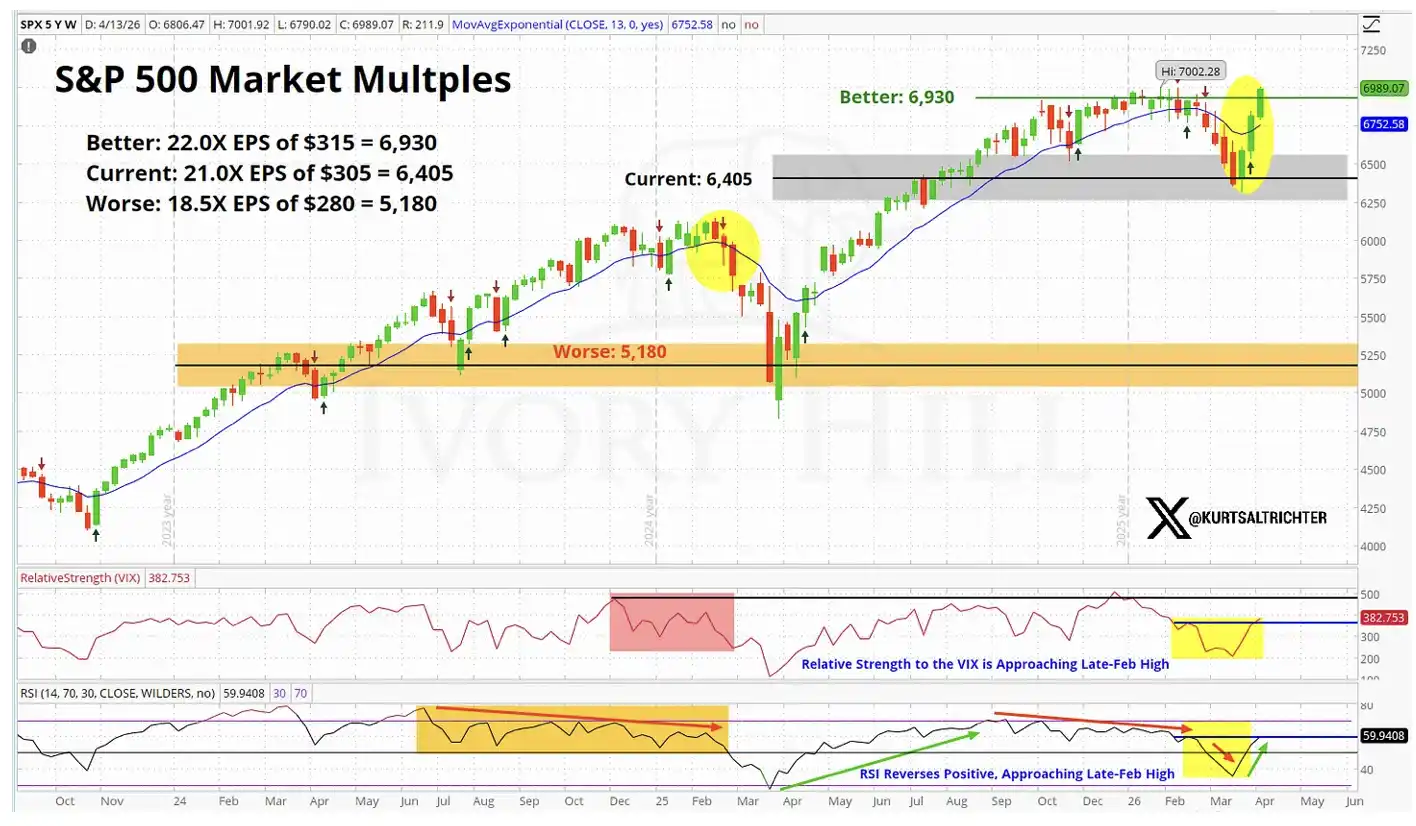
From a fundamental perspective, the pricing of the stock market is nearing "perfect expectations."
Let's look at more specific data
On February 27, the day before the war broke out, the closing conditions of key indicators were as follows:
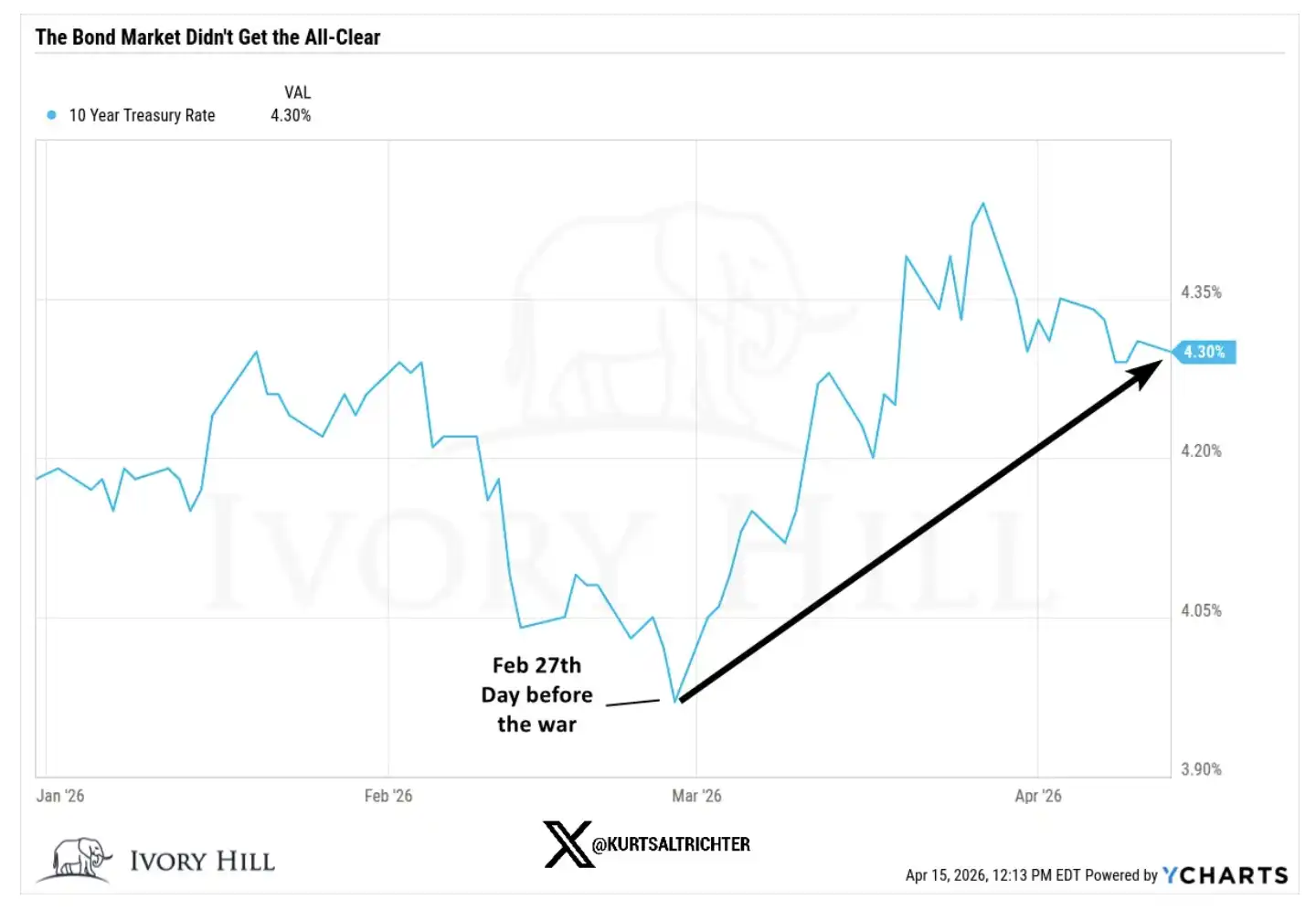
10-year U.S. Treasury yield: 3.95%, whereas it closed at 4.25% yesterday, an increase of 30 basis points from pre-war levels.
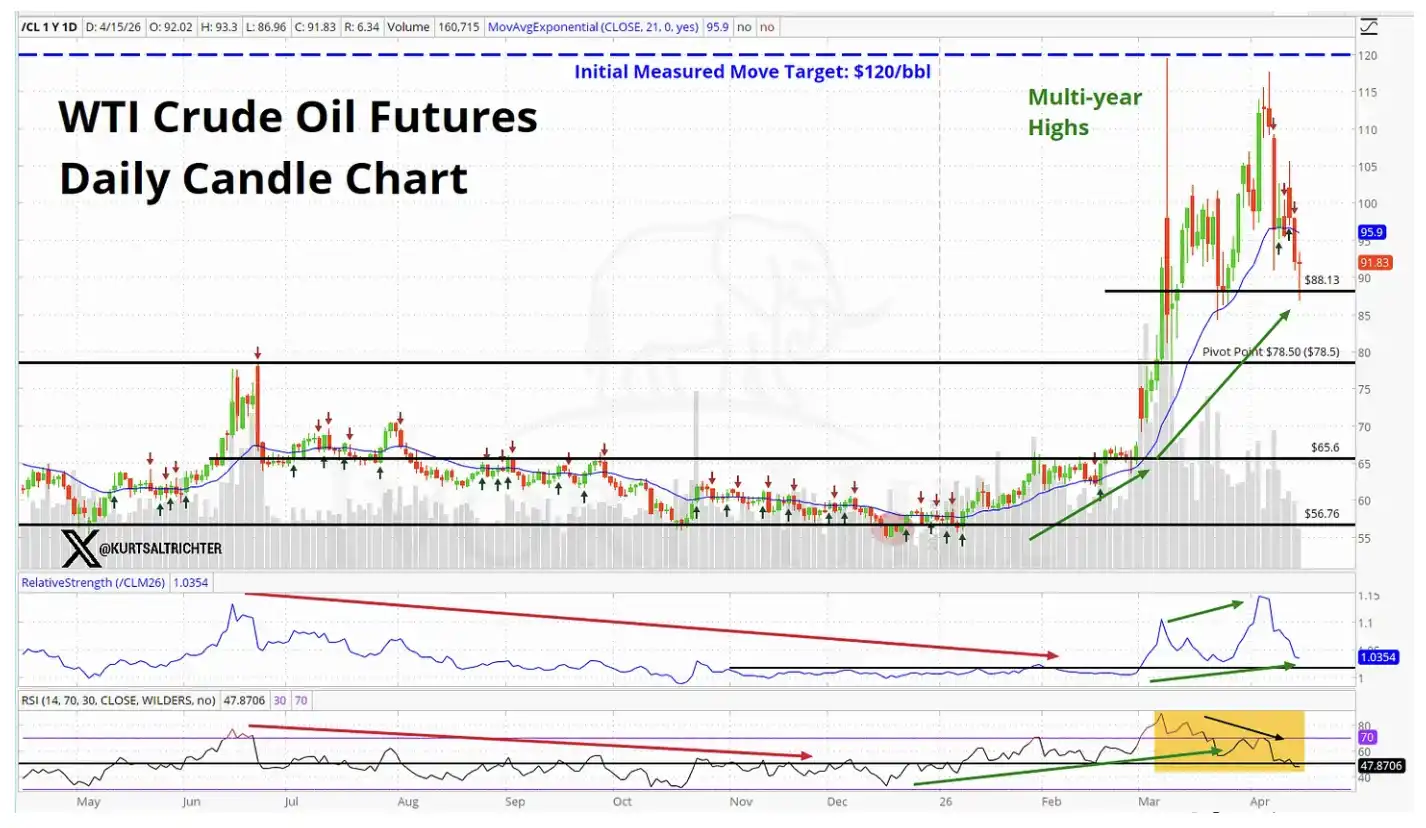
WTI crude oil: $67.02, currently about 37% higher than then.
2-year U.S. Treasury yield: 3.38%, closed yesterday at 3.75%, an increase of nearly 40 basis points from pre-war levels.
Now, let's break down the implications of these changes one by one.
The 10-year yield rising by 30 basis points after the war broke out is not because the bond market is more optimistic about economic growth. Current consumer sentiment is weakening, and confidence remains fragile. This rise in interest rates is essentially the bond market "quietly" pricing in inflation.
The signal it conveys is clear: higher oil prices are transmitting through the overall price system, and the Federal Reserve's future policy space may not be as accommodating as the stock market assumes.
Oil prices have risen 37% in 6 weeks, which is not a performance one would expect when the market believes a genuine, lasting agreement is about to be reached between the U.S. and Iran.
If traders were indeed confident about a stable ceasefire agreement, oil prices should have fallen back to the $70 range and continued to decline. But that is not the case. Oil prices remain high, indicating that the crude oil market is not pricing in the same expectation of "conflict soon to be resolved" as the stock market.
The 2-year U.S. Treasury yield still being 40 basis points above pre-war levels is itself a direct challenge to the narrative of "the Federal Reserve will soon cut interest rates."
The 2-year yield is the most sensitive indicator we observe for interest rate expectations; it reflects the Federal Reserve's policy path more directly than any other asset. And right now, the signal it conveys is that the Federal Reserve's operational space is smaller than the market imagines. This will impact almost all valuation logic supporting this round of stock market rise.
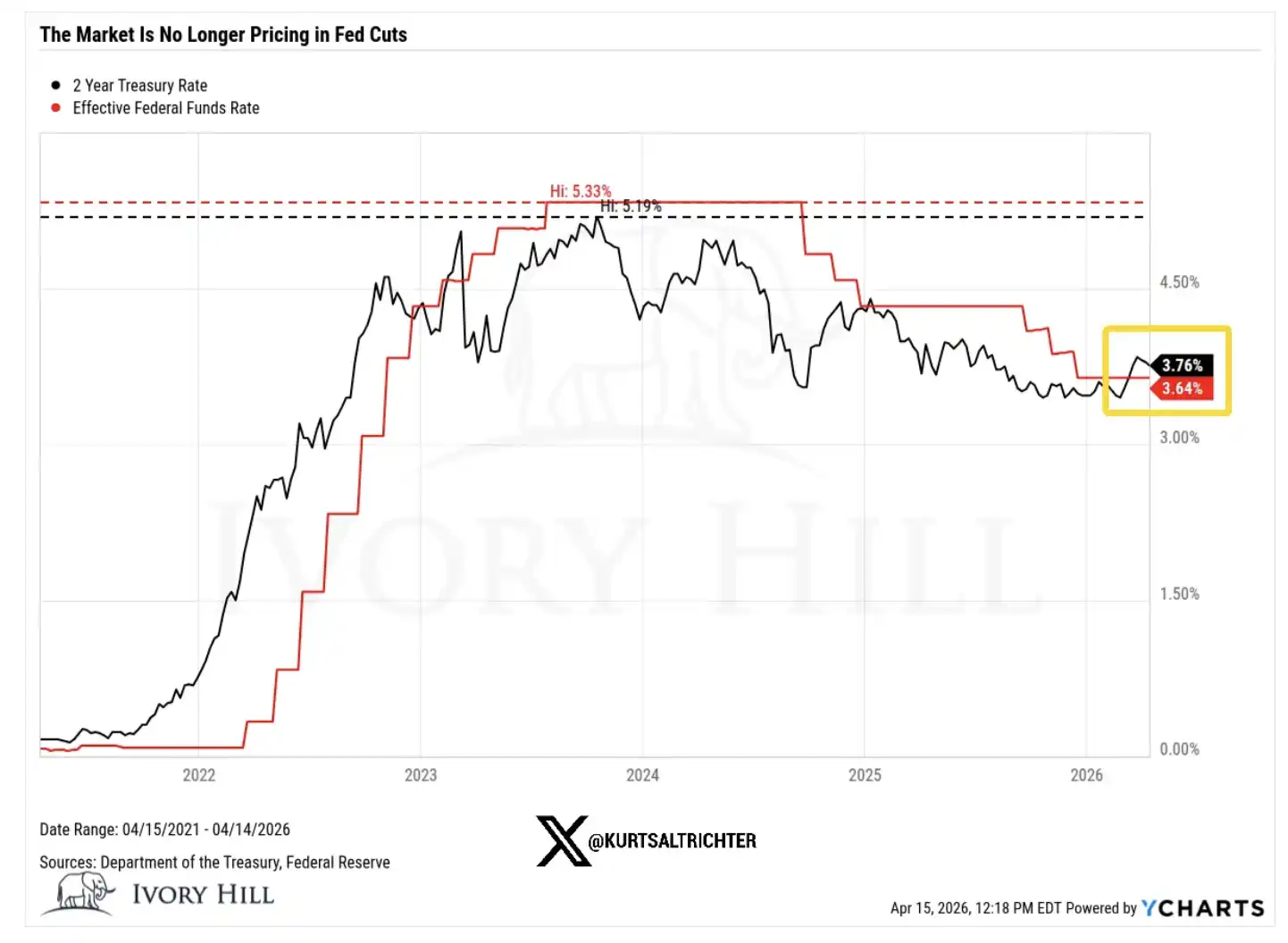
So, who is right?
The stock market may be right, and I am willing to acknowledge that. If a substantial ceasefire agreement were to emerge, bond yields could quickly fall; once supply issues are credibly resolved, oil prices could also drop significantly. This is not the first time the stock market has led, with other markets subsequently "catching up."
But there is another explanation that I believe is currently underestimated.
This round of increase is largely not driven by fundamentals, but by momentum. Traders unwilling to short during an upward trend inherently continue to push the market higher. Such buy-side pressure can indeed sustain the market longer than it ought to last.
But it does not change the underlying logic.
And the underlying reality is: oil prices remain high, interest rates are still rising, and the Federal Reserve's scope for cutting interest rates is even more limited than what the bulls require.
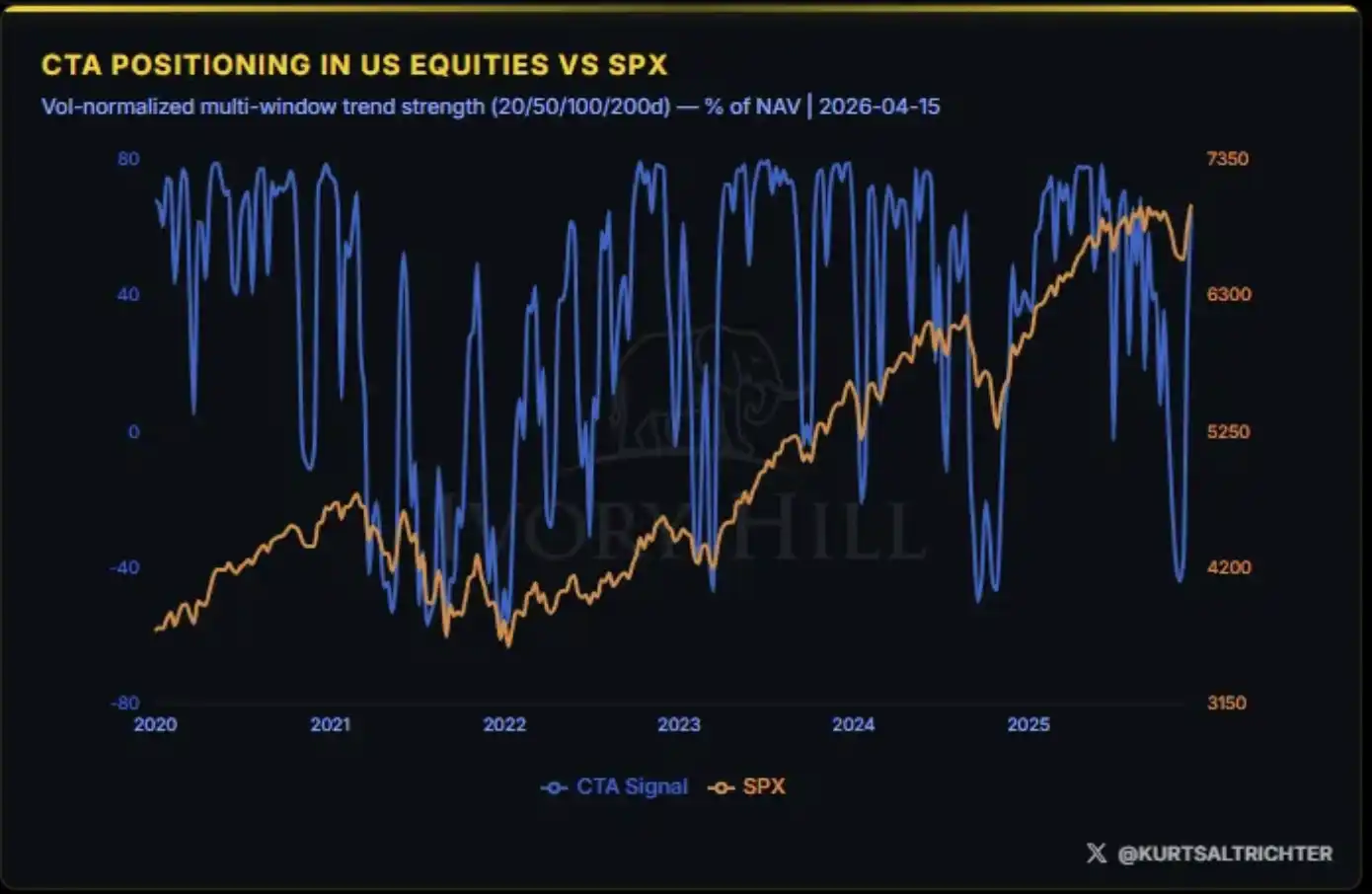
Fundamentally driven rises tend to be more sustainable; whereas momentum-driven rises are generally weaker and shorter-lived. When you are considering adding positions near historical highs, this difference is especially critical. As indicated in the earlier market valuation chart, the current stock market is pricing in a "perfect scenario."
My Actual Judgment
Over the past 10 days, things have indeed improved, which I will not deny. I am not someone who pessimistically predicts without reason.
However, there is still a significant gap between the stock market's pricing and the realities reflected by bonds and crude oil, and this gap has not narrowed. I am closely monitoring this.
Currently, the stock market is at the most optimistic end of the range; while bonds and crude oil are closer to the middle position, reflecting a world where inflation still exists, the Federal Reserve's policy space is limited, and conflicts have not truly been resolved.
This divergence will eventually be corrected, and there are only two paths:
Either a genuine ceasefire agreement is reached, oil prices drop back to around $70, and the Federal Reserve gains clear space for interest rate cuts, ultimately proving the stock market right;
Or, none of this happens, the stock market will retreat, aligning more closely with the levels currently reflected by bonds and crude oil.
From the current situation, bonds and crude oil show no signs of aligning with the stock market; rather, it seems the stock market needs to decline to "align" with them.
The next inflation data will be released on May 12. If my judgment is correct and CPI exceeds 3.5%, then the narrative of rate cuts in 2026 will essentially declare an end.
If you continue to add positions at this level, fundamentally, you are betting that everything unfolds in the most ideal direction: the war ends smoothly, there are no disruptions from "Trump's outbursts"; inflation remains manageable; the Federal Reserve cuts interest rates as planned; corporate earnings stabilize. All four of these conditions must hold simultaneously. Any significant deviation in any of these will likely lead to a swift and severe downward adjustment in the market.
In contrast, I prefer to be patient rather than chase a rally that is "quietly denied" by two key asset classes. If long-term signals point to buying, we will naturally gradually increase positions according to strategy.
And do not forget — the only certainty is that everything will eventually change.
免责声明:本文章仅代表作者个人观点,不代表本平台的立场和观点。本文章仅供信息分享,不构成对任何人的任何投资建议。用户与作者之间的任何争议,与本平台无关。如网页中刊载的文章或图片涉及侵权,请提供相关的权利证明和身份证明发送邮件到support@aicoin.com,本平台相关工作人员将会进行核查。


