The people selling running shoes have also ventured into computing power business.
On April 15, Allbirds, the manufacturer of merino wool sneakers, announced that it would transform itself into an AI computing power company, rebranding as "NewBird AI," with its stock price soaring by 582% by the end of that trading day.
At the time of the announcement, the company's footwear business had just been sold to brand management firm American Exchange Group for $39 million, a mere 1% of its peak IPO valuation of $4 billion less than five years ago.
The story of Allbirds is a standard narrative of brand decline.
In 2016, a pair of merino wool running shoes gained traction in Silicon Valley, positioned as comfortable, environmentally friendly, and minimalist, becoming the standard uniform for tech professionals. In November 2021, it went public on NASDAQ, raising over $300 million in its IPO, with the market giving it a lofty valuation of $4 billion.
The minimalist design and the "eco-friendly" ethical halo perfectly aligned with the aesthetic genes of the tech sector. From Google co-founder Larry Page to former Twitter CEO Dick Costolo, to Apple CEO Tim Cook, and venture capitalists like Ben Horowitz, "internet queen" Mary Meeker, and Jack Ma...


A saying began to circulate in Silicon Valley: "Wherever there are investors, there’s a high chance of seeing a pair of Allbirds."
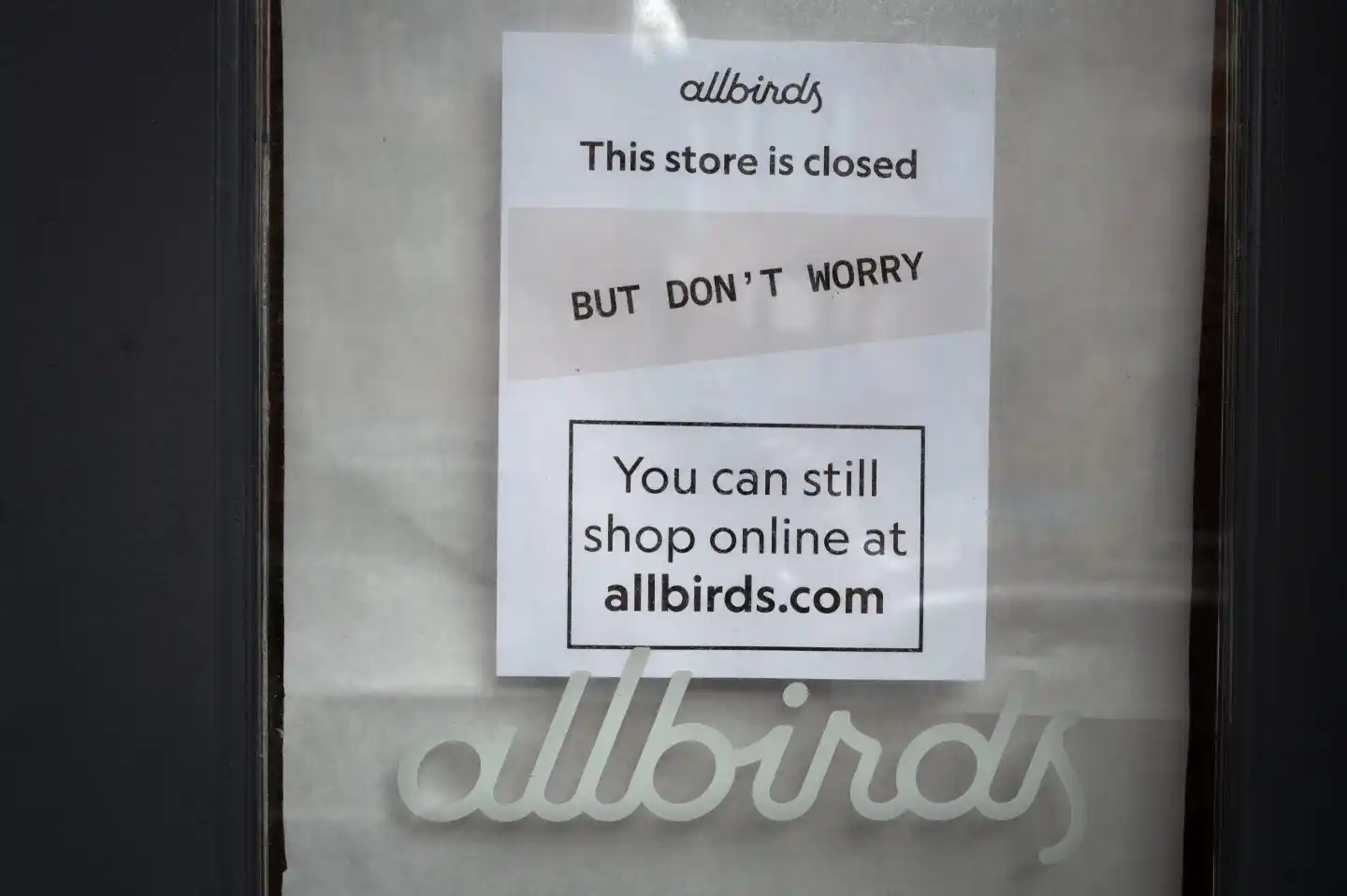
But the trend quickly reversed. The company spent money to expand physical stores and launched non-core products in an attempt to capture Generation Z, but the results were disappointing. Old customers felt it had changed, and new customers didn’t show up. Revenue continued to decline, with a projected net loss of $77.3 million in 2025, and the stock price plummeted by 99% from its peak, becoming a true "penny stock." In February 2026, all full-price retail stores in the U.S. closed down.
The company has died once. What remains is a shell listed on NASDAQ and a few people holding equity.
CEO Joe Vernachio, who took over as the "firefighter" after former co-founder Joey Zwillinger resigned in March 2024, made a radical decision.
Burning bridges with shoes and launching a new brand. After selling its footwear assets, the company has a sum of money from the shoe sale, a NASDAQ listing status, and a willingness to bet on the word "AI."
These three labels may be enough to support a new story in the market environment of 2026.
From Sneakers to GPUs: A Shell's Self-Redemption
The core of NewBird AI is a $50 million convertible bond financing from an "undisclosed institutional investor."
The company plans to use this money to purchase high-performance GPUs to lease them to AI developers and research institutions under a "GPU as a service" model. The wording in the official press release is: "North America's data center vacancy rates are at historic lows, and the computing power expected to be launched in mid-2026 has already been locked in. Enterprises, AI developers, and research institutions are unable to obtain the required computing power through ultra-large cloud vendors or the spot market."
This description of the market reality is true. Supply of high-end GPUs like H100 is indeed tight, with NeoCloud players like CoreWeave and Lambda Labs frantically raising funds to expand production, but the entry barriers are extremely high. The question is, what position can $50 million occupy in this battlefield?
Current rental prices for high-end GPUs remain high, rising about 40% at the beginning of 2026. CoreWeave's latest funding round reached billions of dollars. NewBird AI's $50 million entry is akin to entering a tank battle with just a knife. More critically: Where to buy the GPUs, how to ensure the supply chain, and who will operate the data centers—none of these questions are addressed in the official documents.
The identity of the placement agent is also worth noting. The underwriter for this $50 million convertible bond is Chardan Capital Markets, an investment bank that has extensively operated in the SPAC and reverse merger space. Choosing Chardan is itself a signal; it implies that the structure of this deal is far more complex than mere "internal transformation" and may be closer to a carefully designed "shell merger" operation, just packaged as a narrative of autonomous transformation.
Who Benefits from This Celebration?
There is a cautionary tale in the U.S. market.
In December 2017, the iced tea beverage company Long Island Iced Tea Corp. rebranded itself as Long Blockchain Corp., claiming it would transition to a blockchain business, with its stock price soaring by 380% on the announcement day. In reality, the blockchain business never launched properly, and NASDAQ subsequently delisted it in 2018 for "issuing a series of misleading statements to investors and inflating stock prices through the blockchain craze," after which the SEC officially announced its delisting, with multiple insiders being charged for insider trading.
The transformation of Allbirds bears striking similarities to this script: a publicly listed company with a failed main business, an unverifiable new direction, the hottest buzzword at the moment, and the ensuing stock price frenzy.
Of course, there are differences.
The demand for AI computing power in 2026 is more substantive than that for blockchain in 2017; the computing power shortage is a genuine industry bottleneck, not just a narrative. However, "the demand genuinely exists" and "this company can capture that demand" are two completely different matters.
On May 18, Allbirds/NewBird AI is set to hold a special shareholders' meeting to vote on the asset sale and convertible bond financing. A special dividend is expected to be distributed to registered shareholders in Q3.
This timeline is intriguing. The stock price had already surged 582% on the day of the transformation announcement, jumping from $2.49 to $16.99, with intra-day highs exceeding 800%. A large number of retail investors flooded in due to the news, pushing trading volume to over 150 million shares. Meanwhile, the shareholders' meeting has not yet been convened, all transactions are not officially completed, and the company has no actual operating records of any AI business.
During this window period, who has the most motivation and ability to convert their chips into cash? How is the executive team's equity structure configured, and what are the changes in their holdings before and after the announcement of the transformation? What protections do the convertible bond terms provide to the original investors? These questions remain unanswered in the current public information.
Before the cooling system is installed, the computer is sold first; this is a potential path for the "AI transformation wave" in 2026.
Shells on the Windfall and the Market Below
The story of NewBird AI is a facet of the AI market in 2026.
In the current gold rush for computing power, the real players are NVIDIA, Microsoft, and Amazon, the companies that have poured tens of billions into CoreWeave, and large data center operators backed by national strategic endorsements. But one feature of the capital markets is: wherever the wind blows, the sand will pile up there. With each new concept, a slew of companies rush to label themselves, regardless of whether their main business is selling shoes, iced tea, or something else.
This does not mean every "AI transformation" is a scam, but it also does not mean every "AI transformation" can be successful. The savvy aspect of the market is that sometimes it pushes prices up before a scam lands and vacates before reality hits.
Investors in Allbirds were once captivated by the story of a pair of wool shoes, only to watch as the stock price plummeted by 99%. Now, the same batch of stock code holders may have completely changed hands and are being captivated by another story.
免责声明:本文章仅代表作者个人观点,不代表本平台的立场和观点。本文章仅供信息分享,不构成对任何人的任何投资建议。用户与作者之间的任何争议,与本平台无关。如网页中刊载的文章或图片涉及侵权,请提供相关的权利证明和身份证明发送邮件到support@aicoin.com,本平台相关工作人员将会进行核查。


