Author: RWA Research Institute
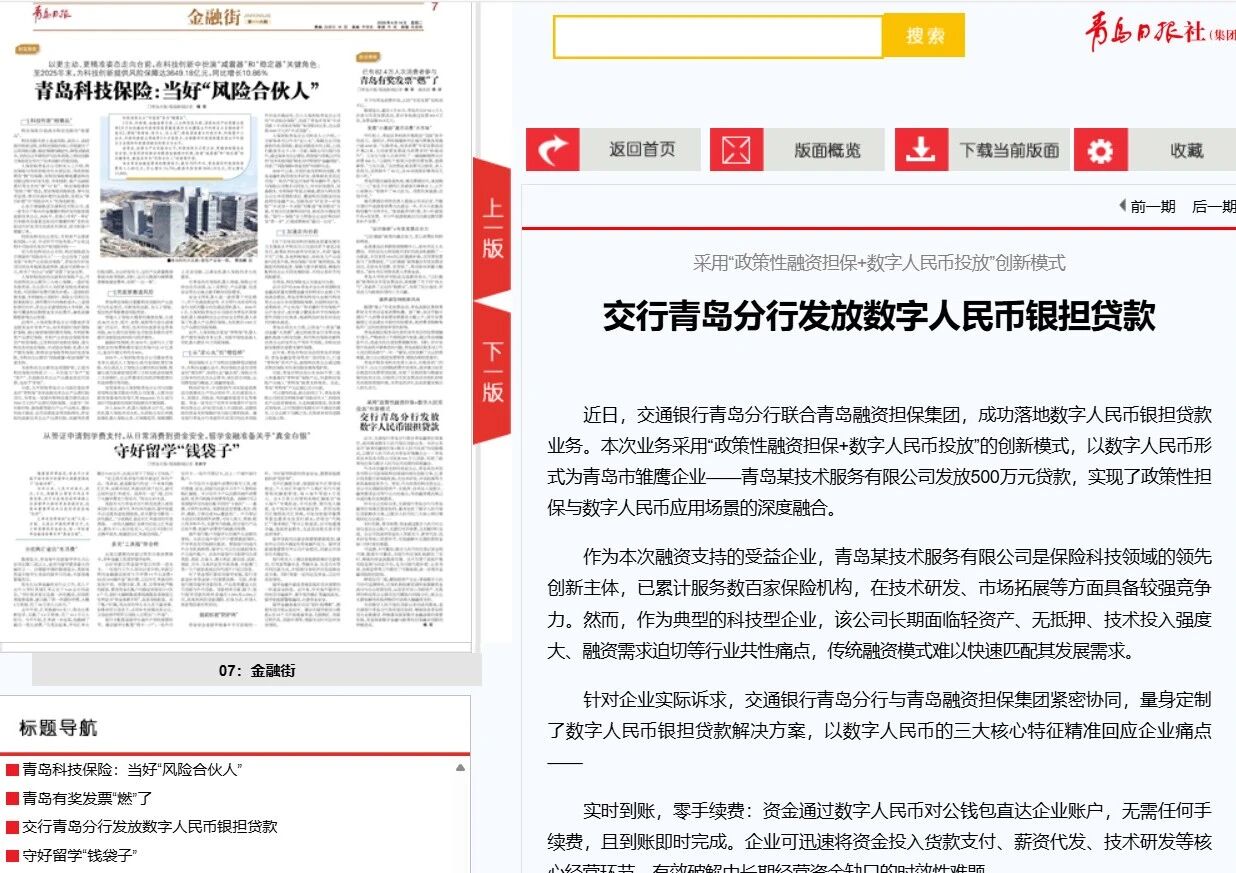
According to a report by Qingdao Finance Daily on April 14, the Qingdao branch of Bank of Communications, in collaboration with Qingdao Financing Guarantee Group, issued a loan of 5 million yuan in digital renminbi to a fledgling enterprise in Qingdao—an insurance technology service company. This enterprise is a typical light asset technology company that has long faced financing difficulties such as lack of collateral and substantial technology investment. During the loan issuance process, the funds were transferred in real time, with zero fees, and the entire transaction was traceable, allowing the company to obtain significant financing without traditional collateral.
The technical elements in this case need clarification. Digital renminbi is a legal digital currency issued by the People's Bank of China, belonging to a centralized management form of fiat currency digitization. Its trust derives from state credit endorsement, and its technical basis is a centralized ledger system led by the central bank. This fundamentally differs from tokenization based on blockchain's distributed ledger, relying on code and community consensus. This article focuses on the value analysis of digital renminbi in corporate credit scenarios, belonging to the realm of digital financial infrastructure research.
The amount is not large, but the structure is intriguing.
Technology has never been the problem; trust is.
1. The "Prisoner's Dilemma" of Light Assets
Before understanding the significance of this loan, it is necessary to clearly see the old problem it faces.
The financing dilemma of light asset technology companies can be summarized in one sentence: those who need money the most often find it hardest to borrow. These companies invest significant funds in research and talent but have a light asset structure, lacking traditional collateral. Banks' risk control models often fail in front of them—not because the companies are not of high quality, but because traditional models cannot comprehend the texture of "human resources and technology as core assets."
This is a typical prisoner's dilemma. Companies need financing to develop but cannot obtain low-cost bank loans without collateral; turning to private lending incurs high-interest rates, further eroding limited profit margins. According to the "Loan Direction Statistical Report of Financial Institutions in the Fourth Quarter of 2025" published by the People's Bank of China in January 2026, at the end of the fourth quarter of 2025, the balance of inclusive small and micro loans was 36.57 trillion yuan, a year-on-year increase of 11.1%, with a growth rate 4.7 percentage points higher than all loans. Data is growing rapidly, but there is still significant room for improvement in coverage and penetration.
The crux of the issue lies not at the funding supply end but in information asymmetry. Banks do not want to lend; they cannot be sure about the security of funds and compliance of usage. This crux is precisely what digital renminbi attempts to unravel.
2. Three Technical Features to Dismantle Three Financing Barriers
Returning to the Qingdao case, its core logic can be dissected into three progressively deepening dimensions.
The first dimension is efficiency. Traditional corporate loans often take hours or even until the next day to approve and release funds. Digital renminbi payments are settled instantly, with funds transferring directly from Bank of Communications' corporate wallet to the enterprise's account, arriving instantly, with zero fees. For a technology company urgently needing funds for R&D and salary payments, time is not just money; it is oxygen for survival.
The second dimension is transparency. This is the most critical layer. The transaction records of digital renminbi are fully traceable, and the data is unchangeable, providing real-time, accurate cash flow data support for banks and guarantee agencies. This means that guarantee agencies no longer need to rely on financial statements provided by enterprises after the fact to assess their operational status, but can directly conduct dynamic assessments through cash flow direction. This penetrating regulatory capability transforms traditional "post-event accountability" into "in-process monitoring," fundamentally reducing credit risk.
The third dimension is credit reconstruction. By leveraging the traceability feature, guarantee agencies can better understand funds' flow and the enterprises' operational realities, thus having more confidence to provide credit empowerment and risk sharing for light asset, non-collateral technology enterprises. Enterprises can obtain significant financing without relying on traditional collateral. This is not a display of technology but a migration of the credit assessment paradigm—from "looking at collateral" to "looking at data flow."
According to a report by Qingdao Finance Daily on April 14, the real-time arrival of digital renminbi, zero fees, and traceable transactions accurately address the pain points of enterprises. This statement succinctly summarizes the internal logic of the three dimensions: efficiency addresses high financing costs, transparency addresses information asymmetry, and credit reconstruction addresses financing difficulties.
3. From "Digital Cash" to "Digital Deposit Currency"
If we place this case within a larger policy coordinate system, its value becomes clearer.
On December 29, 2025, the People's Bank of China officially released the "Action Plan for Further Strengthening the Management and Service System of Digital Renminbi and Related Financial Infrastructure Construction," announcing the implementation of the new digital renminbi measurement framework, management system, operating mechanism, and ecological system as of January 1, 2026. The core adjustment of this document is to upgrade the positioning of digital renminbi from "digital cash" to "digital deposit currency," clearly stating that commercial banks must pay interest on real-name wallet balances and include them in the management of reserve requirements and deposit insurance systems.

The significance of this positioning shift cannot be overstated. Previously, digital renminbi was positioned as a substitute for M0, and banks lacked the motivation to proactively expand scenarios—money in a wallet earned no interest, leading to insufficient holding willingness from customers and limited enthusiasm from merchants. After the positioning upgrade, digital renminbi becomes a liability for commercial banks, allowing them to develop financial management, credit, and other derivative financial products around interest-bearing wallets, shifting the business logic from "passive compliance" to "active operation."
Liu Lei, Deputy Governor of the People's Bank of China, clearly pointed out when explaining the "Action Plan" that the plan clarified the digital solution of "account system + currency chain + smart contracts" and proposed upgrades to the existing account system, promoting the application of emerging technologies based on new types of accounts to enhance the digital and intelligent levels of renminbi issuance, circulation, payment, and other links. This indicates that digital renminbi is no longer just a payment tool but a complete financial infrastructure.
If we view the 5 million yuan loan from Qingdao in this coordinate system, it represents a grounding validation of the "digital deposit currency" positioning in the corporate credit scenario. From payments to credit, the application depth of digital renminbi is opening up.
4. Smart Contracts: From Concept to Infrastructure
Pushing the technological logic one step further inevitably involves smart contracts.
The essence of smart contracts is to write rules into code, allowing the flow of funds to execute automatically based on preset conditions. According to information disclosed by the Digital Currency Research Institute of the People's Bank of China, digital renminbi has entered the 2.0 phase, with operational institutions expanded to 22, and smart contracts have achieved targeted payments and fund supervision in various scenarios. According to Securities Daily on April 6, 2026, loan funds are directly issued to smart contract wallets, where programmable features enable automatic control of usage, real-time capture of flows, and instant triggering of risk controls, promoting the evolution of traditional credit management towards "embedded regulation."
This is not just theoretical. According to information publicly disclosed by the Chongqing branch of the People's Bank of China in November 2025, this bank guided Fumin Bank to use "digital renminbi + blockchain" and smart contract technology to issue a loan of 360,000 yuan to a charging pile company, with the fund usage and repayment processes executed according to preset rules in the smart contract, with relevant data simultaneously recorded on the blockchain. According to a work brief released by the Nanjing Urban and Rural Construction Committee in September 2025, digital renminbi has been used for the payment of wages to migrant workers, with attendance, working hours, and detailed wage information stored on the blockchain, and the platform interfaces with data departments such as construction and human resources can dynamically monitor the flow of funds. According to public reports from the Shenzhen Financial Bureau in December 2025, Southern Power Grid achieved automatic rent payments during non-working hours through smart contract technology, with a total transaction amount exceeding 57 million yuan, marking the first "digital renminbi + smart contract" rent payment business in the Greater Bay Area.
When payment becomes programmable, finance is no longer about post facto accounting but about in-process governance.
These cases outline a clear trend: smart contracts are moving from the proof-of-concept stage to the infrastructure level. For credit scenarios, its core value lies in transforming the supervision of fund usage from being "person watch" to "code watch," significantly reducing compliance costs and moral hazards.
5. The "Chemical Reaction" of Bank and Guarantee Cooperation
Technology is important, but technology is never the whole answer to the problem. The Qingdao loan also involves an important player—policy financing guarantee.
As a government financing guarantee institution, Qingdao Financing Guarantee Group bears the core functions of credit empowerment and risk sharing. In this combination, the guarantee agency provides the variable of "credit," while digital renminbi provides the variable of "data," and their synergy produces a collaborative effect.
In the traditional bank-guarantee cooperation model, guarantee agencies enhance the credit of enterprises, prompting banks to lend accordingly. However, in loan management, guarantee agencies have limited monitoring capacity over the actual flow of funds, often only able to remedy problems after they arise. The traceability feature of digital renminbi changes this situation. Guarantee agencies can obtain cash flow data in real time and accurately, providing a reliable data basis for risk monitoring, dynamic assessment, compensation, business evaluation, and compliance regulation, further strengthening the financial risk prevention line.
This means that policy guarantees are no longer merely "credit endorsements" but are upgraded to real-time data-based dynamic risk management. Banks are also no longer reluctant to lend due to information asymmetry; under the dual guarantee of credit enhancement and data transparency, a service mechanism that encourages lending has a technological basis.
This collaborative model of "policy guarantee + digital renminbi issuance" is an important practice for the Qingdao branch of Bank of Communications to deepen bank-guarantee cooperation and accurately serve the construction of the Qingdao Sci-Tech Innovation Corridor, as well as an active attempt to explore the innovative integration of digital finance and policy guarantees.
6. A New Algorithm for Inclusive Finance
Expanding the view further, the entry of digital renminbi into corporate credit scenarios is essentially providing a new algorithm for inclusive finance.

According to the annual work report on "Bank-Tax Interaction" released by the State Taxation Administration in January 2026, by the end of 2025, national banking financial institutions had cumulatively issued 45.1772 million loans amounting to 15.7 trillion yuan to small and micro enterprises with good tax credit through the "bank-tax interaction" mechanism. This figure indicates that replacing mortgage with credit information has become the mainstream policy consensus and industry practice. The intervention of digital renminbi adds another layer of "data penetrative risk control" on the basis of "information replacing collateral," making the algorithm more precise.
According to the "Digital Renminbi Pilot Progress Report" published by the People's Bank of China in January 2026, by the end of December 2025, the cumulative transaction amount in pilot areas reached 19.5 trillion yuan, processing 3.57 billion transactions and opening 19.08 million digital renminbi wallets. The rapid growth of transaction scale indicates that digital renminbi is accelerating its penetration from retail scenarios to corporate scenarios.
From the policy logic viewpoint, the Central Economic Work Conference held in December 2025 clearly stated the need to guide financial institutions to strengthen support for key fields such as expanding domestic demand, technological innovation, and small and micro enterprises. In January 2026, the People's Bank of China decided to increase the re-lending quota for agricultural and small support to 500 billion yuan. The policy-level support for inclusive finance and technological innovation continues to strengthen, and digital renminbi is becoming the technical channel for carrying these policy intents.
7. Digital Expression of Trust:
From Physical Collateral to Visible Actions
Returning to the initial question: why is a 5 million yuan digital renminbi loan worth repeated discussion?
Because it answers one of the most essential financial questions—how trust is quantified, transmitted, and institutionalized. In traditional financial systems, trust is built on visible and static proofs such as collateral, financial statements, and guarantee endorsements. The reason light asset enterprises find it hard to borrow money is not that they lack value, but because their value cannot be recognized by this traditional trust assessment system.
Digital renminbi brings a new possibility. It transforms enterprises' operational activities into traceable, unchangeable data flows, allowing banks and guarantee agencies to "see" how funds flow and how enterprises operate. Trust is no longer built on static asset inventories but on dynamic behavioral data. This is a shift from "material" trust to "behavioral" trust.
It is essential to clarify that the essence of this trust mechanism is an upgrade of digital monitoring within the traditional financial system, and its source of trust remains state credit endorsement and the risk control judgments of centralized institutions, fundamentally differing from decentralized trust mechanisms based on distributed ledgers and consensus algorithms. Both are addressing the trust problem, but the tools and logic employed are vastly different.
The profound impact of this transformation may far exceed the loan itself. When enough enterprises obtain financing in this way, and when enough banks and guarantee agencies get accustomed to a data flow-based risk management model, the entire infrastructure of the credit system will undergo fundamental changes. The essence of finance is the management of trust, and the trustworthy digital data flow is providing new measurement dimensions for traditional financial trust mechanisms.
The exploration of digital renminbi in corporate credit is just beginning, from Qingdao to Chongqing, from 5 million to 360,000, from guarantee loans to supply chain financing, various pilot programs are weaving together a larger picture. The next step for the Qingdao branch of Bank of Communications is to continue to delve into the field of digital finance, focusing on the financing needs of technology-driven small and micro enterprises, constantly enriching service scenarios and optimizing service models to empower new productive forces with financial innovation, effectively writing the "five major articles" of finance. The end point of this path is not just to help more enterprises borrow more money, but to change the logic of borrowing—from "what do you have" to "what do you do," from "static collateral" to "dynamic credit," from "human governance" to "data governance."
When data is trustworthy, trust has a new scale.
(Note: This article is an analysis of the application scenarios of digital renminbi. The trust mechanism described falls within the realm of traditional financial digital monitoring, with technological pathway differences from asset tokenization based on blockchain.)
免责声明:本文章仅代表作者个人观点,不代表本平台的立场和观点。本文章仅供信息分享,不构成对任何人的任何投资建议。用户与作者之间的任何争议,与本平台无关。如网页中刊载的文章或图片涉及侵权,请提供相关的权利证明和身份证明发送邮件到support@aicoin.com,本平台相关工作人员将会进行核查。


