Just finished reading the anniversary letter released by #MSX. As an early user, I can say I have witnessed the growth of MSX all the way, and it hasn't been easy to hold on!
The past year has been a breakthrough year for the AI derivative market, from cloud computing power, nuclear power to memory chips, optical modules, liquid cooling, and so on. The MSX Research Institute timely launched many quality US stocks, which benefited many of our community partners, for which we are very grateful. 🙏
Next, I want to share my thoughts and feelings after reading the anniversary letter, just a simple chat with everyone. 🧐
The first feeling: the tokenization of US stocks is becoming increasingly compliant!
A year ago, when MSX just launched, many people were mocking and questioning, saying "What's the point of putting US stocks on-chain?" "Isn't it just redundant?" Some also questioned security issues. However, I firmly believe in the integrity of Big Brother B, and I also strongly support the innovative path of RWA. So what happened this year? Let's look at the timeline:
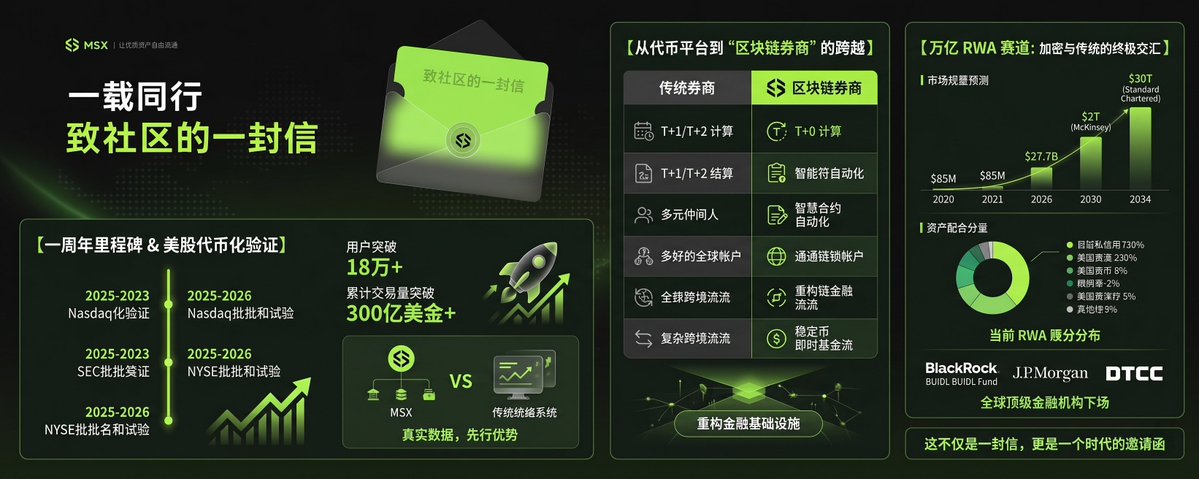
• September 2025, Nasdaq submitted an application for stock tokenization trading to the SEC.
• December 2025, the SEC approved DTCC to launch a pilot for stock tokenization.
• January 2026, the NYSE announced the development of a tokenized securities trading platform to support 24/7 trading.
• March 2026, the SEC officially approved Nasdaq to carry out a pilot for securities tokenization trading.
Nasdaq, the NYSE, and DTCC are essentially the top structures of global traditional financial infrastructure. When they all start to engage in this themselves, the question of "Is it necessary to put US stocks on-chain?" has been answered by the market through action.
As one of the first platforms to take the plunge, MSX has experienced solid growth since the Beta version launched on April 15 last year, with over 180,000 users and a cumulative trading volume surpassing $30 billion. This figure may not be the largest in the overall crypto market, but you must understand that this is real data produced in a field that was considered mere "narrative" just a year ago.
What's more critical is what the MSX team has been doing this year: stepping on pitfalls, validating, honing product details, and establishing compliance structures. These are all moats. When traditional financial institutions truly enter the arena, the first-mover advantage will not be about "launching a year early," but rather the product understanding, user relationships, and operational capabilities accumulated during this year.
The second thought: Why do they position themselves as a "blockchain brokerage" instead of a "US stock token trading platform"?
This is the most enlightening part after reading the anniversary letter.
The pain points of traditional brokerages have never been about "stocks not being tokens," but about the outdated infrastructure behind them: the T+1 or even T+2 settlement cycle, the layers of nested intermediaries, the segmented account systems across countries, slow cross-border remittances, and high account opening thresholds. These are the structural obstacles truly restricting global investors' participation in US stocks.
A "US stock token trading platform" merely changes the form of stocks to trade them on-chain, but a "blockchain brokerage" aims to reconstruct the underlying processes of the entire brokerage business using blockchain technology: deposits and withdrawals, clearing and settlement, asset custody, global account systems, and cross-border capital flows.
For example 🌰:
• You can complete instant deposits and withdrawals using stablecoins without waiting for 3-5 working days for bank cross-border remittances.
• On-chain clearing and settlement replace multiple intermediate steps, enabling T+0 real-time transactions.
• Smart contracts enhance the transparency of custody and settlement.
• A globally unified on-chain account system replaces various countries' segmented brokerage accounts.
This is not a simple "turning stocks into tokens," but "rebuilding global brokerages with a new generation of infrastructure." This logic is strikingly similar to the rise of internet brokerages, which did not change stocks themselves but completely altered how people accessed stocks, shifting from offline service halls to online apps, reducing barriers, enhancing efficiency, and expanding reach.
MSX's ambition is clearly beyond just being a trading entry point; it aims to become a "new type of brokerage" in the blockchain era.
The third extension: Is the RWA sector really as large as imagined?
I specifically looked up some data to provide a reference for everyone. 📊
As of April 2026, the on-chain RWA (excluding stablecoins) market cap reached $28.6 billion, a 300% increase compared to the same period last year. In 2020, this number was merely $8.5 million. In five years, it has grown 325 times.
But this is just the beginning. Let's take a look at the predictions from various institutions:
• McKinsey predicts that by 2030, the market size for RWA tokenization will reach $2 trillion.
• Standard Chartered is more aggressive, predicting that by 2034, the RWA market size could exceed $30 trillion.
• Grayscale believes that certain sub-sectors have the potential for 1,000 times growth.
Why is there such a vast space? Because the total size of global core financial assets (stocks + bonds) exceeds $300 trillion, while currently tokenized assets account for only 0.001% of global financial assets.
Looking at the subdivided sectors, the current on-chain RWA is mainly concentrated in several areas:
• Tokenized US Treasury: $12.98 billion
• Commodities (mainly gold): $7.37 billion
• Private credit: $5 billion (active loans)
• Corporate bonds/funds: $1.8 billion
• Tokenized stocks/ETFs: $1.15 billion
• Real estate: $450 million
The growth of this sector is driven by global top financial institutions such as BlackRock, JP Morgan, Franklin Templeton, and Apollo. BlackRock's BUIDL fund currently has an asset management scale of $2.9 billion and is accepted as collateral by mainstream exchanges like Cryptocom, becoming the first tokenized US Treasury fund accepted by mainstream exchanges.
This means that traditional financial institutions no longer view RWA as an experiment, but rather as a business they are advancing with real money.
#MSX, as a pioneer in the "blockchain brokerage" niche, is standing at the starting point of a trillion-dollar market.
Finally, here are my own judgments: The biggest change in the crypto market over the past two years is not how many times a particular coin has increased, but that the narratives are being validated. DeFi Summer, NFT Summer, GameFi Summer - these trends come quickly and fade just as fast, and most projects ultimately end up in ruin.
But RWA is different; it is not an ephemeral concept, but rather about bringing real-world assets onto the chain, truly creating intersections between traditional finance and the crypto world. When giants like Nasdaq, BlackRock, and JP Morgan start making moves, it indicates that this path is indeed feasible.
MSX has been advancing steadily and rapidly this year, but the future challenges are also evident: regulatory compliance, liquidity depth, user education, and competition from traditional financial institutions. However, one thing I am certain of is that the tokenization of US stocks is no longer a question of "whether it will happen," but rather "who can come out on top."
As an excellent partner that has accompanied us along the way, MSX is worth continuous attention. DYOR 🙏
免责声明:本文章仅代表作者个人观点,不代表本平台的立场和观点。本文章仅供信息分享,不构成对任何人的任何投资建议。用户与作者之间的任何争议,与本平台无关。如网页中刊载的文章或图片涉及侵权,请提供相关的权利证明和身份证明发送邮件到support@aicoin.com,本平台相关工作人员将会进行核查。


