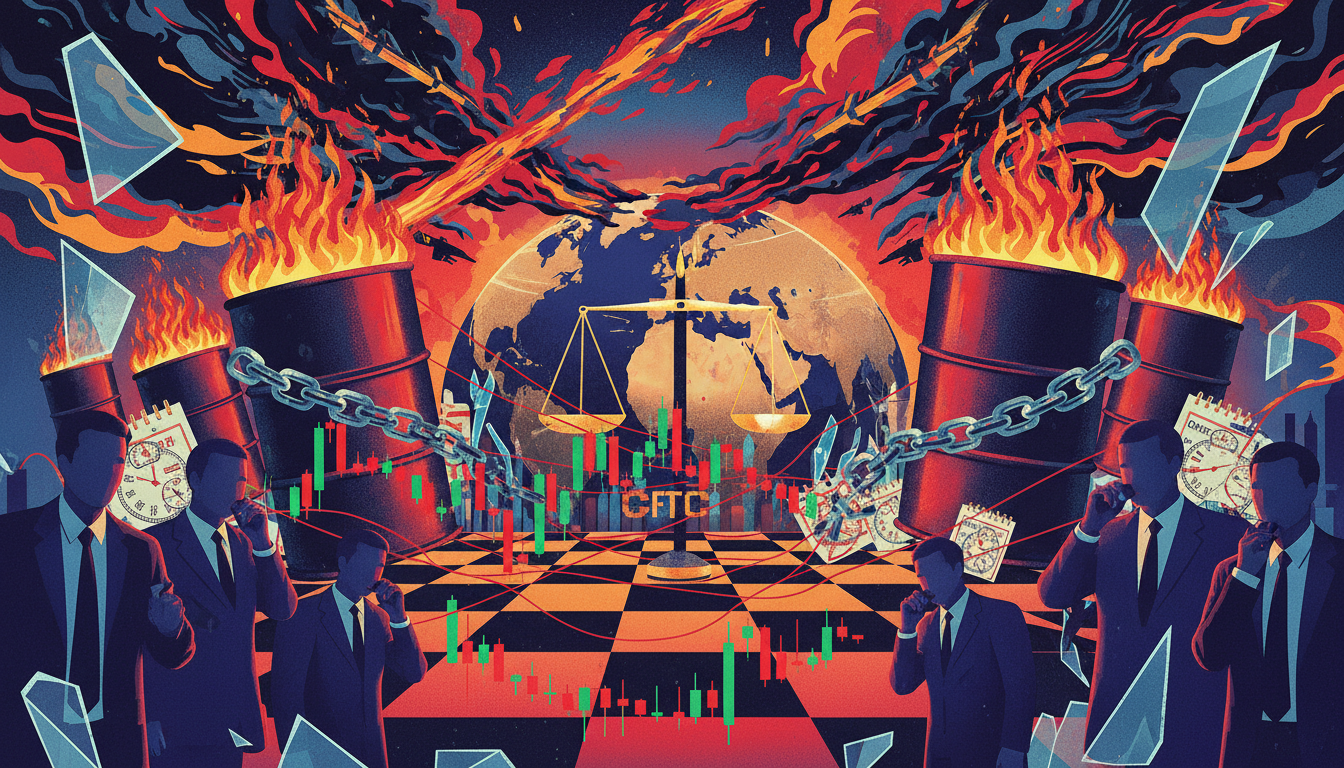
On April 15, 2026, in the same time slice, two seemingly unrelated narratives unfolded in parallel: on one side, BNB Life on the Binance Chain skyrocketed 112% within three days, accompanied by a massive withdrawal of 30 million tokens (approximately $11.4 million) raising doubts about market manipulation; on the other side, the negotiations between the U.S. and Iran tentatively advanced towards extending the ceasefire agreement by two weeks in the aftermath of the attack on Ras Laffan. Localized liquidity showcased traditional strategies of market-making and profit-taking within small-cap tokens, while the global level of geopolitical risk, influenced by disruptions in gas supply and fluctuating expectations of a ceasefire, propelled a mild rebound in mainstream risk assets like the Nasdaq and S&P. The attack on the Ras Laffan LNG facility and the market speculation regarding the extension of the ceasefire were starkly intertwined on this day—one being a price game indistinguishable to retail investors, the other an IMF warning of "broad impacts potentially manifesting in the coming months," both testing the market's understanding of risk and speculative dynamics on different scales.
30 million tokens withdrawn: Life...
The price curve of this phase of BNB Life is notably textbook-like: over three days, it surged from around $0.17 to near $0.36, a total increase of about 112%. This range is not a slow climb but more akin to being forcefully lifted—below lies an unclear fundamental backdrop and circulation structure, above is short-term sentiment easily ignited by narratives. When the price oscillated between $0.17 and $0.36, the market appeared filled with imaginings of a "double your investment" storyline, yet on-chain data suggested an alternative interpretation.
According to a singular source, an account suspected of holding control has approximately 227 million BNB Life tokens, followed by a behavior of withdrawing 30 million tokens to an off-chain wallet, equating to about $11.4 million. This combination of "concentrated chips + large withdrawals" is highly unlikely to occur in mature assets but is quite common in small-cap tokens—where a few addresses essentially function as "liquidity," and once they decide to reposition at high levels, they can significantly sway the price. For ordinary traders, the candlestick chart presents a dazzling story of doubling over three days, but on-chain it writes an unspoken message of "concentrated chips that could be dumped at any moment."
From the perspective of liquidity and holding concentration, small-cap tokens almost inherently carry the "easily manipulable" gene: thin order books, limited pending orders, and large buys or sells can amplify price impacts several times. As long as there is an account far exceeding others in size, its actions can dictate the main theme of the price. BNB Life currently lacks public and transparent disclosure regarding actual circulation, lock-up arrangements, and project fundamentals, leaving the market to speculate within limited on-chain fragments. This asymmetric information is, in itself, one of the most significant "weapons" of manipulators—complex structural designs are unnecessary; just making things unclear enough means they've already won half the battle.
The liquidity trap of small-cap tokens and...
Treating BNB Life as a sample allows for a clearer view of the common liquidity traps in small-cap tokens: a thin order book implies that a slightly larger market order can push the price up or break through multiple levels, creating exaggerated candlestick forms. On the surface, this is a technical signal of "trend initiation," yet it might just be a single fund testing the waters or attempting to manufacture a trend. For retail investors not closely monitoring, seeing large bullish candlesticks in a short period can easily lead them to misinterpret it as "mainstream funds entering," while overlooking the absolute amount behind it isn’t substantial, merely a result magnified by a lack of liquidity.
When chips are highly concentrated in a few addresses, the controllers have enough room to design a "script": first quietly gathering chips during a calm phase, controlling a certain percentage of the circulation; then steadily pushing up the price at lower levels, creating a sustained upward technical formation, fabricating the illusion of a "established trend" through social narratives and pending orders. Once enough high-buy volume gathers in the secondary market, they can execute slow profit-taking at high levels or suddenly dump, completing a real value transfer amid apparent prosperity. The doubling of BNB Life over three days and the withdrawal of 30 million tokens does not necessarily imply immediate dumping but at least demonstrates: any address choosing to do so is fully capable.
For ordinary traders, the greatest temptation of high-volatility tokens lies in the speed of "get-rich stories"—a 112% increase over three days naturally stimulates FOMO, and a few robust bullish candlesticks on the order book can easily distract from the cold variables such as contract holdings and on-chain concentration. Many investors habitually use "order book thickness" and "instant transaction volume" to gauge their sense of security, without realizing that these can be artificially fabricated by manipulators in the short term; and once sentiment shifts from "I want to participate cautiously" to "if I miss out, there won't be another chance," they have already positioned themselves on the side to be harvested.
In a time when regulation and information disclosure are severely lacking, the risk identification in the small-cap sector relies more on personal risk control and position management. What individuals can do is: accept the premise of "possible total loss," limit exposure to single assets, and avoid heavily betting on tokens with a lack of transparency and high holding concentration. However, what individuals cannot achieve is correcting a market structure that is inherently loose and easily manipulated with even the most rigorous risk control. This sense of boundary may deserve more attention than the profit and loss of any single token.
The attack on Ras Laffan to ceasefire renewal:...
Zooming out to the broader macro picture of the same day, the attack on the Ras Laffan LNG facility continues to cast a long shadow over the energy market. According to public information, this facility is linked to about 20% of the global gas supply, implying that a single-point event can create systemic shocks to the global energy chain. The Qatari Finance Minister warned in an interview that "the rise in energy prices is just the tip of the iceberg," and the real concern lies in the second and third effects on supply chains, inflation, and financial markets triggered by this. Echoing this, the IMF also provided a signal: comprehensive economic shocks may gradually unfold in the coming months, rather than being fully priced in on the day the event occurs.
In this context, the negotiations between the U.S. and Iran over the ceasefire agreement are particularly sensitive. What the market can currently confirm is that both sides are considering extending the existing ceasefire arrangement by about two weeks and, under the mediation of parties involved, attempting to initiate so-called "technical talks" to address some key differences. However, the details of the exact date for the original expiration of the ceasefire agreement, the participants in the technical talks, and internal mechanisms continue to lack sufficient details in public channels; including claims from some mediators advocating for an extension of 45-60 days still remain unverified. One thing can be assured: this is a negotiation about time and space, and any hesitation from either side could rapidly be interpreted by the market as "adjusting risk premiums."
More importantly, the details and contentious contents of the ceasefire terms have not been fully disclosed. The outside world is unable to determine what red lines have been crossed, which topics have been temporarily shelved, and cannot ascertain whether more sensitive nuclear-related issues are involved. The incompleteness of information means the market can only adjust risk expectations based on the relatively vague signal of "extending for two weeks," leaning towards optimism in the short term, though mid- to long-term uncertainty has not dissipated. The supply shocks from Ras Laffan, the warnings from Qatar and the IMF, and the struggle over the renewal of the ceasefire agreement form a causal chain from geopolitics to energy prices and then to financial assets, yet the latter half of this chain remains shrouded in fog.
Wall Street's small bullish candlestick: Nasdaq and crypto...
Under the heavy pressure of geopolitics and energy, Wall Street on April 15, 2026, responded relatively gently: the Nasdaq index rose about 1%, and the S&P 500 index increased by 0.4%, a modest small bullish candlestick representing a cautious recovery of risk appetite under high-pressure conditions. The market interpreted the potential for a "two-week extension of the ceasefire" as a relaxation of short-term conflict escalation risks, while considering that extreme scenarios of energy supply have been temporarily postponed, providing a bit of breathing room for tech stocks and broad indices.
This expectation of an extended ceasefire plays a role as a "safety valve" on the emotional level: on one hand, it alleviates investors' concerns about further surges in oil and gas prices, thereby elevating inflation; on the other hand, it prompts signs of retreat in previously crowded risk-off trades due to geopolitical tensions. In such an atmosphere, the overall pricing of risk assets shows a tendency to be "slightly optimistic"—not a large increase, but in an upward direction. In stark contrast is the dramatic pull of small-cap tokens: the doubling of BNB Life over three days and the large withdrawal of tokens from a single address reflect more of a localized game driven by a few funds, rather than a systemic allocation under macro logic.
Traditional stock indices are steadily rising, primarily due to organized and passive capital flowing in orderly; they need to assess the complex chain between the ceasefire process, IMF warnings, energy prices, and corporate profits; whereas in small-cap tokens like BNB Life, prices are often dictated by a few high-risk preference funds, with decision cycles measured in "hours" or even "minutes." This difference in fund nature determines that the former is pricing for the next few quarters, while the latter is pricing for a few candlestick cycles.
At the same time, compliance and mainstream narratives are progressing along another line: Circle's CEO was selected for Time's list of the 100 most influential people, symbolizing that certain roles in the crypto industry have been recognized by the traditional elite system as "important participants within the institution." On one side is an institutional process supported by compliance, transparency, and regulatory frameworks, while on the other side, the small-cap speculative track driven by anonymous on-chain addresses manipulating billions of chips is rapidly diverging. For investors, how to draw a clear boundary between macro risk-relief narratives and localized speculative stories may be more crucial than determining the direction of the next candlestick.
The shadow of manipulation and the dual gamble under ceasefire expectations
Shifting the view back to the overall picture: the cloud of control over BNB Life reflects the micro-risk of high concentration and easy manipulation at the token level; the U.S.-Iran ceasefire negotiations reflect how global geopolitics injects uncertainty into all risk assets. On one side is 227 million chips concentrated in a few addresses, and the suspense brought by 30 million tokens being withdrawn at once; on the other side stands the wobbly framework of "extending for two weeks" regarding the ceasefire, alongside the IMF's warning of a potential "broad economic shock" over the coming months. Together, they intertwined on April 15, 2026, into a picture: localized speculation and macro uncertainties leveraged at different dimensions simultaneously.
The current market seems to be in a phase of "over-amplifying both micro positives and micro risks": the expected two-week extension of the ceasefire is enough to propel the Nasdaq to rise 1% and the S&P to rise 0.4%; a small-cap token doubling within three days is sufficient to attract significant attention, overlooking its underlying concentration and liquidity risks. The IMF's warning reminds us: real shocks often do not get fully priced in on the day the news headlines emerge, but rather gradually sediment in the following months via earnings expectations, credit spreads, and capital flows. Comparatively, those price surges completed within hours resemble fleeting bubbles in the macro ocean.
For participants, the key lies in distinguishing between structural opportunities and short-term speculative traps. The rebound driven by geopolitical easing is more a correction of prior risk premiums rather than the start of a new cycle; similarly, small-cap tokens like BNB Life, even if they leverage momentum to achieve stunning gains, possess far less inherent sustainability than mainstream assets. Investors must recognize the emotional boost from the ceasefire expectations, but also be aware that the details of the agreement remain unclear, and contentious issues unresolved, raising the potential for sudden negative amplification at any moment.
In the coming weeks, the trajectory of U.S.-Iran ceasefire negotiations will directly influence energy price trajectories and macro risk appetite; simultaneously, on-chain capital flows will continue to vote on these macro signals in a higher frequency manner. If the ceasefire can be continuously extended, some risk premiums will continue to unwind, benefiting the performance of the Nasdaq, S&P, and leading crypto assets; if negotiations falter or even break down, it may trigger a new wave of risk-off flows. In small-cap tokens like BNB Life, funds may still leverage any macro sentiment fluctuations to tell new stories of soaring and plummeting prices—just that, amidst the dual gamble of manipulation shadows and ceasefire expectations, distinguishing players from chips remains a question worth repeatedly asking by every participant.
Join our community to discuss and grow stronger together!
Official Telegram community: https://t.me/aicoincn
AiCoin Chinese Twitter: https://x.com/AiCoinzh
OKX welfare group: https://aicoin.com/link/chat?cid=l61eM4owQ
Binance welfare group: https://aicoin.com/link/chat?cid=ynr7d1P6Z
免责声明:本文章仅代表作者个人观点,不代表本平台的立场和观点。本文章仅供信息分享,不构成对任何人的任何投资建议。用户与作者之间的任何争议,与本平台无关。如网页中刊载的文章或图片涉及侵权,请提供相关的权利证明和身份证明发送邮件到support@aicoin.com,本平台相关工作人员将会进行核查。