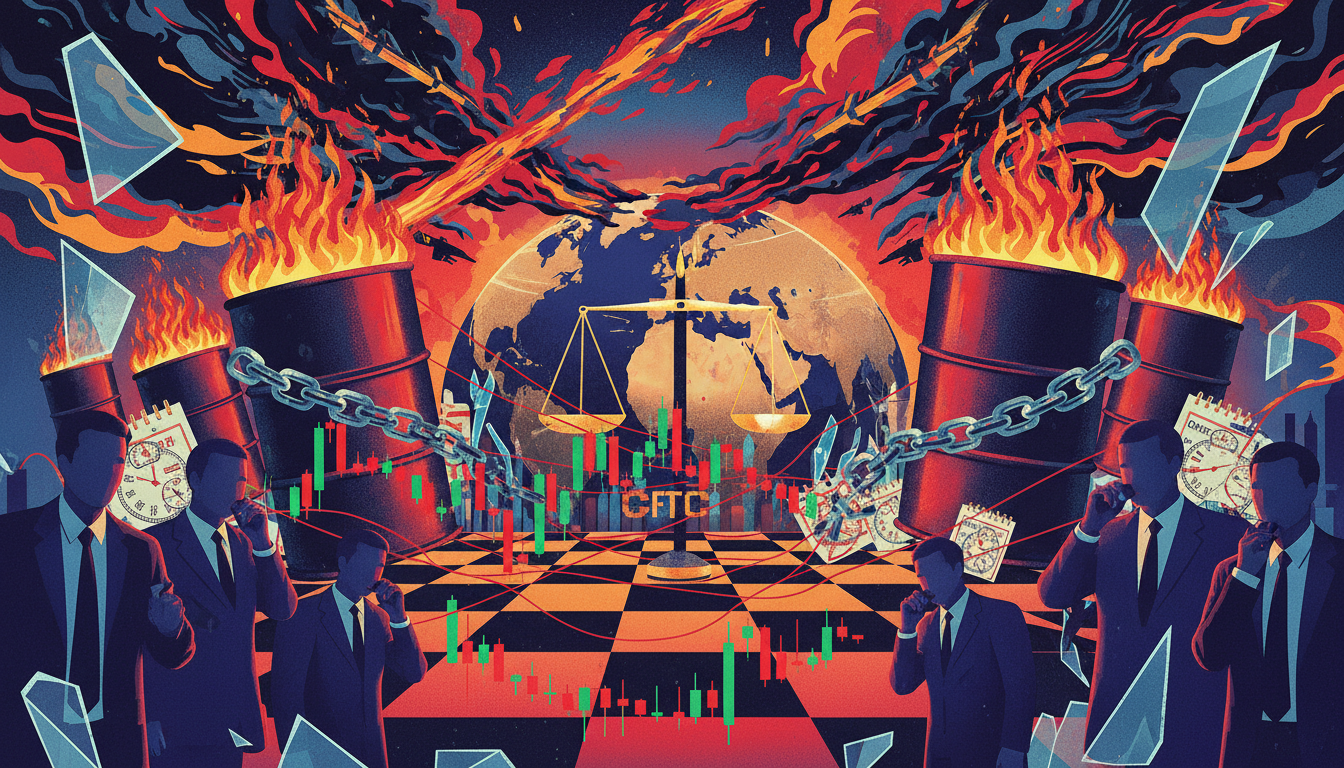
On April 15, 2026, at 8:00 AM Beijing time, Chief of Army Staff Asim Munir of Pakistan led a senior delegation to Tehran, confirmed by Iranian media to be "carrying messages from the United States." This rare move brought the second round of US-Iran negotiations to the forefront. The core contradiction is not an abstract "reconciliation," but is remarkably technical, concerning the life-and-death issue of the uranium enrichment freeze deadline—how long to freeze and how to regulate will determine how both sides recalculate risks and benefits. At the same time, data on the 91,300 barrel decrease in US EIA crude oil inventory was released, with supply tightening and geopolitical uncertainties fermenting together, leading to subtle re-evaluations in oil prices and the risk pricing behind inflation expectations. The question is: when a Muslim nuclear state, claiming to be neutral and maintaining channels with both the US and Iran, steps up as a "messenger," to what extent can such mediation suppress Middle Eastern geopolitical risks and then support risk assets including cryptocurrencies and the stock market?
Munir's Arrival in Tehran: The Tension Before the Second Round of Negotiations
On April 15, Asim Munir led the Pakistani senior delegation to Tehran, just days after the failure of the first round of US-Iran negotiations on April 11-12, almost a direct sequel to an unfinished game. Iranian media quickly confirmed the visit, clearly mentioning that one of their tasks is to coordinate around the second round of US-Iran negotiations. This public report outlines a verifiable timeline for the outside world: first round negotiations ended without agreement—brief silence—followed by a second round led by high-ranking military officials carrying “US messages” on the eve of the negotiations.
Regarding "carrying US messages," current public statements remain at the principle level, emphasizing that Pakistan plays a role in conveying and coordinating, without disclosing content details or touching on the specific positions and ranks of delegation members, leading to a gap in available information where the outside world can only infer its symbolic meaning within the confirmed facts. The first round of negotiations from April 11-12 have been confirmed by multiple parties as "not reaching an agreement," with the market generally pointing to the key issue being the uranium enrichment freeze deadline: the US hopes to lock in the future space of Iran's nuclear program, while Iran aims to retain reversible technology and time buffers. This structural contradiction is unlikely to be bridged in a short period. Munir's trip seems more like a "pre-processing" of the parties' bottom lines and wording rather than bringing a final document on-site in Tehran.
Uranium Enrichment Deadline Tug-of-War: The Security Calculations of the US and Iran
What makes it difficult for Washington and Tehran to take a step back is their completely different security perceptions regarding the uranium enrichment freeze deadline. For the US, the question is not what Iran is doing today, but what it could do in the future—if Iran maintains high levels of uranium enrichment capacity for a considerable duration, even if it temporarily does not cross the nuclear weapon threshold, it could quickly achieve a "breakthrough" in times of crisis. Therefore, the longer the freeze deadline, the more the US can "sleep soundly" within a foreseeable political cycle; conversely, a deadline that is too short appears to Washington as setting a fuse for a far more uncontrollable confrontation.
Trump's public statement—"Iran cannot have nuclear weapons"—in this context was not just a political slogan, but engraved the red line of the US into the archives of international public opinion. Here, “cannot” is interpreted by many observers as encompassing both actual possession and the proximity of a state of "being able to possess at any time" in terms of technology and time. In other words, how long to freeze and to what technical level directly determines whether this red line is considered breached.
For Iran, however, the issue is another calculation: under multiple rounds of sanctions and regional containment pressures, nuclear activity space is not only a technical issue but also a bargaining chip and safety insurance. A too long freeze period means actively weakening its own deterrence and bargaining power without gaining equivalent security and economic returns; conversely, by advocating for a shorter and more flexible freeze timeline, Iran can reassess its path amid regional changes, using its nuclear program as a strategy that can be "scaled up" at any time. If the second round of negotiations continues to get stuck over the deadline issue, the market will see this as a signal for an upward trend in Middle Eastern geopolitical and energy risk premiums: oil prices will be repriced due to supply and disruption expectations, and related inflation expectations and safe-haven demands will also rise accordingly, with risk assets potentially experiencing a magnified "discount" in short-term fluctuations.
From Observer to Broker: Pakistan's Role and Stakes
Pakistan's ascent to prominence at this moment relates to its long-standing special position between the US and Iran. On one hand, Pakistan possesses traditional security and aid ties with the US, and communication channels with the military have proven crucial during multiple regional crises; on the other hand, it maintains complex and lasting interactions with Iran in religious culture, border security, and energy cooperation. This dual embedding provides the formal conditions for it to act as a communication bridge, but it cannot be viewed as a completely "neutral" and detached arbitrator.
As a Muslim and nuclear state, Pakistan's "messaging" inherently carries a certain symbolic credit: it understands the significance of nuclear capability for national security at least technically and knows how to balance between nuclear deterrence and external pressures, giving it the ability to contextualize when relaying the US position to Iran. However, this credibility also has its limits—Tehran cannot overlook the security entanglement between Pakistan and the US; for Washington, Islamabad's ties with other regional actors create another layer of uncertainty. Therefore, the role of Munir's delegation appears more like "colored lenses" rather than a transparent channel.
The involvement of a military-led delegation rather than a purely diplomatic system itself sends a strong signal: negotiations have evolved beyond a text game for technical officials, touching upon how security agencies assess future threats at their core. The military system’s direct engagement in information transmission can be viewed as a pragmatic posture from both the US and Iran seeking to clarify security concerns, but it may also be interpreted by some observers as a preparation under a crisis management model—how to find a buffer between "controlled tension" and "uncontrolled escalation" when written agreements falter. If Pakistan can assist in pulling the US and Iran back from the brink during this mediation round, its voice and security bargaining power within South Asia and the broader Muslim world could see structural enhancement.
Reduction in Oil Inventory and Risk Assets: Pricing Gaps Under Geopolitical Shadows
On the same timeline as Munir's delegation's arrival in Tehran and the brewing atmosphere for the second round of negotiations, the US Energy Information Administration (EIA) reported a reduction of 913,000 barrels in oil inventory. This number, while not extreme in itself, is interpreted by the market as a signal of supply-side and risk expectation overlap within the context of geopolitical tension. A decline in inventories suggests that, with demand not yet significantly retreating, the buffer is thinning, and should US-Iran negotiations deteriorate affecting critical passages like the Strait of Hormuz, both the space and speed of rising oil prices will be re-evaluated.
The slight reduction in inventory, combined with uncertainty around negotiation results, heightens the imagination of inflation rearing its head again: if oil prices significantly rise driven by geopolitical premiums, previous tightening efforts by central banks may be partially offset, with interest rate expectations and asset discount models recalculating accordingly. In such an environment, the performance of risk assets becomes dichotomous—on one hand, risk-averse sentiment elevates preferences for stable cash flow assets; on the other hand, voices in the market suggest that "the worst-case scenarios have been priced in." Tom Lee, chairman of Bitmine, publicly stated, "Risk assets have bottomed out amid geopolitical conflict," attempting to bestow an optimistic interpretation of current volatility as a "bottom range repricing."
For typical risk assets like cryptocurrencies and the stock market, the uncertainty surrounding US-Iran negotiations is both a source of volatility and a narrative catalyst: each turn of events magnifies price gyrations within liquidity and leverage structures. If the market believes that geopolitical conflicts primarily affect oil prices and localized inflation, rather than evolving into a systemic financial crisis, then the logic of "buying on dips" may come to the fore in a high-volatility environment; conversely, if a breakdown in negotiations is seen as a prelude to regional conflict escalation, then the discount for risk assets may be far from over.
Narrative Fork: Nuclear Negotiations, Tech Acquisitions, and Self-Custody Urge
Interestingly, beyond these traditional macro variables of US-Iran nuclear negotiations, oil inventory, and geopolitical pricing, an apparently unrelated event has emerged on the same timeline—eToro’s acquisition of self-custody wallet provider Zengo. On the surface, this represents a merger within the fintech and cryptocurrency industries; structurally, it resonates with the current reshaping of global investors' risk perceptions: as the competition between countries intensifies, the question of who truly holds the assets and whether they can seize control in extreme situations becomes increasingly urgent.
The classic narrative around geopolitical risks focuses on oil prices, exchange rates, and capital flows, while the self-custody wave shifts the focus toward asset sovereignty and technological security: in extreme situations, will accounts be frozen, will cross-border transfers be hampered, and will clearance infrastructures be cut off? These issues were often viewed as "doomsday scenarios," but are continually validated in the reality of geopolitical confrontation and sanctions chains today. This is precisely why, as uncertainties in the Middle East rise and prospects for ceasefires become murky amid nuclear negotiations, some funds begin to place greater emphasis on on-chain security, key management, and decentralized custody solutions as a hedge against sovereignty risks.
The eToro-Zengo merger does not determine the direction of the US-Iran negotiations, but lays a narrative groundwork for subsequent discussions: regardless of the outcome of the negotiations, geopolitical turbulence continues to educate the market—focusing not just on asset prices but also on the ownership and control paths of assets. Once this self-reinforcing self-custody narrative overlaps with the next round of macro volatility, the "sense of infrastructure security" in the cryptocurrency industry may become an increasingly important hidden variable when choosing targets for capital allocation.
The Ceasefire Clock and Chip Game: Next Steps for the US, Iran, and the Market
In summary, Pakistan’s high-level military-led visit to Tehran, carrying US information prior to the second round of US-Iran negotiations, represents more of a marginal adjustment within the existing game structure: it is unlikely to single-handedly rewrite the fundamental structure of US-Iran confrontation but may help both sides find several "acceptable but not ideal" compromise solutions regarding wording, timelines, and technical details, thereby slightly reducing the probability of a breakdown. In this sense, Islamabad plays the role of a buffer and lubricant, rather than a designer of the chessboard.
It is important to emphasize that information around critical deadlines like the ceasefire duration still contains uncertainties. The April 21 ceasefire expiration date mentioned in research briefs remains to be cross-verified, without being regarded as an established fact or undergoing excessive speculation based on it. For the market, what truly matters is not a specific date, but whether all parties are willing to avoid "unannounced escalations" within the window period, leaving space for negotiations and risk repricing.
On this basis, a few scenario paths can be roughly outlined: if negotiations achieve breakthroughs on the uranium enrichment freeze deadline, geopolitical premiums for oil prices may temporarily ease, inflation expectations may be alleviated, and risk assets may find upward channels amid high volatility; if negotiations drag on without a complete breakdown, the market may oscillate in uncertainty over prolonged indecision, with oil prices and risk assets presenting staggered fluctuation patterns; conversely, if a breakdown in negotiations is seen as a signal for regional conflict escalation, oil prices and traditional safe-haven assets as well as some tools with a “digital gold” narrative may strengthen, while cyclical risk assets and high-leverage directions may face a new wave of deleveraging pressures.
Regardless of the path taken, the main narrative unfolds around three intertwined dimensions: whether a neutral mediator can continue to play a buffering role, whether the technical negotiations on nuclear deadlines are controllable, and how the market can reallocate premiums between oil prices and risk assets. In the coming weeks, where these three narratives resonate, prudence may prove more important than determining bullish or bearish directions—understanding the uncertainties surrounding game structures and timelines may offer investors greater practical value than betting on a singular outcome.
Join our community, let's discuss together and grow stronger!
Official Telegram community: https://t.me/aicoincn
AiCoin Chinese Twitter: https://x.com/AiCoinzh
OKX welfare group: https://aicoin.com/link/chat?cid=l61eM4owQ
Binance welfare group: https://aicoin.com/link/chat?cid=ynr7d1P6Z
免责声明:本文章仅代表作者个人观点,不代表本平台的立场和观点。本文章仅供信息分享,不构成对任何人的任何投资建议。用户与作者之间的任何争议,与本平台无关。如网页中刊载的文章或图片涉及侵权,请提供相关的权利证明和身份证明发送邮件到support@aicoin.com,本平台相关工作人员将会进行核查。