Original author: Changan, Amelia I Biteye content team
What? Someone used AI to trade cryptocurrencies and made 480 times their investment in 8 days?
In the past, financial markets were hunting grounds characterized by information asymmetry. Retail investors lacked capital, but even more so lacked the computing power to process massive amounts of data, the energy to stay awake 24 hours, and the discipline to resist human greed.
Now, AI has become that "lever of Archimedes." As long as your logic is correct, AI is the tenfold leverage that helps you pry open your wealth.
Below are the hard-core AI practical applications in four major financial markets. 👇
🌟Perpetual Contracts: From 100 to Hundreds of Thousands, the Power of Rule Execution
📌 Case Review
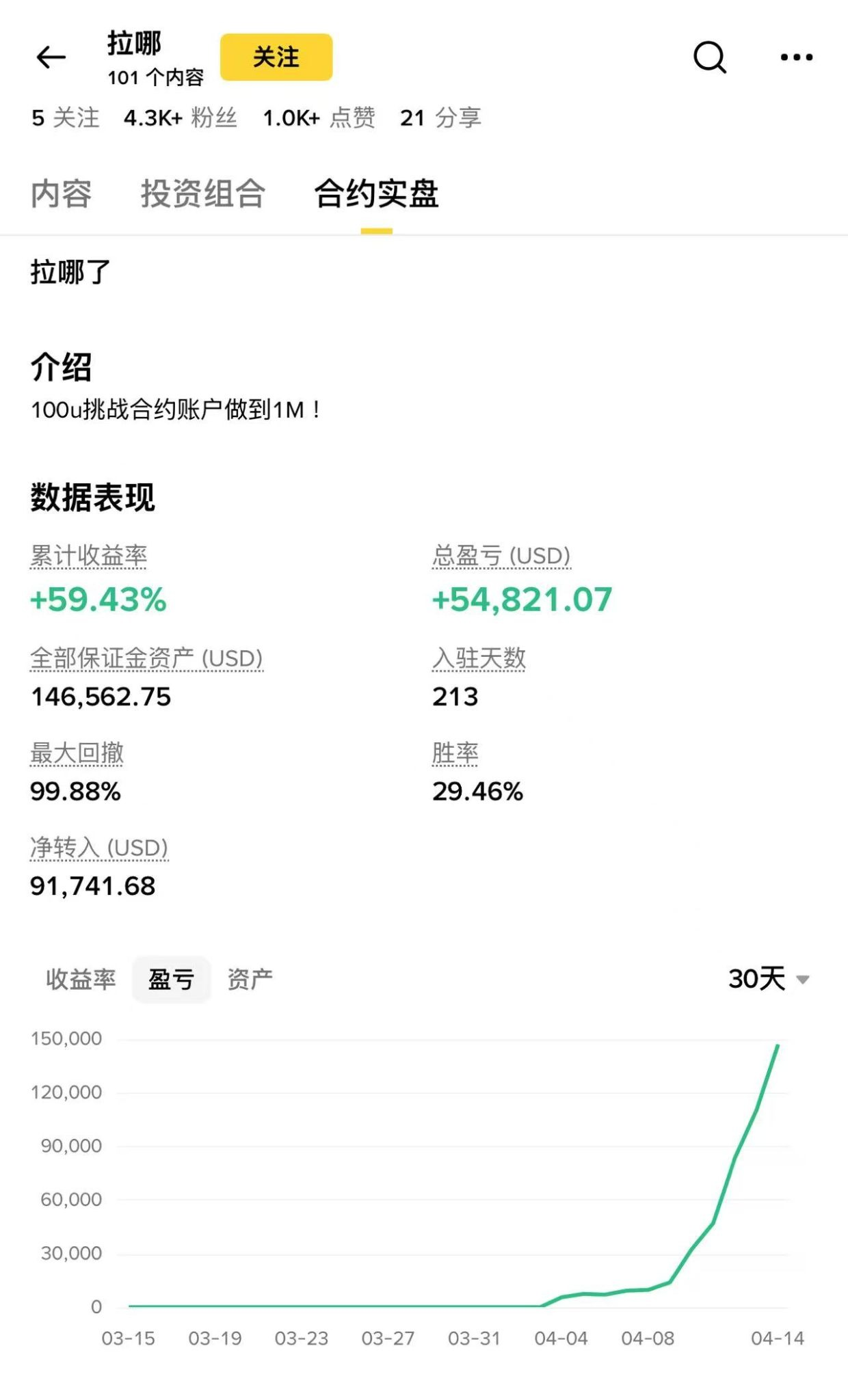
Lana had Claude write a script: it fetched the most popular posts on Binance's forum, filtered out bot accounts, and identified the most volatile assets on the gainers list—buy and set a stop loss. The entire process was fully automated by AI. In 8 days, the account grew from 100 USDT to 48,000 USDT. As of April 14, Lana's Binance live account profit had reached 146,000 USD.
Simultaneous experiments (Nof1.ai and Aster) also confirmed: AI systematically outperformed humans in risk control—no emotional over-leverage, no panic stop losses, no greedy chasing of highs. Absolute returns may not be top-notch, but the advantage lies in not making big mistakes and not losing a lot.
🧠 Methodology Summary
1️⃣ Information Filtering
He had Claude write a script to automatically fetch the highest posts daily by volume on Binance's forum and identify the assets with the most discussion. The forum is where retail investors gather information; his logic was that before the manipulators raised prices, they must first have fish, and the forum popularity is an early signal for retail investors to enter.
2️⃣ Signal Identification
Based on forum data, he laid on top the gainers list. Instead of looking for the coins that increased the most, he sought the coins with the most volatility: high volatility signifies active capital movement, and where there is capital movement, there are trading opportunities. He also monitored assets where the Open Interest changed significantly within 48 hours but the price did not react immediately, as these often indicate signals of capital pre-positioning.
3️⃣ Style Distillation
He distilled his Twitter style and content from KOLs like the forum main poster into it, allowing AI to learn their posting logic and coin selection reasoning, assisting in judging market sentiment and trending directions.
When he asked AI why it chose a certain coin, AI replied that it was because the post with the highest traffic was shared by CZ, and that post mentioned the book "Binance Life," which was the hottest topic of the past three days.
4️⃣ Rule Execution
After buying, he set a stop loss and posted on the forum, capturing profit images to maintain interest. The rules were defined by him: initially a 20% stop loss, later changed to regardless of the position size, a loss of 200 USDT would trigger a stop loss, pursuing only one direction and not counter-trending, with AI responsible for execution.
💡Biteye Perspective
- In the entire process, AI did the writing of scripts, data fetching, and posting. The trading strategy was hers; AI merely automated these tasks. In the contract market, the ability to execute rules more steadily than others is itself an advantage.
- Action Strategy: First, write down your stop-loss rules: at what loss to exit, which direction to pursue, not to counter-trend. The framework can borrow from Lana's, but the strategy must be your own.
🌟Prediction Market: Arbitrage + Information Discrepancy + Automation
Prediction markets (like Polymarket) have simple rules: each question has a Yes/No outcome, and prices range from 0 to 1 representing probabilities.
🧠 Methodology Summary
The community profits using AI in three areas:
1️⃣ Arbitrage
In the Neg Risk market, using AI scripts to periodically scan the total Bid prices across all Neg Risk markets, automatically filtering opportunities greater than 1, executing Split + sell.
2️⃣ Narrowing Information Discrepancy
Using the open-source project worldmonitor to aggregate over 435 global news sources across 15 categories including military, economy, geopolitics, disaster, and finance. AI compiles these information streams into briefs in real time while executing cross-signal correlation analysis. Anticipating leading signals of events like geopolitical issues.
3️⃣ Strategy Automation
Describing one's trading judgment framework in natural language to AI, allowing AI to convert it into an executable script. The script automatically monitors triggering conditions, calculates position sizes, and executes orders according to strategic logic.
💡Biteye Reflection
Arbitrage requires a technical foundation, while information discrepancy is more suitable for novices: start by saving worldmonitor, spend 10 minutes daily reading the briefs, and try small positions on events you can judge.
The key to information discrepancy arbitrage is "leading signals": do not chase news, but focus on the changes in non-mainstream data sources before the news breaks.
Strategy automation is an advanced form: once you have a stable manual framework that generates profits, then consider using AI to turn it into a program.
🌟Crypto Spot: K-line Large Model, Turning Charts into Probabilities
In addition to events and narratives, AI is also bringing revolutionary changes to the technical aspects of spot trading.
📌 Case Review
The hot GitHub project Kronos tokenizes OHLCV data and pre-trains on historical data from multiple markets using autoregressive Transformers. Retail investors no longer need to memorize dozens of patterns—the model directly provides the future 24-hour increase probability for BTC/USDT, the volatility amplification probability, and Monte Carlo simulation paths. The project enables fine-tuning, allowing further training with your own asset data.
🧠 Methodology Summary
The reason large language models can understand text is because they learn the statistical relationships between words across massive amounts of text. Kronos applies the same logic to K-lines: it first uses a specially designed tokenizer to convert OHLCV data into discrete token sequences, and then pre-trains autoregressive Transformers on these tokens.
The training data covers historical data from 45 exchanges worldwide. After its launch, the project's GitHub stars quickly surpassed 11,000, with over 2,400 forks.
In the past, retail investors had to memorize dozens of forms and repetitively add indicators, ultimately relying on personal experience to decide. Now the path has fundamentally changed; you do not need to practice reading charts intensively; you can rely on a model that has been pre-trained on massive multi-market data to extract signals.
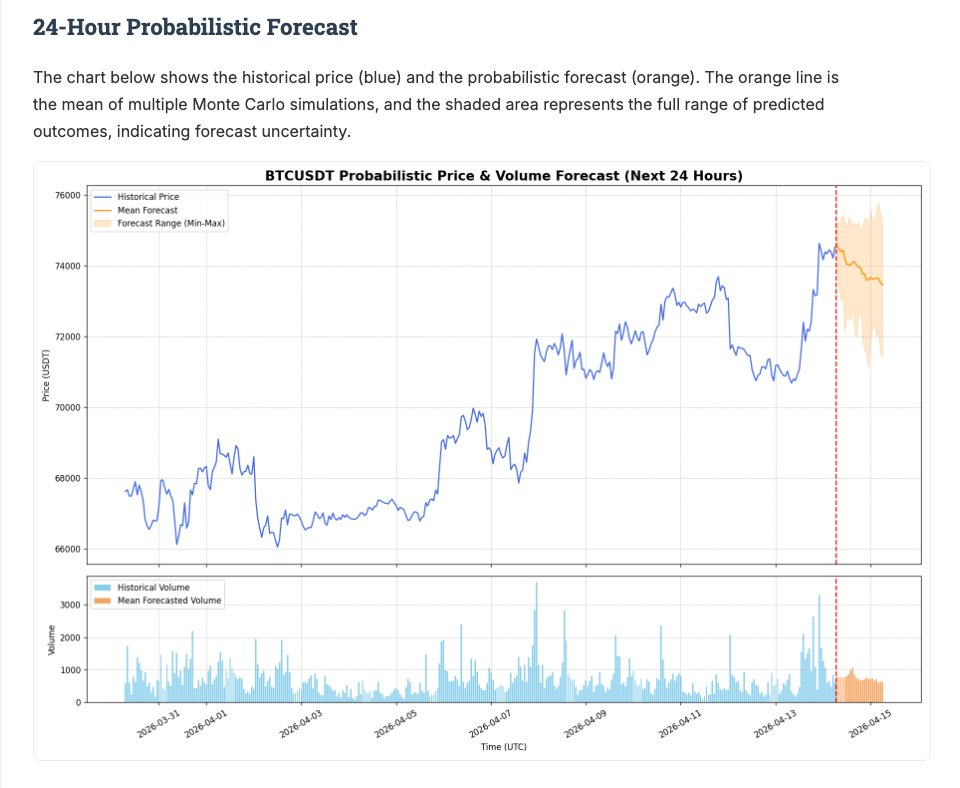
The project also opened a complete fine-tuning process, allowing you to continue training with specific asset historical data, making it more attuned to your trading targets. Additionally, a live demo showing BTC/USDT's future 24-hour predictions is available for anyone to access and see real-time forecasting results; the model provides the probability of an increase in 24 hours, the volatility amplification probability, along with a 24-hour probability forecast graph below: the blue line represents historical prices, while the orange line is the average predicted path from multiple Monte Carlo simulations.
💡Biteye Perspective
- No need for intensive practice of technical analysis: in the past, one had to recall dozens of formations and stack numerous indicators; now, one can directly use model output as reference.
- Observe first, then trade: watch the Kronos live demo once a day, comparing model predictions with actual trends to cultivate “probability thinking.”
🌟US Stock Market: AI Agent Monitoring Geopolitical Crises, Capturing Expectation Gaps
📌 Case Review
XinGPT (@xingpt) built a geopolitical crisis monitoring system using AI Agent. At that time, the market's focus was on the Strait of Hormuz, with a lot of noise. His agent directly monitored first-hand data sources: JMIC ship traffic, Iranian official news agency, maritime intelligence sources, capturing core metrics every six hours—“the actual number of ships passing through the strait.” This figure dropped from 153 ships per day to single digits, indicating that the situation had not genuinely eased. Based on this, he held onto oil ETFs since March 7, weathering the pullback, until Brent crude oil rose from 87 dollars to over 100 dollars.
🧠 Methodology Summary
- Information Source Planning: First, identify high-quality, low-noise first-hand data sources (official institutions, maritime data, local news agencies), rather than letting AI blindly crawl the entire internet.
- Core Metric Capture + Noise Filtering: Focus only on the most honest indicator (ship traffic), setting up a Flash Alert mechanism and ignoring market noise.
- Decision Framework Automation: Write a separate “Investment Decision Skill” for the Agent, generating a daily report with signals and position recommendations automatically every morning.
💡Biteye Perspective
- The framework is more important than the tool: first choose a sector you can track long-term (AI, semiconductors, energy), then find a reputable investment bank research framework, and finally use Claude to help you build a daily briefing.
- Focus on one core metric: do not try to monitor all variables. Find the most reflective indicator of the real situation, akin to "ship traffic."
- Making money in the US stock market depends on information processing speed and expectation gaps: retail investors often struggle to digest earnings reports, macro data, geopolitical events, and industry intelligence promptly and comprehensively, but AI can process massive amounts of information within minutes, identifying market opportunities that are not yet fully priced in.
🌟In Closing
Previously, financial markets were distant from the average person, with information asymmetry, insufficient capital, unaffordable tools, and slow accumulations of experience.
Now, AI has almost entirely erased the once unattainable technical barriers; you only need to tell AI your logic in natural language, and it can help you write scripts, fetch data, analyze, and execute.
Lana made 480 times her investment in 8 days; Teacher Jiang managed to steadily profit amid macro crises; ordinary people can also use models like Kronos to turn K-lines into probability forecasts. These tasks that once only professional teams could accomplish can now be done from home with just a computer by beginners.
AI does not bring the illusion of "everyone can get rich," but rather true technical egalitarianism: equal access to information, equal analytical capability, equitable execution efficiency, and equal decision-making systems.
To start from here, you can implement these three steps:
- Select a market that interests you most and find 2-3 KOLs you will follow long-term.
- Distill their recent content into Skills, allowing AI to extract their judgment logic.
- Clearly describe your strategy in natural language, and let AI help you write an automated script.
The first pot of gold has never belonged to the wealthiest, but to those who know how to leverage AI and systematize their judgment frameworks.
免责声明:本文章仅代表作者个人观点,不代表本平台的立场和观点。本文章仅供信息分享,不构成对任何人的任何投资建议。用户与作者之间的任何争议,与本平台无关。如网页中刊载的文章或图片涉及侵权,请提供相关的权利证明和身份证明发送邮件到support@aicoin.com,本平台相关工作人员将会进行核查。


