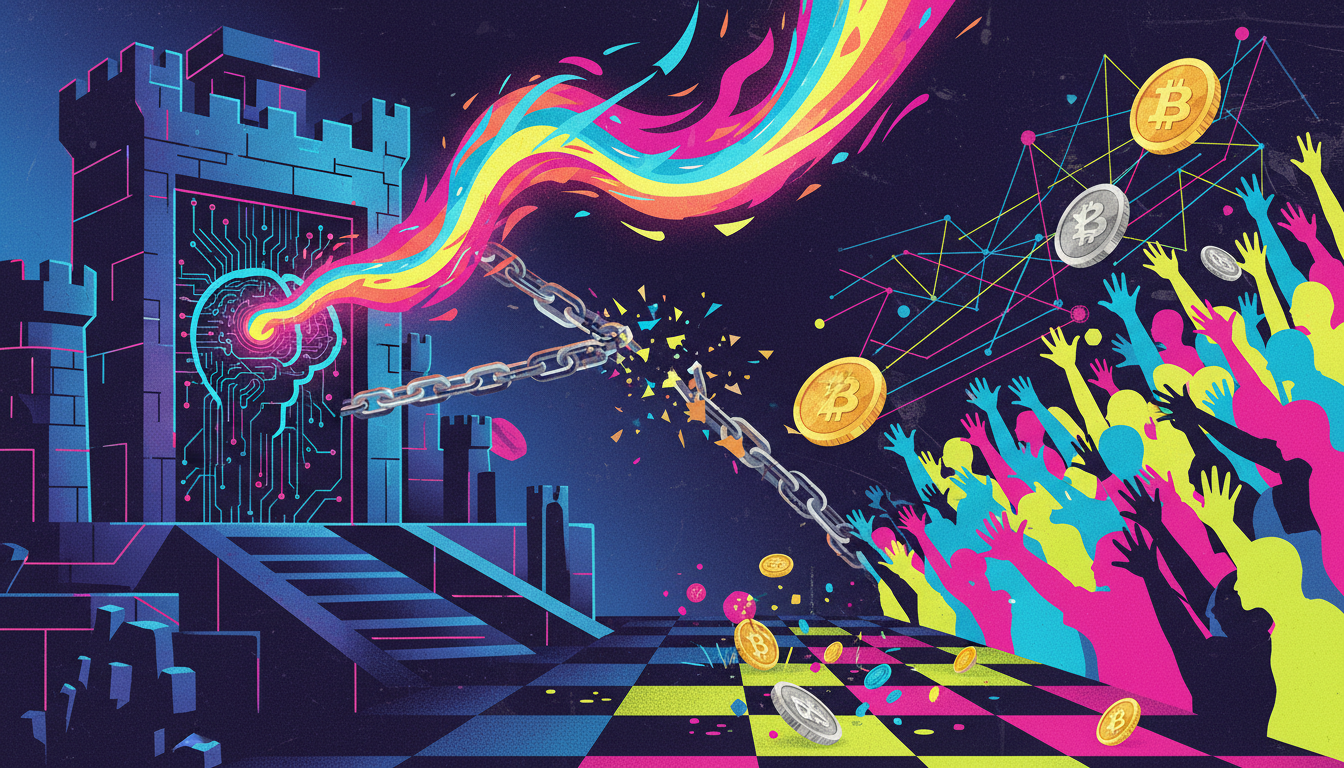
On April 15, 2026, two seemingly unrelated events occurred simultaneously in the Bitcoin narrative: on one end, mining company TeraWulf announced it would raise 900 million dollars by issuing new shares to bet on building AI data centers; on the other end, a "ancient whale" address that had been dormant for 14.5 years suddenly transferred 500 BTC, worth about 37.04 million dollars at current prices. In the secondary market, TeraWulf's stock price dropped about 6.5% on that day, while on-chain monitoring tools highlighted the movement of this large old chip. This synchronous abnormality in both stock and blockchain was interpreted by many participants as: capital is rearranging its chips within the Bitcoin ecosystem, from mining company valuations to whale positions, and the market quietly entered a "reallocation" phase. This article will explore the transformation of mining companies to AI, concerns about equity dilution, and whale behavior, examining the underlying financial logic and emotional structure.
900 million dollar capital increase: Miners begin to bet on AI data centers
The core information provided in TeraWulf's announcement was quite direct: the company plans to raise 900 million dollars through issuing new shares, primarily to build AI-oriented data centers, extending its computing power infrastructure that originally relied solely on Bitcoin mining to a broader high-performance computing business. For a typical mining company, this means actively embracing a whole new growth curve, upgrading from "selling hash rate to the Bitcoin network" to "selling computing power and cabinets to AI clients."
The timing of this transformation is not surprising. With the latest round of Bitcoin halving, the block rewards across the network were halved, compressing mining profit margins once again, especially for small and medium-sized miners with already high electricity costs and insufficient aggressive model iterations, survival pressure has increased sharply. Against this backdrop, shifting to AI computing power with higher margins and stronger bargaining power has been packaged by leading mining companies as a new narrative export: since both consume electricity and utilize data centers, why not connect with AI clients willing to pay a premium for low latency and high reliability?
From the management's perspective, there is another more implicit motive in betting on AI data centers: to reduce the company's valuation's "kidnapping" by a single Bitcoin price. When the company's cash flow, asset pricing, and stock price fluctuations almost entirely follow the BTC trend, once the coin price encounters a cyclical retreat, the valuation discount given by the capital market is often magnified. By diversifying its business structure and linking a portion of its revenue to the cycles of AI and cloud computing, TeraWulf attempts to tell a story of becoming "no longer a pure mining cyclical stock," steering itself towards a "computing power infrastructure" label.
Stock price plummets 6.5%: Market worries about who is paying for AI
However, the initial feedback from the capital market was not friendly. Following the announcement, TeraWulf's stock price dropped about 6.5% during the trading day, reflecting the rapid pricing of this large-scale equity issuance by short-term funds — even if it's for a grander AI narrative, the equity of existing shareholders present is currently being diluted. For many traditional investors, the promise of "dilution first, growth later" naturally incurs a discount in the highly volatile mining industry.
Supporters have equally clear arguments: the 900 million dollar equity financing helps reduce leverage and improve the balance sheet, providing a safety cushion for the high capital expenditure involved in building AI data centers. In this narrative, the issuance is not purely a means of "raising money," but rather transforms capital that might have been raised through debt into equity funding to reduce financial risk exposure. For some tech stock investors familiar with this logic, this is a typical approach of "first building a large asset base, then discussing profit ascent."
Opponents are more concerned about cash flow uncertainty and time costs: Mining companies are already deeply entrenched in the cyclical volatility of Bitcoin, and now adding a high-investment, slow-earning, and fiercely competitive AI sector means that original shareholders must not only accept short-term dilution but also bear the execution risks of a new unfamiliar business. Especially in the absence of detailed capacity planning and timelines, the tension between "improving on-balance sheet risks" and "diluting existing shareholders' equity" is quickly magnified by the market into downward repricing of the stock price.
This conflicting sentiment reflects the adaptation period of traditional funds to the crypto mining companies' shift towards "tech stock narratives." In the past, mining companies resembled highly financialized commodity firms, with valuation anchors clearly tied to Bitcoin prices and production capacity; now, as they begin discussing AI, cloud services, and data centers, institutional investors need to reassess the risk-return structure: Is this an upgrade of the moat, or a blind cross-border expedition? Until the answer is revealed, discounts and cautious observation become the rational choice.
The awakening of a dormant Bitcoin whale after 14.5 years
Unlike TeraWulf, which "loudly" tells its story in capital markets, another protagonist on the blockchain chose to act quietly. On-chain data shows that an address dormant for 14.5 years suddenly transferred 500 BTC, worth approximately 37.04 million dollars at the day’s price, immediately marked as the "awakening of the ancient whale" by on-chain analysis platforms. For those familiar with the early history of Bitcoin, such chips not only represent a substantial amount but also carry a certain symbolic "time stamp."
Public data indicates that this address historically held about 3000 BTC, and after this transfer, still retains about 2359 BTC, valued at approximately 174 million dollars at the latest quotes. This means that even if this early participant only moves a small part of it, the remaining chips are still capable of impacting market imagination. The attention given to such "ancient positions" is largely because they are seen as extremely low-cost, extremely high-yield "primitive capital," and their movements can easily be interpreted by the outside world as votes on attitudes towards future cycles.
On an emotional level, such behavior is often simply categorized as "potential selling pressure." Once an early address is marked as active, social media and market traders easily associate it with terms like "cashing out" and "dumping," thereby amplifying short-term volatility emotions. However, it is important to emphasize that the blockchain only records the transfer of UTXO and does not directly provide intent clarification: these 500 BTC could flow to exchanges for cashing out, be split into multiple wallets for asset restructuring, or even be migrated to a more secure custody environment. Therefore, simply equating a large transfer with a "sell-off alert" is more about emotional projection than the actual fact.
Mining financing and whale migration: A single map of capital movement
If we place these two events from April 15, 2026, on a larger capital flow map, an interesting contrast emerges: on one side, mining companies like TeraWulf initiate financing for AI narratives, trying to bring traditional equity capital into the Bitcoin derivative arena; on the other side, old-money whales quietly move their chips, redeploying their position within the BTC system on-chain. One side is engaged in equity reallocation in the stock market, while the other side is involved in UTXO-level redeployment on-chain, together forming a dynamic picture of capital games within and outside the Bitcoin ecosystem.
Structurally, TeraWulf's equity issuance reflects the willingness of "traditional capital" to pay a premium for Bitcoin-derived infrastructure — especially AI computing power and data centers. Even with the short-term stock price drop, the 900 million dollar financing plan itself indicates that someone is willing to bid within this narrative. The actions of the whale address, on the other hand, represent more the reallocation of existing cryptocurrency wealth: early ultra-low-cost chips, transferred, pledged, or partially cashed out in the new cycle, redefine the profit rights with institutions and retail investors that entered the market later.
In this scenario, Wall Street's presence has already emerged significantly. Public data shows that Morgan Stanley holds a Bitcoin ETF position worth about 64.4 million dollars, rhythmically allocating BTC exposure through compliant products. These types of funds do not directly participate in mining or on-chain activities but bind the asset-liability balance sheets of the traditional financial system to Bitcoin price fluctuations through ETF, trusts, and other vehicles.
The intertwined forces of institutions, mining companies, and whales mean that Bitcoin prices are no longer a simple function of textbook "halving models." Halving remains an important variable, but it is layered with a more complex capital structure story: who is exchanging equity dilution for computing infrastructure, who is entering the market via ETFs, and who is rewriting their risk allocation curve with chips from over a decade ago. Prices become the result of these narratives and capital flow games, rather than a linear mapping of a single supply shock.
Is the mining company's transformation to AI an upgrade of the moat or self-dilution?
From a business logic perspective, the transformation of mining companies to AI data centers appears to be a natural extension of "computing power business": equally involving high-density cabinets and the game of wholesale electricity prices, it superficially shifts computing power from PoW networks to AI model training and inference. However, in actual operations, the electricity load curve, capital expenditure structure, and customer profiles all have essential differences from traditional mining operations — AI clients care more about SLA and latency, have completely different preferences for energy reliability, geographical location, and cooling systems, and the payment cycles and contract structures are far more complex than "mine and immediately sell" BTC.
If mining companies like TeraWulf successfully establish a commercial loop for their AI businesses, their future valuation anchors may shift from "highly cyclical mining stocks" to "stably cash-flowing computing infrastructure stocks." In mature capital markets, these two types of assets have vastly different valuation multiples: the former is often viewed as high Beta, swinging violently with BTC; the latter is closer to data center REITs and cloud services providers, enjoying relatively higher valuation premiums and more stable institutional holding structures.
However, the AI sector itself is also a highly competitive and rapidly evolving industry. If mining companies partially distance themselves from the highly cyclical Bitcoin risk exposure and instead take on another cycle risk in the tech sector, they are essentially performing a "risk type conversion," rather than just "risk reduction." The speed of chip updates, concentration of AI clients, and the pressure from cloud giants building their own data centers could make the mining companies' new story quite challenging.
From an investor's perspective, the real questions to pursue here are: Are mining companies enhancing their long-term survival resilience, or are they diluting their originally scarce Bitcoin beta attribute? For holders hoping to leverage mining stocks to amplify BTC cycle yields, the heavier the AI narrative pulls, the weaker the correlation between stock price and coin price may become; conversely, for funds seeking "cross-cycle computing infrastructure," such a transformation may be just what they want. The TeraWulf case is just the first round of this transformation experiment.
Between AI illusions and ancient chips, what is the real anchor?
Bringing the timeline back to the current prices and market conditions, TeraWulf's short-term stock price adjustment and the transfer of 500 BTC by the ancient whale seem more like an instantaneous revaluation about pricing and emotion, rather than a structural change to the long-term supply and demand pattern of Bitcoin. The 900 million dollar financing plan is still in the early execution phase, and when the AI data center will generate stable cash flow remains a question mark; the whale address has moved part of its chips, yet still holds approximately 174 million dollars worth of BTC, showing no sign of a "clearance sale" exit.
In the medium term, the diversification transformation of mining companies alongside Wall Street's BTC positioning through compliant vehicles like ETFs means that Bitcoin is evolving from a relatively singular "coin price gamble" into a multi-layered capital market asset: it is both a native on-chain asset and the underlying logic behind equity financing stories; it is the target of ETF products, as well as a source of cash flow for mining companies, data centers, and AI infrastructure. Different types of funds are progressively binding themselves to Bitcoin across different dimensions, gradually weaving a more complex financial network.
For true long-term investors, there are two key variables going forward: first, whether mining companies like TeraWulf can truly generate sustainable, predictable cash flow from their AI businesses rather than remaining in the "storytelling stage"; second, whether these "ancient chips" will continue to flow back to the market in future cycles, altering the circulation structure and concentration of holdings. The former determines whether the mining company's valuation system successfully reconstructs, and the latter impacts Bitcoin's own supply elasticity and chip distribution.
In the tug-of-war between the new AI narrative and ancient whale chips, so-called "margin of safety" comes neither from emotion nor from some simple macro slogans, but from patient research on cycles, valuations, and chip structures. Understanding who is bidding, who is retreating, and who is restructuring balance sheets is far more important than just focusing on short-term fluctuations. Bitcoin is in a phase transitioning from a linear narrative to a multi-line game; maintaining a clear framework amid the noise will determine your position in the next round of capital migration.
Join our community to discuss and grow stronger together!
Official Telegram community: https://t.me/aicoincn
AiCoin Chinese Twitter: https://x.com/AiCoinzh
OKX benefits group: https://aicoin.com/link/chat?cid=l61eM4owQ
Binance benefits group: https://aicoin.com/link/chat?cid=ynr7d1P6Z
免责声明:本文章仅代表作者个人观点,不代表本平台的立场和观点。本文章仅供信息分享,不构成对任何人的任何投资建议。用户与作者之间的任何争议,与本平台无关。如网页中刊载的文章或图片涉及侵权,请提供相关的权利证明和身份证明发送邮件到support@aicoin.com,本平台相关工作人员将会进行核查。