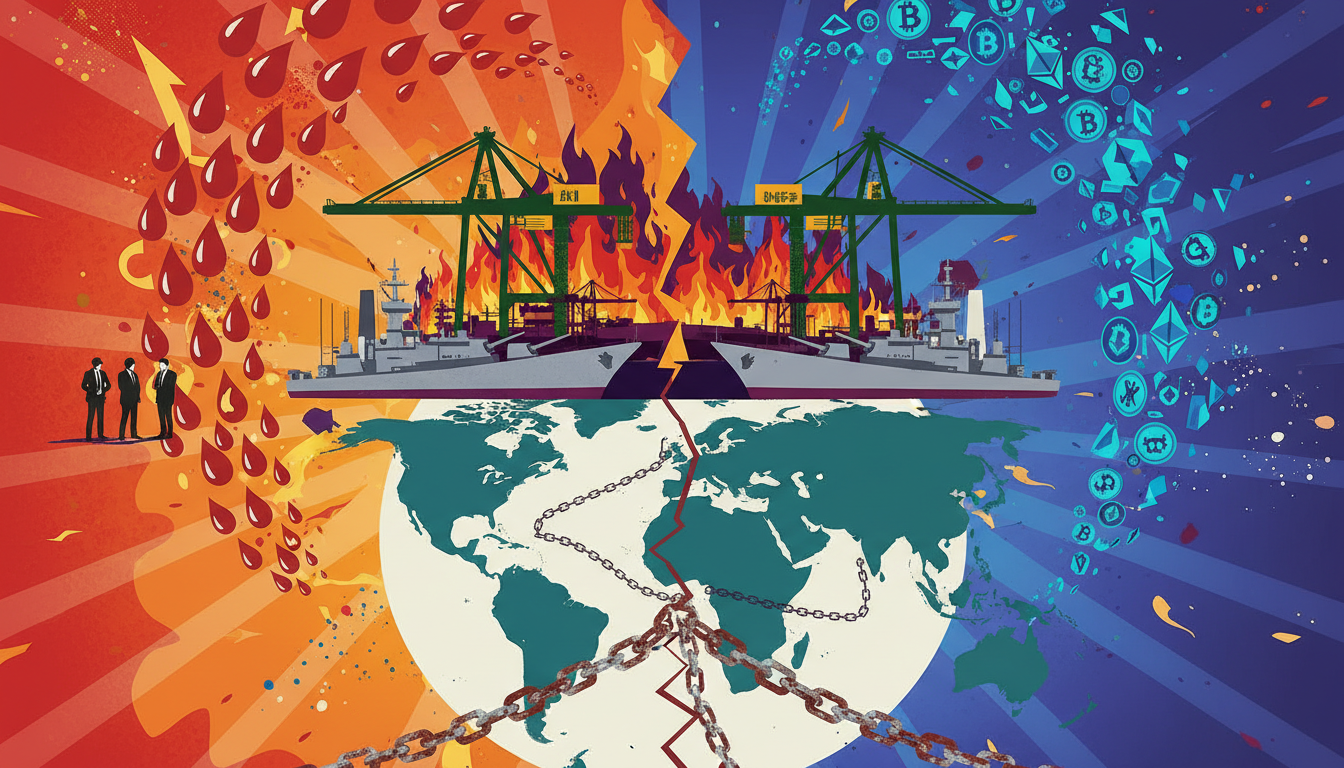
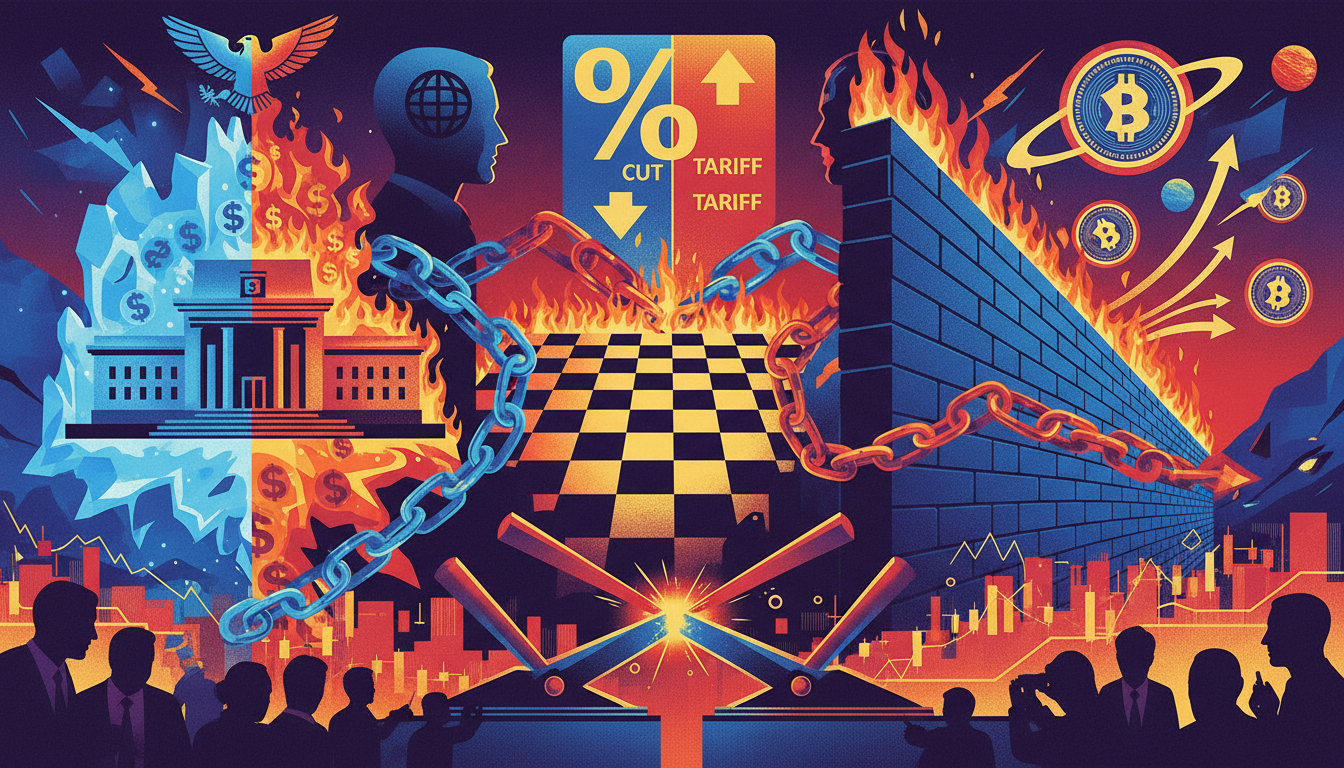
On April 14, 2026, Beijing time, the spokesperson of the Chinese Ministry of Foreign Affairs, Guo Jia Kun, responded at a routine press conference to foreign media reports about "providing military support to Iran" and Trump's threat to impose a 50% tariff on Chinese goods, simultaneously bringing China's dual conflicts with the United States on the issues of Iran and trade policy into the spotlight. On one hand, there are accusations of "military aid" amid a fragile ceasefire in the Middle East and deepening U.S.-Iran tensions, and on the other hand, the old problem of "tariff wars having no winners" is being re-politicized. In contrast to the tense public discourse, the financial market's immediate reaction was relatively calm—by the end of the day, U.S. stock index futures saw slight increases, with Dow futures up 0.09%, S&P 500 futures up 0.14%, and Nasdaq futures up 0.29%. Meanwhile, the on-chain prediction platform Polymarket recorded extreme movements, showing a floating loss of $34,000 and a loss ratio as high as 85%. These two distinctly different pricing approaches provided an emotional entry point for observing this round of geopolitical and trade noise.
Iran's Accusation Countered: A War of Words on the Powder Keg of the Middle East
Regarding the Iran issue, some foreign media cited anonymous sources to amplify claims that China is "providing military support to Iran," situating it within the larger narrative of Middle Eastern conflicts and regional alliance restructuring, attempting to construct a framework for reporting on "China's deep involvement in the Middle East security landscape." In response to such reports, Guo Jia Kun explicitly refuted them on April 14, emphasizing that the accusations are inconsistent with facts and questioning the motives of the relevant media and politicians, aiming to sever the direct association between "military support" and actual policy.
China reiterated its cautious and responsible attitude toward arms exports and emphasized compliance with its own laws and international obligations, repeatedly mentioning the fragility of the Middle Eastern ceasefire, positioning itself as one that "encourages peace talks and opposes escalating tensions." This self-positioning, on one hand, responds to the narrative of "military aid," and on the other hand, competes for moral high ground in the discourse on Middle Eastern security, sending a signal to the outside world that it "does not wish to see the situation escalate."
The sensitivity of this accusation arises as it coincided with the precarious ceasefire arrangements in the Middle East and the time window for U.S.-Iran negotiation teams to possibly meet in Islamabad (this meeting remains in the realm of unverified information according to sources). Against this backdrop, any statement about "external military aid" could be interpreted by various parties as an escalation of future negotiations or an excuse for potential conflict escalation. Thus, both domestically in the U.S. and among regional allies, there is a natural tendency to amplify the risk implications of such reports.
It is important to clarify that current public information has not provided specifics on what so-called "military support" entails, nor are there any verified details on weapon models. Research bulletins also clearly indicate that details regarding "anti-aircraft missiles" and other specifics are yet to be verified and should not be fabricated. For investors, this means that such reports can only be treated as tools of public opinion in the geopolitical game, and not as established military realities for pricing.
Threat of 50% Tariffs Raised: Trade Memories Reawakened
Coinciding with the Iran issue, Trump issued another "shot" during a domestic U.S. event: threatening to impose tariffs as high as 50% on Chinese goods. This statement remains at the level of personal remarks, but referencing past rhetorical styles, it can easily be rapidly amplified in the public discourse; China, in response through diplomatic channels, stated that "there are no winners in a tariff war," reiterating its opposition to coercing other countries using tariffs, and emphasizing that such practices would harm global supply chain stability and the interests of American consumers.
The memory of the previous round of the U.S.-China trade war has never truly dissipated in the markets: the sequence of high tariffs, intermittent negotiations, the migration of supply chains by companies, and the stock market's repeated volatility on tariff news have all formed a foundational emotional context around the term "tariff threat." Therefore, when a high figure like "50% tariffs" reappears in public discourse, even in the absence of immediate policy text, it is sufficient to evoke associations of rising production costs, renewed inflation pressures, and declining global risk appetite.
From the domestic U.S. political context, such threats are not merely declarations of foreign policy but serve more as signal products aimed at specific voter groups: on one hand, catering to the political correctness of "hardline against China," and on the other, attempting to shape a hardline image regarding industrial protection and employment issues. During the election cycle, threats of high tariffs essentially serve as a cheap but loud campaign tool, primarily targeting domestic public opinion rather than policymakers at the negotiating table.
It is crucial to emphasize that, based on current publicly available information, this remains a verbal threat and has not entered formal policy procedures: there is no specific list of tariff items, no initiation of relevant hearings or legislative processes, and certainly no timeline for implementation. For investors, the key is to distinguish between "political noise" and "real risk"—the former primarily affects short-term sentiment and the public discourse environment, while the latter would materially change corporate profit models and trade patterns. Mixing the two can lead investors to follow erroneous narratives in moments of high emotion and overlook the structural variables that truly drive asset pricing.
Wall Street Slightly Up: Calm Pricing Amid Geopolitical Noise
On the same day when dual risk narratives were densely released, U.S. stock futures provided a thought-provoking picture: as of April 14, Dow futures were up 0.09%, S&P 500 futures were up 0.14%, and Nasdaq futures were up 0.29%. Though modest, the increases clearly pointed to a fact—at least on that day, Wall Street's comprehensive reaction to the Iran accusations and tariff threats was closer to "no panic despite the news" rather than a panic sell-off.
The choice of U.S. stock futures to climb gently while both the Iran rhetoric war and the 50% tariff threat captured headlines can be attributed first to the result of "risk habituation." Over the past few years, the market has experienced multiple rounds of similar political rhetoric and geopolitical friction, leading investors to gradually learn to filter noise using a “watch actions, not words” approach: as long as no substantive sanction texts, tariff lists, or clear escalation signals of military conflict are observed, funds are more inclined to maintain existing positions rather than hastily cut exposure.
Secondly, from a pricing logic perspective, the signals released that day mostly remained at the rhetorical level, whether it be the Iran "military aid" allegations or the future threats of high tariffs, both of which lacked quantifiable timelines and impact pathways. For traditional funds anchored in performance and liquidity, a lack of clear cash flow discount impacts makes it difficult to justify a significant reevaluation. Furthermore, as the current macro liquidity environment has not exhibited sudden changes, many procedural and quantitative strategies will continue to drive orders based on technical and fundamental models, rather than reacting excessively to political rhetoric.
This does not mean that the market is entirely indifferent to the Middle Eastern ceasefire, energy prices, and global supply chains; rather, there exists a notable "worry-price" disconnect: in investment narratives, many institutional strategy reports highlight the risks of potential upward movements in oil prices and freight disturbances, but in the current futures prices and stock index movements, such worries have not been fully internalized. In other words, short-term price movements reflect more of a sigh of relief over "no immediate deterioration" rather than a collective judgment that "medium to long-term geopolitical risks no longer matter."
Polymarket Heavily Loses: Discrepancy Between On-Chain Emotions and Reality
In stark contrast to Wall Street's mild reactions, the chain prediction markets experienced violent fluctuations. According to data cited by Jinse Finance, a certain relevant contract on Polymarket showed a floating loss of approximately $34,000, with a loss ratio as high as 85%; this data is from a single source but is sufficient to indicate that some participants faced near-zero-level erroneous bets in a short time frame. Such contracts are typically linked to specific political, geopolitical, or policy outcomes; although the bulletins do not disclose the titles of the texts, it is reasonable to deduce that they are related to the current situation in Iran or U.S.-China negotiations.
The reason the prediction markets have shown such a significant deviation from actual developments in the short term largely reflects the emotional and information asymmetry of chain-based funding structures. Compared to regulated futures markets, platforms like Polymarket have lower barriers to entry, and their smaller funding volumes are often dominated by a few high-leverage viewpoints. When a particular narrative (such as "conflict will certainly escalate quickly" or "high tariffs are inevitable") resonates on social media, some users will flood into the same direction to place bets, often without firsthand intelligence or professional pricing models. Once actual developments do not meet extreme expectations, their positions are easily prone to halving or even catastrophic liquidation in a short time.
This starkly contrasts with the reactions in U.S. stock futures: on one side, a calm discount based on liquidity and corporate earnings, and on the other, “narrative trading” driven by social media and emotional resonance. For observers, this divergence itself serves as an important signal—it suggests that on-chain predicted prices are neither "smarter money" nor inherently leading indicators, but rather a highly amplified emotional mirror, capable of capturing extreme values of market panic or greed, yet should not be simply construed as an objective gauge of probabilities in the real world.
Iran Negotiations and Middle Eastern Ceasefire: The Marginal Role of Cryptocurrency as a Safe Haven
Regarding the next steps in the Iran game, research bulletins mentioned a key but unverified clue: the U.S.-Iran negotiation teams are expected to meet in Islamabad, intertwined with the already fragile ceasefire situation in the Middle East. This indicates that, in the near future, the market will face two starkly different paths: one of "advancing negotiations, de-escalation" and the other of "failed negotiations, renewed conflict." If the latter occurs, its chain reaction is likely to first manifest in surging oil prices, rising energy costs, and strengthening safe-haven assets, quickly spilling over through U.S. dollar liquidity and global risk appetite.
Historically, whenever geopolitical tensions significantly escalate, the U.S. dollar and U.S. Treasuries typically receive safe-haven buying in the first instance, while gold and certain commodities would also strengthen simultaneously. Within this safe-haven chain, the role of cryptocurrency is more "marginal but not to be ignored": on one hand, it has been used as a tool for value transfer and asset diversification against some sanctions or capital controls; on the other hand, for broader global capital, the high volatility and high correlation characteristics of the crypto market make it resemble a risk asset more than a traditional safe haven.
Nonetheless, in extreme scenarios—such as a regional conflict affecting key energy or shipping channels, or triggering broader discussions of financial sanctions—cryptocurrency assets may still gain marginal demand growth as "sanction evasion" and "offshore liquidity carriers." The issue is that the current pricing and trading structure seems to not fully reflect this extreme scenario: there has been no unusual surge in on-chain activity similar to the early days of the Russia-Ukraine conflict, nor is there any concentrated narrative premium concerning the Middle East situation. This gap between real developments and price performance leaves room for risk outlook in the following discussion: once geopolitical risks shift from "noise" to "real constraints," the crypto market may be forced to re-evaluate its functions and marginal demand.
What the Market is Really Betting on Under the Shadow of Tariffs and Missiles
Synthesizing the event clues from April 14, China, in the same diplomatic context, both refuted foreign media accusations of "providing military support to Iran" and reiterated the position that "there are no winners in a tariff war," outlining the current dual front pattern of the U.S.-China contest: one front revolves around influence and discourse on the Middle East and Iran issues, while the other repeatedly tests the market and public opinion's tolerance on tariff and trade topics. For investors, these two fronts are not isolated but interwoven into a more complex risk web across multiple dimensions including energy prices, global supply chains, and technological regulation.
In this web-like structure, the slight rise in U.S. stock futures and the significant losses in Polymarket contracts represent two distinct risk pricing styles: the former anchors on macro liquidity and corporate earnings, viewing that day's shocks as manageable noise in the absence of substantive grounded policy and military escalation; the latter, meanwhile, amplifies geopolitical and political narratives driven by social media and emotional resonance, willingly bearing the costs of extreme scenarios, ultimately suffering losses up to 85% when reality does not unfold as scripted.
Looking ahead, key indicators to watch should include at least three groups: first, whether the "50% tariff" will transition from a verbal threat to institutionalized pathways, for instance, whether specific tariff items, procedural documents, or substantive negotiations among the two parties regarding tariff tools emerge; second, the actual progress of the Middle Eastern ceasefire and U.S.-Iran negotiations, especially any nodes that could alter oil supply expectations or trigger new rounds of sanction discussions; third, the trading and volatility structure of the crypto market, observing any abnormal activity that synchronizes with geopolitical news and whether the on-chain prediction market continues to form substantial expectation discrepancies with traditional finance.
For individual and institutional investors, it is even more crucial to hold onto a bottom line: remain vigilant against singular narratives hijacking judgment, especially the "certainty stories" that quickly gain traction on social media. Beneath the high-stimulation imagery of tariff threats, missile shadows, and prediction contract liquidations, what truly requires patient observation are often those slowly evolving structural variables—supply chain migrations, energy price centrality, global liquidity environment, and regulatory frameworks. Patience in the time dimension is the only reliable tool for distinguishing political noise from structural risks.
Join our community to discuss and grow stronger together!
Official Telegram community: https://t.me/aicoincn
AiCoin Chinese Twitter: https://x.com/AiCoinzh
OKX welfare group: https://aicoin.com/link/chat?cid=l61eM4owQ
Binance welfare group: https://aicoin.com/link/chat?cid=ynr7d1P6Z
免责声明:本文章仅代表作者个人观点,不代表本平台的立场和观点。本文章仅供信息分享,不构成对任何人的任何投资建议。用户与作者之间的任何争议,与本平台无关。如网页中刊载的文章或图片涉及侵权,请提供相关的权利证明和身份证明发送邮件到support@aicoin.com,本平台相关工作人员将会进行核查。