Original | Odaily Planet Daily (@OdailyChina)
Author | Wenser (@wenser 2010 )

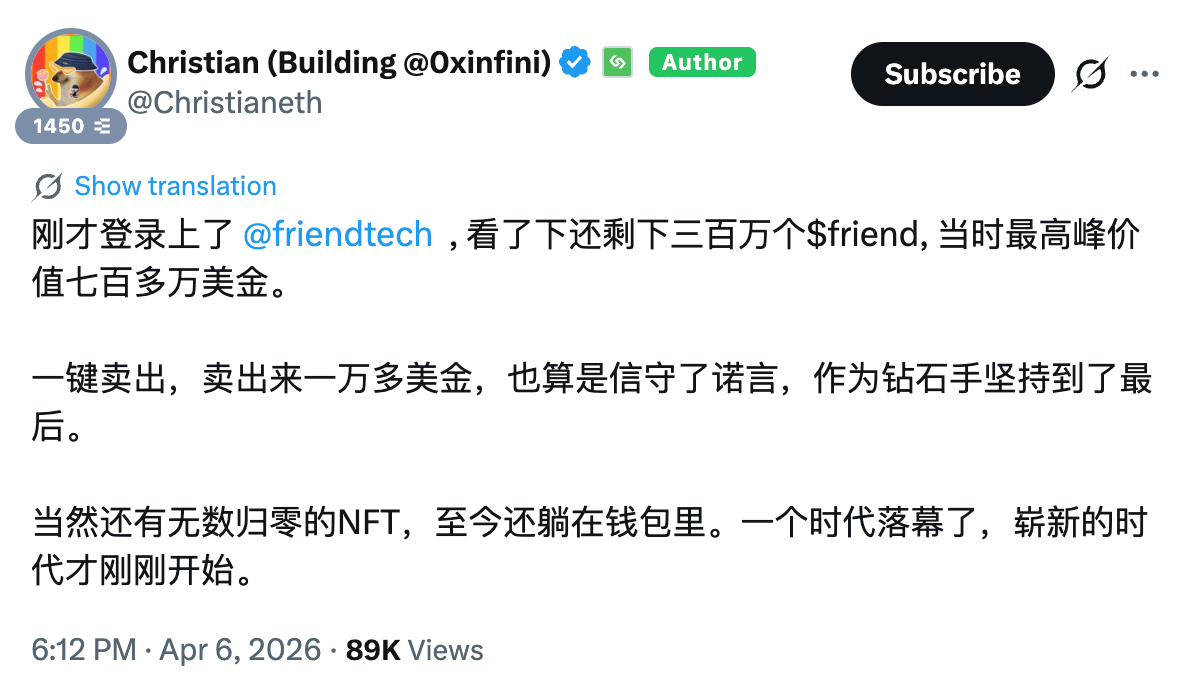
Not long ago, a tweet released by Infini founder Christian sparked discussions among many in the circle. In that tweet, he shared his personal experience of having a "diamond hand"—after logging back onto friend.tech, he found that the FRIEND token, which had once peaked at a value of 7 million dollars, could now only be sold for 10,000 dollars. He subsequently mentioned the "wallet tragedy" of some in the cryptocurrency space—countless NFTs that have gone to zero.
Looking back at the past waves of turmoil in the crypto space as of 2026, those once famous projects have now sunk to the bottom, with the once alluring fruits of wealth becoming shriveled grains of unnoticed sand in the long river of time.
The Death of the SocialFi Sensation: The Glory of Friend.tech Series Products is No More
Speaking of Friend.tech, a hot SocialFi product that began in August 2023, many may still remember the lively scenes at that time.
Targeting the concept of "monetizing social capital," Friend.tech became the sole hot topic in the industry within just a few months, leading numerous blockchains and platforms to flood the market with countless "FT (short for Friend.tech) clone products." The prices of tokens in celebrity chat rooms surged, quickly rising from 0.0xx ETH to 0.x ETH or even several ETH and upwards of ten ETH.
Even though it was during a crypto bear market, the "expensive entry ticket" still commanded thousands to tens of thousands of dollars. Coupled with the news of renowned VC Paradigm participating in the seed round funding, Friend.tech took the crypto industry by storm with its asset-focused products.
Even more mythic is the fact that the Friend.tech team consisted of only 4 people, and during its roughly one-year operation, it generated about 90 million dollars in fee income, of which 44.67 million dollars was allocated to creators, with the remainder kept by the Friend.tech team.
After Friend.tech launched its token in May 2024, the FRIEND token briefly reached a historic high of around 3.2 dollars, and its price on major mainstream CEXs stayed around 2 dollars.
The following events are well-known—an unsuccessful update to version 2, founder Racer hinting at disagreements with Base and plans to migrate the project, the team continuously dumping and selling tokens, and the team's clear statement to abandon control of the project contract.
In less than a year, Friend.tech has completed its lifecycle, marked by a fleeting rise and gradual descent in the crypto circle.
The Christian mentioned at the beginning might be the "last major player of Friend.tech." According to hisstatement, not counting prior expenses for purchasing various room keys, the value of the 3 million FRIEND tokens he holds peaked at 7 million dollars, while at the current price of around 0.004 dollars, that asset has shrunk to 10,000 dollars.
During this wave of SocialFi excitement sparked by Friend.tech, Christian wasn't the only one feeling sorrowful. After FRIEND was launched, major player Maji was also one of Friend.tech’s "die-hard fans." Between May 3 and June 8, 2024, he spent a total of 4,975 ETH (approximately 15.6 million dollars) buying 8.6 million FRIEND tokens at an average price of 1.81 dollars, but by a month after the token launch, the FRIEND price had dropped below 0.01 dollars, causing Maji to incur losses exceeding 14 million dollars. Two months later, feeling "nostalgic," Maji continued to buy FRIEND tokens, further extending his losses to over 15 million dollars .
On November 26, 2024, Friend.tech founder Racer's X platform account @0xRacerAlt was completely deleted (currently, the identity of the account holder cannot be verified; Odaily Planet Daily warns readers to beware of scams), and this SocialFi product, once filled with industry expectations, has since vanished from the scene.
As for a series of imitative projects, including @tribedotrun, @TheArena, @tomo_social, although they attracted momentary attention, ultimately perished on the path of SocialFi.
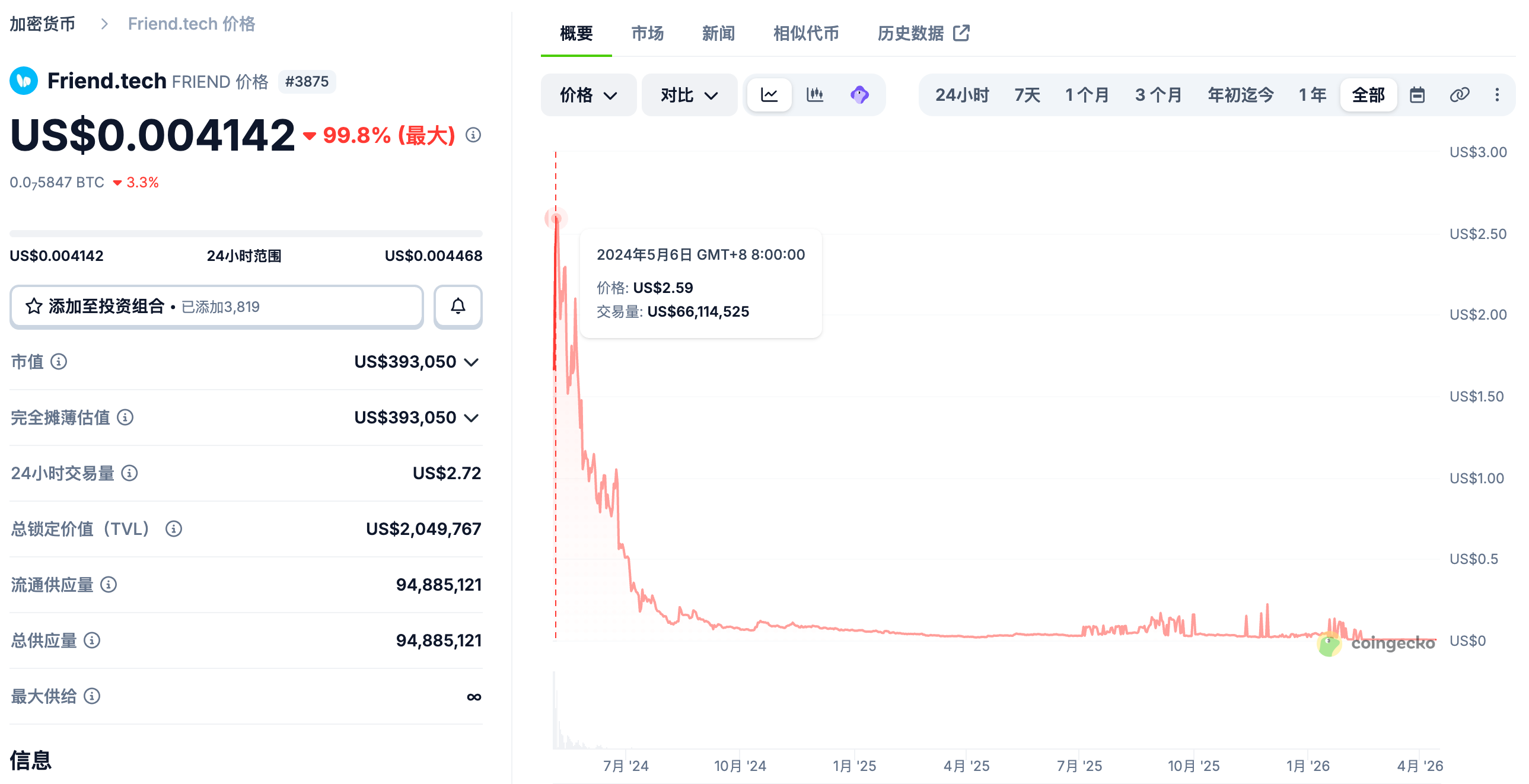
According to Coingecko data, the FRIEND token currently has a market cap of just under 400,000 dollars, a decline of over 99.8% compared to its peak market cap of 230 million dollars.
Recommended reading:
SocialFi "narrative failure," does crypto social have a future?
SocialFi data comparison: Friend.tech VS Farcaster, who is the king of social?
The Final Chapter of NFTs and the Rhyme-less End of L2: The Double Game of Blur and Blast
"Those who lose money are those who are rich enough to afford to lose."
Maji lost millions on Friend.tech, and he also took a big hit on BLUR.
To add a point, as a NFT platform that completed its seed round with 11 million dollars in funding, Blur also has Paradigm among its investors. Despite being a top-tier VC in the space, Paradigm maintains an extremely high presence rate in the cut-throat realm of VC profits. Moreover, in the L2 startup project Blast led by Blur founder Pacman (translated as Tieshun in Chinese), Paradigm was also the lead investor in the 20 million dollars funding round.
In February 2023, after experiencing the crypto winter of 2022, Blur gifted the NFT players who still stood firm in the crypto camp with a "airdrop bonanza"—a total supply of 3 billion BLUR tokens, 51% of which was allocated to the community. Data later indicated that 23 addresses received over a million tokens each in the airdrop.
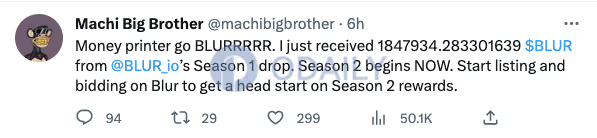
Among them, Maji, known as a big player in NFTs, was evidently on the list—during the BLUR token airdrop, he claimed to have received nearly 1.85 million BLUR tokens and subsequently sold nearly 960,000 BLUR at a price of 0.62 dollars. (Odaily Planet Daily Note: This tweet has since been deleted)
In the subsequent ups and downs of the coin price, Maji still regarded BLUR as his "favorite": he kept buying and hoarding, followed by multiple rounds of high buying and low selling. Ultimately, in July 2023, he deposited 18.4 million BLUR tokens (worth 3.13 million dollars) into Binance, estimating a loss of 3.16 million dollars at that time; additionally, during the same period, he also held 275 million BLAST tokens valued at 4.45 million dollars, incurring a floating loss of 1.5 million dollars.
As time passed, the "NFT Holy Grail" and "L2 Narrative" of Blur and Blast gradually faded, and the continuing decline in prices led more people to shout “scam,” although later Blur launched S2, S3 incentive activities, the grand bonanza from S1's airdrop has long since vanished.
As for the former NFT projects like BAYC (Yuga Labs), Moonbirds (Kevin Rose), CloneX (RKTF), their recent dismal performance is hard to describe.
Currently, the official account of Blur hasn't updated since December 2025; the "retired" founder Pacman's latest tweet was a reminder to the public about "identity fraud, be cautious of scams."
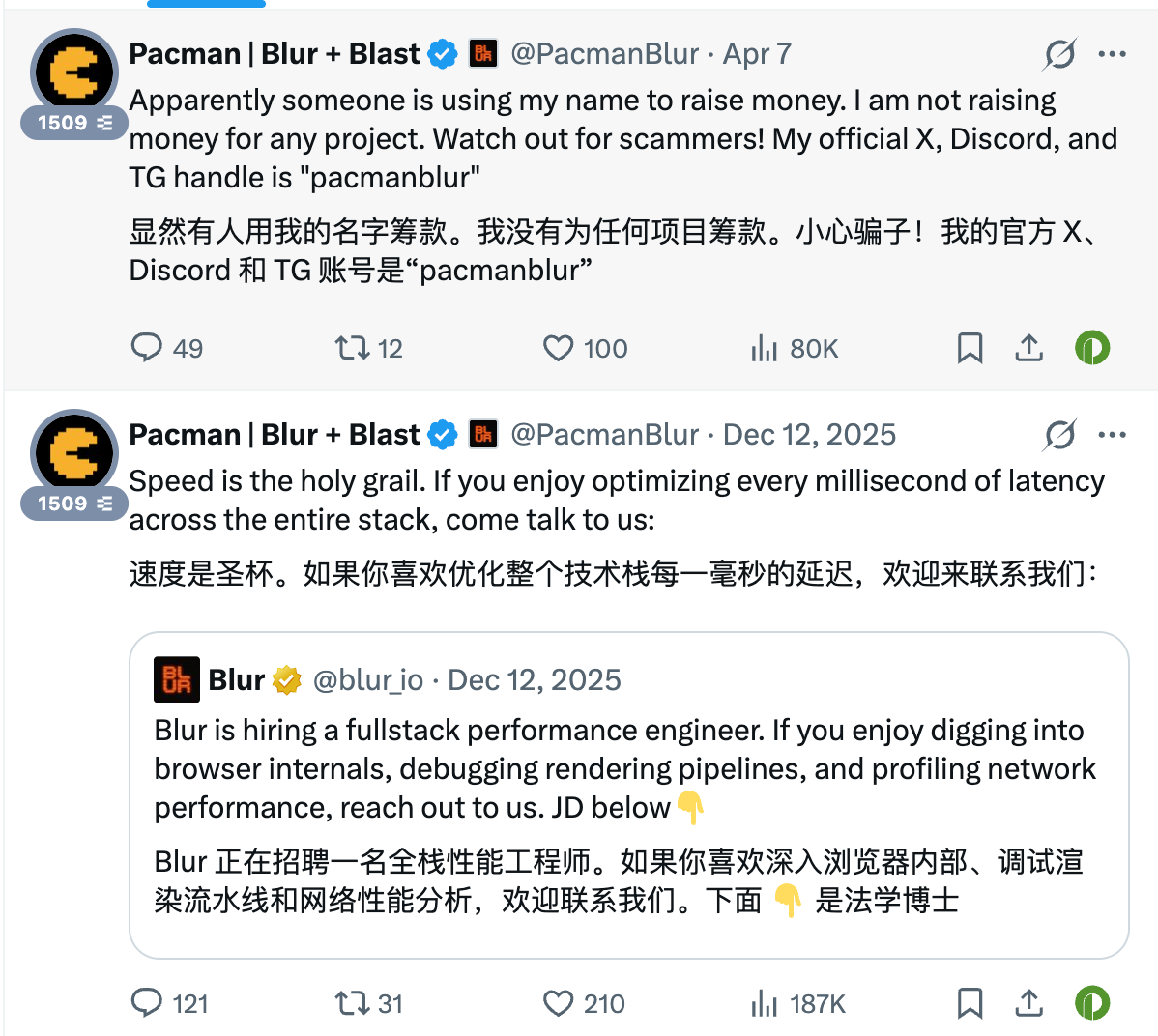
Could this be Pacman's "farewell tweet"?
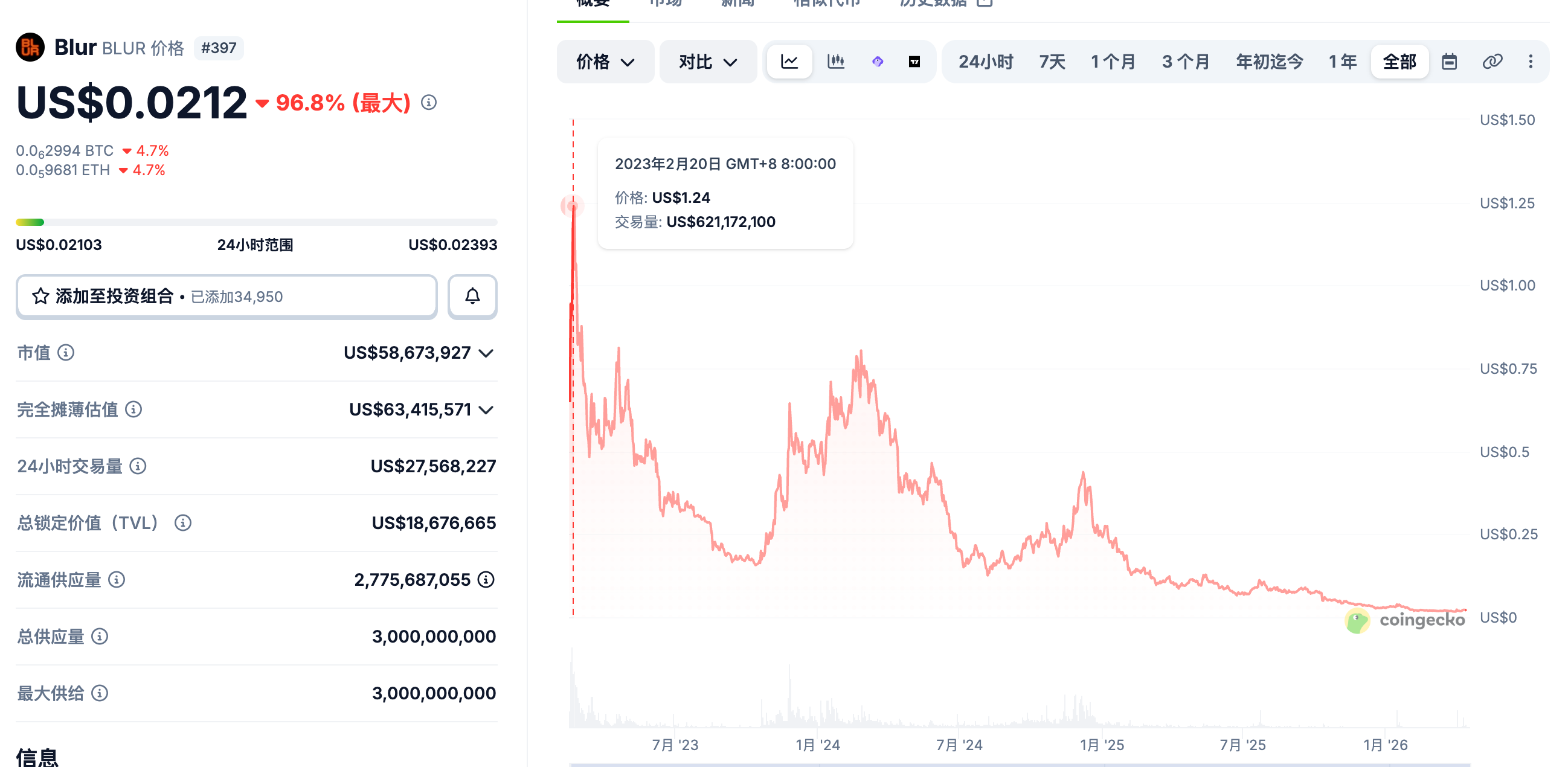
According to Coingecko data, the current price of BLUR is about 0.02 dollars, with a market cap around 58 million dollars, compared to its historical price high of 1.24 dollars, a decline of 96.8%.
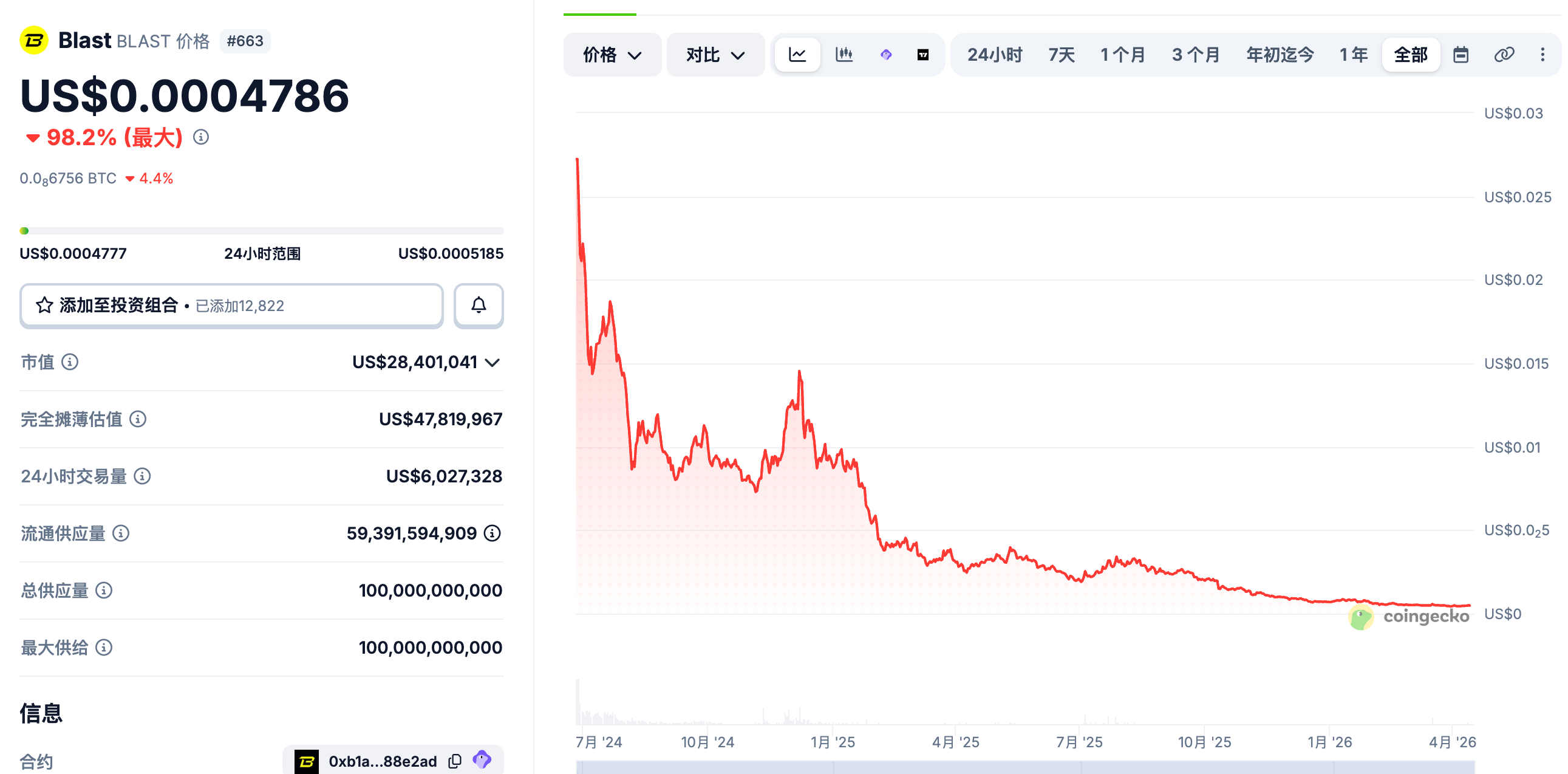
Currently, BLAST is priced around 0.00048 dollars, with a market cap of about 28 million dollars, with its maximum historical decline reaching 98.2%.
The King of Inscriptions Makes a Comeback and Ends in Defeat: ORDI's Success is Fair, its Failure is Fair
Compared to the "explosive innovation of the previous two parts," inscriptions represent a truly "pioneering track," and ORDI, as the "ancestor of inscriptions," evolved from a fairly launched inscription project to a "favorite among retail investors" upon listing on Binance, justifiably characterized by saying success is fair, failure is fair.
From late 2022 to early 2023, the Ordinals project, which promotes the concept of "BTC ecological NFT protocol," quietly emerged, but it remained lukewarm. By February 2023, only a few thousand of these assets had been minted. However, as more people began to pay attention, Ordinals NFTs saw rapid growth to 13,000 pieces.
On February 15, the NFT protocol Ordinals on the Bitcoin network surpassed a total minting volume of 100,000 pieces. Despite the fact that Ordinals caused costs for Inscriptions (inscriptions) on the Bitcoin network to escalate and led to the most severe mempool congestion since the collapse of FTX and the bankruptcy of 3AC, its innovative asset issuance model and skyrocketing prices drove the market crazy.
In March of that year, BTC ecological anonymous developer domo launched BRC-20 based on the Ordinals protocol, utilized for transactions as a specific JSON text file, where the JSON file represents Ordinal inscriptions. The total supply of this token is 21 million, with early minting prices around 3 dollars each (including 1000 tokens), creating a “once-in-a-lifetime opportunity” for those with sharp senses and quick tech-savvy.
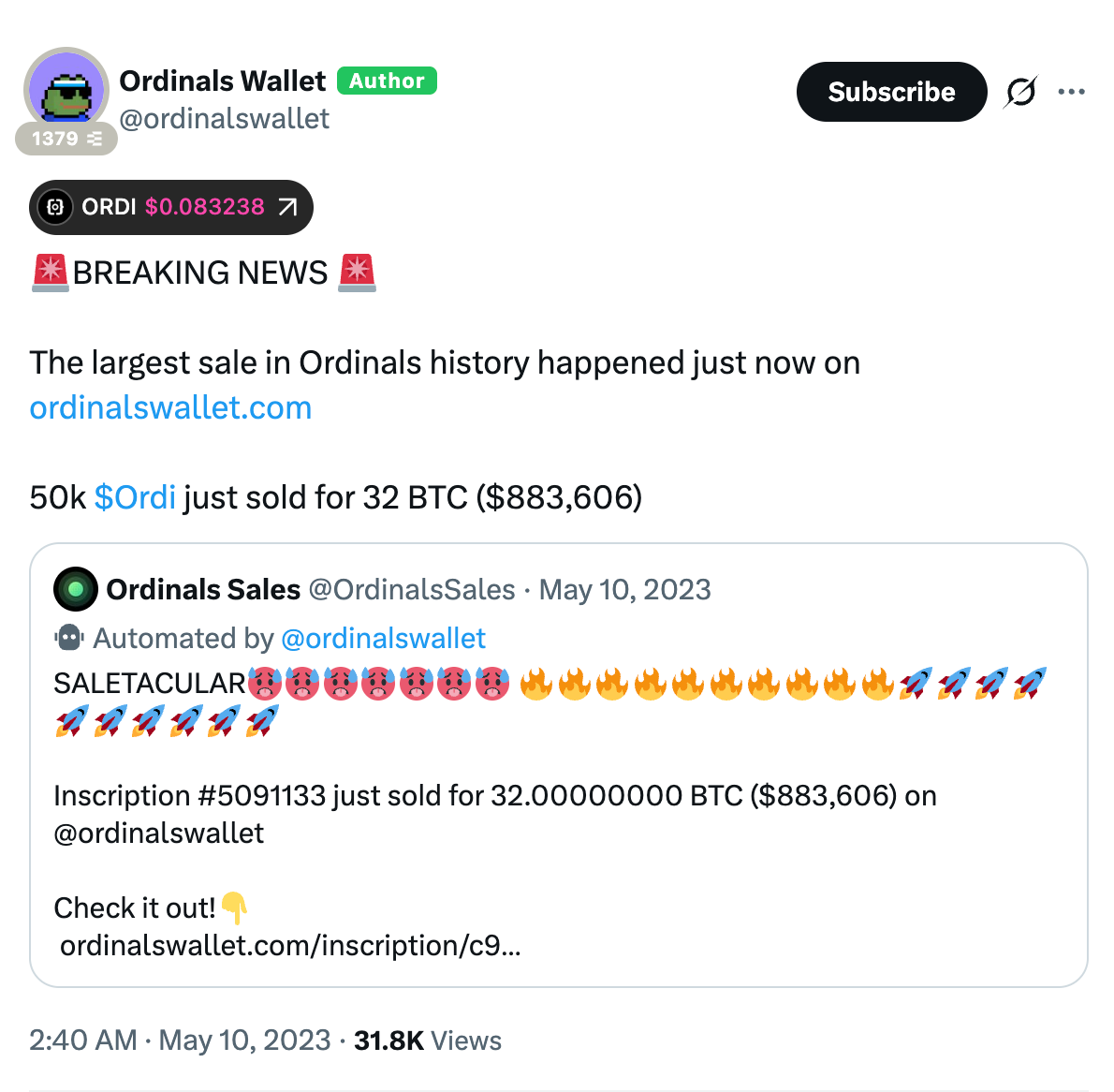
In May 2023, an Ordinals inscription #5091133 containing 50,000 ORDI tokens was sold on the Ordinals Wallet for 32 BTC, setting a record for single transaction value; few at the time could have predicted that this seemingly 880,000 dollars transaction would eventually turn into a staggering fortune.
During the same period, the OKX Web3 wallet announced it would officially launch a BRC20/Ordinals market, making it the first multi-chain wallet in the industry to support Ordinals transactions, as well as the first wallet to trade BRC20 tokens on mobile. This also marked that exchanges and public chains began to find new growth points for trading activity in the industry winter.
By early May 2023, the price of ORDI tokens officially broke 10 dollars, with a market cap exceeding 220 million dollars and over 5,200 active addresses. This milestone surge further propelled ORDI's momentum—major CEXs rushed to list ORDI, and within a few days, the ORDI price rose sharply, surpassing 27 dollars, and the market cap of BRC-20 tokens approached 1 billion dollars as expected.
However, as ORDI's price once approached 30 dollars, the time to take profits led to a sharp drop, even halving. Subsequently, ORDI prices kept falling, with new concepts and projects like recursive inscriptions, runes, and sigils emerging, causing many to shift their enthusiasm away from ORDI, whose price fell to around 3 dollars.
After nearly half a year of a somewhat lonely journey, Binance became the key game changer for ORDI's fate.
In November 2023, Binance announced it would list Ordinals (ORDI) and add seed labels; subsequently, Binance also announced plans to launch ORDI U native contracts. Once the news hit, the market reacted strongly. ORDI began to soar, rising sharply from below 10 dollars to around 27 dollars within just a few days.
The following story is well known—by December 2023, ORDI's market cap officially surpassed 1 billion dollars, making it the first inscription project on Bitcoin to break the 1 billion dollar market cap.
The rise in price was driven either by persistent buying from more diamond hands or by the concentration of chips held by whales.
At that time, statistics showed that the top 30 holders of ORDI collectively held 16.78 million ORDI (around 950 million dollars), accounting for 79.94% of the total supply.
In March 2024, after enduring several months of price fluctuations, ORDI's price once again reached a historic high of 92 dollars, rising nearly 30,000 times compared to a year prior. While many still held high expectations that ORDI might surpass 100 dollars, the market does not bend to personal wishes, especially since the whales had already taken their profits and safely pocketed their gains.
With the approval of Bitcoin spot ETFs, the crypto market has begun its "mainstream integration journey," and the ORDI that has already been "fairly distributed" to retail investors naturally became the ticket for whales to exit.
ORDI gradually faded from the public eye within media, KOLs, and the broader crypto community, until it vanished entirely. Once-renowned founders, like Casey, the creator of the Ordinals protocol, and domo, the creator of the BRC-20 protocol, also gradually fell silent.
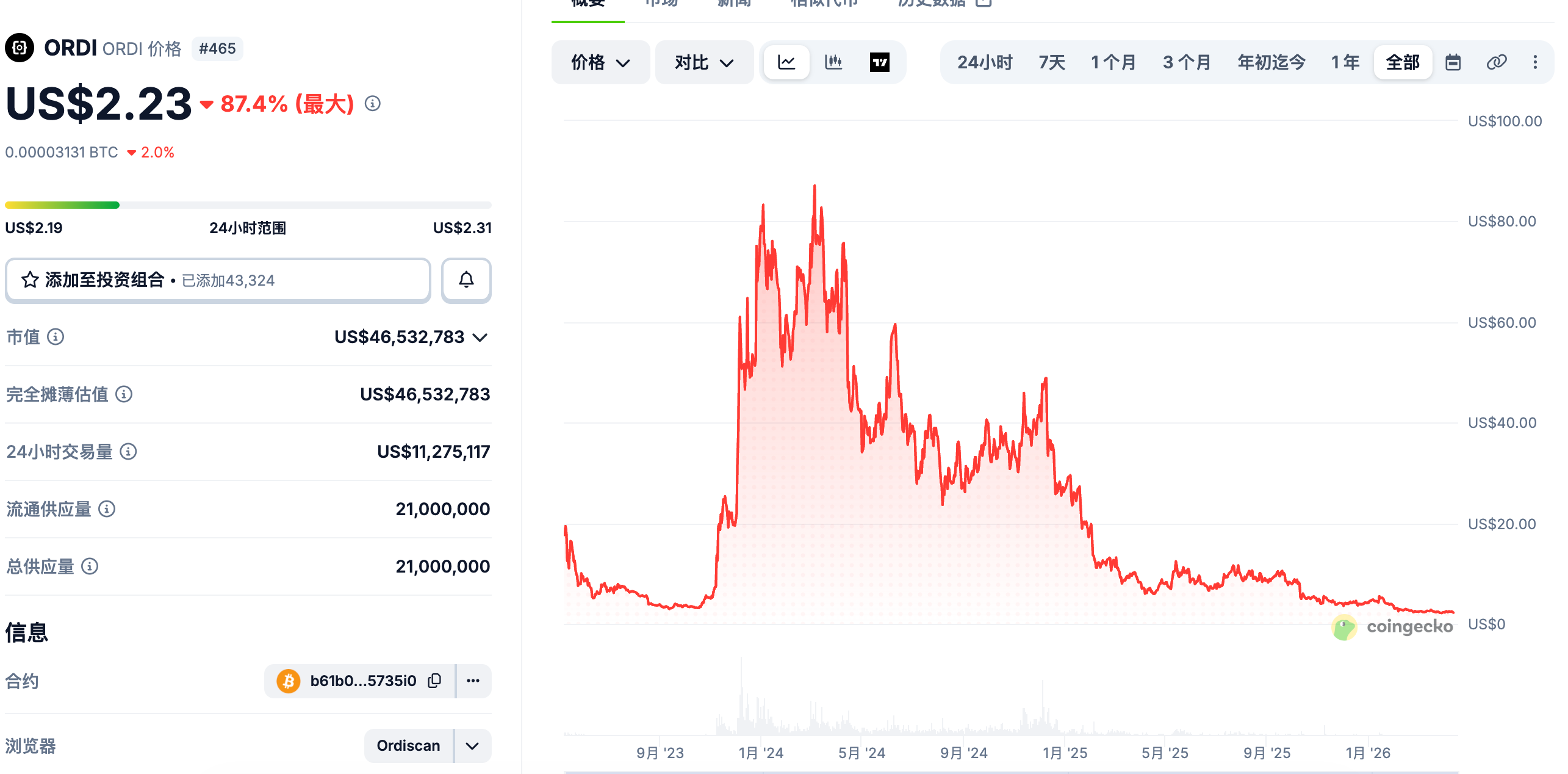
According to Coingecko data, ORDI is currently priced at about 2.2 dollars, with a market cap of around 4600 dollars; from its peak price of 95.5 dollars, it has decreased by 87.4%.
Conclusion: At That Time, It Was Just Common
Looking back, during the booming and blossoming times, everyone thought getting rich was just a matter of luck, feeling they were one in ten thousand; yet after going through countless experiences, they realize that many things are simply a matter of timing and destiny.
Just like the past DeFi, GameFi, and NFTs, countless crypto project tokens have been on a smooth downward trend, and the hot concepts and industry-favored projects were merely temporary excitement. Whether one can stay at the table for the long term still heavily depends on one's ecological position in the industry and whether they can consistently generate a steady cash flow.
The wealth creation effect in the crypto market continues to shrink, traditional finance is aggressively integrating, sovereign nation regulatory policies are improving yet remain complex, and all we can do may just be to let go of path dependence, embrace hot concepts, and earn the portion of money that matches our own understanding.
Recommended Reading
The Evolution Theory of Crypto Venture Capital Cycles (Part 1): Rebuilding a New World
The Evolution Theory of Crypto Venture Capital Cycles (Part 2): The Lost Future
免责声明:本文章仅代表作者个人观点,不代表本平台的立场和观点。本文章仅供信息分享,不构成对任何人的任何投资建议。用户与作者之间的任何争议,与本平台无关。如网页中刊载的文章或图片涉及侵权,请提供相关的权利证明和身份证明发送邮件到support@aicoin.com,本平台相关工作人员将会进行核查。


