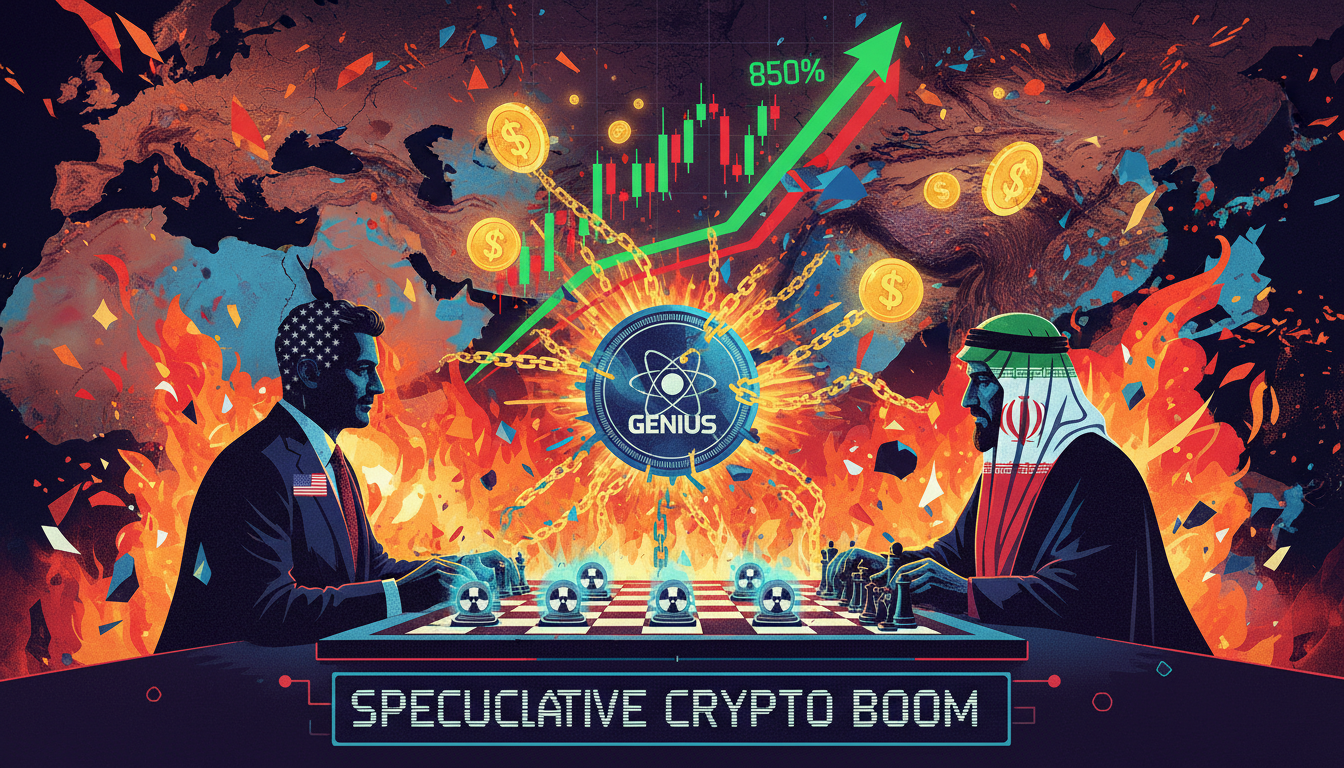
On April 13, 2026, Eastern Eight Time, the military confrontation between the United States and Iran sharply escalated. The United States announced a maritime blockade of Iranian ports, setting 10 PM of the same day as the effective time for the blockade order, corresponding with the policy point of 10 AM Eastern Daylight Time on April 13. On the same day, Trump publicly claimed that the Iranian Navy had been "completely destroyed," with a total of 158 vessels sunk, and warned that any remaining "fast attack boats" approaching the U.S. military blockade line would be immediately destroyed. This statement quickly spread through encrypted media and traditional financial circles, sparking heated debates over the authenticity of the information and potential escalation paths.
In terms of energy and asset prices, the geopolitical tensions were immediately reflected in market pricing: according to a single source of data, U.S. oil briefly reported $100.51 per barrel and Brent oil rose to $95.94 per barrel, as the market rapidly priced in potential supply disruptions and shipping risks. At the same time, the Polkadot ecosystem cross-chain project Hyperbridge exposed security vulnerabilities, leading to approximately $237,000 in losses. The U.S. compliance project Ondo Finance submitted applications related to tokenized securities to the SEC. These seemingly disparate events converged on April 13 to form a common question: in the context of war threats, oil price shocks, and on-chain risks, how would crypto assets be repriced and subjected to renewed scrutiny under the regulators' spotlight?
158 Warships Destroyed? Battlefield Discourse and Market Expectations
The public opinion whirlpool on April 13 began with Trump’s astonishing remarks about the Iranian Navy. According to reports from Jinse Finance and Planet Daily, he claimed that the Iranian Navy had been "completely destroyed," with specific numbers stating 158 vessels sunk, and further released a deterrent signal: any remaining "fast attack boats" that approached the U.S. military blockade line would be "immediately destroyed." This emotionally charged statement painted an extreme military scenario for the market—not just a conventional blockade, but an attempt to fundamentally deprive the opponent of maritime operational capabilities.
However, in stark contrast to this dramatic "battlefield report" is the void of information verification. Research briefs clearly stated that there is currently a lack of independent third-party accounts providing a systematic assessment of the relevant claims, and the actual total number of Iranian Navy vessels does not have authoritative data support, making it unclear whether this number is statistically significant in terms of actual battle outcomes. Additionally, the specific channels through which Trump's statement was released remain to be confirmed, making this seemingly "quantitatively accurate" battlefield result susceptible to exaggeration or misrepresentation.
The sense of information conflict was further heightened by statements from regional political figures. According to a single source, the Prime Minister of Pakistan emphasized during the same period that the ceasefire agreement between the U.S. and Iran is "still in effect," which stands in stark contrast to the U.S. side's high-profile declaration of blockade and destruction of vessels. On one side is a continual escalation of the war script, and on the other is a political statement attempting to maintain the ceasefire framework, making it difficult for external observers to quickly form a unified judgment on the actual battlefield situation and the probability of escalation.
In this high-noise environment, whoever controls the narrative finds it easier to dominate the market’s imagination of the "worst-case scenario." The unverifiability of military data provides significant shaping space for political discourse, making it easy for the pricing of risk assets to tilt toward extremes. For the crypto market, investors do not need to wait for battle results to be fully verified; the mere imagery of "158 vessels destroyed" is sufficient to trigger hedging actions ahead of time, viewing geopolitical conflict as an infinitely extendable tail risk, thereby leading to reductions and reallocations in positions and leverage.
Countdown to the Blockade Order: Oil Prices Between Panic and Expectation
If the exaggerated figures of battlefield outcomes provide an emotional narrative for the market, then the specific effective time of the blockade order anchors this narrative within the real timeline. Research briefs indicate that at 10 AM Eastern Daylight Time on April 13, the U.S. military's "blockade order" reached a critical point; by 10 PM Eastern Eight Time that evening, the related measures were regarded as officially in effect. This "countdown-style" policy setting offers a temporal coordinate for global markets to hedge and speculate simultaneously, with oil prices becoming the most direct reaction curve.
During the window of the blockade order, the market quickly priced in potential supply disruptions through oil prices. According to a single source, U.S. oil prices surged to $100.51 per barrel, while Brent crude reached the high range of $95.94 per barrel. In recent years, energy prices have repeatedly served as "amplifiers" of geopolitical risks, and this time is no exception—regardless of the specifics of how the blockade will be executed or whether ships will be significantly obstructed, funds have already preemptively priced in a significant "war premium" on the price front.
From a macro transmission perspective, increases in crude oil and shipping costs primarily drive a repricing of future inflation paths. Higher cost expectations weaken the attractiveness of risk assets, prompting some funds to withdraw from high-volatility assets in search of more defensive allocation targets. For crypto assets, this chain typically manifests as: slight adjustments in inflation and interest rate expectations → decline in risk appetite in traditional markets → high-leverage, high-beta sectors in crypto encountering pullbacks first, while better-liquidity, more clearly narrative top assets withstand pressure relatively.
It is important to emphasize that the current oil prices reflect a discounting of the "worst-case scenario," rather than already established facts. Whether the blockade completely halts Iran's oil exports and whether shipping risks spread to larger shipping routes remain highly uncertain. The rise in oil prices is more a risk pricing related to potential escalation paths, rather than a simple follow-up to existing realities. This leaves room for two narrative developments: if subsequent enforcement is mild or ceasefire progress accelerates, there is room for oil prices to "remove the war bubble"; if the blockade intensifies or conflicts spread, then energy re-inflation will continue to compel a global asset restructuring, and the crypto market will face a new round of extreme volatility.
On-chain Vulnerabilities Resurface: Hyperbridge Incident and Systemic Bias
In contrast to the "hard power" on the battlefield, the "soft vulnerabilities" on-chain appear limited in scale but played a similar role as an emotional amplifying trigger on April 13. According to the brief, the cross-chain project Hyperbridge in the Polkadot ecosystem exposed security vulnerabilities, with confirmed losses of approximately $237,000. This figure comes from a single source and lacks broader technical tracking and audit disclosures; therefore, it requires deliberate suppression of the impulse to exaggerate in reporting and interpretation, to avoid rendering limited losses as "large-scale black swan" events.
Even so, against the backdrop of heightened geopolitical and energy market tensions, any on-chain security incident will instinctively lead the market to associate it with "systemic risk." Investors easily overlap uncertainties from different dimensions: on one side is maritime blockade and military conflict; on the other side is cross-chain bridge security and asset misappropriation risks; thus, an originally technical single-point failure is magnified into a magnifying glass of "whether the crypto system will fail as a whole under pressure."
As funds are driven by risk-averse sentiments, the differentiation of protocol security tiers becomes particularly sensitive. Cross-chain and bridging sectors, which inherently bear the function of asset movement and concentrated custody across multiple chains, are often seen as key nodes in risk transmission. In high-pressure cycles, the market tends to prefer reducing exposure to complex bridging solutions and increasing allocations to underlying public chain native assets and more mature infrastructure, giving higher valuation premiums to projects with good security records and higher audit transparency. Meanwhile, those cross-chain protocols that frequently experience security incidents and lack clear governance structures may face a "double blow" in valuation and liquidity.
From this perspective, the actual loss scale of the Hyperbridge incident may not be large, but it triggers a "conditioned reflex" doubt: when the outside world enters a phase of re-pricing due to war risks, can the on-chain world truly provide a safe haven, or does it instead expose new vulnerabilities at critical moments?
From the Battlefield to Wall Street: The Compliance Narrative of Tokenized Securities
In stark contrast to the gunpowder scent on the front lines, Wall Street and regulatory institutions continue to advance the process of asset tokenization on a set schedule. Research briefs mentioned that Ondo Finance has submitted a tokenized securities application to the U.S. Securities and Exchange Commission (SEC), an action seen as a representative sample of the current "compliance narrative"—as macro and geopolitical uncertainties rise, institutions are not fully retreating but rather working to migrate some assets to regulated on-chain forms.
This dramatic contrast indicates that the frontline warfare has not paused the institutional development in the rear. On the contrary, the vulnerabilities of the traditional financial system exposed by warfare and blockades—such as reliance on cross-border settlements, low clearing efficiency, and asset liquidity constrained by geopolitical controls—have instead strengthened regulators' and compliance projects' long-term interest in "asset tokenization." Tokenized securities are essentially not unregulated crypto tokens but aim to package traditional assets like bonds and fund shares as on-chain certificates within existing legal frameworks.
During high uncertainty cycles, the focus of institutional risk appetite also subtly shifts. Compared to completely unregulated, highly volatile native tokens, projects like Ondo offer a "regulated decentralized" option: asset registration, compliance audits, and information disclosures are still dominated by traditional systems, while clearing and holding rely on on-chain infrastructure. This hybrid form reduces the regulatory uncertainty premium, allowing long-term funds to enjoy some on-chain liquidity and programmability benefits without fully abandoning compliance protection.
From the perspective of risk premium structures, these compliance actions open a new pricing dimension in the crypto world: on one end is the "geopolitical premium" brought by wars and blockades, and on the other end is the "institutional premium" arising from compliance and regulation. As regulatory-led on-chain assets begin to be systematically included in institutional asset allocation pools, traditionally "high-risk" crypto exposures are being restructured into more detailed tiers—determining which tokens can be viewed as quasi-securities with legal backing, and which remain in regulatory gray areas and can only attract funds through pure market risk compensation, will profoundly impact the future returns and valuation structure of crypto assets.
Fund and Emotion Restructuring: Multiple Overlaps of Risk Narratives
On April 13, rising oil prices, military blockades, on-chain security incidents, and compliance applications—these seemingly unrelated news threads appeared almost simultaneously, forming a market landscape of "multiple overlapping risks." On one side is the energy panic, with U.S. oil surging past $100.51 per barrel and Brent oil rising to $95.94 per barrel; on the other side are the U.S. military blockade points and the extreme narrative of "158 vessels sunk," further adding to Hyperbridge's security vulnerabilities and Ondo's SEC application. Investors were forced to price in war, technology, and regulation across three fronts on the same day.
Driven by risk-averse sentiments, the natural response of funds is to reduce leverage and lower exposure to high-beta assets. High-volatility, small market cap, and singular narrative tokens often face the first wave of selling in such environments, while assets with higher liquidity, more mature trading infrastructures, and potential compliance expectations tend to withstand pressure relatively well. Some funds may even proactively "move from high-risk segments within the crypto world to on-chain dollar instruments" to maintain participation in the on-chain ecosystem while reducing the impact of price fluctuations on net value.
Research briefs indicated that the WLFI net increase of 22 million USD1 (from a single source) can be seen as a facet of this fund migration trend: amidst soaring uncertainty, some participants chose to increase on-chain dollar positions, conveying an attitude of "first locking in nominal dollars, then discussing risk and return," regardless of the specific mechanisms and collateral structures. This is highly analogous to the traditional market logic of funds flowing from stocks to cash or short-term bonds for safety.
On the narrative level, the market is simultaneously restructuring three types of premiums:
● War Premium: Driven by the U.S.-Iran blockade, military outcome disputes, and soaring oil prices, it demands risk assets to provide higher expected returns as compensation for potential shocks.
● Security Premium: Triggered by security incidents like Hyperbridge, forcing funds to make stricter distinctions regarding the security levels of different protocols and assets, providing higher valuation tolerance to underlying infrastructure and top protocols.
● Regulatory Premium: Driven by compliance actions such as Ondo's application to the SEC, assigning additional valuation space to regulated on-chain assets while compressing the risk compensation space for unregulated tokens.
Redistributing chips and narrative power between these three premiums is a deep restructuring process currently underway in the crypto market. Different types of funds—from high-frequency trading institutions to long-term funds, from on-chain natives to traditional family offices—are choosing to position themselves on different combinations of premiums based on their constraints, constructing new asset allocation logics.
War Rumors May Not Come True, But the Market Has Already Priced In
Ultimately, the escalation of the U.S.-Iran blockade, the dispute over the outcome of 158 vessels, the rapid surge in oil prices, and the on-chain turmoil of Hyperbridge collectively establish a high-pressure trading environment: externally, there is the threat of geopolitical conflict escalating at any moment; internally, technical and security issues occasionally explode; sandwiched in between is the regulatory institutions' ongoing compliance process. In the absence of complete information and while facts await verification, the market is forced to preemptively express positions through pricing and allocations.
In such an environment, maintaining caution regarding unverified military and market data becomes particularly important. Whether the horrifying assertion of "the Iranian Navy being completely destroyed" or the single-source number regarding the loss scale of a certain cross-chain protocol is insufficient to form a basis for isolated decision-making. Making extreme bets based on a single narrative—whether betting everything on war escalation or wishfully hoping for a comprehensive ceasefire—means entrusting one's assets to emotional fluctuations rather than verifiable facts.
From a short-to-medium-term perspective, investors need to closely track three evolving mainlines: firstly, the actual enforcement intensity of the blockade order—whether it is symbolic or constitutes substantial obstruction, which will directly affect oil prices and global risk appetite; secondly, the genuine progress of the ceasefire agreement—including whether mediation by regional countries like Pakistan can translate into verifiable de-escalation actions; and thirdly, regulatory approvals and compliance processes—such as the approval nodes for projects like Ondo at the SEC, which will shape institutional long-term confidence in the category of "on-chain assets."
Looking ahead, it is foreseeable that similar geopolitical conflicts and financial market linkages will play out multiple times. However, after each shock, the crypto market has the opportunity to further refine its "layered structure of hedging and compliant assets" through violent fluctuations: on one end are tokenized assets closer to traditional finance and under regulatory constraints, performing value storage and robust income functions; on the other end are high-volatility, high-innovation native tokens, continuing to provide a testing ground for funds with higher risk appetites. Finding a suitable position between these two ends will become a question that every crypto participant must repeatedly answer over the next few years.
Join our community to discuss and become stronger together!
Official Telegram Community: https://t.me/aicoincn
AiCoin Chinese Twitter: https://x.com/AiCoinzh
OKX Welfare Group: https://aicoin.com/link/chat?cid=l61eM4owQ
Binance Welfare Group: https://aicoin.com/link/chat?cid=ynr7d1P6Z
免责声明:本文章仅代表作者个人观点,不代表本平台的立场和观点。本文章仅供信息分享,不构成对任何人的任何投资建议。用户与作者之间的任何争议,与本平台无关。如网页中刊载的文章或图片涉及侵权,请提供相关的权利证明和身份证明发送邮件到support@aicoin.com,本平台相关工作人员将会进行核查。