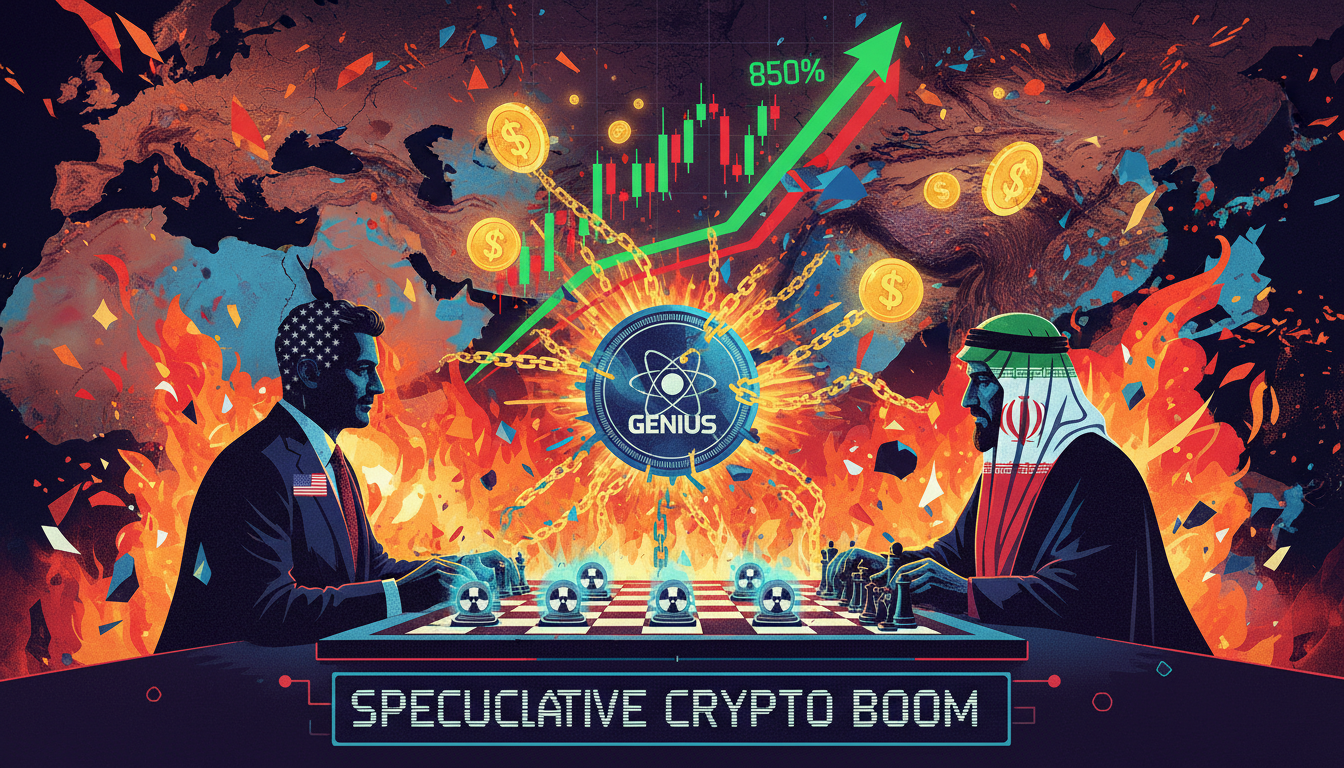
On April 13, 2026, in East 8 Time Zone, two seemingly contradictory signals emerged from the direction of Iran: on one hand, the U.S. military's blockade order against some Iranian ports entered the actual execution phase, sharply tightening expectations for the safety of shipping and energy channels; on the other hand, there were reports from a single media source stating that Iran was studying the option to "give up uranium enrichment," a key bargaining chip in nuclear negotiations. Within the same time frame, crude oil prices on platforms like Bitget and Gate plummeted by nearly $3, while the cryptocurrency market was dominated by internal narratives such as GENIUS airdrops and regulatory compliance developments, exhibiting a volatility rhythm distinctly different from traditional commodities. Faced with the dissonant scenario of "ports being blocked but oil prices falling" and "the nuclear shadow not dissipating yet risk assets not experiencing widespread panic," what the market really tried to price was the likelihood of escalation in war, increased sanctions, or a thaw in negotiations?
Implementation of Port Blockade: An Intuitive Pricing Drop in Oil Prices
On April 13, the U.S. military's blockade order against Iranian ports officially took effect, marking a shift in military pressure on this key energy export channel from a rhetorical level to practical execution. The timing of the blockade coincided closely with the market trading hours, adding to prior debates about maritime security, making "whether oil transport is obstructed" immediately the top variable on energy trading desks. According to traditional logic, such events are often seen as triggers for supply constraints and push oil prices upward, but the market presented a different picture that day.
Price data from Bitget and Gate exhibited high consistency: following the sealing news, crude oil prices experienced a rapid drop of nearly $3 in short-term trading, completing a transition from uplifting expectations to plunging then weakly stabilizing within a few candlesticks. The decline was not a slow slide, but rather concentrated in the phase where the market digested the actual terms and scope of blockade execution, with a general rhythm leaning towards an "emotional sharp turn" instantaneous reaction. Oil prices and the degree of geopolitical tension temporally overlapped, but briefly diverged in direction from traditional textbook logic.
Attributing the aberration in oil prices solely to "panic clearing caused by the blockade" or "the market betting on a thaw in negotiations" carries a significant risk of oversimplification. Specific execution scales in the blockade order, alternative expectations from other oil-producing regions, adjustments in speculative capital positions, and triggers from algorithmic trading might all play a role behind this $3 decline. The visible data can only indicate that the price turning point was highly synchronized with the blockade's implementation, yet it cannot support the linear conclusion that "blockade = oil price drop." In the absence of more granular trading and positioning disaggregation, perceiving this volatility as a result of multiple factors overlapping is closer to the truth than constructing a single narrative.
Divided Rumors of Nuclear Negotiations: Confrontational Narratives from Two New York Media Outlets
Coinciding almost with the port blockade, there were reports that Iran was considering "giving up uranium enrichment" in potential nuclear negotiations, placing this core issue on the negotiating table. It is crucial to emphasize that this claim currently originates from a single media source and has not been cross-verified by Iranian officials or other authoritative institutions. In terms of factual content, only the mere existence of the "leak" can be securely included in a pricing model, rather than the more radical version of "Iran has decided to concede." In the absence of official texts, the market is primarily trading on the "rumor premium" regarding the possibility of concessions, rather than established facts.
Regarding the core question of "Is Iran making significant concessions," the New York Post and the New York Times present sharply contrasting narratives in their reporting tones and political orientations. The former is traditionally closer to pro-Trump positions and tends to interpret the rumor as potential evidence of the Biden administration's "soft handling" of Iran, emphasizing the risks of U.S. concessions on nuclear issues; the latter is more cautious in wording, maintaining significant reservations about the statement to "give up uranium enrichment," stressing the lack of sufficient evidence to support the judgment of "significant structural concessions." The same news, under the packaging of these two media, was embedded in entirely different narrative frameworks of "damage to hardline policies against Iran" and "negotiations still in a vague exploratory phase."
Some circulating information regarding negotiation details is currently clearly in a "pending verification" state. Quantitative expressions like "The U.S. requests Iran to remove approximately 400 kilograms of highly enriched uranium," along with specific probability numbers predicted by the market, have yet to receive confirmation from reliable sources; research briefs explicitly mark them as unsuitable for serious quantitative analysis. For traders, what matters is not merely "hearing what numbers," but rather clearly defining boundaries in their minds: which are confirmed facts, and which still remain unverified rumors of negotiations and media interpretations. When this boundary is intentionally blurred, prices tend to move faster than reality and become more susceptible to emotions.
Dislocation between Cryptocurrencies and Commodities: Two Price Curves for Risk Assets
From experience, geopolitical tensions in the Middle East typically spill over into broader assets through two pathways: one is rising oil and freight prices, pushing up global inflation expectations and safe-haven demand; the other is an overall contraction in risk appetite, initially affecting high-leverage assets and emerging markets, then gradually transmitting to cryptocurrencies. Especially in multiple samples post-2020, surges in crude oil and strengthening of the dollar often accompanied an increase in volatility in the cryptocurrency market and reduced leverage funding; this "oil price-macro-crypto" chain reaction was once considered common knowledge.
However, on April 13, crude oil experienced a quick drop of nearly $3 around the execution point of the blockade, while the cryptocurrency market did not simultaneously exhibit massive panic selling. Mainstream coins and most on-chain assets exhibited more of a "wait and differentiate" attitude in daily fluctuations, rather than unilateral selling: segments driven by local narratives remained active, and sentiment indicators did not display extreme readings similar to those under traditional safe-haven patterns. This "dislocation" phenomenon, not completely aligned with historical samples, suggests that the market might be performing a more refined risk segmentation—temporarily treating localized tensions in the Middle East separately from global systemic risks.
It must be acknowledged that, in the absence of systematic, multi-variable regressions and historical back-testing support, we currently cannot provide a strict quantitative explanation for the "dislocation between oil prices and cryptocurrencies" in this round. What we can do is propose a few possible associative pathway hypotheses: for instance, geopolitical risks are viewed as local and controllable, applying more pressure on energy and regional stock markets; internal narratives in crypto (such as airdrops and on-chain compliance) have gained explanatory power over fund flows in the short term; and macro-level interest rate expectations have not exhibited drastic revisions. These hypotheses require validation from subsequent data and can only serve as observation frameworks, rather than providing a definitive conclusion on "why this time is different."
GENIUS Airdrop Coincides with Bay Tensions: A Short-Term Safe Haven of Intrinsic Narrative
On the same day when geopolitical news stirred macro emotions, traders' screens were also occupied by another markedly different message: Holders of 230 Binance Alpha points can receive 240 GENIUS tokens. This airdrop rule offers a relatively clear expectation range of returns for some active users—trading known points for a specified amount of tokens, with an inherent attraction of "quantifiable chips" before prices are entirely driven by secondary market negotiations. For funds accustomed to mining marginal returns on-chain, such straightforward rules with clear barriers present an opportunity to seek "certainty discounts."
More subtly, the official start time for claiming the GENIUS airdrop was postponed to 11 PM on April 13, nearly overlapping with the fermentation of reports on the Iranian port blockade and nuclear negotiation rumors. The outcome is that on news channels, there is a tug-of-war of sanctions and negotiations, while in the on-chain world, it is a race against time to "grab quotas and snapshots." Within the same time window, two completely different tense emotions unfolded simultaneously across different groups, but only in the mindset of a minority of overlapping users did they occur in conjunction.
From the perspective of capital behavior, narratives like GENIUS airdrops have indeed provided some participants with an "intrinsic story" to hedge against external uncertainties in the short term. When macro and geopolitical signals are highly noise-ridden, expected airdrop returns and transparently defined point exchanges become more easily modelable and gamified; some marginal funds prefer to focus their efforts on "how to maximize airdrop gains" instead of swinging repeatedly between half-truths in nuclear negotiation rumors. In a sense, such on-chain native activities constitute a cushion against geopolitical shocks on an emotional level, allowing the price curve of the cryptocurrency market to maintain a locally-driven "safe haven" while external winds howl.
Ondo Submits Regulatory Request: Compliance Narrative and War Cloud Imagination on the Same Stage
Parallel to the buzz of the airdrop is a seemingly calm yet potentially transformative message for market structures: Ondo Finance has formally submitted a regulatory request to the U.S. SEC, with the core demand being to establish a clearer regulatory framework for on-chain assets, particularly for tokenized products based on safe assets like government bonds and cash. Ondo repeatedly emphasized in its statement that "on-chain records help enhance collateral monitoring efficiency," meaning that through traceable and immutable on-chain data, regulators and institutional investors can more easily monitor underlying assets and leverage levels in real-time, reducing systemic risk.
During geopolitical fluctuations, this combination of “transparent collateral + regulated structure” is particularly critical for potential gains in institutional participation confidence. In the traditional financial world, whenever Middle Eastern tensions or commodity shocks occur, institutions often compress non-core risk exposures, prioritizing retreats from asset classes seen as "gray" from a regulatory perspective. If on-chain assets can be viewed as qualified collateral within a regulatory framework, and the underlying positions and risk exposures can be audited in real-time, then even in the presence of external geopolitical risks, some institutions might choose to maintain or reposition in cryptocurrency-related products, seeing them as a "return source with regulatory backing" rather than purely speculative chips.
Thus, within the same time window, on one side is "the imaginary safe haven under war clouds"—a serial drama about oil prices, sanctions, and conflict escalation; on the other side is the slow but continuous advancement of "on-chain compliance construction." These two narratives seem unrelated, yet they intertwine at the level of capital decision-making: macro and geopolitical uncertainty drives some capital to seek asset forms with higher transparency and clearer rules, while the on-chain compliance process just happens to provide a potential channel for this. Under geopolitical shadows, risk assets do not only have "retreat or all-in" two options; compliance-driven structural upgrades are providing the market with a third pathway—reshaping the way allocations are made within a controlled framework.
Trading Amid Ambiguous Information: How the Market Re-prices in Light of Nuclear Shadows
In summary, April 13 saw multiple events collide: the rumor that Iran might give up uranium enrichment was amplified and torn apart in the media, the U.S. military's port blockade order officially took effect, and crude oil experienced a nearly $3 short-term fluctuation, all closely coinciding. Simultaneously, the cryptocurrency market underwent on-chain events such as the delayed launch of GENIUS airdrops and Ondo's submission of SEC regulatory requests. Geopolitical uncertainty, energy price volatility, and internal narratives from the on-chain world coalesced, jointly shaping a sentiment base in the cryptocurrency market of "calm yet turbulent undercurrents" on that day.
In such a phase where media narratives are highly contradictory and details of negotiations are severely lacking, what investors first need to do is not speculate on "what was actually discussed at the negotiating table," but rather clearly delineate information layers: which are confirmed facts (such as the effectiveness of the port blockade order, actual drop in crude oil prices, GENIUS airdrop rules and timing, Ondo confirming submission of regulatory requests), and which remain as pending verification rumors and political discourse (such as whether Iran truly gives up uranium enrichment, specific requirements of the U.S. in terms of techniques and strategies, and unverified probability numbers). Only upon establishing this boundary can any decisions regarding positions and risk exposures have a solid basis in reality; otherwise, it's merely paying for information noise.
Looking forward, once an official text regarding Iranian nuclear negotiations is revealed, clear statements from the White House or Tehran are issued, or the SEC provides a clearer response to Ondo's regulatory request for on-chain assets, the prices formed within the current "ambiguous information interval" will face a systemic revaluation: if negotiations are confirmed to be progressing towards a de-escalation, oil prices might further shed "nuclear shadow premiums," and the pressure on risk assets, especially cryptocurrencies, is expected to ease, with the explanatory power of internal narratives and compliance progress rising; if negotiations collapse or sanctions escalate, energy and safe-haven assets may again encounter severe revaluation, and the cryptocurrency market will need to confront the dual challenge of "liquidity constriction + declining risk appetite." Regardless of which pathway unfolds, what ultimately decides the outcome remains the grasp of information boundaries and how to manage positions and rhythms within the highest uncertainty intervals.
Join our community to discuss and become stronger together!
Official Telegram community: https://t.me/aicoincn
AiCoin Chinese Twitter: https://x.com/AiCoinzh
OKX Benefit Group: https://aicoin.com/link/chat?cid=l61eM4owQ
Binance Benefit Group: https://aicoin.com/link/chat?cid=ynr7d1P6Z
免责声明:本文章仅代表作者个人观点,不代表本平台的立场和观点。本文章仅供信息分享,不构成对任何人的任何投资建议。用户与作者之间的任何争议,与本平台无关。如网页中刊载的文章或图片涉及侵权,请提供相关的权利证明和身份证明发送邮件到support@aicoin.com,本平台相关工作人员将会进行核查。