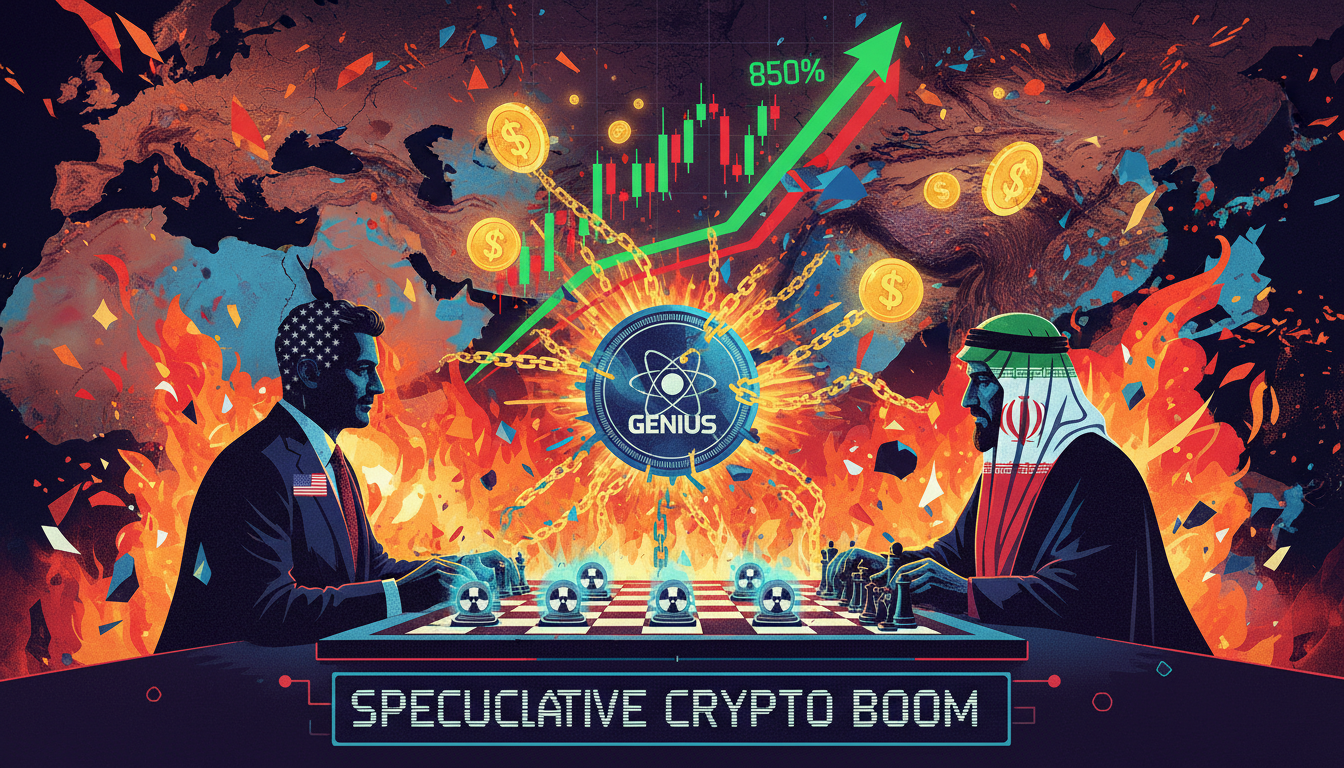
On April 13, 2026, at East Eight Time, Iran's acting Minister of Defense Seyed Majid Ibn Reza announced through official channels that the national armed forces have entered a state of highest alert (maximum combat) readiness, sending a strong external deterrent signal. This statement comes above the Strait of Hormuz, a global energy "throat," tightening the already tense geopolitical nerves. For global assets reliant on stable energy prices and risk appetite to maintain valuation, an invisible pressure chain is taking shape, from crude oil to stock markets to crypto assets. This article will trace how this readiness upgrade affects the sentiment and dynamics in the coin market along the path of "military signals—energy expectations—hedging demand—crypto assets."
Winding Up the Strait: Iran Reveals Hardline Cards
The source of this upheaval is a highly condensed statement thrown out by the Iranian government on April 13: the armed forces are entering a state of maximum alert and warn that "any hostile action will be met with a strong and decisive response." The words "highest level," "strong," and "decisive" constitute a clear signal of escalation, reflecting an unyielding stance towards potential conflict and allowing considerable room for external expectations to imagine.
From the information flow perspective, this statement was first released by Iran’s Tasnim News Agency, which serves as a close local media outlet playing an amplifying role in regional security issues. Subsequently, the news was quickly referenced by Golden Finance, Planet Daily, TechFlow, and other Chinese crypto and finance media, spreading within hours to various social media platforms and market communities, achieving a cross-circle dissemination from "regional military news" to "global risk asset discussion topics." For market participants accustomed to capturing sentiment through keyword searches, combinations like "highest alert," "Hormuz," and "strong response" are sufficient to trigger concentrated imaginations about geopolitical risks.
The reason a readiness upgrade can be magnified in the global market lies in the overlapping roles of Iran in the regional security structure and the strategic position of the Strait of Hormuz. Iran is not only an important coastal nation on the northern shore of the strait but also one of the major energy producers and military forces in the region. Its statement naturally evokes associations with "potential impact on the safety of vital shipping lanes." Even if the briefing did not provide any specific military deployments or triggering events, the mere designation of "maximum alert" is enough for the market to interpret it as a substantive elevation of regional uncertainty, which in turn reflects in the pricing of energy, exchange rates, and risk assets.
From Strait to Oil Prices: How Energy Nerves are Affected
For traders focused on macro and commodity logic, the Strait of Hormuz is not an abstract geographical term but a risk curve highly bound to oil price volatility. During the Trump administration, market opinions frequently voiced concerns such as “the Strait of Hormuz could be blocked,” which were used to explain severe fluctuations in oil prices during certain periods—it's important to note that such historical narratives stem from a single source perspective, reflecting market sentiment and media selective memory more than a unified conclusion.
Structurally, the Strait of Hormuz has long been considered one of the critical bottlenecks for global oil and gas transportation, serving as a vital export channel from the Middle Eastern oil-producing region to the world. Once this "throat" is deemed to carry risks, regardless of whether the actual physical flow is affected, the pricing chain often reacts in advance: futures markets lead in re-evaluating risk premiums, with downstream channels transmitting these premiums to the broader economic system through refined oil, shipping rates, and production costs.
Against this backdrop of historical memory and structural understanding, Iran's announcement of entering a state of maximum alert is easily interpreted as a signal of rising risks to crude oil supply disturbances. Even if there are currently no public facts of a blockade or conflict, the market tends to reprice future inflationary pressures on the expectation level: on one hand, potential "upward expectations" for oil prices raise input inflation; on the other hand, high inflation might compel major economies to be more cautious in monetary policy, thereby suppressing growth expectations and risk appetite. This "dual anxiety" regarding inflation and growth is the breeding ground for the emergence of hedging demand and the starting point for subsequent capital reallocation among assets.
Coexistence of Panic and Profit-Seeking: A High-Pressure Testing Ground for Risk Assets
In the discussions among Chinese financial and crypto media, "global energy and risk asset sentiment under pressure" has become the mainstream summary of this event. Such expressions aim to convey a consensus: even if the current conflict has not materialized into substantive military action, the mere readiness upgrade and hardline stance are enough to cast another shadow on the already fragile risk appetite.
Traditional risk assets face a significant issue in such an environment, which is the bidirectional disturbance of valuation anchors and discount rates. On one hand, if the market fears upward pressure on energy and inflation, it will tend to increase the discount rates on future cash flows, compressing high-valuation assets, with tech stocks and emerging market equities often taking the brunt; on the other hand, narratives of geopolitical conflict can amplify volatility, and algorithmic trading and leveraged funds may intensely clear positions during sensitive periods, creating steeper price curves that make "technical sell pressure" appear as “fundamental collapse.”
During times of heightened hedging preference and frustrated growth expectations, the rebalance of funds among equities, commodities, and crypto assets often revolves around several ideas: some funds may increase allocations to gold, some commodities, and defensive assets to hedge against inflation and tail risks; while another portion attempts to capture "wronged" and oversold rebounds in high-volatility environments, especially in segments that have seen considerable increases previously and offer ample liquidity. Crypto assets sit at the intersection of this rebalancing chain: regarded as high beta risk assets and packaged in some narratives as "alternative assets to hedge against fiat currencies and geopolitical risks," they present a more complex price trajectory between panic and profit-seeking.
The Information Storm in the Crypto Circle: How a Military Situation Becomes a Trading Signal
In the dissemination chain of this event, the crypto circle exhibits consistent high sensitivity and high amplification characteristics. After the news leaked from Tasnim News Agency, it was quickly edited and pushed by Chinese crypto media like Golden Finance, Planet Daily, and TechFlow, with related content rapidly dominating market groups, Chinese communities on Twitter, and various KOL channels. For participants accustomed to capturing trading clues through information flows, titles like "Iran's highest alert" and "Hormuz tensions" are seen as potential preambles to volatility.
Within the crypto community, expressions like "highest alert" are often bound to narrative templates such as "black swans" and "hedging waves," and their secondary rendition on social platforms naturally leads to discussions about "whether it benefits certain coins" and "whether it will trigger capital shifts." The interpretations by KOLs and anonymous accounts typically do not linger on the facts themselves but quickly embed a price perspective and position recommendations, transforming news originally leaning towards political and security domains into a set of actionable trading signals.
It is worth emphasizing that the currently available public information lacks specific details about military deployments and does not disclose clear events that triggered the readiness upgrade. In this high uncertainty scenario, market sentiment and narratives tend to take on greater "price interpretive power": bulls can tell the story of "hedging funds flowing into crypto," while bears can amplify the logic that "risk assets are generally under pressure." Short-term traders often act based on expectations, sentiment, and technical positions without waiting for facts to materialize; under the amplification of high leverage and high-frequency dynamics, a military situation can quickly give rise to a wave of market fluctuations.
Entanglement of Military Situation and Coin Prices: Finding Pricing Boundaries in Uncertainty
In summary, Iran's raising of armed forces to a state of maximum alert influences the pricing of crypto assets roughly through three paths: first, via energy and inflation expectations, triggering worries about crude oil supply disturbances through the imagination of the Strait of Hormuz, subsequently pushing up global inflation and monetary policy uncertainty; second, through a rebalance of risk appetite and hedging demand, causing funds to redistribute among equities, commodities, and high-volatility assets including crypto; lastly, through information propagation and sentiment amplification mechanisms, driving short-term trading behavior by layering a military alert message with price narratives via media and social networks.
At the same time, it must be clear that the currently available public information does not contain known triggering events or specific military deployment details, and assessments of the actual control status of the Strait of Hormuz, the extent of blockades, or military actions by related parties exceed the disclosed facts. In other words, the current market revaluation of prices is more based on expectation and imagination rather than a reaction to confirmed facts. This phase, dominated by sentiment and defensive pricing, is often prone to "overreaction" and "narrative distortion," which is frequently classified as "short-term displacement of risk premiums" when reviewing market trends.
In trading and allocation aspects, what is more deserving of consideration is not whether this military situation is "bullish" or "bearish" for crypto, but rather how to distinguish short-term emotional fluctuations from medium- to long-term geopolitical risk premiums. On one hand, short-term participants need to be wary of being swayed by emotions during high-volatility windows, avoiding leveraging unverified assumptions as if they were certainties; on the other hand, medium- to long-term allocators can view such events as a "stress test" for their own risk exposures, reassessing sensitivity towards energy, inflation, and geopolitical risks within their portfolios. From this perspective, instead of betting on the direction of a single military situation, it is more important to set boundaries on uncertainty itself: clarifying what are known facts and what are merely narratives amplified by the market.
Join our community to discuss and grow stronger together!
Official Telegram group: https://t.me/aicoincn
AiCoin Chinese Twitter: https://x.com/AiCoinzh
OKX welfare group: https://aicoin.com/link/chat?cid=l61eM4owQ
Binance welfare group: https://aicoin.com/link/chat?cid=ynr7d1P6Z
免责声明:本文章仅代表作者个人观点,不代表本平台的立场和观点。本文章仅供信息分享,不构成对任何人的任何投资建议。用户与作者之间的任何争议,与本平台无关。如网页中刊载的文章或图片涉及侵权,请提供相关的权利证明和身份证明发送邮件到support@aicoin.com,本平台相关工作人员将会进行核查。