Written by: Xiaoza Legal Team
In March this year, the work report of the Standing Committee of the National People's Congress listed "formulating a law against cross-border corruption" as a key legislative task for the year, marking a new stage for our country in the field of specialized governance against cross-border corruption. What impact will the formulation of the new law have on Chinese companies going abroad and other entities? How should companies take action to deal with cross-border corruption?
Today, the Xiaoza team will systematically sort out the legislative dynamics and practical challenges of combating cross-border corruption, combining foreign experience to provide compliance guidance for Chinese enterprises that "go out."
1. Legislative Dynamics Abroad
In the face of global corruption challenges, developed countries such as the United States, the United Kingdom, and France have taken the lead in establishing strict anti-corruption legal systems, mainly specifying jurisdiction, defense grounds, and other regulations. The core contents are shown in the table below:
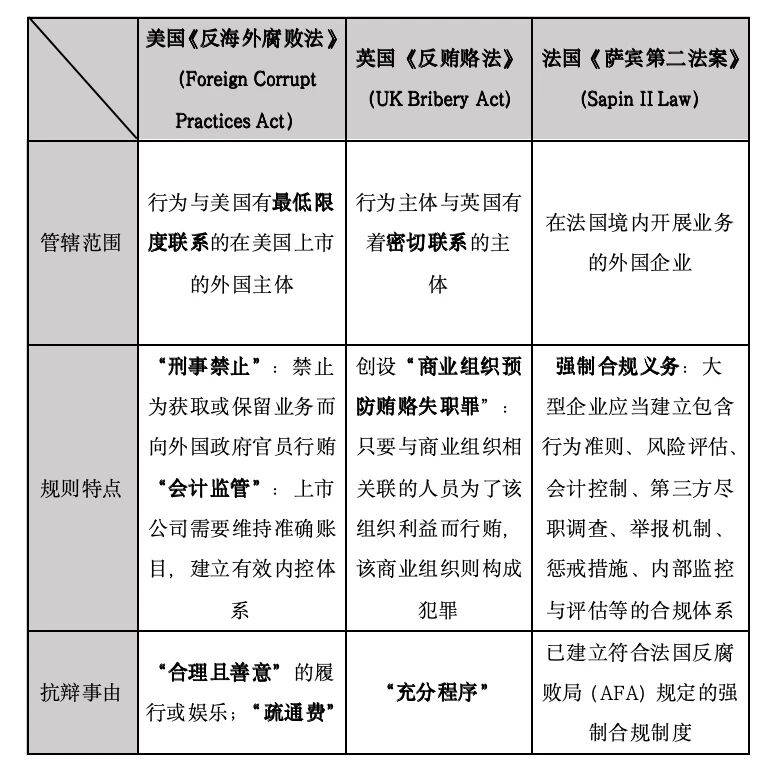
A comprehensive design of the systems in these three countries shows that current global legal regulations against cross-border corruption present three characteristics. First, they emphasize extraterritorial jurisdiction, extending the scope of legal applicability to effectively regulate overseas corrupt practices; second, they focus on establishing preventive mechanisms, requiring companies to build effective internal compliance systems; third, they coordinate punitive and preventive measures with heavy fines for punishment. At the same time, they encourage proactive self-inspection and active rectification by companies through means such as deferred prosecution agreements and judicial settlements.
These common rules are not only the crystallization of global anti-corruption governance experience, but also provide important references for our country to promote specialized legislation against cross-border corruption and improve the corporate compliance supervision system.
2. Pain Points of Corporate Compliance
Against the backdrop of parallel international and domestic legislative progress, Chinese companies going abroad still face the following practical dilemmas when fulfilling compliance obligations:
First, there are deviations in compliance awareness. Some enterprises have a tendency to prioritize business over compliance, viewing compliance with anti-cross-border corruption as a cost burden, failing to integrate it into their strategic planning and business decision-making; some companies also exhibit complacency and even actively evade regulation.
Second, there is an inaccurate grasp of compliance boundaries. Enterprises have vague understandings of the standards and operational limits for identifying cross-border corrupt practices, making it difficult to distinguish between normal business transactions and improper commercial bribery, particularly in scenarios involving overseas gifts and business hospitality, where even slight negligence may cross legal red lines.
Third, the construction of compliance systems is inadequate. Most enterprises have not yet established a complete compliance organizational structure, and their compliance departments lack independence, making effective checks and balances difficult to form. The internal control systems also often merely follow formalities, applying generic templates without adapting them to their specific business characteristics, resulting in a lack of operability.
Fourth, there is confusion in the application of cross-border laws. Companies engaged in cross-border operations need to comply with domestic laws, host country laws, and relevant international regulations simultaneously. The rules across different jurisdictions vary greatly; for instance, China adopts a comprehensive prohibition stance on commercial bribery, while some countries allow minor "facilitation payments," which can easily lead enterprises to misjudge the boundaries of legality.
3. Insights on Corporate Compliance and Internal Control
In the face of an increasingly strict domestic and international regulatory environment and their own pain points, companies need to shift from passive responses to proactive compliance, elevating compliance with cross-border anti-corruption to a strategic level, transforming statutory compliance obligations into actionable daily norms. To this end, the Xiaoza team provides the following suggestions:
(1) Unify Cross-Border Compliance Standards
In response to the confusion in legal applicability observed in practice, companies should establish a regular legal tracking mechanism to systematically organize the anti-corruption legislative rules in the regions where they operate. Additionally, they should create an internal legal conflict assessment mechanism, preparing contingency plans in advance for conflicts to ensure the legality of their business activities under multiple regulatory frameworks.
(2) Improve the Top-Level Governance Structure
Establish a dedicated compliance management department and staff it with dedicated compliance personnel responsible for compliance reviews, risk stoppages, accountability for violations, etc., ensuring the independent conduct of compliance efforts. Furthermore, an anonymous reporting channel can be established to improve whistleblower protection systems, promptly investigating relevant violation leads and ensuring the integrity of the enterprise.
(3) Strengthen Comprehensive Risk Control Mechanisms
Conduct pre-emptive anti-corruption due diligence during project admission, investment mergers, and bidding processes, and formulate special plans for high-risk areas to strengthen proactive defense measures. Meanwhile, during the execution stages, monitor risk in real-time using digital tools for funds flow, contract execution, and third-party cooperation. After discovering violations, strictly implement accountability systems and promptly initiate investigations and corrective measures to minimize corporate losses.
(4) Enhance Third-Party Compliance Management
Implement strict admission reviews for third-party entities such as agents, subcontractors, and suppliers, signing special compliance clauses during cooperation to clarify compliance execution standards and liability for breach; concurrently, conduct regular reviews and audits to promptly address compliance risks that arise from third parties.
Final Remarks
The Xiaoza team particularly reminds that the formulation and implementation of China's "Anti-Cross-Border Corruption Law" may pose additional enforcement risks for foreign entities. For example, foreign multinational companies with specific connections to Chinese business (such as having key technology support teams in mainland China, certain payment or reimbursement processes in mainland China, and significant business risks appearing in mainland China) must reassess connection point risks.
The Xiaoza team predicts that the confirmation of jurisdiction under China's "Anti-Cross-Border Corruption Law" may be similar to the U.S. FCPA, meaning that as long as a matter has a certain connection to China, it may fall under the jurisdiction of the "Anti-Cross-Border Corruption Law." Therefore, for numerous foreign cryptocurrency exchanges and virtual asset service providers, it is necessary to reassess the risks arising from the "Anti-Cross-Border Corruption Law" in their relevant business lines.
免责声明:本文章仅代表作者个人观点,不代表本平台的立场和观点。本文章仅供信息分享,不构成对任何人的任何投资建议。用户与作者之间的任何争议,与本平台无关。如网页中刊载的文章或图片涉及侵权,请提供相关的权利证明和身份证明发送邮件到support@aicoin.com,本平台相关工作人员将会进行核查。


