Author: etherealize_io
As AI agents cannot open traditional bank accounts, they are turning to decentralized finance for payments, lending, and yield management, and the machine economy is expected to become the core driver of Ethereum's future growth.
In early 2026, an AI agent named Felix generated over $300,000 in revenue in about five weeks. Felix employs other AI agents—Iris for customer support, Remy for managing sales—and operates multiple business lines. He sells a continuously updated AI agent deployment guide; he built and operates Claw Mart, a marketplace for pre-built AI skills; he also builds custom AI agents for businesses. His total operating costs are approximately $1,500 per month.
Felix can write code, deploy websites, and manage sales without human assistance. But he cannot open a bank account. Felix's creator, Nat Eliason, had to personally create a Stripe account. The revenue Felix earns can only be placed there, as he cannot open a brokerage account to invest those funds. The traditional financial system assumes that there is a human on the other end of every account. But Felix is not human.
However, when Nat instructs Felix to do something with crypto, "he has no problem doing it. It’s a breeze for him."
Felix is not alone. As Marc Andreessen pointed out in the Latent.Space podcast:
"I think AI is the killer app for crypto... It’s already obvious that AI agents will need funding. This is already happening... My most aggressive friends using OpenClaw have already paired their Claws with bank accounts and credit cards... It’s completely obvious. There are probably about 5,000 people doing this today. But that number will grow."
Felix represents a new model: an autonomous agent capable of earning, spending, and needing financial services. Lending their financial identities from humans is merely a temporary workaround. Ultimately, these agents will use financial systems on Ethereum.
Agents are already transacting
Discussions around AI agents and crypto have largely focused on payments. Coinbase, Cloudflare, and Stripe have laid the groundwork for x402, an open protocol for stablecoin micropayments aimed at agents. Stripe and Paradigm have also launched the Machine Payments Protocol on Tempo, a blockchain for stablecoin settlement.
These numbers are already significant:
- In the first nine months, x402 processed over 140 million agent-to-agent transactions.
- Total transaction volume reached $43 million.
- x402 now contributes about one-fifth of all traffic on Coinbase's Base network.
- Nearly 16,000 verified agents are operating on-chain.
Agents are accelerating the shift to crypto-native payments, as traditional card payment rails are incompatible with agentic commerce. The average amount for an agent-to-agent transaction is $0.31. At this amount level, Visa's fixed fees would nearly consume the entire payment.
Which Agents Will Need DeFi?
Most agents, such as those operating internally within companies, will not require financial systems. Agents that need DeFi are autonomous economic actors: those with their own sources of income, expenditures, and treasury, and that do not rely on a human identity.
As agents become more powerful, their numbers will increase. Coinbase CEO Brian Armstrong believes that AI agents will eventually outnumber humans. These agents will require specific financial services:
- Lending: Agents need operating capital to cover computational costs or fund new businesses. On Aave, an agent can deposit collateral and immediately borrow stablecoins without human involvement.
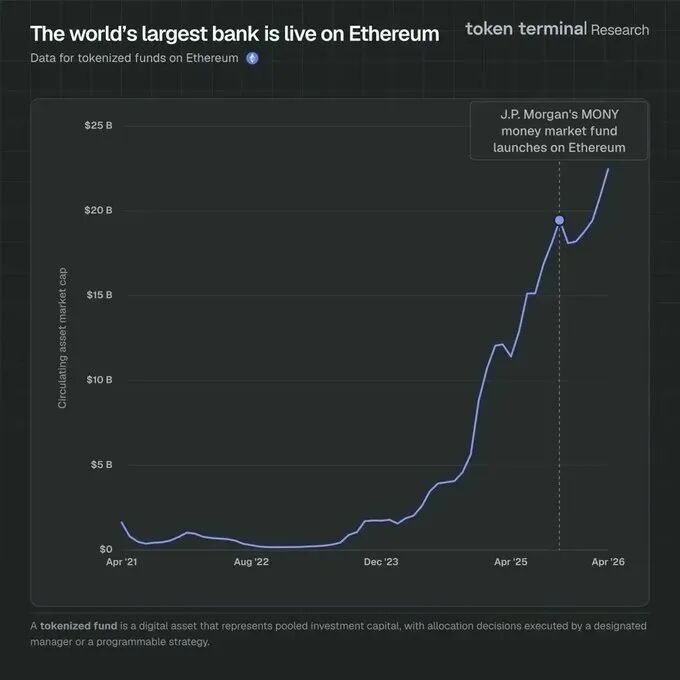
- Yield generation: Idle funds can be deposited into lending protocols or used to buy tokenized treasury products like BlackRock's BUIDL. Tokenized treasury products on Ethereum have already held over $22.5 billion (71.9% market share).
- Capital formation: An agent can deploy smart contracts, issue tokens representing revenue shares, and programmatically manage allocations.
- Custody: Agents need to hold assets (tokens, identity credentials) without a custodian freezing their assets. Self-custodied Ethereum wallets natively provide this capability.
Why Agents Will Use Low-Risk DeFi on Ethereum
Vitalik Buterin proposed in 2025 that foundational financial services represent Ethereum's most important application. For agents, the tail risks of traditional finance (bank failures, account freezes) outweigh the risks of tried-and-true DeFi protocols.
In DeFi, transaction costs are extremely low, settlements are nearly instantaneous, and the entire system operates with low friction globally. The rules of each protocol are encoded in open and auditable code, which agents can verify. While smart contracts have been somewhat "awkward" for human UX, they are very suitable for agents.
Ethereum's Unassailable Network Effects
Although other chains also have DeFi, Ethereum has achieved a difficult-to-challenge network effect:
- Protocol maturity: Protocols like Aave, MakerDAO, and Uniswap have operated flawlessly through multiple market crashes and black swan events.
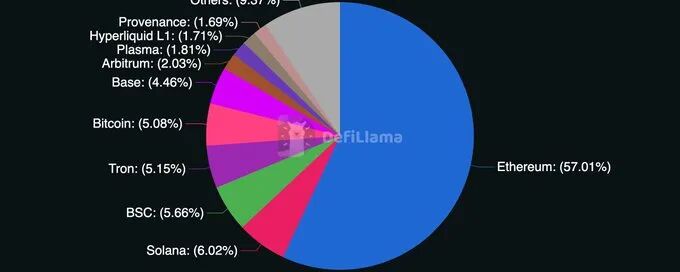
- Liquidity depth: As of April 2026, Ethereum’s DeFi TVL exceeded $55 billion, approximately 10 times that of Solana, accounting for 57% of market share.
- Institutional presence: Major players like BlackRock and Franklin Templeton have chosen Ethereum for their on-chain funds, creating a self-reinforcing cycle of liquidity and regulatory clarity.
- Network reliability: Ethereum has achieved zero downtime over its more than 10-year history, which is crucial for managing collateral positions for agents.
- Composability: Agents can execute complex multi-step financial strategies in a single atomic transaction.
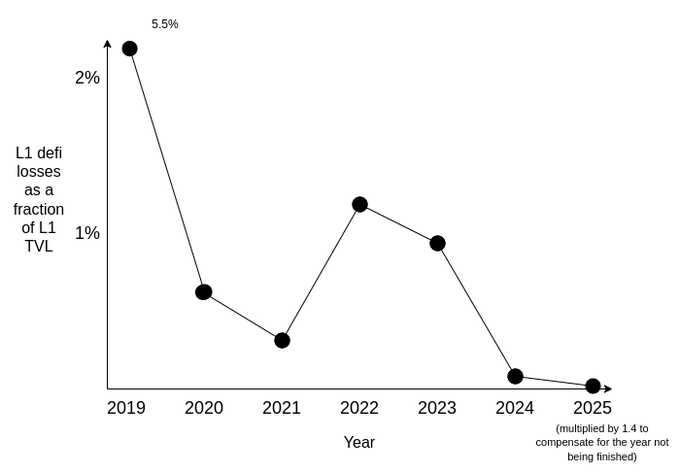
Ethereum L1 DeFi Losses. Source: Vitalik Buterin
Economic Impact on ETH
Autonomous agents mainly trade using stablecoins (98.6% of agent payments use USDC). However, every interaction with the Ethereum DeFi stack requires gas to be paid in ETH.
As agentic DeFi activity grows, the blockspace on Ethereum L1 will become more valuable. Under the EIP-1559 mechanism, a portion of each gas fee is burned, removing ETH from circulation. Additionally, agents borrowing stablecoins need to provide collateral, with ETH being the most liquid collateral asset on the network. This will lock up supply and create structural demand.
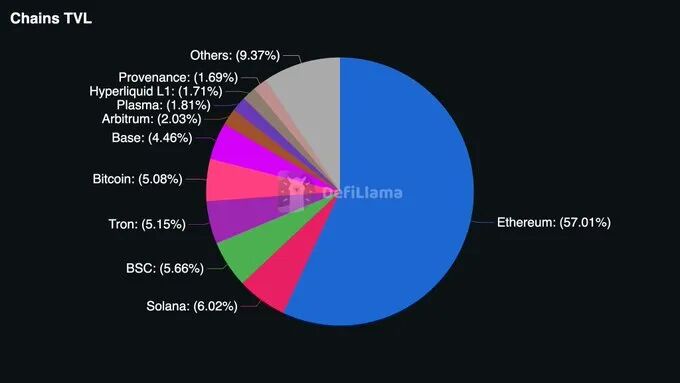
57% of DeFi TVL is on Ethereum (Source: DeFi Llama)
Potential Risks and Challenges
There are three factors that could undermine this argument:
1. Gas abstraction: If agents use stablecoins to pay for gas through account abstraction, it could reduce the direct demand for ETH as operating capital, although ETH would still be burned in the background.
2. Competition: Other blockchains may eventually reach similar levels of liquidity and maturity.
3. Adaptation of traditional finance: Banks may eventually create APIs for agent accounts, although they will still carry the added burden of human-centered systems.
Conclusion: The Next Billion Users of Ethereum Will Not Be Human
Ethereum is becoming the financial system for the machine economy. It provides the services autonomous agents need—lending, borrowing, yield, and custody—without requiring a human identity, and does not fracture access due to jurisdiction.
As the number of agents increases, those that evolve into autonomous economic actors will generate an increasing demand for low-risk DeFi. Due to Ethereum's unique combination of liquidity, reliability, and institutional trust, the infrastructure they rely on is likely to remain on Ethereum.
免责声明:本文章仅代表作者个人观点,不代表本平台的立场和观点。本文章仅供信息分享,不构成对任何人的任何投资建议。用户与作者之间的任何争议,与本平台无关。如网页中刊载的文章或图片涉及侵权,请提供相关的权利证明和身份证明发送邮件到support@aicoin.com,本平台相关工作人员将会进行核查。


