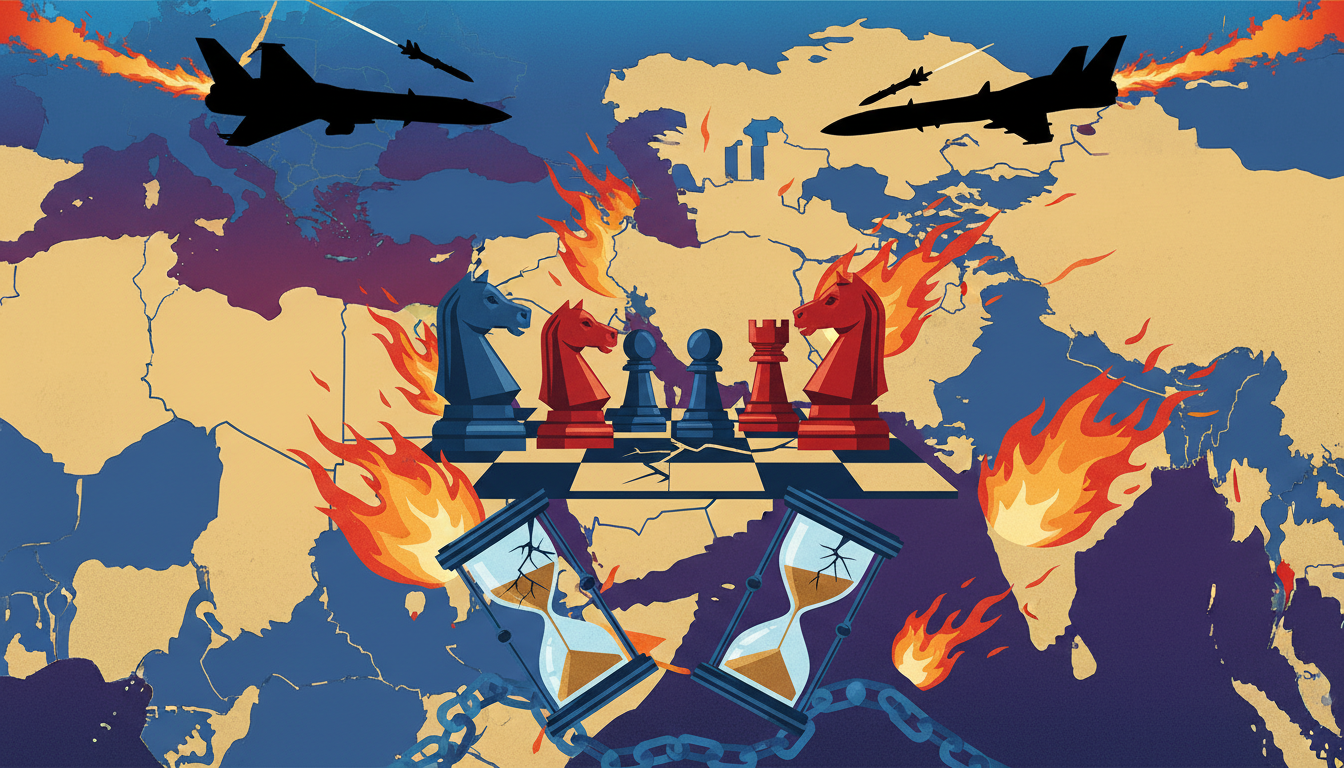
Eastern Standard Time this week, an accusation surrounding the US-Iran negotiations has intertwined geopolitical issues with financial markets once again. Former Director of the US National Counterterrorism Center Joe Kent publicly stated that Israel's insistence on a "zero uranium enrichment" stance regarding Iran's nuclear issue led to the breakdown of negotiations; he emphasized that the true red line for the US is simply that "Iran must not have nuclear weapons." This statement lays bare the long-standing but often overlooked policy divergence between the US and Israel. Almost simultaneously, media reports indicated that there are only about 9 days left for a ceasefire window, with the European Stoxx 50 index dropping by approximately 1.02% in a single day, while the TRUMP token, tied to the narrative of the US elections, plummeted by 33% this week. Traditional markets and crypto assets exhibited correlation and amplification under the same geopolitical narrative. This article seeks to question: how does the breakdown of US-Iran negotiations and the countdown to a ceasefire transmit layer by layer through oil price expectations and global risk appetite, ultimately landing on the trading tables of Bitcoin, major coins, and various politically narrative tokens? The preliminary judgment is that in the short term, emotion-driven movements will amplify volatility, with capital trading on geopolitical news and "the fluctuation itself"; however, the long-term trend will still be determined by the reshaping of energy patterns, regulatory paths, and the global liquidity environment.
US-Iran Negotiation Stalemate: Red Lines Misaligned Between Washington and Tel Aviv
Joe Kent's identity makes this commentary more than just typical media commentary. He has served as the Director of the US National Counterterrorism Center and has been deeply involved in Middle Eastern security affairs, thus providing him with long-term observations on Iran's nuclear issue and US-Israel alliance relations. In his latest statement, he specifically criticized Israel's insistence on a "zero uranium enrichment" position in the negotiations, considering it a key node that led to the breakdown of US-Iran talks. This statement did not address the specific locations, rounds, or technical details of the negotiations but instead focused on a symbolic "position setting."
According to Joe Kent, the red line for the US government is not "zero enrichment," but rather "Iran must not have nuclear weapons", with significant differences between the two: the former almost denies Iran any space for a civilian nuclear program under any framework, while the latter leaves some technical and agreement leeway. This difference highlights the policy misalignment between Washington and Tel Aviv on nuclear issues—where the US emphasizes preventing nuclear armament proliferation in practical terms, whereas Israel's security narrative tends to view nuclear capability itself as an unbearable burden.
For this reason, "zero enrichment" from Iran's perspective can very easily be interpreted as an unacceptable political signal: not as a starting point for negotiations but as an endpoint, or even as a symbolic request that undermines its sovereignty and technical capabilities. Joe Kent's criticism amplifies the effect of such signals: when key intermediary parties insist on conditions close to "zero space," negotiations effectively become locked. The real consequence is that the space for diplomatic channels to ease tensions between the US and Iran may be compressed, forcing the ceasefire and mitigation window to shift toward military and security issues.
It is important to emphasize that currently available public information has not provided the specific location, round arrangements, or duration of the US-Iran negotiations, and these details are not crucial for understanding the price transmission in the crypto market. What can be clearly outlined at this stage is just an outline: the rare scene of a few former security officials in the US publicly questioning Israel's position, showing that tension within the geopolitical alliance is rising, while the market tends to label this tension with a higher risk premium.
Countdown to Ceasefire and Oil Price Expectations: Risk Priced on a Timeline
As several Chinese media outlets reported that the "ceasefire window has only about 9 days left", the time pressure itself has become part of the narrative. The market does not have a complete military and diplomatic timetable, but the concept of "only a few days left to negotiate" is enough to trigger a collective imagination: if there is no substantial progress in this window, the probability of further escalation will be subjectively amplified. Investors find it difficult to predict precisely what will happen next but tend to reflect this uncertainty in the pricing.
The most direct target of such expectations is energy. The Governor of the Bank of Japan Kazuo Ueda recently reminded that "rising oil prices lead to deteriorating trade conditions," pointing out that for most net energy-importing countries, high oil prices are not just disturbances in inflation data but rather concrete growth and trade pressures. This statement provides a realistic economic anchor for linking geopolitics with oil prices: once the situation in the Middle East is considered likely to disrupt crude oil supply or transportation security, the market automatically maps it as a risk of "deteriorating trade conditions," which then translates into monetary policy, corporate profits, and household consumption.
Within this framework, the breakdown of US-Iran negotiations, the countdown to a ceasefire, and future oil price expectations are interconnected: the breakdown of negotiations suggests a reduced likelihood of diplomatic risk mitigation; the shrinking time window increases the marginal impact of any negative news; and oil prices are viewed as one of the most sensitive pricing vehicles. Thus, from energy commodities to European and US stocks, and to assets highly related to inflation and liquidity expectations, a "chain of emotion" has formed: geopolitical narrative → energy concerns → macro expectations re-evaluated → risk assets discounted.
It must also be made clear that there are currently no authoritative data that can correlate "a specific date of the ceasefire window" with "the inevitable upward path of oil prices," let alone provide a timetable for any potential military action. In the absence of hard data, a more prudent approach is to regard the "9-day window" as a time anchor for market sentiment rather than a timeline for military actions, seeing oil price fluctuations as a result of risk repricing rather than precise "trailers" for specific tactical actions.
Chain Reaction in Risk Assets: European Stocks Weakening and TRUMP Narrative Coins Plummeting
In traditional markets, Europe is seen as a sensitive area exposed to both energy prices and geopolitical security risks. In the latest trading situation, the European Stoxx 50 index dropped approximately 1.02% in a single day (from a single source), which many commentators regard as a microcosm of the overlap between geopolitical uncertainty and macroeconomic concerns. This drop is not extreme in itself, but combined with the aforementioned ceasefire countdown and oil price expectations, is easily interpreted as "European investors beginning to reserve discounts for the worst-case scenario." Rising energy input costs, constrained central bank policies, and pressures on corporate profits—these longstanding issues are being brought back to the forefront against a backdrop of geopolitical strain.
In the crypto market, the most dramatic moments come from political narrative coins. According to Deep Tide TechFlow data, the TRUMP token plummeted by as much as 33% this week, with a decline rate significantly faster than mainstream coins. Research briefings indicate that its price volatility corresponds in timing with the movements of certain large addresses; although it is not yet possible to provide a complete on-chain path for each transaction, the temporal correlation is sufficient to support an intuitive observation: some whale capital treats such tokens as emotional amplifiers for US political and geopolitical news, accelerating the entry and exit in a high-noise environment.
The "Trump-related narrative coin" essentially represents a basket of emotional contracts anchored by personalities and election probabilities. When US-Iran negotiations break down and the questioning of US diplomatic capabilities intensifies, market debates about the "direction of US domestic and foreign policy" heat up, making TRUMP-type assets a vehicle for some traders to express views or speculate. On one hand, they bear the brunt of risk appetite's extreme swings by amplifying volatility; on the other hand, due to a lack of fundamental anchors, they become the first to be sold off and rallied.
It is important to be frank with readers: whether it is the 1.02% drop in the European Stoxx 50 index or the 33% weekly drop in the TRUMP token, the data currently disclosed primarily comes from a single or a few sources, making it more suitable as "samples" for observing market sentiment rather than a "complete set" supporting systemic conclusions. When constructing narratives with these data, we should always remember their limitations regarding sources and statistical scopes and be cautious in defining their applicability.
From Oil to Blockchain: How Geopolitical Shocks Rewrite Crypto Risk Premiums
If we view the breakdown of US-Iran negotiations as a starting point, we can clearly outline the transmission path: first, geopolitical tensions push oil prices and energy risk expectations higher, whether through supply-side worries or imaginings of transportation route security; second, rising energy costs increase both inflation and growth pressures, forcing central banks to make difficult choices between "anti-inflation" and "economic growth"; third, when the combination of "high inflation + low growth" is repriced, traditional risk assets—especially the stock market, which is sensitive to interest rates and profits—come under pressure; finally, when traditional assets decrease in cost-effectiveness and volatility rises, some funds will actively or passively seek new hedging and speculative targets, bringing crypto assets into view.
At the end of this chain, not all funds will treat Bitcoin and other major coins as "digital gold-like ultimate hedging." More often, they are seen as "trading tools for geopolitical hedging": on one hand, their liquidity is relatively sufficient and the market-making is mature, allowing for substantial positions to move in and out temporarily; on the other hand, high volatility and 24/7 continuous trading allow them to reflect new information shocks while traditional markets are closed. This attribute makes Bitcoin, certain mainstream coins, and tokens related to geopolitics or political themes naturally suitable as derivative markets for "risk narratives," rather than as real "safes."
Distinguishing between the behaviors of different types of funds is particularly important. Short-term event-driven funds tend to speculate around news headlines and time windows, showing high sensitivity to situations in the Middle East and quickly increasing or decreasing positions when keywords like negotiations, ceasefires, or sanctions appear; whereas long-term allocation funds are more concerned with regulatory paths, global macro liquidity, and industry adoption, seeing geopolitical shocks in their framework more as "noise." What we often see on the trading floor is predominantly short-term fluctuations magnified by futures leverage, leading to a misunderstanding that all price differentials are driven by a single conflict event.
In reality, geopolitical risks are always intertwined with regulatory policies, market liquidity, and the industry’s own technological and business iterations. A situation in the Middle East can indeed alter the short-term direction of funds and the pricing of risk premiums, but ignoring the SEC's stance on spot ETFs, the compliance requirements for trading platforms by major economies, and the changes in global interest rate centers while explaining the entire crypto cycle using one conflict will inevitably lead to the trap of a "single-cause narrative."
Hedging Emotional Outbursts: RAVE Contracts and a New Chess Game in Asian Computing Power
In this geopolitical context, the demand for "hedging tools" in the derivatives market has been further amplified. The Chinese platform Sun Wukong launched the RAVE_USDT contract, providing an example: for some traders, this type of new contract is not just a single subject but a way to "leverage and amplify bets on geopolitical risks." The timing of its launch combined with geopolitical news has led many funds to consider it as one of the tools for trying to gamble during this high uncertainty window.
These high-leverage contracts typically exhibit several distinctive features during geopolitical event windows: first, trading volume expands rapidly in a short period, with funds willing to pay higher transaction costs for greater price volatility; second, the liquidation points are extremely sensitive, causing massive liquidations with slight price fluctuations, further amplifying the volatility; third, emotions spread quickly through communities and KOLs, with prices being driven more by "narrative" and "who is leading the trade" in the absence of sufficient fundamental support.
Simultaneously, the Japanese government is promoting the establishment of a National AI Team, signaling Asia's pursuit of greater autonomy in technology and computing power. Although the current understanding is limited to macro contexts and directional statements, lacking a comprehensive list of member companies and project technical details, this trend is already sufficient to spark market imaginations regarding the "geographic redistribution of computing power and mining": if Asia increases its investment in AI and high-performance computing infrastructure, combinations of hardware and energy for crypto mining and node services are likely to be adjusted accordingly.
Over a longer time horizon, the relationships between geopolitical factors, energy costs, and the migration of computing power will become increasingly intertwined. Tensions in the Middle East exacerbate oil price expectations, prompting rising energy costs in some regions and undermining their relative advantages in mining and data center layouts; conversely, countries and regions with more flexible energy structures, stable policies, and established advancements in AI and semiconductors have opportunities to accommodate new demands arising from the migration of computing power and mining. Whether the "short-term hedging emotions" reflected by contracts like RAVE or the "medium-to-long-term reconstruction of computing power" implied by Japan's National AI Team, both point to the idea that the crypto infrastructure itself is a map of geopolitical and energy games.
Normalization of Geopolitical Pressure: How to Price the Crypto Cycle Amidst Noise
In summary, the breakdown of US-Iran negotiations, Israel's insistence on a "zero enrichment" stance, along with the frequently mentioned countdown to a ceasefire, collectively elevate the market's valuation of Middle Eastern risk premiums. In traditional markets, this premium is reflected in oil price expectations, declines in European stock indices, and global inflation re-evaluations; in the crypto market, it is further amplified and redistributed through rising Bitcoin volatility, sharp corrections in political narrative coins like TRUMP, and increased trading volume in leveraged contracts like RAVE. Geopolitics and crypto are no longer parallel lines but mirrored reflections projecting onto each other across multiple time scales.
At this current stage, crypto assets resemble a "magnifying glass" for geopolitical sentiments rather than a safe haven endpoint. Many participants are not buying in for a safe harbor but rather to amplify bets on the probabilities of certain events and market reactions—volatility itself is treated as a tradable asset. The more complex the geopolitical events, the more fractured the narrative, the more intense the price tug-of-war becomes, making it increasingly difficult to explain short-term fluctuations using traditional "bullish/bearish" binary divisions.
In concrete trading practices, the split we can make is: on a short-term level, pay attention to how oil prices, ceasefires, and negotiations-related headlines drive emotional waves, respect the high-volatility opportunities created by geopolitical news in the futures leverage and narrative coin sectors, while soberly viewing these opportunities as "event-driven trading" rather than a starting point for trend investment; on a medium-to-long-term level, return to more "blunt" yet strongly decisive variables such as computing power costs, regulatory paths, and global liquidity, treating geopolitical shocks as disrupting factors within cycles, rather than the entirety of the answer.
More importantly, be wary of the temptation to construct a so-called "certain narrative" from a single event. Whether it's the failure of a particular round of US-Iran negotiations or the frequent mention of a certain ceasefire date, neither is sufficient to explain the long-term trends in the crypto market independently. A cautious stance should be maintained regarding any unverified rumors, military exercises not validated by multiple sources, and overly politicized price interpretations. What truly needs pricing is not just the next headline but a slowly emerging new order in crypto amidst geopolitical pressures, technological iterations, and regulatory reshaping.
Join our community to discuss together and become stronger!
Official Telegram community: https://t.me/aicoincn
AiCoin Chinese Twitter: https://x.com/AiCoinzh
OKX Welfare Group: https://aicoin.com/link/chat?cid=l61eM4owQ
Binance Welfare Group: https://aicoin.com/link/chat?cid=ynr7d1P6Z
免责声明:本文章仅代表作者个人观点,不代表本平台的立场和观点。本文章仅供信息分享,不构成对任何人的任何投资建议。用户与作者之间的任何争议,与本平台无关。如网页中刊载的文章或图片涉及侵权,请提供相关的权利证明和身份证明发送邮件到support@aicoin.com,本平台相关工作人员将会进行核查。