🧐 Let's talk about Prep Dex: using GRVT as an example to see whether the Perp DEX track is experiencing cyclical fluctuations or a structural ceiling?
Last month, the EdgeX and BP TGE had a significant impact on the Prep Dex market, causing many people to lose hope in this track.
The market is currently in a phase of cooling down, especially since Hyperliquid emerged to a peak last October and now, the overall trading volume has clearly contracted.
Thus, many people have raised the soul-searching question of whether Prep Dex can no longer shine and is only heading towards decline.
I believe the current market reaction and doubts are perfectly normal since everything in the world is subject to ups and downs. After a track suddenly bursts with tremendous energy, there will inevitably be a period of adjustment; $BTC experiences horizontal consolidation and declines after rising.
We can only address one question: Is the Perp DEX track experiencing cyclical fluctuations or is it a structural ceiling?
Can the Prep Dex track truly become an evergreen in the industry? If so, where might the next breakout point be?
If you extend the timeline a bit, you will notice a more crucial change:
1️⃣ Demand has not disappeared; it has just been suppressed.
Ultimately, we are a trading track, so when market sentiment weakens in Q1 and risk appetite declines, the first to retract will definitely be high-frequency trading and high-leverage demand.
This will directly reflect in the trading volume of Perp DEX.
Therefore, I believe that the weakening trading volume is quite normal, but this does not mean that the demand does not exist; it only means that the "timing" and "venue" for participation have changed.
Once the market warms up, the speed of demand returning is actually quite rapid.
2️⃣ Recent data has begun to show some signals:
Here, using GRVT @grvt_io as an example: its 24-hour trading volume is around $2 billion, and open interest (OI) is at $459 million.
If it were just a daily increase in volume, there wouldn't be much to say. But the simultaneous presence of trading volume + OI at this level suggests that real activity is being maintained.
I believe the reason for this maintenance is that as soon as there is a possibility of a positive market trend, trading behavior will begin to return; additionally, since coins have not yet been issued, people still hold some expectations.
3️⃣ Newly opened tracks: stock perps / asset tokenization
Regarding DEX, we should expect to see more and more projects beginning to extend along the line of “tokenized stocks / traditional assets” in the future.
The crypto perps space is, in essence, a relatively mature market with extremely fierce competition.
Finding new increments is actually quite difficult; to put it bluntly, now we can only look for new asset categories. If DEX can list high-quality assets that cannot be purchased elsewhere, we can use Crypto to buy them, and people will engage. Alternatively, DEX could facilitate the purchase of assets that are hard to buy in WEB2, and they would also join in.
This necessitates the formation of a comprehensive landscape of asset diversification:
So within the subfield of “stock perps / asset tokenization,” a second layer of competition is already beginning to emerge:
Aster, GRVT, Ostium, Extended, etc., are all experimenting along different paths.
But I personally believe that the key to this line has never been "who goes online first," but rather a more fundamental question: who can create liquidity.
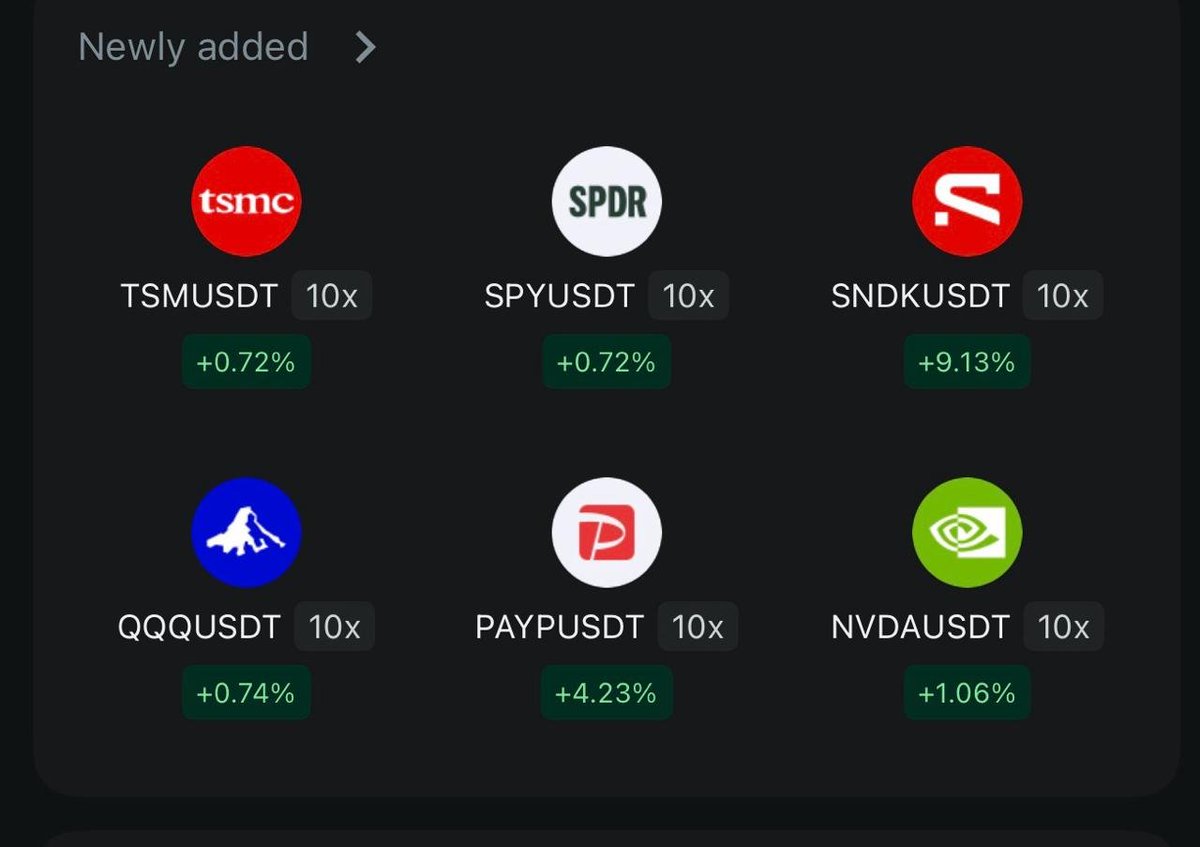
The picture below shows some new assets recently launched on @grvt_io. I looked at the liquidity data from April 7, and one point is particularly interesting: GRVT ranks second in stock slippage within the $100,000 volume level, while also being among the top in stock trading volume.
A single ranking is not that important, but when these two indicators are combined, it becomes interesting, representing new assets and new directions.
4️⃣ Trading is very realistic.
Regarding trading, you can discuss products, narratives, and visions,
but real traders only focus on two things:
1) Can I purchase higher quality assets that I need, which cannot be obtained elsewhere;
2) When large orders are placed, is there slippage?
This creates a very typical positive feedback loop; once this loop begins to form, it ceases to be "a functional advantage" and has the potential to become: a structural liquidity advantage, which is the real moat, and Hyperliquid has successfully set the template here.
From this perspective, GRVT's path is actually quite clear: it does not aim to compete head-on with crypto perps that are already overly competitive,
but instead focuses on establishing execution quality and liquidity in this new branch of “stock perps.” Then, it adds on its One-Balance design (a single account bridging Crypto / stocks / commodities while also earning yields on idle assets),
converging different market trading demands into a unified trading entry.
If this path can be successfully navigated, the significance is actually quite substantial.
This means users do not need to switch between platforms across different asset categories but can complete all trading actions within one system.
5️⃣ Conclusion: So returning to the initial question:
Has Perp DEX reached its limit?
My current answer leans towards: it hasn't disappeared; it's just being redistributed.
The sluggishness of Q1 is more like demand being suppressed; once the market warms up, trading will return.
Funds do not reward narratives; they will flow towards areas with deeper asset breadth, better liquidity, more stable execution, and smoother experiences.
And whoever can run ahead in this dimension has the chance to transform "cyclical advantages" into "structural positions."
免责声明:本文章仅代表作者个人观点,不代表本平台的立场和观点。本文章仅供信息分享,不构成对任何人的任何投资建议。用户与作者之间的任何争议,与本平台无关。如网页中刊载的文章或图片涉及侵权,请提供相关的权利证明和身份证明发送邮件到support@aicoin.com,本平台相关工作人员将会进行核查。


