Original Title: "US-Iran Negotiations Break Down, Bitcoin Faces a Battle at 70,000"
Original Author: Maher, Foresight News
The significant rebound in the crypto market is still a long way off. On April 13, the BTC price hovered around $71,000, down about 2.6% in 24 hours, while ETH performed even weaker, dropping 3.63% to about $2,200. Bitcoin's market capitalization remains at 58.8%, and the trading volume in the entire crypto sector has not significantly increased.
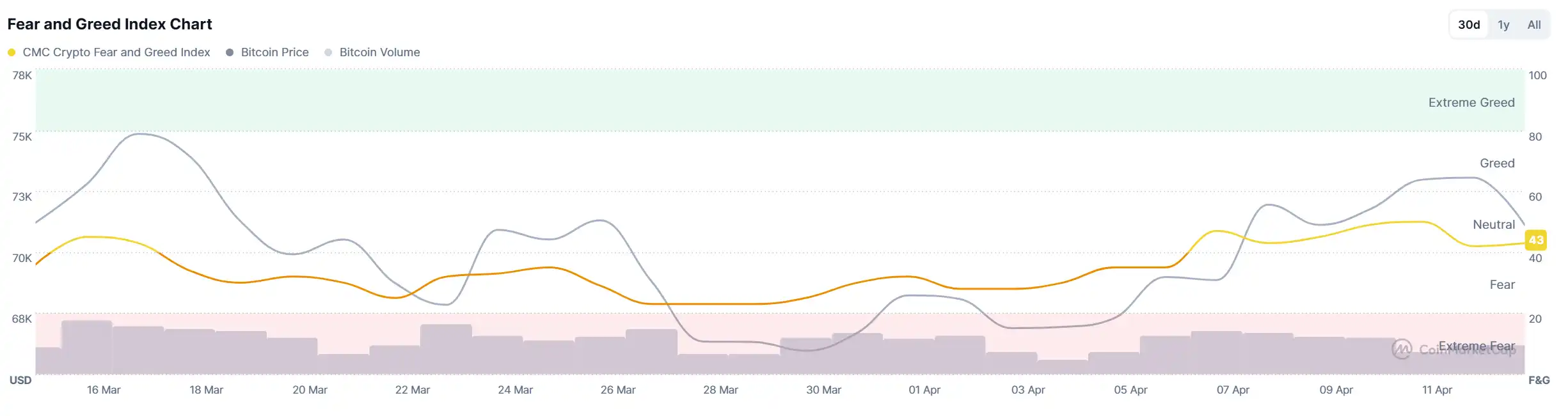
According to Coinglass data, the total liquidation amount across the network in the past 24 hours was $284 million, with long positions liquidating $203 million. Meanwhile, CoinMarketCap's fear index is currently at 43, indicating a neutral market sentiment.
The traditional financial market is also experiencing extreme volatility. Influenced by the situation in the Middle East, international oil prices remain high, with Brent crude oil briefly approaching $107 per barrel, a significant increase compared to pre-conflict levels. In the US stock market, the S&P 500 fell about 5% in March, marking one of the worst monthly performances in recent years; international stock markets have suffered greater declines due to energy import pressures and a stronger dollar. Bond yields have risen, and inflation expectations have reignited, prompting investors to rapidly switch between risky assets, elevating demand for traditional safe-haven assets like gold. This cross-market connectivity reaffirms that crypto, as a high-beta risk asset, is facing simultaneous macro and geopolitical shocks.
US-Iran Negotiations Collapse
One of the core driving factors behind this week's lackluster cryptocurrency market is the sharp escalation of tensions between the US and Iran. The US-Iran face-to-face peace talks held in Islamabad, Pakistan, on April 11-12 lasted over 20 hours but ultimately ended in failure.
US Vice President Vance led a delegation that failed to reach consensus with the Iranian delegation on core disagreements, including Iran's abandonment of its nuclear weapons program and the "red line" of stopping uranium enrichment. Iran accused the US side of "maximalism" and "constantly changing goals."

Vance departs Islamabad aboard Air Force Two
After the talks broke down, US President Trump announced on social media on Sunday that US military operations to block the Strait of Hormuz would begin immediately. The US Central Command (CENTCOM) subsequently confirmed that at 10 PM Beijing time on April 13, the blockade would target all vessels entering and exiting Iranian ports, but would not obstruct normal passage from non-Iranian ports. The Iranian foreign minister and military quickly responded, warning that any military vessel approaching the strait would be considered a violation of the ceasefire and they reserve the right to retaliate.
The Strait of Hormuz is a crucial artery for global oil transportation, accounting for about 20% of global crude oil transport. If the blockade continues, the risk of supply chain disruption will directly raise oil prices, further igniting global inflation concerns and expectations of economic growth slowdown.
This geopolitical black swan event strikes risk assets most directly: investors are fleeing high beta assets and turning to cash or gold, with BTC's safe-haven characteristics as "digital gold" suppressed by risk-averse sentiment in the short term, unable to serve its hedging role. Historically, the crypto market has reacted sharply before traditional markets during similar Middle East crises, undergoing violent corrections, which directly reflects the current downturn.
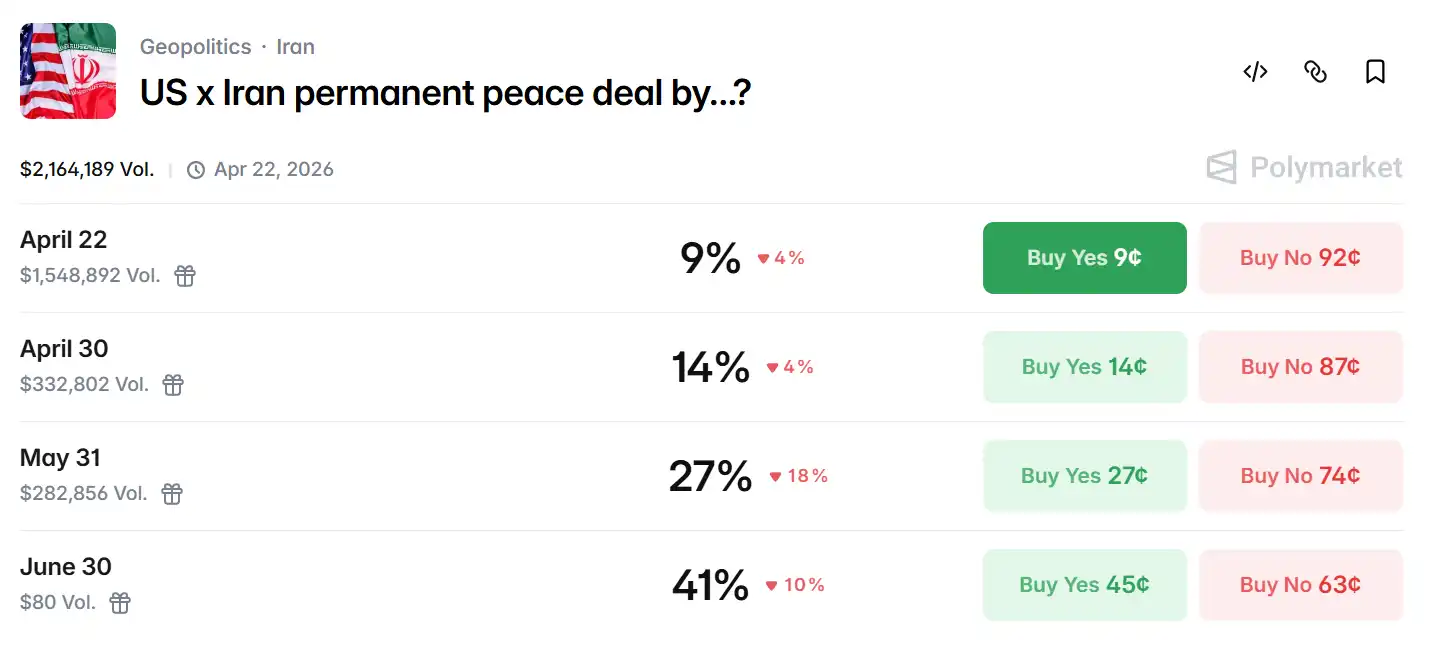
Latest data from Polymarket indicates that the probability of the US and Iran reaching a permanent peace agreement before May 31 is 27%, while the probability of reaching an agreement before the 30th of this month has dropped to 14%.
However, future US-Iran negotiations remain full of uncertainties.
According to the Wall Street Journal, informed officials revealed that after the marathon peace talks in Islamabad failed to yield an agreement, countries in the Middle East are racing to push the US and Iran back to the negotiating table.
Despite both sides issuing tough statements, diplomatic doors remain open, and a second round of negotiations may be held in a few days. Regional countries are negotiating with the US to ensure the fragile two-week ceasefire can be extended.
Only One Rate Cut Expected from the Fed This Year
Another key suppressive factor comes from monetary policy. The minutes from the Federal Reserve's March meeting indicate that despite the high level of uncertainty brought by the Iran conflict, policymakers still maintain the expectation of only one rate cut in 2026,
On April 10, CPI data was released, showing that the US March unadjusted CPI year-over-year rate was 3.3%, the highest since May 2024, which met market expectations of 3.3% and increased from 2.40%. The US March adjusted CPI month-on-month rate recorded 0.9%, the highest since June 2022, also in line with market expectations. The US Bureau of Labor Statistics stated that the record surge in gasoline prices contributed to nearly three-quarters of the CPI increase for the month. Another indicator, excluding food and energy costs, saw a month-on-month increase slow to 0.2%.
The market originally hoped for a more aggressive easing cycle to boost risk assets, but the oil price shock has made the Fed's "data dependency" strategy more conservative. Higher energy costs could delay the inflation decline path, thereby postponing the timing of rate cuts.
This is undoubtedly exacerbating the already tight liquidity situation for the crypto market. Historically, missed rate cut expectations often accompany a valuation reset for risk assets; BTC's current consolidation around $71,000 reflects this adjustment of macro expectations.
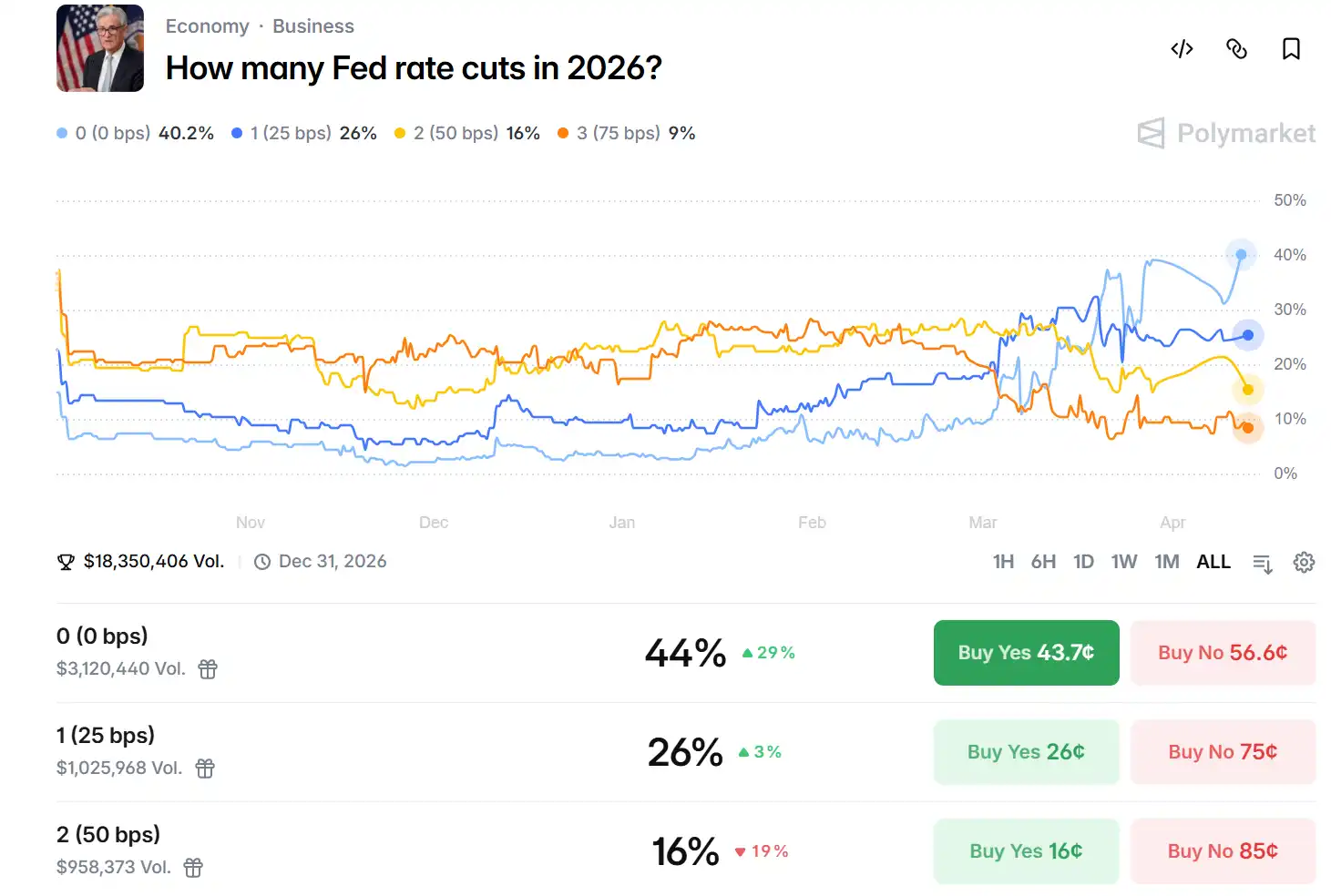
Currently, the latest data on Polymarket shows that the market's bet on the probability of a 25 basis point rate cut by the Fed this year is only 26%, while the probability of keeping rates unchanged has risen to 44%.
Market liquidity tightening casts a shadow over the crypto market's rebound.
Profit-Taking Suppresses BTC Price Recovery
On-chain data indicators genuinely reveal the real intentions of crypto players. Glassnode data shows that any attempt to reach the $70,000 to $80,000 range faces liquidity shortages and profit-taking pressures, thereby limiting the rebound magnitude.
Another rally above $70,000 was stymied by profit-taking exceeding $20 million per hour.
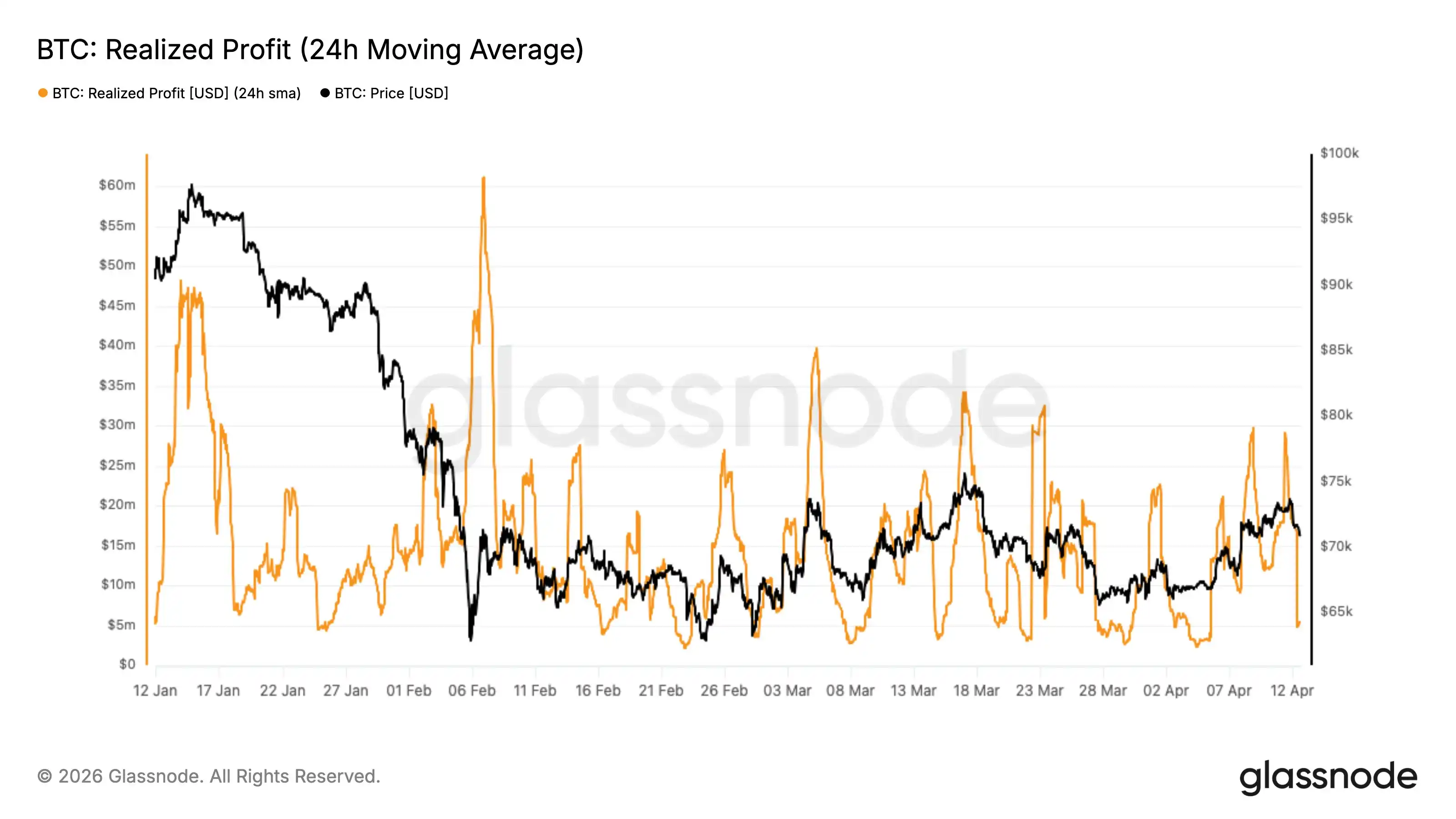
Some sellers perhaps view this BTC rebound as temporary and not a reversal.
Currently, with the BTC price at $70,800, the number of addresses in a loss state is about 13.5 million.
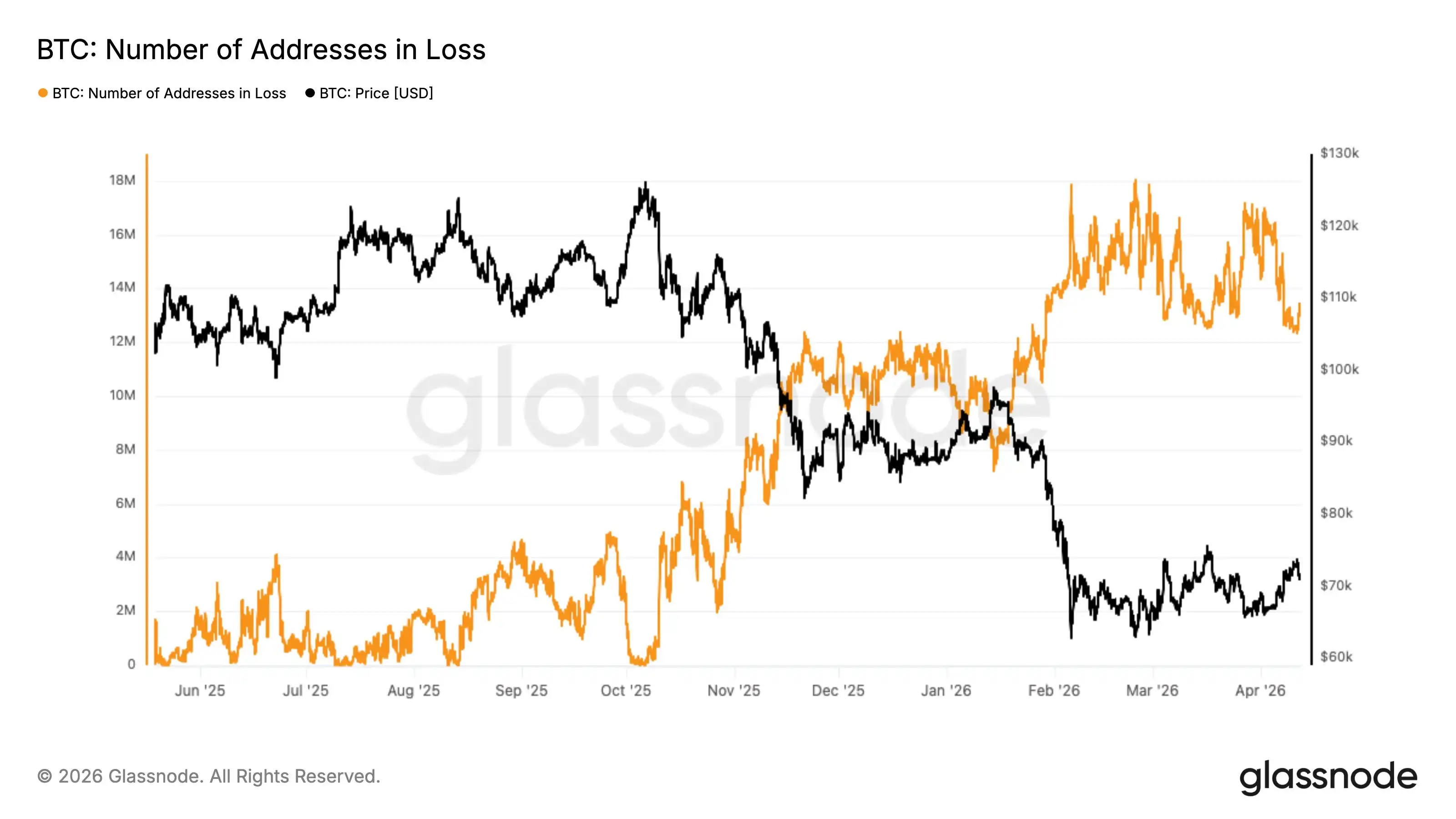
This indicates that a considerable portion of users in the network purchased Bitcoin at prices above the current spot price.
Future Market Trends
Despite short-term pressures, seasoned professionals in the crypto industry remain structurally optimistic in the long term.
Strategy founder Michael Saylor stated that Bitcoin likely bottomed near $60,000 in early February, when forced sellers were cleared from the market. The bottom is more determined by seller exhaustion rather than valuation.
He believes the current selling pressure is limited, ETF capital inflows are absorbing daily supply, and corporate asset allocations to Bitcoin also generate sustained demand. Michael Saylor predicts that the catalyst for the next bull market will be the establishment of a bank credit and digital credit system based on Bitcoin, which will turn Bitcoin from a non-yielding asset into an engine of the capital market.
Arthur Hayes, founder of BitMEX, mentioned at the end of March that "there's a lot of fantasy about future good news in the current market; individuals certainly hope violence can stop but will not buy risk assets here."
Tom Lee posted that there are increasing signs in the market indicating "the bottom has formed," although the overall market remains largely skeptical. If you're still doubtful, consider buying assets that performed well during the US-Iran war.
免责声明:本文章仅代表作者个人观点,不代表本平台的立场和观点。本文章仅供信息分享,不构成对任何人的任何投资建议。用户与作者之间的任何争议,与本平台无关。如网页中刊载的文章或图片涉及侵权,请提供相关的权利证明和身份证明发送邮件到support@aicoin.com,本平台相关工作人员将会进行核查。


