Source:AI Agents in Action Summit Roundtable
Date:March 31, 2026
Content Organizer:Techub News
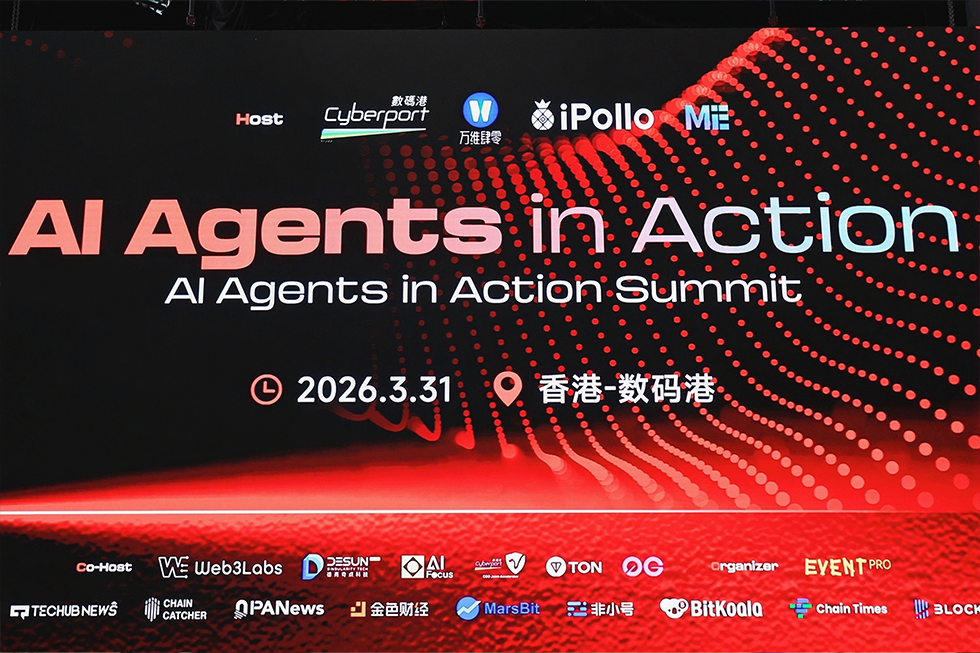
“If Web3.0 has not yet truly taken off, is Web4.0 on its way?”
This was the first question posed by Alma at the beginning of the discussion. On March 31, 2026, at the AI Agents in Action summit, this founder of Techub News served as the roundtable moderator, inviting four guests from different infrastructure layers to attempt to answer a key question: When AI Agents transition from concept to large-scale application, who will build the road? Who will drive the vehicle? Who will lay the last step?

Guest Lineup
- Lambert Zhang — GAIB Investor (Computing Layer)
- JT Song — 0G Head of Asia-Pacific (Data Layer)
- Harvey Chen — Monad Foundation Greater China Ecological (Execution Layer)
- Yuki — TON Foundation Head of Institutional Business in Asia-Pacific (Distribution Layer)
Web4.0: Is it a Trend or a Concept?
Alma first directed the question to the four guests: “I’d like to ask each of you, what does Web4.0 mean to you? Do you think the era of Web4.0 has already arrived?”
Yuki first provided her definition: “People define Web3 as a vision colored by utopia —— absolute decentralization, challenging authority, removing central control. And today, when we talk about Web4.0, it is essentially because we see the real potential for Crypto and AI to empower each other, and this fusion is pushing the vision of Web3 into a whole new dimension.”
She further elaborated: “In my view, Web4.0 is about AI empowering a comprehensive improvement in productivity, especially breakthroughs in payment capabilities. In the future, a significant amount of economic activities will be conducted by automated AI. A typical example is: AI Agents directly replace users to place bets on Polymarket. Currently, major exchanges and public chains are actively developing and laying out their own AI trading infrastructure, such as the x402 payment protocol, Agentic wallet, TON MCP … all striving in this direction.”
Lambert responded from an investment perspective: “We believe that as AI Agents are applied more deeply and broadly, the demand for computing power will certainly increase significantly. We are actually investing in many AI infrastructure projects, supporting the arrival of the Web4.0 era. I think this is a trend.”
Alma pressed further: “So do you believe this is an era that is about to come?”
“Yes, it’s a trend.” Lambert confirmed.
In contrast, JT's viewpoint was more cautious: “I personally have a slight disagreement with the definition of Web4.0, but the trend is undeniable. The direction of this trend is that AI Agents, as independent entities, will gradually become essential in human economies and lives. However, whether this trend will ultimately become Web4.0, I think there is still some controversy.”
He added a key insight: “When AI Agents can trade independently, hold assets independently, and even make independent decisions, that direction is beyond doubt. The central challenge is: how do you trust it?”
Alma keenly captured this point: “So this is the issue that JT wants to solve —— making AI's decisions traceable and verifiable through the data layer.”
Harvey: “Web4.0 is about defining the issues, but the AI or intelligent agent economy has already begun to infiltrate various industries.”
Alma continued: “Do you think Monad is ready now? Are ecosystem developers ready?”
“I believe the biggest change that AI Agents bring to the chain is transforming interaction from 'human low-frequency operations' to 'machine high-frequency concurrent decisions.'”
“In this model, TPS is no longer the core issue; the real challenge is whether execution remains stable, low-latency, and predictable under high concurrency.”
Data Layer: Credibility is the Biggest Bottleneck
Alma then shifted the topic to the data layer: “If computing power is the energy of AI Agents, then data is essentially the rations for AI Agents, can we understand it this way? For AI Agents to act autonomously on the chain, they need to continuously obtain, validate, and store large amounts of data. What is the biggest bottleneck in the data layer today?”
JT was straightforward: “Cost, speed, and credibility are all pain points, but the most painful one, credibility must come first.”
He provided an example: “Just like the 'Doubao' mentioned earlier, I found something quite dangerous —— many people, including parents, develop dependencies on Doubao. A friend of mine asked if it's okay to take medicine on an empty stomach; Doubao said it was fine, and after taking it, the person had a stomachache all day. Doubao still has hallucinations.”
Alma responded: “Indeed, the hallucination issue of AI Agents is currently quite serious.”
JT continued: “If such hallucinations involve medical or critical issues, who is responsible when problems arise? That’s why we need credibility, and credibility is also built on the transparency and verifiability of the data. This is why we currently cannot use AI for core decisions —— for example, using AI for diagnosis; while AI capabilities can replace many ordinary doctors, why does Meituan still require an online doctor to prescribe anti-inflammatory medication? Because of accountability —— when problems arise, someone needs to be responsible.”
Alma summarized: “So 0G needs to solve the issue of making AI’s decisions traceable and accountable.”
Execution Layer: Parallelism is the Answer
Alma turned the topic to the execution layer: “AI Agents also need execution —— when thousands of Agents simultaneously initiate transactions, call contracts, and collaborate, the underlying pressure will be completely different from today. What is the core advantage of Monad's parallel execution framework in such concurrent Agent scenarios? How do the requirements for chains in the AI era fundamentally differ from traditional DeFi?”
Harvey provided a detailed answer: “I believe a complete workflow of an Agent is actually a closed loop —— from expressing intent, to obtaining data, making decisions, executing transactions, and then providing feedback and review.”
“If the execution of this process is unpredictable —— such as unstable delays, potential transaction failures, and uncontrollable costs —— you actually would not dare to entrust important decisions to the Agent.”
“Therefore, the core of the Agent era is not whether it can execute, but whether the execution is predictable.”
Alma asked: “Then compared to traditional DeFi scenarios, where is the core difference?”
Harvey explained: “That is why the design of the execution layer becomes very critical.”
“In high concurrency scenarios, many Transactions by Agents are actually non-conflicting; however, if the underlying layer executes sequentially, they will be forced to queue, ultimately resulting in congestion, increased failure rates, and unstable gas fees. Monad's parallel execution essentially addresses this issue —— freeing these originally non-interfering transactions from the sequential queue.”
“This leads not to superficial TPS enhancements, but to higher 'effective throughput', lower failure rates, and a more stable execution experience.”
“Therefore, from our perspective, the core metric of the execution layer in the Agent era is not peak performance, but: predictable execution capacity even under high concurrency.”
“This is also the real issue that Monad’s parallel execution aims to solve.”
Distribution Layer: Imagination Space of 1.1 Billion Users
“Ultimately, it still needs to be user-centric.” Alma shifted the topic to the distribution layer, “Telegram has 1.1 billion users; TON has unique advantages in payment and DApp scenarios. I want to ask two questions: First, what AI Agent products have impressed you in the TON ecosystem? Second, what killer Agent applications might emerge from the combination of Telegram’s social scene and TON's on-chain capabilities?”
Yuki first shared a set of data: "We just held an online AI Hackathon, receiving over 180 project submissions. What impressed me the most are those that can integrate the underlying capabilities of multiple large models and package them into products with unique commercialization models —— these products inherently possess the potential for large-scale user growth."
She then cited several specific scenarios: "For instance, in cross-border e-commerce —— users only need to interact with AI through voice, and the AI can automatically filter products available for local delivery and directly complete on-chain payments. This is a scenario that is easily accessible to ordinary users, after all, everyone has shopping needs."
"Another example is in professional service sectors like legal consultation and tax declaration —— users only need to describe their requirements to the AI Agent, and the AI can automatically generate solutions. From a business model perspective, the marginal cost is extremely low; just a one-time professional domain training for the AI Agent can continuously serve a vast number of users. For small-scale merchants, it is also a low-cost way to enjoy professional consulting services and establish compliance systems."
Alma responded: “I also feel using various models that each model has different capabilities. For example, my spouse, who is a university math teacher, finds GPT to be the smartest for solving math problems, but in terms of coding, Cloud is definitely better —— each model may have different advantages.”
Yuki further described her vision for the future: "In the Telegram and TON ecosystem, we expect to see the emergence of a mature Agent Skill Marketplace —— users can pay directly for access to various Agent capabilities. You can train an AI to be your own 'digital employee' —— some responsible for handling daily work tasks, and others executing on-chain transactions. This is not just an upgrade of tools, but a profound reshaping of production relations.
Core Collision: Do Agents Really Need Blockchain?
This was a sharp question posed by Alma: “I have come into contact with many AI native developers recently, and they are actually unwilling to associate with Crypto —— they feel they are purely AI entrepreneurs and simply need to work on AI. So, do AI Agents necessarily need blockchain? What is the irreplaceability of combining with Crypto?”
Lambert was the first to respond from the perspective of computing power: “A decentralized computing network can aggregate these idle GPUs and rent them out to AI entrepreneurs. Why are there idle GPUs? Training foundational models may require 100 machines running continuously for 6 months, and after training, most can be used for inference, so there will definitely be idle opportunities in between. A decentralized computing network can provide this part of the computing power to AI entrepreneurs at a relatively low price —— especially for early-stage AI entrepreneurs, trying to minimize these costs.”
Harvey clearly expressed his stance: “I actually agree with many AI developers' intuitions —— most AI applications do not require blockchain. However, the question is not 'does AI need Crypto', but when Agents begin to act independently, hold assets, and interact with other Agents, can traditional systems still support this?”
“Once Agents transition from 'tools' to 'participating subjects in economic activities', you need an open, programmable, permissionless economic infrastructure. The first and most obvious application will be payments.”
“Because the payment model for Agents is completely different from that of humans —— it is high-frequency, automated, and very small amounts.
“Stablecoins + on-chain payments can reduce payment precision, costs, and programmability to machine level, which traditional systems cannot achieve. However, I think more importantly, Crypto is not just a payment layer; it actually provides a 'trust and settlement layer' between Agents.”
“So my view is this: AI does not need blockchain, but the Agent economy definitely requires a system like blockchain.”
Alma followed up, asking: “What other scenarios must be combined besides payments?”
JT added three reasons: “The first is the asset-side trading —— as long as it involves finance, investment, and asset management, if you want AI to assist in money-related matters, there is no more effective way than Crypto; this is where Crypto can have a strong competitive edge over traditional finance.
The second is accountability —— it is impossible to determine whether AI has completed its work, and having that data on-chain is very important.
The third is the memory layer —— in our ecosystem, projects have already solved the interoperability of memories across different large models. Every 24 hours, all interactions with Agents' memory will be synchronized on-chain —— it’s akin to reinstalling a browser with plugins to import your memory; after 20 seconds, everything will be unified.”
Yuki provided a more direct perspective: "From the C-end, ordinary users' resistance to Crypto essentially stems from the usage threshold issues —— unfamiliarity with wallet operations, concerns about asset security. The strategic value of the embedded wallet in Telegram lies here: it encapsulates on-chain capabilities within the user-friendly social interface, allowing users to complete on-chain interactions without awareness, which is a key path to achieving large-scale user growth."
"From the B-end, AI companies' estrangement from Crypto mainly comes from the speculative nature of the early industry, immature business models, and high integration friction costs with mainstream AI development toolchains. Most AI entrepreneurs prefer to focus on the product itself and monetize through subscription or API services. This is a completely understandable path choice."
However, she pivoted: "But if we seriously examine the payment needs of AI Agents, we will find that Crypto is not an option but the most technically suitable native path. The KYC mechanisms and account approval processes of traditional financial systems cannot adapt to the autonomous operating logic of Agents. Outside the fiat channel, Crypto is currently the only feasible solution to support Agents' autonomous payments."
"The deeper advantage lies in the programmability of smart contracts —— once the rules of a transaction are deployed on-chain, AI Agents only need to trigger execution based on conditions without needing any third-party trust endorsement. This 'code is the rule' characteristic fits the high-frequency, autonomous collaboration and settlement scenarios between Agents that traditional payment systems cannot replicate."
Alma concluded: “So the speakers have articulated very well —— from the C-end's perspective, they are afraid because they don't know how to use it; from the B-end's perspective, they disregard it because early on many speculative attributes existed. But the speed, censorship-resistance, and low cost of Crypto are attributes that will inevitably be adopted by Agents; this is also the only monetary pathway.”
Conclusion
In her summary, Alma stated: “Thank you very much to the four guests for their wonderful sharing. We have discussed the infrastructure of AI Agents from computing power to data, execution, and distribution. We can see that while the industry is currently in a vigorous state, there are still many builders working diligently. We believe that the combination of AI and Crypto will certainly come, and it will not rely solely on one chain, one protocol, or one trend, but will genuinely form a closed loop across these four layers.”
The excitement of this roundtable was that Alma, as the host, was always “threading the needle” —— from questioning the definition of Web4.0 to exploring bottlenecks in the data layer, then addressing performance issues in the execution layer, finally leading to the core collision of “Do Agents need blockchain?” Though the four guests came from different projects, they shared a strong consensus on the necessity of “AI Agents needing Crypto.” This perhaps indicates that the emergence of Agent infrastructure will not solely be a matter of the AI industry itself.
免责声明:本文章仅代表作者个人观点,不代表本平台的立场和观点。本文章仅供信息分享,不构成对任何人的任何投资建议。用户与作者之间的任何争议,与本平台无关。如网页中刊载的文章或图片涉及侵权,请提供相关的权利证明和身份证明发送邮件到support@aicoin.com,本平台相关工作人员将会进行核查。


