🤔 After the ceasefire news last week, the U.S. stock, bond, and oil markets have shown different trends —
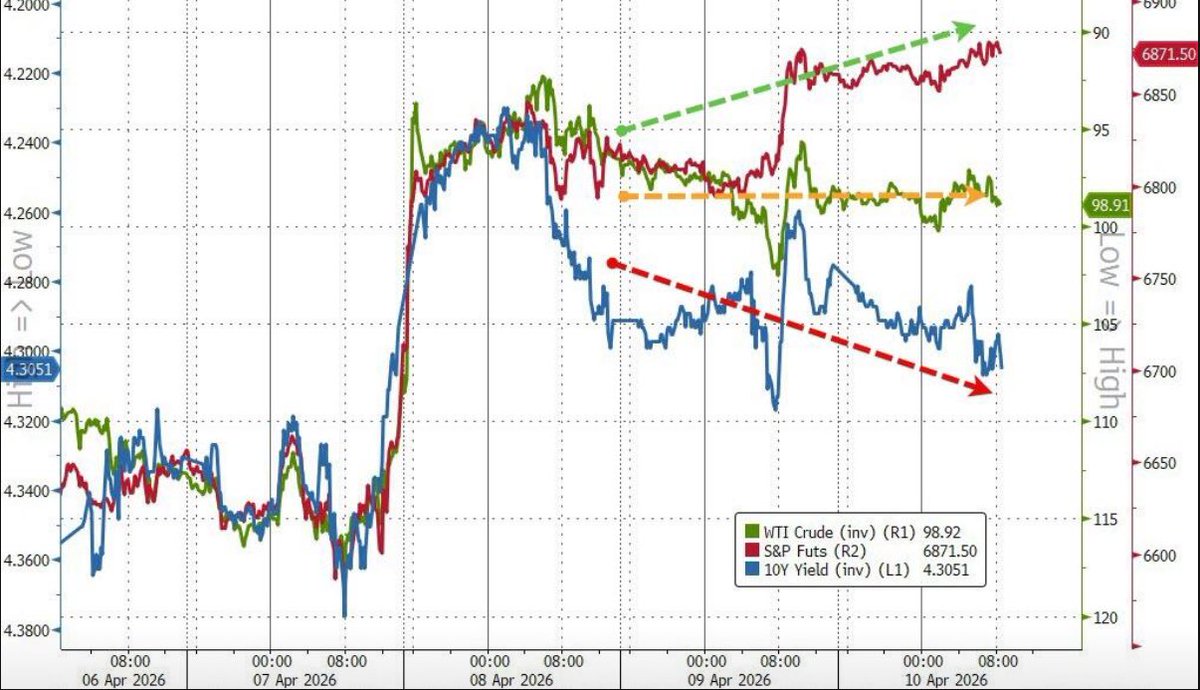
U.S. stocks (red line) performed better than U.S. oil (green line), while U.S. bonds (blue line) underperformed compared to U.S. oil.
To some extent, this trend represents the investors' voting on the direction of the U.S.-Iran war across the three markets:
1) The stock market is closest to liquidity. The market believes that the core pricing of U.S. stocks is not in the Middle East, but in Washington.
So the war is just an event; as long as the risks are controllable, asset volatility will eventually be restored.
2) Crude oil is closest to geopolitical risks. The market does not believe in verbal easing; the Strait of Hormuz is right there, and as long as the physical risks do not disappear, supply issues will always exist.
3) Bonds are the most interesting; they are closest to policy costs and are betting on a more complex rate-cutting path.
Because of the current inflation challenges and fiscal pressures, it means that the U.S. is now much less able to externally transfer the costs of war at low costs as it did in the past,
and it may ultimately result in the further compression of the internal policy space in the U.S.
免责声明:本文章仅代表作者个人观点,不代表本平台的立场和观点。本文章仅供信息分享,不构成对任何人的任何投资建议。用户与作者之间的任何争议,与本平台无关。如网页中刊载的文章或图片涉及侵权,请提供相关的权利证明和身份证明发送邮件到support@aicoin.com,本平台相关工作人员将会进行核查。


