Original Title: How perps are rewriting global trading
Original Author: Jay Drain, a16z crypto investment partner
Original Translation: Luffy, Foresight News
Perpetual futures are futures contracts without an expiration date. They were originally a native innovation in the crypto space and will fully explode on-chain in 2025. Today, perpetual contracts have become one of the largest categories by scale in the crypto market, covering traditional assets and reaching trading volumes in the trillions of dollars.
Last year, the trading volume of perpetual contracts on leading centralized exchanges (CEX) reached $86.2 trillion, a year-over-year increase of 47%; while the growth of on-chain decentralized perpetual contracts was even more rapid: the trading volume on mainstream decentralized exchanges (DEX) reached $6.7 trillion, a year-over-year increase of 346%. Currently, DEX trading volume accounts for about 7.8% of CEX trading volume, compared to just 2.5% a year ago.
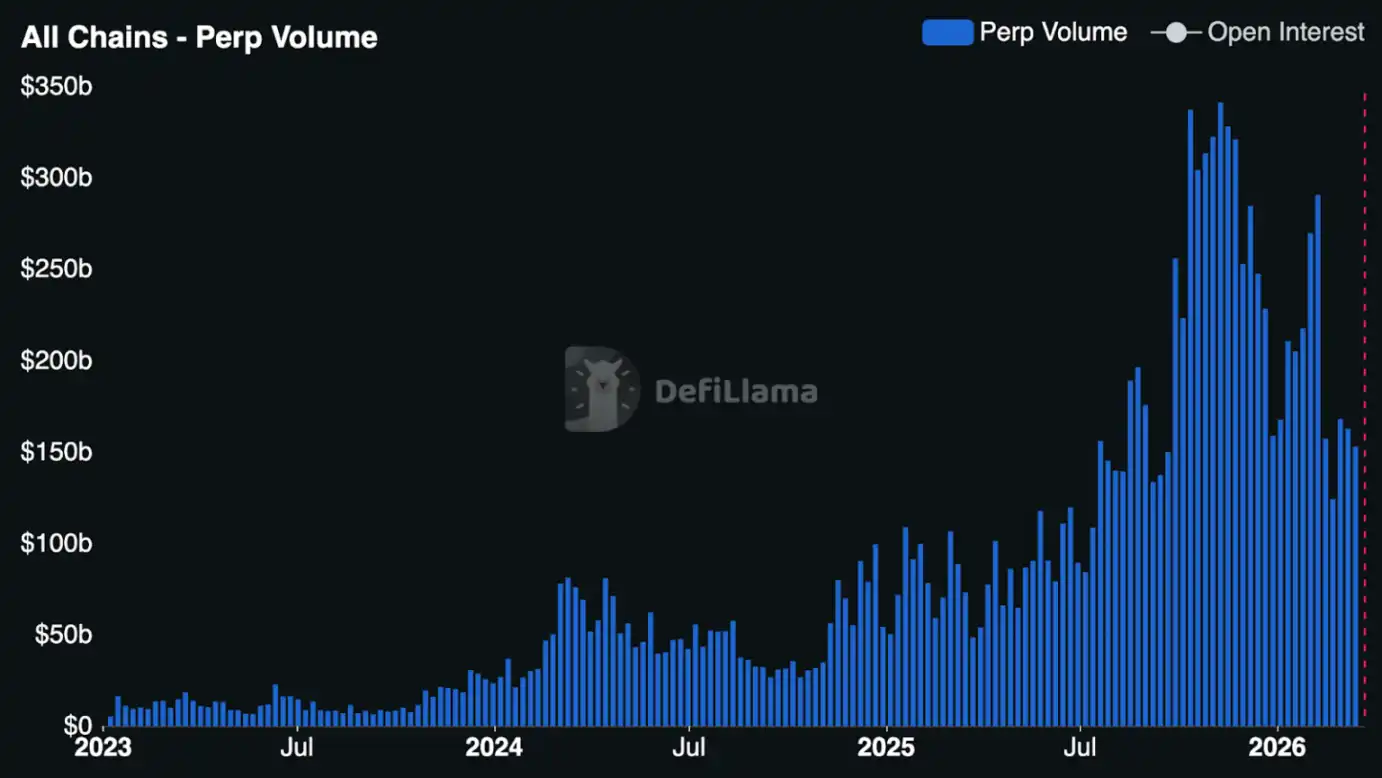
But more importantly: perpetual contracts are gradually shedding the label of "niche crypto-native tools" and becoming a fundamental force for transformation in trading behavior and market structure.
What is driving the popularity of perpetual contracts? Why now? This article will analyze the reasons why perpetual contracts are widely accepted by traders globally, the potential market scale, and the opportunities developers see.
Brief History and Evolution of Perpetual Contracts
The concept of perpetual contracts is actually older than the crypto industry itself. As early as 1993, Nobel laureate Robert Shiller proposed perpetual futures contracts, originally envisioned as a tool for hedging real estate price risk. However, it was not until 2016, with the rise of BitMEX and the longest-running Bitcoin perpetual swap contract XBTUSD, that perpetual contracts really gained traction in the crypto realm.
Ten years later, various trading platforms have launched perpetual contracts covering stocks, indices, commodities, interest rates, startup valuations, and even the prices of NVIDIA H100 GPUs.
For many years, perpetual contracts have been a billion-dollar revenue engine for CEX. As retail demand for leverage has risen, perpetual contracts have become a core venue for short-term price discovery, liquidity, and trading activity. On several mainstream CEXs in Asia, the trading volume of perpetual contracts is several times that of the spot market.
In the past year and a half, the market share of DEX has changed significantly, as they have begun to encroach on CEX's market share. With the structural advantages of self-custodial wallets, perpetual contract DEXs are rapidly narrowing the gap with CEX in terms of liquidity, performance, and functionality.
With the explosive success of perpetual DEXs like Hyperliquid, mainstream crypto wallets and applications are connecting to perpetual contracts and creating high-quality trading experiences that allow millions of users to use them with ease. In the second half of 2025, the front-end of perpetual DEX will see explosive growth, ranging from simple mobile apps to professional multi-platform trading terminals.
Especially Hyperliquid, which has broken through the capability boundaries of DEX with the HIP-3 mechanism, allowing anyone to launch perpetual markets on the platform without permission. With HIP-3, developers can list almost any asset, receive 50% of the transaction fee share, and self-manage oracles and risk parameters.
At the same time, new players like Avantis, Lighter, Ostium, and Variational are emerging or accelerating product development. Intense competition pushes perpetual DEXs to differentiate themselves in trading platform design, market structure, asset support, and permissionless access, allowing some platforms to find strong product-market fit in new areas such as real-world asset (RWA) perpetual contracts.
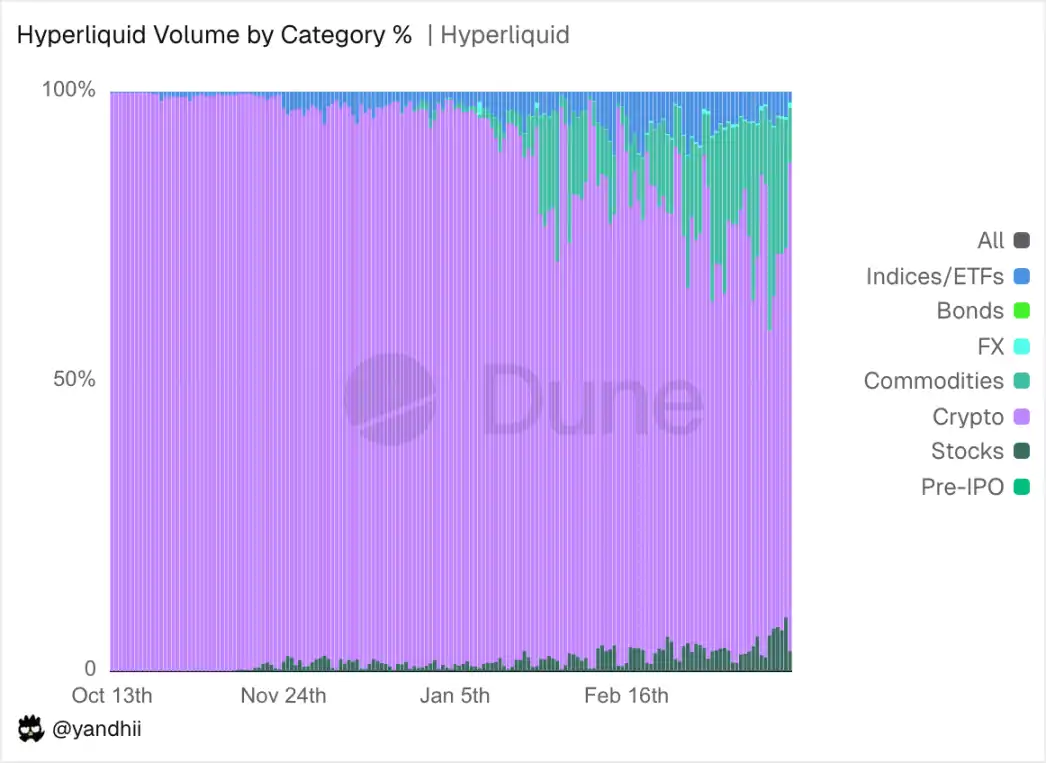
For a long time, perpetual contract traders speculated only on crypto assets like BTC, ETH, SOL, and a host of non-mainstream tokens. But since the second half of last year, despite the overall decline in the crypto market causing perpetual trading volumes to drop from their peaks, RWA perpetual contracts have emerged against the trend.
Several DEXs have launched commodities, stocks, and index contracts, expanding the range of tradable assets to include publicly traded companies like NVIDIA and Samsung, as well as private companies like SpaceX, and commodities such as silver and palladium.
This year, RWA perpetual contracts have experienced accelerated growth. In recent weeks, RWA accounted for as much as 44% of Hyperliquid's total trading volume and continued to be the highest revenue-generating trading pair for the platform.
DEX also provided efficient price discovery channels for RWA assets like crude oil over weekends when traditional markets were closed.
With the explosive growth of RWA perpetual contracts, a large number of related startups and products have quickly emerged. In just the past six months, a number of new trading platforms, trading interfaces, market deployment tools, and liquidity providers have appeared.
Participants entering this field include brand new startups, projects transitioning into the perpetual track, and global leading fintech giants, all of whom are integrating perpetual trading into their existing products.
All participants are targeting the same opportunity: perpetual contracts are expected to become a mainstream trading tool in global financial markets.
Market Opportunities for Perpetual Contracts
Looking at traditional financial markets, options are one of the largest and most actively traded markets globally, covering various assets including currencies, stocks, indices, commodities, and ETFs. Options have powerful functionalities, supporting trading strategies based on time, volatility, price ranges, and more.
However, focusing on retail behavior reveals that a large amount of trading is concentrated in a specific type of option: short-term, leveraged, directional exposure. The most typical example is 0DTE options (same-day expiration options), where traders aim for low-cost bets on intraday price movements.
This type of trading is the fastest-growing segment in the options market. By 2025, the average daily trading volume of SPX 0DTE options will reach 2.3 million contracts, representing a year-over-year increase of 51%, accounting for 59% of the total SPX options trading volume.
In response to this demand, the market has launched a number of daily expiration index products, including CBTX, MBTX Bitcoin ETF index options, and Cboe Magnificent 10 weighted index options.
In other words, while options offer structured hedging, volatility trading, and convexity trading for complex use cases, the massive and continuously growing retail capital primarily seeks short-term, leveraged directional exposure. And this is precisely what perpetual contracts excel at fulfilling.
The choice between the two is very clear: options excel at fixed risk and convex returns and remain the default tool for volatility trading, with the maximum loss for traders limited to the premium; while perpetual contracts can lead to the liquidation of the entire margin.
However, for the directional leverage that the vast majority of retail participants truly want, perpetual contracts have several structural advantages:
Round-the-clock trading: The new generation of perpetual markets operates 24/7 without market closures or interruptions. For global crypto-native users, uninterrupted trading is a basic expectation.
No strike price, no expiration date, no rollovers: A single continuous position means traders do not need to choose parameters, manage expiration dates, and do not have to rebuild positions daily/weekly. Positions can last from seconds to months, theoretically held indefinitely.
Risk structure is simpler: Perpetual contracts only need to focus on price, margin, and liquidation line. Options can incur losses even with correct directional judgment due to time decay, changes in implied volatility, or path dependence. Perpetual contracts strip away this complexity, purely expressing directional judgment.
Higher capital efficiency for continuous exposure: Short-term options require full premium payment and repeated rollovers; perpetual contracts only require margin, making them more capital-efficient for intraday to several days of directional positions.
Options will not disappear. As a long-term component of financial markets, they will continue to dominate in scenarios involving fixed risk and complex return structures. However, for the large and continuously growing capital that seeks short-term, directional leverage, perpetual contracts have already captured trading volumes in the trillions of dollars and billions in revenue.
This raises a key question: As perpetual contracts move from niche tools to mainstream financial products, at which level of the industry chain will value accumulate?
In traditional markets, the most valuable companies are often built on trading platform infrastructure rather than the trading platforms themselves. For instance, the market capitalization of retail brokerage Robinhood is higher than that of its underlying trading platform, Nasdaq.
Whether this model holds in the crypto space, and whether platforms like Hyperliquid, Lighter, and Ostium can accumulate strong network effects at the trading platform level, remains one of the industry's most noteworthy open questions.
Regardless, the developer ecosystem is rapidly expanding, focusing on several directions:
· Vertical distribution layers: Front-end interfaces aimed at specific audiences that showcase not only market data but also integrate narratives, strategies, gamification, and social elements.
· Market creators and operators (like HIP-3 deployers): Operate popular markets within Hyperliquid, equivalent to owning a mini trading platform without needing to build complex infrastructure.
· Specialized market-making: Focus on long-tail markets, event-driven order books, and cross-platform position management.
· Perpetual-exclusive data infrastructure: Community-driven dashboards, block explorers, heat maps, and analytical tools are forming around dimensions like positions, funding rates, liquidation, trader signals, leverage exposure, and user retention. More mature and higher-quality real-time data will enhance the overall ecosystem's transparency and efficiency.
These are the growing pains necessary for perpetual contracts to transition from the crypto-native realm to the global financial main stage. As the ecosystem matures, the question is no longer "Can perpetual contracts scale?" but "Who can build the most valuable applications and infrastructure around them?"
免责声明:本文章仅代表作者个人观点,不代表本平台的立场和观点。本文章仅供信息分享,不构成对任何人的任何投资建议。用户与作者之间的任何争议,与本平台无关。如网页中刊载的文章或图片涉及侵权,请提供相关的权利证明和身份证明发送邮件到support@aicoin.com,本平台相关工作人员将会进行核查。


