Written by: Max.S
“Binance Life: A Memoir of Luck, Resilience, and Protecting Users”
This work is not only a historical account of how Binance rose from nothing to become the world's largest cryptocurrency exchange but also a crisis management manual filled with personal reflections. From a teenager working at McDonald's in Vancouver to a tech executive at Bloomberg, and then to a legendary figure who found himself imprisoned before ultimately receiving a presidential pardon in the United States, CZ candidly reveals in the book the insider stories of the tussle with the U.S. Department of Justice (DOJ), the skirmishes before and after the collapse of FTX, as well as his true experiences in a federal prison.
This article will deeply dissect this memoir, revealing the realistic struggles of an idealist for those in finance and Web3.
Early Years and the “All In” Risk Philosophy
CZ’s understanding of wealth and risk originates from his ordinary early experiences. At the age of 12, he moved with his family to Vancouver, Canada. Upon arriving in a foreign country with financial difficulties, CZ began working at McDonald's at 14, and worked night shifts at a gas station at 16 to help support his family.
While studying computer science at McGill University, he discovered that the creative joy of programming far surpassed that of biology, laying the foundation for his later development of high-performance trading systems. After graduation, he served as a tech executive at Bloomberg in Tokyo and New York, and in 2005 founded a financial technology company called Fusion in Shanghai.
A turning point in his fate occurred in 2013. During a card game, Li Qiyuan introduced CZ to Bitcoin. After thoroughly studying the Bitcoin whitepaper, CZ realized that blockchain is a revolutionary technology for currency that could bring financial freedom. Subsequently, CZ made a decision that was difficult for most to understand: he resigned from his stable job and sold his property in Pudong, Shanghai, investing all his funds into Bitcoin.
Even after suffering a significant loss in assets due to the collapse of Mt. Gox, he never wavered in his belief in blockchain. In his philosophy of risk, risk varies from person to person. He firmly believed that he could easily find a job on Wall Street due to his abilities, hence for him, the biggest risk was not going bankrupt, but missing the greatest opportunity of this era.
Binance’s Rapid Growth and the Foundation of “Protecting Users”
In July 2017, Binance officially launched and issued its platform token BNB, raising the equivalent of $15 million in digital assets during the ICO. However, on the first day of launch, the BNB price fell sharply, putting immense pressure on the system. Faced with the criticism, CZ insisted on honest communication and live-streamed to let the community see the team’s efforts.
Binance’s core value of “protecting users” was epitomized during the “9.4 Announcement” incident in 2017. At that time, Chinese regulators banned ICOs and cryptocurrency exchanges, requiring project teams to refund investors. Although Binance, as a platform provider, had no obligation to compensate, CZ still decided to use company funds, personally putting in approximately $6 million to cover users’ losses. This substantial expenditure, which accounted for more than 40% of the company’s cash flow at the time, earned Binance invaluable trust from the global crypto community. Binance began to turn a profit, with the number of users skyrocketing from 35,000 to 120,000 within a month.
Crisis Management, Industry Competition, and Boundless Expansion
As Binance ascended to become the world's largest exchange, various crises followed. In May 2019, hackers exploited advanced viruses to breach Binance's withdrawal system, stealing approximately $40 million worth of 7,000 Bitcoins from the hot wallet. In the face of this crisis, CZ rejected the suggestion to “roll back the Bitcoin blockchain,” choosing instead to let Binance bear the loss entirely and taking advantage of the downtime to complete a secure upgrade of the system architecture. This transparent crisis handling approach instead enhanced user trust.
In the game of capital and industry competition, CZ exhibited a strong bottom-line mentality. When Sequoia Capital threatened with litigation during negotiations, CZ chose to fight to the end and ultimately won the lawsuit. In dealing with the competitor FTX, CZ disclosed the complexities of SBF.
SBF once sought investment from Binance, but after receiving the investment, FTX maliciously poached Binance's VIP account managers and attempted to smear Binance in political circles. When FTX faced a liquidity crisis at the end of 2022, SBF sought help from CZ, and while Binance intended to sign a letter of intent to protect users, they decisively withdrew after discovering FTX's financial black hole. The collapse of FTX triggered a withdrawal surge at Binance that reached $14 billion within a week, with Binance relying on 100% real reserves to withstand the “run.”
A Century of Reconciliation, Imprisonment, and Judicial Reflection
The heaviest part of the memoir is CZ’s account of the investigation and imprisonment by the U.S. Department of Justice (DOJ). Although Binance was not involved in fraud or misappropriation of client funds, CZ ultimately admitted to violating one provision of the U.S. Bank Secrecy Act, which was the failure to register in the U.S. early on.
During the lengthy negotiations, CZ experienced profound reflections:
- He found that the amount of the DOJ fine was not based on the severity of the violations but depended on the financial capacity of the company; the DOJ initially demanded $6.8 billion.
- To reach a settlement to protect Binance, CZ agreed to personally pay a fine of $150 million, with Binance paying $4.3 billion, and he resigned as CEO.
- When the judge issued the final sentencing, he dismissed additional charges due to lack of evidence against the DOJ and highly praised CZ's personal integrity and charitable contributions, ultimately sentencing him to four months in prison.
However, CZ's imprisonment process was fraught with challenges. Due to his non-U.S. citizen status, he was assigned to the outdated Lompoc II low-security prison instead of the recommended “camp.” In prison, CZ faced extremely harsh living conditions and encountered bureaucratic obstacles from the U.S. Immigration and Customs Enforcement (ICE), leading to an additional 14 days of confinement after his sentence was completed.
After being released from prison, CZ felt a new sense of liberation regarding wealth, power, and fame. He firmly believed in the “simulation theory,” thinking that life should be focused on living beautifully in the role one plays. No longer serving as Binance’s CEO, he turned his attention to more socially valuable fields, founding Giggle Academy, aiming to leverage AI and Web3 technology to provide free education for children in impoverished regions worldwide.
In October 2025, President Trump fulfilled his promise, granting CZ a full and unconditional pardon. Although this could not retrieve lost time, it restored his reputation.
As CZ stated in the book: “Many people strive hard to pursue money, yet always find themselves ‘wanting.’ True wealth comes from the value you create for others.” The success of Binance is rooted in its choice of long-termism over countless temptations for short-term gains.
A Financial Experiment on Long-Termism
The publication of the Binance Life memoir has also injected unprecedented narrative depth into the meme token of the same name issued last October.
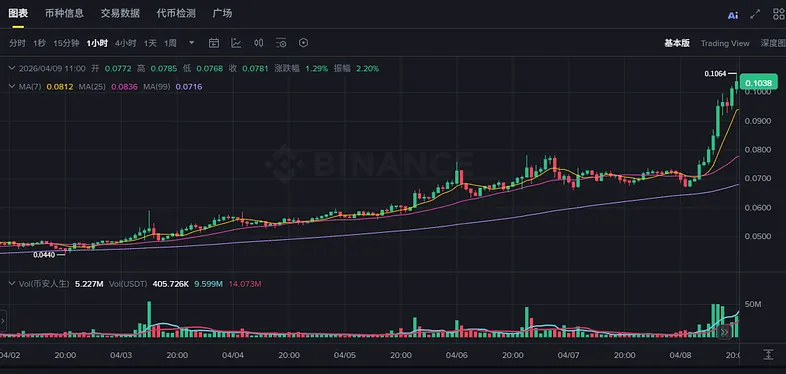
Although “Binance Life” is formally a highly volatile meme asset, its core is deeply tied to the most profound entrepreneurial spirit of the cryptocurrency industry. Through this memoir, we see the resilience, extreme transparency, and absolute protection for users of an entrepreneur in the face of adversity.
For professional investors, participating in the token game, in addition to needing to strictly control volatility risks, is essentially a bet on CZ’s personal philosophy and the pioneering spirit of early Web3.
As long as CZ’s influence and spirit of construction continue to resonate in this industry, the narrative engine of “Binance Life” will not go out, and its potential to evolve into a market value tier of hundreds of millions or even higher remains worthy of strategic attention from professional institutions.
Finally, thanks to CZ for bringing us a real-life experience through this memoir. For the future, CZ wrote at the end of the book: “I have always believed: If you can, you must.” This is not only his personal motto but also reflects the spirit of innovation of the entire cryptocurrency era.
免责声明:本文章仅代表作者个人观点,不代表本平台的立场和观点。本文章仅供信息分享,不构成对任何人的任何投资建议。用户与作者之间的任何争议,与本平台无关。如网页中刊载的文章或图片涉及侵权,请提供相关的权利证明和身份证明发送邮件到support@aicoin.com,本平台相关工作人员将会进行核查。
Selected Articles by Techub News
Related Articles


X
Telegram
CopyLink