According to a report by the Financial Times on April 8, the Iranian government issued a notice to global shipping companies, demanding that during the two-week ceasefire period between the U.S. and Iran, all oil tankers passing through the Strait of Hormuz pay a toll in Bitcoin, based on barrel capacity, as a condition for passage. The notice did not mention an enforcement agency, only provided a Bitcoin address and stated, "Ships that do not pay will not be guaranteed safe passage."
This is the first time since 1979 that a non-sovereign nation has demanded transit fees in the Strait of Hormuz. The initial public reaction was to question, "How much money can Iran actually collect from this toll?" However, when the numbers are calculated, the answer turns out to be surprisingly small.
Twenty-one million dollars a day, passing by Iran's doorstep
First, let’s clarify the upper limit of the toll. According to the latest figures released by the U.S. Energy Information Administration (EIA) in June this year, the daily average oil flow through the Strait of Hormuz in the first half of 2025 is expected to reach 20.9 million barrels, of which approximately 14.2 million barrels will be crude oil and condensate, while the remainder will consist of refined oil and other petroleum liquids. Based on a toll of $1 per barrel, with a full execution over the 14-day ceasefire, the theoretical total would be $292.6 million, averaging $21 million per day. With the Bitcoin closing price of $71,906 on April 8 after the announcement of the ceasefire, this would equate to about 4,069 Bitcoins.
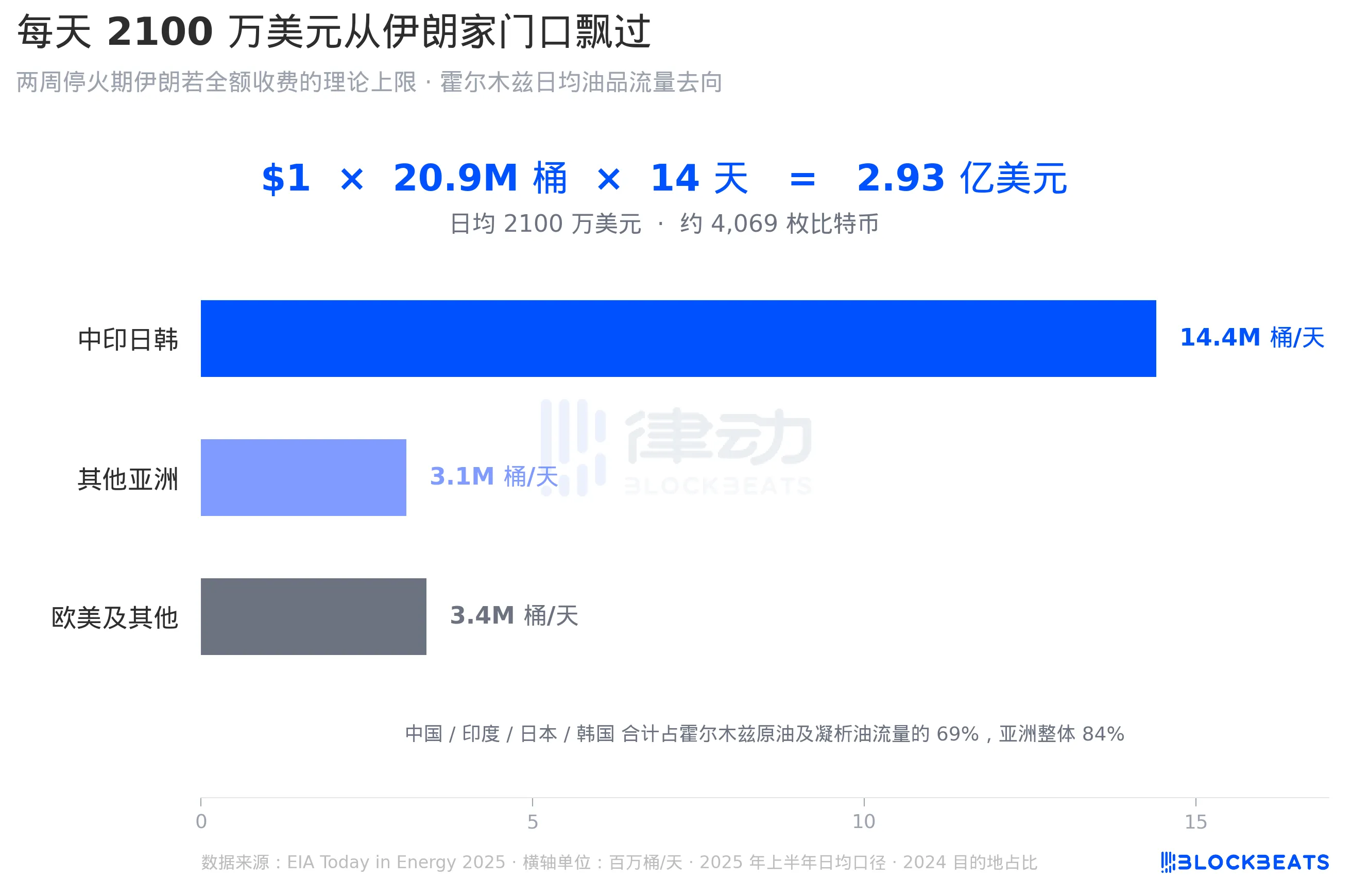
This money is nominally collected from "passing ships," but in reality, it is collected from the buyers behind the tankers. According to the same EIA report, in 2024, 84% of the crude oil and condensate exported through Hormuz went to Asia, with China, India, Japan, and South Korea alone consuming about 69%, totaling 14.4 million barrels per day. Europe and the U.S. combined account for less than 16%, with the U.S. importing only about 500,000 barrels, which accounts for 7% of U.S. crude oil imports and 2% of total consumption. In other words, if this toll bill were to be formalized, the recipients would be the refineries and national oil companies in Asia.
It is worth noting that the real exporting power in the Strait of Hormuz is not Iran, but Saudi Arabia, which exports an average of about 5.5 million barrels per day, accounting for 38% of the strait's crude oil exports. Iran's own exports have to follow the same waterway, collecting tolls from neighboring countries.
This money is a matter of days in Iran's accounts
Shifting the perspective from "tanker" to "accounts," the $292.6 million immediately reveals its size.
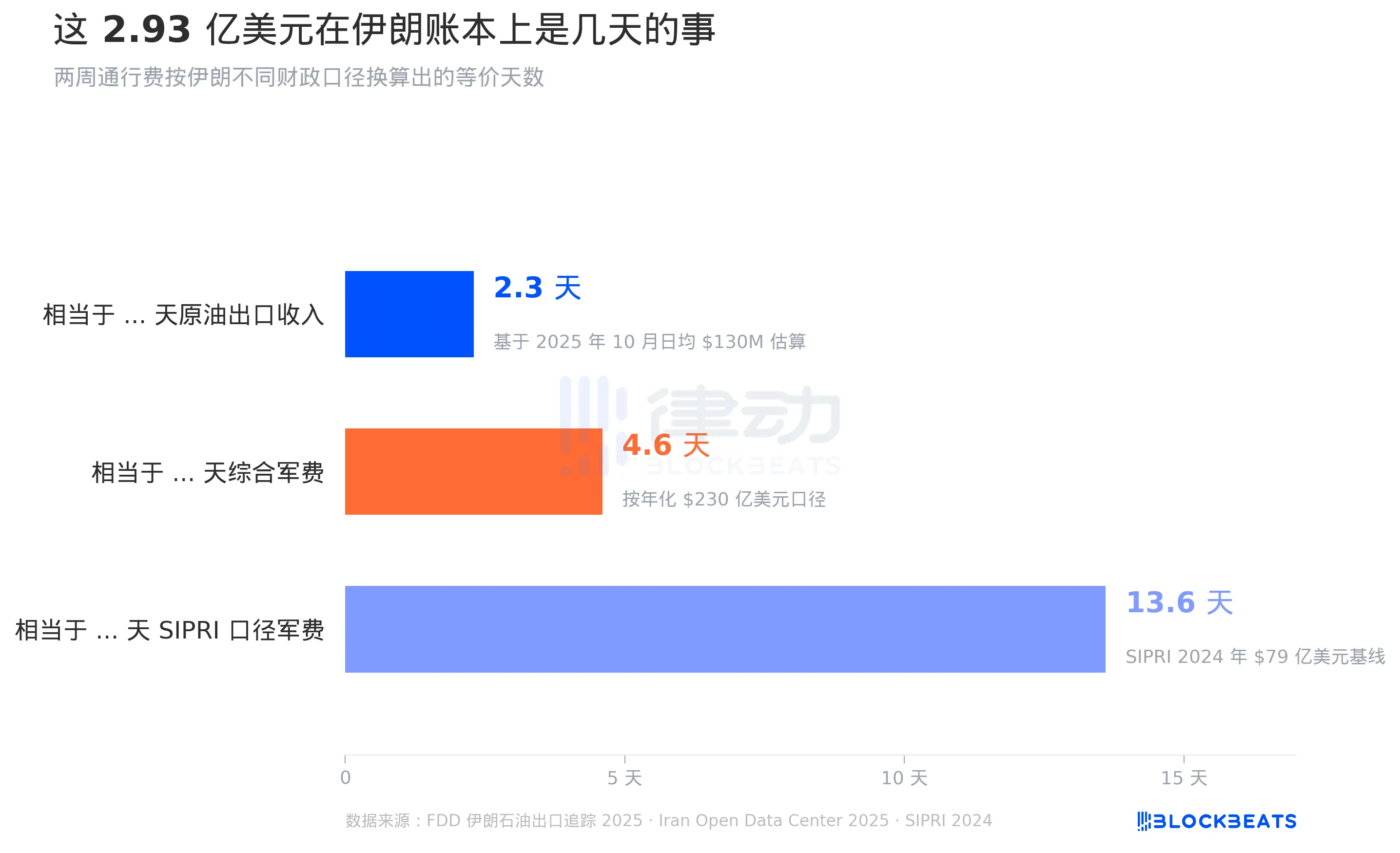
According to two analyses published by the U.S. sanctions watchdog FDD in October and November this year, Iran's crude oil exports are projected to peak at 2.15 million barrels per day in October 2025, with estimated monthly revenue ranging from $3.9 to $4.2 billion (at a 5 to 10% discount to Brent benchmarks), translating to approximately $130 million in daily revenue. Based on this measure, the theoretical full toll of $292.6 million would only equal 2.3 days of Iran's crude oil export revenue.
In comparison, military spending figures are even more stark. According to calculations by the Iranian think tank Iran Open Data Center, Iran's total military expenditure in 2025, adding the official budget of $12.36 billion with about €11 billion (approximately $10.74 billion) earmarked for oil and gas, totals nearly $23 billion. This toll could only support Iranian military spending for 4.6 days. Even using a more conservative figure, the Stockholm International Peace Research Institute (SIPRI) estimates Iran's military spending in 2024 at $7.9 billion, making the toll cap equivalent to only 13.6 days of military spending.
Comparing it to the treasury, the data recorded by the Federal Reserve FRED shows that Iran's foreign exchange reserves in January 2025 are approximately $33.8 billion, and this toll only represents 0.87% of that amount. The International Monetary Fund (IMF) stated in its May report on the 2025 economic outlook for the Middle East that for Iran to balance its budget in 2025, oil prices would need to reach $163 per barrel, while the actual oil price is only half of that. The same report estimates Iran's GDP growth rate for 2025 at 0.3%, and inflation has been revised upwards from the 37% estimated at the beginning of the year to 43%. This toll is merely a fragment of the accounts that "can't even feed for half a month."
This is why this toll should not be understood as "war spoils." It is an experimental fee collection by Iran under a suffocating fiscal condition, too small to solve any problems, yet symbolically large enough to evoke global market tension.
For seven years, unable to sell oil, but the neighbor's business has not stopped
Why did Iran choose this particular moment and method to attempt to collect tolls? The answer lies in a long-term trend that has been overlooked.
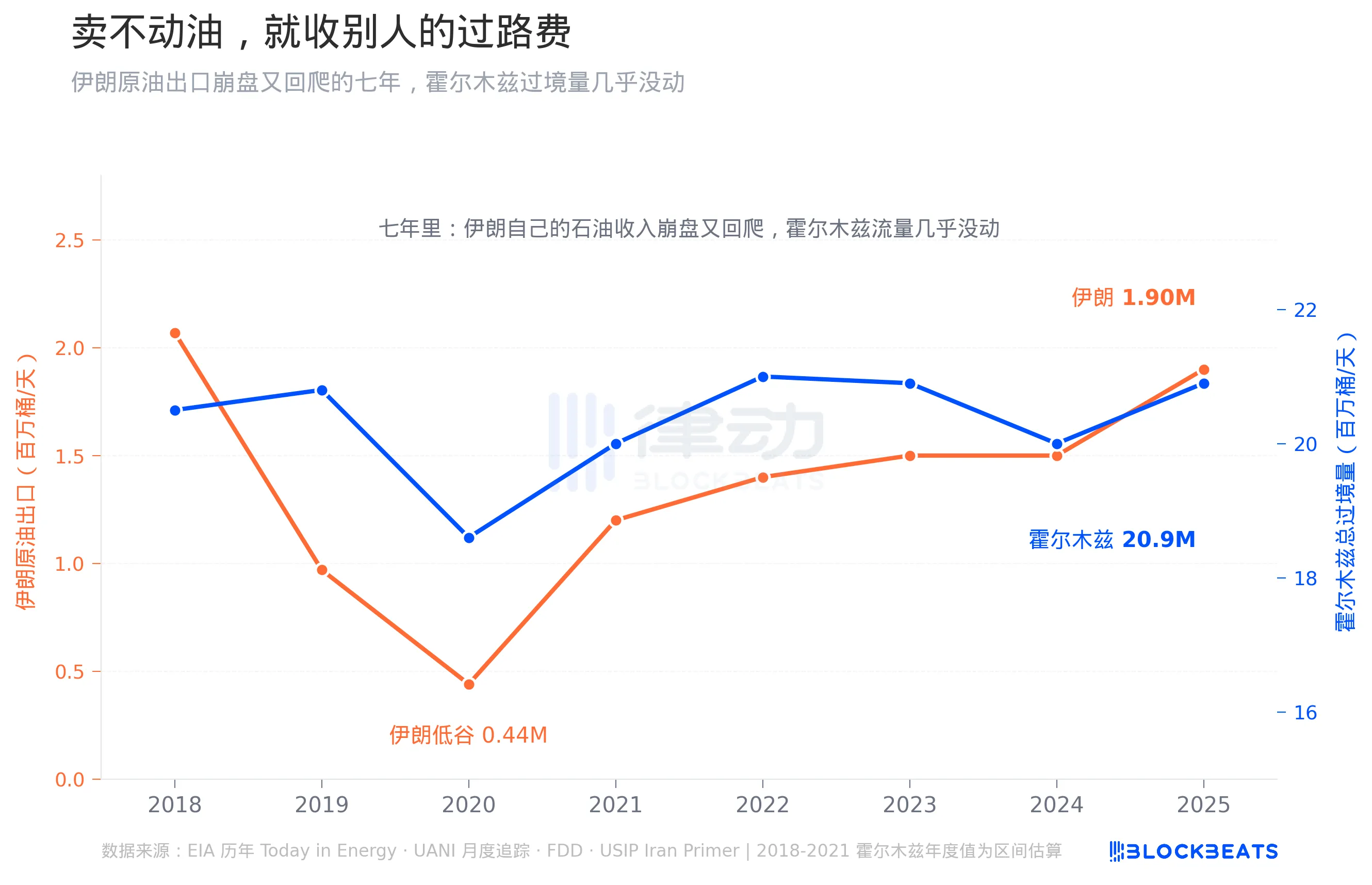
The left axis of this chart shows Iran's own crude oil exports, which averaged 2.07 million barrels per day before the U.S. reinstated sanctions in 2018, then halved to 0.97 million barrels per day in 2019, and fell to a historic low of 0.44 million barrels per day in 2020 due to sanctions compounded by the pandemic. According to estimates from the U.S. Institute of Peace (USIP), Iran lost $41.3 billion in export revenue in 2020 alone. Afterward, it climbed back with a gray fleet and discounted oil to China, not reaching the peak of 2.15 million barrels per day until October 2025.
The right axis shows the total transit volume through the same waterway. According to EIA reports, in 2018, it was 20.5 million barrels per day, followed by 21 million barrels in 2022, 20 million barrels in 2024, and 20.9 million barrels in the first half of 2025. Over the past seven years, while Iran’s own oil exports diminished, its neighbors' oil exports remained unaffected. From Iran's perspective, this waterway has always been "other people's business, my door."
This provides the historical context for the toll collection plan. After three unsuccessful attempts to rescue itself through oil revenue and three times punished by sanctions, Iran has, for the first time, shifted the target of toll collection from "my oil" to "your oil." The U.S.-Iran ceasefire has given it a two-week policy window; whether it actually collects from this toll is one thing, but the act of "pricing" this waterway is a signal to both itself and its neighbors.
From the accounts perspective, this resembles a bill that was seven years overdue.
Cryptocurrency is the only conduit that can truly facilitate this money
The final question is, why Bitcoin, and not U.S. dollars, renminbi, or euros?
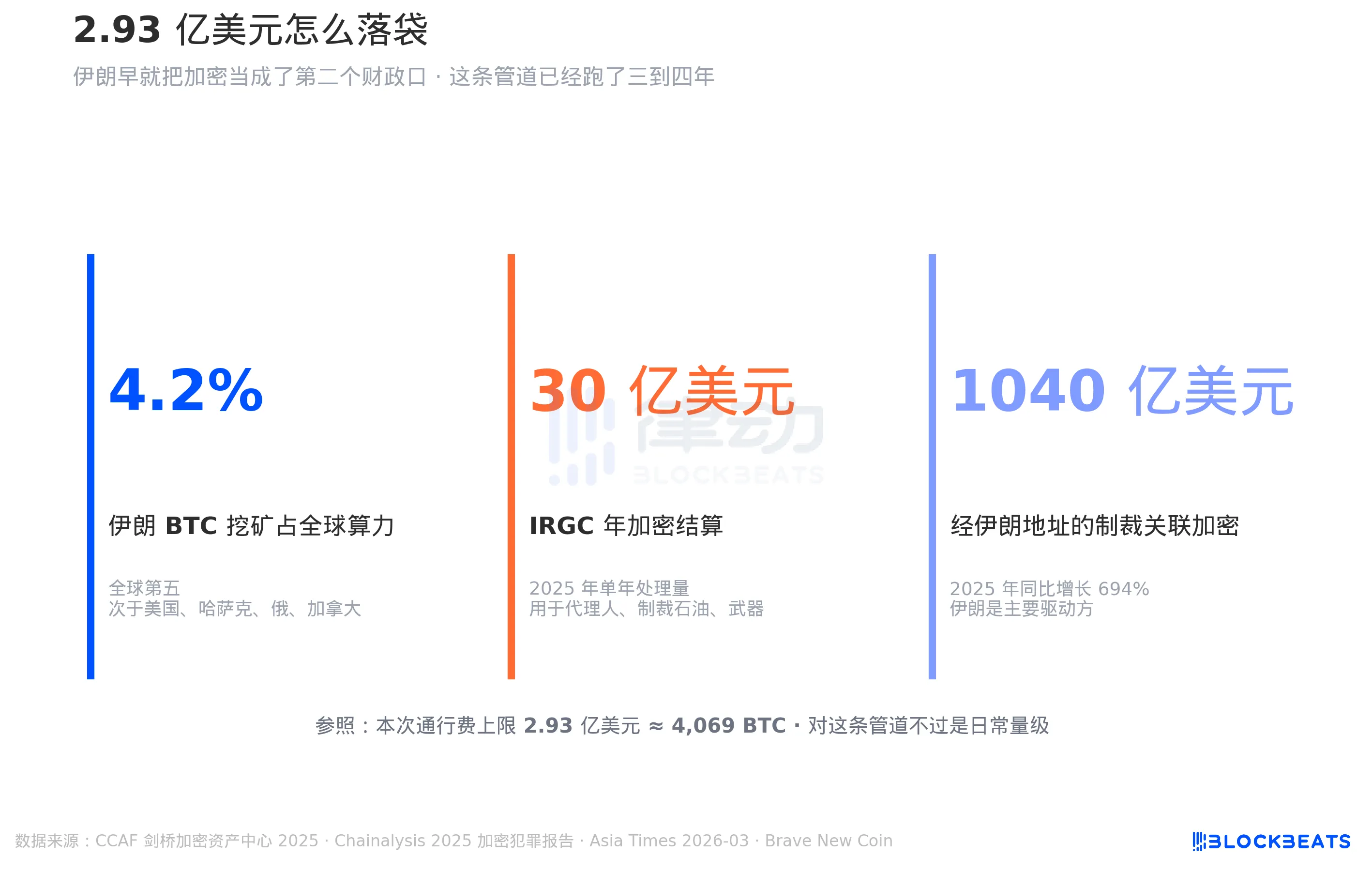
According to data analyzed by industry platform Brave New Coin based on the Cambridge Centre for Alternative Finance (CCAF) 2025 report, Iran's Bitcoin mining accounts for about 4.2% of the global hashrate, ranking fifth in the world, only behind the U.S., Kazakhstan, Russia, and Canada. This means that the native computing power within Iran itself serves as a settlement channel that does not rely on SWIFT, allowing mining machines to directly produce easily transferable assets.
A lengthy investigation published by Asia Times in March of this year indicated that the Islamic Revolutionary Guard Corps (IRGC) handled over $3 billion in cryptocurrency flows in 2025, which were used for payments to intermediaries, transferring sanctioned oil, and acquiring weapons. According to Chainalysis's 2025 annual cryptocurrency crime report, entities under sanctions globally received approximately $104 billion in cryptocurrency flows in 2025, an increase of 694% year-over-year, with Iran being a major driver. These figures tell the same story; Iran has long treated cryptocurrency as a second financial channel, and this conduit has been running for three to four years, with the infrastructure, channels, and clearing points all ready.
As for why not to use the trending stablecoins? It is because the dollar-pegged stablecoins USDT and USDC are regulated and can be seized just like the U.S. dollar. If one knows Iran's wallet address, they can directly freeze the stablecoins in that address, which has historically happened many times.
Therefore, "charging tolls in Bitcoin" is not just a gesture; it is Iran's only channel to ensure that this money lands in its pockets, not passing through SWIFT, Western banks, or getting frozen by intermediary banks. Even if Iran’s two-week toll could only translate to a bit more than two days of crude oil export revenue, it chose to price it in Bitcoin because no other form of currency could reach the account.
免责声明:本文章仅代表作者个人观点,不代表本平台的立场和观点。本文章仅供信息分享,不构成对任何人的任何投资建议。用户与作者之间的任何争议,与本平台无关。如网页中刊载的文章或图片涉及侵权,请提供相关的权利证明和身份证明发送邮件到support@aicoin.com,本平台相关工作人员将会进行核查。


