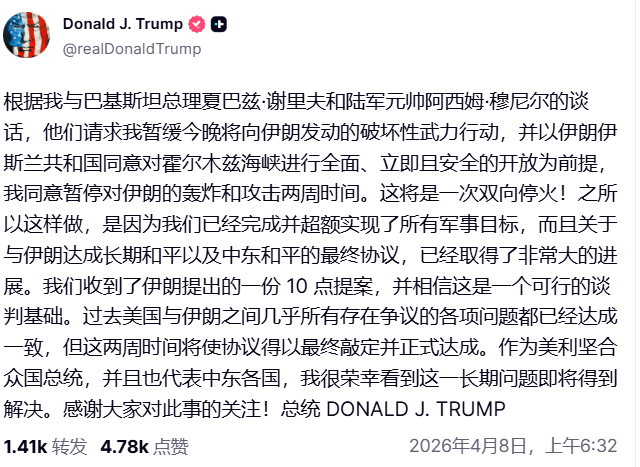
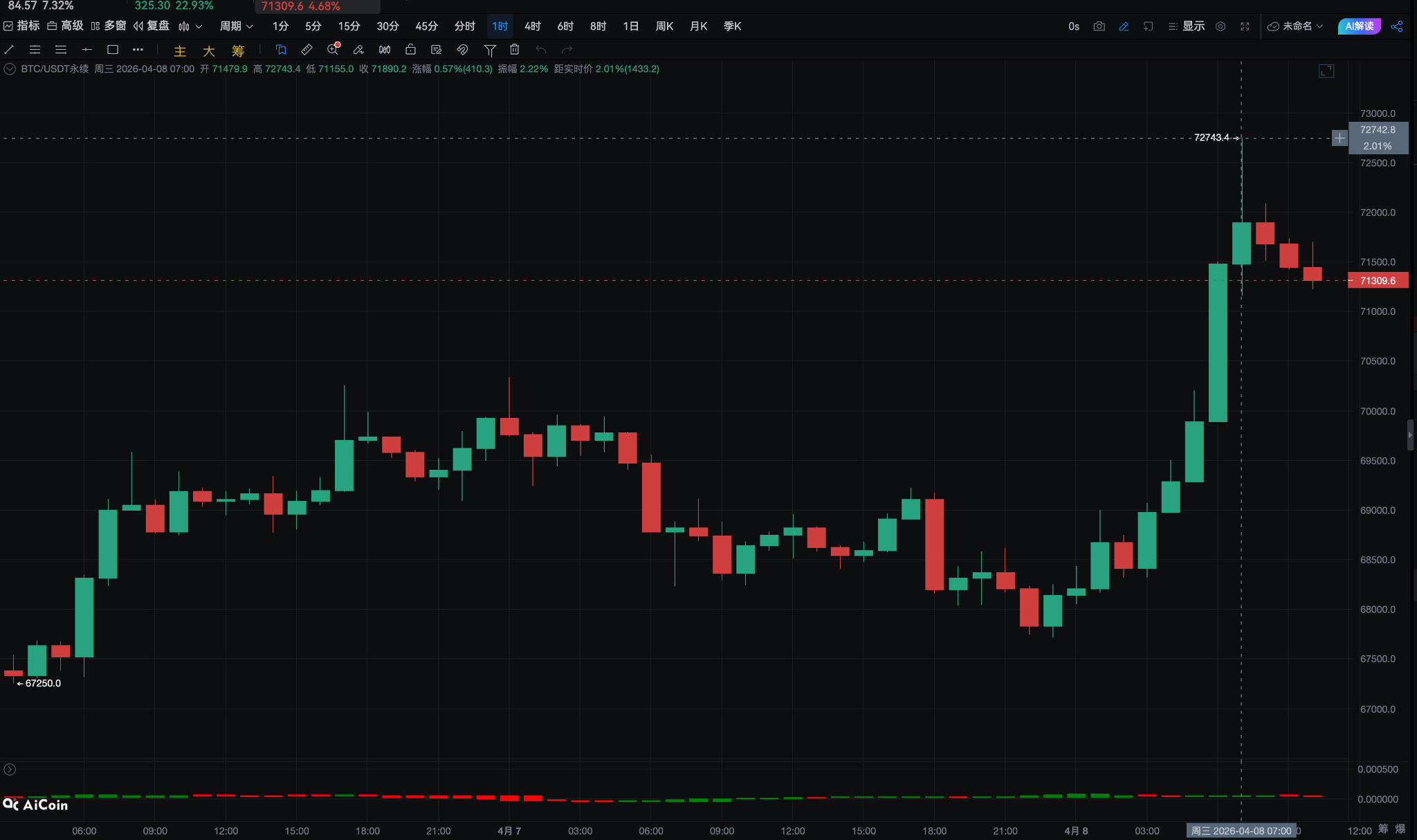
On April 8, 2026, at 8 a.m., a ceasefire agreement sent global markets into a frenzy. U.S. President Trump announced a temporary halt to military strikes against Iran, and Iran agreed to reopen the Strait of Hormuz. Following the announcement, the price of Bitcoin surged sharply, briefly breaking past $72,500, with an increase of over 5% within 24 hours. Global risk assets experienced a welcome "simultaneous rise in stocks, bonds, and currencies."

However, under this temporarily cleared geopolitical sky, a more ominous thunder is rumbling deep within Wall Street. As investors celebrated the ceasefire news, a liquidity crisis concerning trillions of dollars in assets was quietly erupting in the private credit market—this crisis may be the true "historic catalyst" Bitcoin needs.
Under Currents Behind the Ceasefire: Wall Street's "Redemption Tsunami"
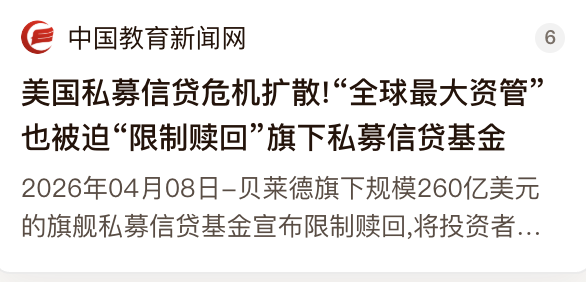
On the same day the U.S. and Iran announced a ceasefire, the world's largest asset management company, BlackRock, released a shocking message to the financial sector: its flagship private credit fund HLEND, with a size of $26 billion, was forced to activate a "flow limit" after redemption requests in the first quarter reached 9.3% of net assets, capping investor withdrawals at 5%. This means over $600 million in funds were "locked" in the fund.
This is not an isolated incident. Since 2026, the U.S. private credit market has been facing unprecedented stress tests:
- Blackstone Group: The flagship credit fund BCRED, with a size of $82 billion, saw redemption requests reach 7.9% of the fund's size in the first quarter, exceeding the 5% quarterly cap. Blackstone and its executives were forced to urgently inject approximately $400 million in their own capital to cope.
- Blue Owl Capital: Two of its private credit funds faced an epic run on liquidity. The OTIC fund, focused on the technology sector, saw redemption requests reach 40.7%, while another fund, OCIC, reached 21.9%. Faced with such a wave of withdrawals, the company could only implement a 5% redemption cap mechanism.
- Industry Winter: In the first quarter of this year, stock prices of private credit giants like Blackstone, Apollo, Blue Owl, and Ares fell by 22% to 38%.
This "redemption tsunami" is backed by the systemic pressure of an $18 trillion private credit market and a $20 trillion global management scale. As U.S.-Iran hostilities temporarily extinguish, the deep fractures in the financial system begin to emerge.
Mismatched Maturities: Wall Street’s "Original Sin" and Bitcoin’s "Original Intention"
The root cause of the private credit crisis lies in an ancient and dangerous financial game: maturity mismatch.
These funds invest in corporate loans with maturities of 3-7 years (illiquid assets) but promise investors redeemable liquidity on a quarterly basis. During calm times, new capital inflows can cover redemption demands; but when market sentiment reverses, and a large number of investors rush to the exit, the redemption mechanism transforms from a buffer into a blocker.
"This gap is not a design error but a deliberate trade-off," admitted a person from a cross-border asset allocation institution. "The problem arises when these products are heavily marketed to retail high-net-worth clients who do not genuinely understand this mechanism."
This is precisely the historical context of Bitcoin's birth replaying in 2026.
In 2008, the collapse of Lehman Brothers exposed the fatal flaws of the centralized financial system—moral hazard of being "too big to fail," information asymmetry behind complex derivatives, and the helplessness of ordinary investors during a crisis. The phrase inscribed by Satoshi Nakamoto in the genesis block, "the Chancellor on the brink of the second bailout for banks," was the ultimate response to this systemic distrust.
The fixed total of 21 million Bitcoins is a rebellion against central banks' unlimited money printing power; its decentralized validation is a rebellion against the monopoly of "too big to fail" institutions; and its permissionless cross-border movement is a rebellion against capital controls and censorship.
Now, as BlackRock, Blackstone, and other "cash cows" begin to limit redemptions, and when 40.7% of investors attempt to escape but can only redeem 5%, the foundational trust in traditional financial intermediaries is beginning to erode. Capital will need to seek a value storage method that does not rely on third-party commitments, has no redemption limits, has no maturity mismatches—this is precisely Bitcoin's most primitive and core function.
Why, After the U.S.-Iran Ceasefire, Is the Crisis Actually Closer?
Superficially, the alleviation of geopolitical risks should reduce market volatility. However, the logic of financial markets is often the opposite: when the most overt risks (war) temporarily recede, investors turn their attention to more fundamental, concealed risks (structural defects in the financial system).
The U.S.-Iran ceasefire caused oil prices to plummet over 22% momentarily, gold rebounded, and risk assets surged. But this is merely a short-term repair of risk appetite. Savvy capital is actually contemplating two deeper questions:
The destabilization of the credit foundation under AI disruption: The most favored underlying assets in the private credit market are loans to software companies. But the AI's near-zero marginal cost of automation is fundamentally compressing the value of traditional software tools. Global software stocks plummeting has directly shaken the asset quality of private credit. UBS warns that, under AI disruption scenarios, the default rate in private credit may rise significantly.
The paper prosperity of PIK traps: When a company's cash is insufficient to pay interest, the PIK (Payment-In-Kind or deferred interest payment) mechanism allows interest to be added to the principal until the loan matures and is settled in one lump sum. This creates a façade of no defaults on paper, but allows risks to snowball.
Ironically, just as the wave of redemptions surged, Blackstone's latest "opportunistic credit fund" raised $10 billion and was oversubscribed. This reveals a harsh reality: the crisis is a disaster for some, but an "opportunity" for others. And ordinary investors often become the former.
The "Crisis Option" Value of Bitcoin Is Being Reevaluated
Historical data shows that within about 60 days after global crisis events occur, Bitcoin's rebound has historically outperformed gold and the S&P 500 index. This "post-crisis resilience" is being reappraised.
If you want to enter the market, now is a good time.
By registering with a dedicated invitation link or entering a suitable code, you can not only enjoy a direct commission on fees but may also receive current new user benefits.
The answer is just two words: depth.
The order book thickness of Binance ETH/USDT spot has long been globally leading, making it hard for other platforms to compare. This means:
Placing buy orders in the millions or even tens of millions won’t easily break the price or cause significant slippage;
Main players can get the most accurate and concentrated feedback from counterparties, knowing the real distribution of buy and sell forces;
Large funds entering and exiting is smoother, execution efficiency is higher, and risks are more controllable.
Many on-chain whales often choose Binance first after transferring ETH. Because here, they can comfortably test supports, adjust positions, participate in wealth management, and seamlessly integrate spot operations with other tools. Simply put: other platforms can also place orders, but only in the location of the most terrifying liquidity can the main players truly unleash themselves to "play psychological warfare," while observing the clearest market signals.
These details are actually the experiences that many old traders have purchased with real money: observing the main players, not just what they are posting but where they are posting on what platform. The depth of the platform itself is the hard currency of liquidity and reliability.
Want to compete on the same field as the main players? Actually, for newcomers, entering is far less complicated than imagined.
Many friends can complete the first step in minutes by registering with an email or phone number;
Click https://jump.do/zh-Hans/xlink-proxy?id=3
An email/phone number can register on Binance in a few minutes;
Then do a simple KYC (ID + facial recognition)
Once these are completed, you can recharge, trade, and participate in Earn wealth management. The platform's new user tasks can also award trading vouchers or small rewards.
The U.S.-Iran ceasefire on April 8, 2026, may become a key turning point in Bitcoin's narrative:
From "geopolitical safe haven asset" to "systemic safe haven asset."
Before the ceasefire, Bitcoin was highly correlated with geopolitical risks—declining during conflict escalations (liquidity shocks) and rising during de-escalations (risk appetite recovery). But after the ceasefire, the market's focus will shift to:
How high will the private credit default rate rise from 5.8%?
How many more funds will trigger redemption caps?
How deep is AI's impact on the software industry?
How will central banks respond to potential economic recessions?
In the face of these questions, Bitcoin's "digital gold" narrative may give way to a more fundamental narrative of "alternative to the financial system." Its value will no longer just hedge geopolitical risks but also the trust crisis within the entire centralized financial system.
Investor Action Framework: Positioning for the Storm Amid Calm
For Bitcoin investors, a clear strategy is needed at this moment:
1. Understand the cyclical position
Bitcoin's value discovery is incremental: the 2008 financial crisis birthed it, the 2020 pandemic stimulated it, and the potential credit crisis in 2026 may elevate it to new heights. Every crisis within the centralized system is a moment for reevaluation of the decentralized network's value.
2. Differentiate between short-term noise and long-term signals
The U.S.-Iran ceasefire is a short-term event; the structural issues in private credit are a long-term trend. The latter has more enduring and fundamental benefits for Bitcoin.
3. Allocate for "asymmetry"
Within an asset portfolio, Bitcoin should play the role of a "crisis option": with limited downside risk (as a long-term value store) and immense upside potential (if a systemic crisis erupts). This asymmetry is difficult for traditional assets to provide.
4. Pay attention to on-chain signals
Long-term holders (those holding for over 155 days) have holdings close to historical highs, indicating a strengthening belief in "strong holding." Institutions continue to accumulate through sustained net inflows into ETFs (with a single-day inflow of $471.3 million on April 7).
Conclusion: When Alarms Shift from the Battlefield to Wall Street
On April 8, 2026, the world witnessed two parallel narratives:
In the Persian Gulf, the U.S. and Iran reached a temporary ceasefire, and the geopolitical smoke dissipated momentarily.
On Wall Street, redemption alarms from BlackRock, Blackstone, and Blue Owl sounded one after another, and the cracks in the trillion-dollar market became apparent.
The former pushed Bitcoin past $72,500, while the latter might drive it toward $100,000 or even higher.
Because Bitcoin's deepest paradox lies in: the more it is needed, the more unreliable the traditional system becomes. In 2008, Satoshi Nakamoto responded to Lehman's collapse with code; in 2026, when private credit's "redemption limits" become the norm and when 40.7% of investors cannot get their money back, people will once again remember that genesis block and the promise behind it:
A value storage system that does not rely on any intermediaries, has no redemption limits, has no maturity mismatches, and has no centralized failure points.
The U.S. and Iran can have a ceasefire, but the fundamental contradictions within the financial system will not cease. As the battlefield shifts from the Persian Gulf to Wall Street, Bitcoin's "state of war" may just be beginning.
This time, what it faces is not the army of a single nation, but the "original sin" of the entire modern financial system. And history has repeatedly proven that assets that resist the "original sin" often possess the most enduring vitality.
Join our community to discuss and become stronger together!
Official Telegram community: t.me/aicoincn
AiCoin Chinese Twitter: https://x.com/AiCoinzh
Binance benefits group:
https://aicoin.com/link/chat?cid=ynr7d1P6Z
The content of this article only represents the author's personal views and does not represent the stance of this platform. The opinions, conclusions, and recommendations in the text are for reference only and do not constitute any investment advice related to this platform. Markets are risky, and investment requires caution.
免责声明:本文章仅代表作者个人观点,不代表本平台的立场和观点。本文章仅供信息分享,不构成对任何人的任何投资建议。用户与作者之间的任何争议,与本平台无关。如网页中刊载的文章或图片涉及侵权,请提供相关的权利证明和身份证明发送邮件到support@aicoin.com,本平台相关工作人员将会进行核查。