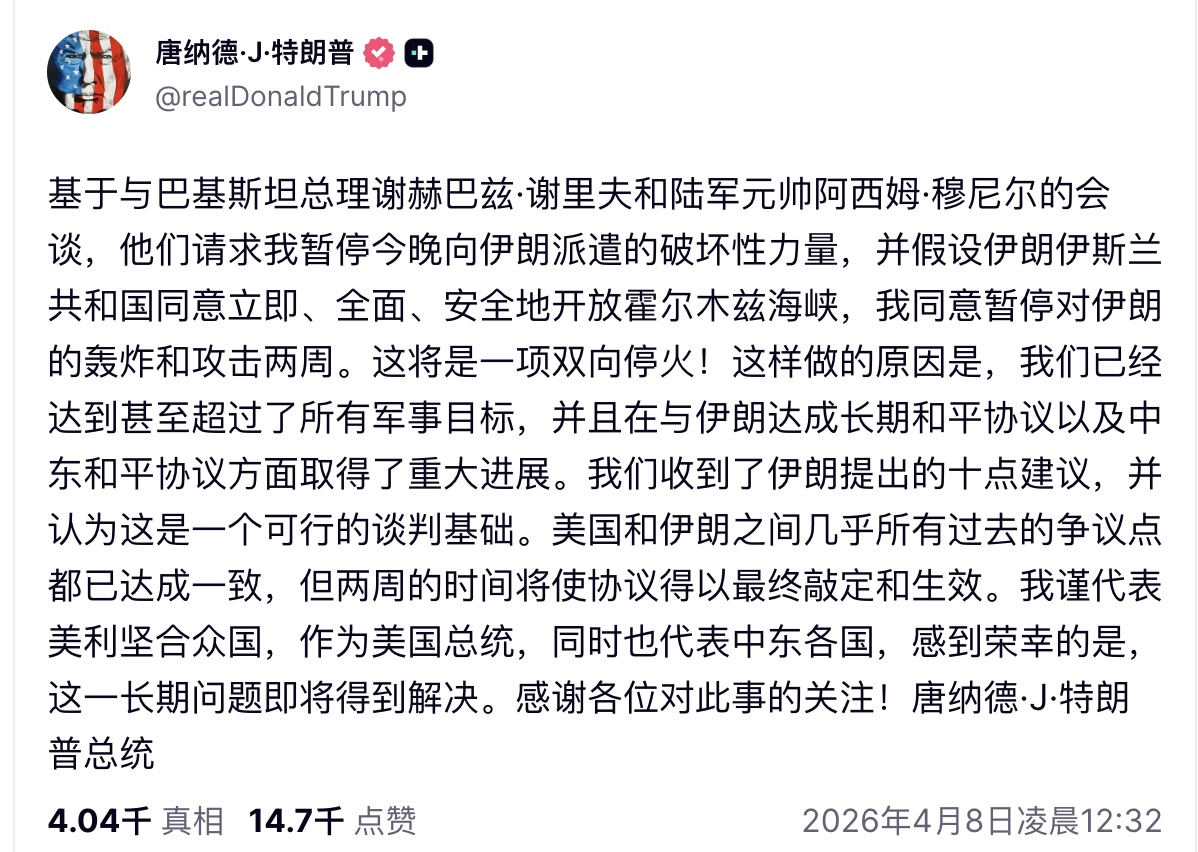
On April 8, 2026, in the evening under East Eight Time, both the U.S. and Iran, under the mediation of Pakistan, announced an immediate ceasefire, marking the first time since the outbreak of the U.S.-Iran war in 2025 that both sides simultaneously pulled the trigger under the name of "comprehensive ceasefire." Along with the ceasefire statement, a critical commitment regarding the Strait of Hormuz was simultaneously released: to ensure safe passage through this channel in the next two weeks, creating a limited but crucial buffer window for global crude oil and energy supplies. Meanwhile, foreign media cited a single source stating that the U.S., Iran, and related parties are preparing to hold talks on April 10 in Islamabad, a time frame overlapping with the two-week security period, becoming a political and price intersection point watched closely by the market. The question is, to what extent is this ceasefire viewed as a "fragile and tentative" political pause—how much will it lower the energy risk premium? And how will it leave brief peaks and correction shadows related to geopolitics on the sentiment curve of cryptocurrencies like Bitcoin?
From War Clouds to Handshakes: How Pakistan Facilitated the First Comprehensive Ceasefire Between the U.S. and Iran
Returning to the starting point of the timeline, after the outbreak of the U.S.-Iran war in 2025, the skies over the Middle East were long overshadowed by missile exchanges and proxy conflicts, with frequent attacks and reprisals rendering terms like "limited conflict" and "regional de-escalation" particularly pale. The ceasefire announced on April 8, 2026, was explicitly marked by several media outlets as the first "comprehensive ceasefire" since the outbreak of war, indicating not only a decrease in the intensity of firepower but also a phased reversal of political posture: both sides shifted from high-profile confrontation to publicly acknowledging the need for a verifiable period of silence. This turn does not mean that contradictions have vanished; rather, it appears to be a passive "breather" forced out by the endurance of war and domestic political pressure.
In this turning point, Pakistan's role is particularly prominent. Briefings indicate that this is the first time Pakistan has gained the trust of both the U.S. and Iran, authorized to act as a mediator to promote a ceasefire and subsequent talks. For Iran, Pakistan is neither a traditional "Western ally" nor a country with significant regional power, maintaining a working relationship and presenting certain security and religious ties; for the U.S. and its allies, Pakistan is familiar with the regional security landscape while lacking the hard power needed to challenge U.S. hegemony, making it easier to be seen as a "controllable neutral party" on sensitive issues. This bi-directional acceptability is the geopolitical leverage needed for mediating a ceasefire.
Even so, public statements still reveal a sense of testing and distrust. Iranian Foreign Minister Amir-Abdollahian emphasized in an interview, "If attacks cease, defensive actions will come to an end," defining the ceasefire as a "conditional pause for defense," rather than an unconditional cessation of hostilities; the White House, on the other hand, through Press Secretary Levitt, released a markedly different tone — "the possibility of talks is being discussed, everything awaits official confirmation," neither endorsing the timing of talks nor making political commitments regarding the prospects of the ceasefire. The juxtaposition of a conditional ceasefire with a procedurally cautious dialogue indicates that behind the ceasefire remains a game of testing the opponent's limits rather than a genuine shift toward reconciliation.
Two Weeks of Safe Passage Through the Strait of Hormuz: The Price Game Between Commitment and Reality
If the ceasefire declaration pressed the pause button on political narratives, then the commitment to "two weeks of safe passage" through the Strait of Hormuz directly touched the most sensitive nerve of the global market. Research briefings point out that the Strait of Hormuz accounts for about 20% of global oil transportation, serving as a "single gateway" for crude oil and liquefied natural gas flowing from the Gulf to the world. This figure means that even a rise of a few percentage points in the risk premium of this gateway can amplify into a series of chain reactions ranging from freight rates to terminal oil prices. Thus, when the agreement explicitly ensures safe passage in the next two weeks, the market immediately views this as a temporary relief of concerns over prior supply interruptions.
Surrounding this "two-week window," imaginations in the energy market began to diverge. On one hand, derivative traders would reassess short-term supply risks, compressing the risk premium that had widened due to threats to shipping, to some extent alleviating upward pressure on crude oil prices; on the other hand, spot trading and shipping companies would aim to accelerate shipments and passage as much as possible during this period to lock in more deliverable supplies before the "uncertain peace" ends. The result is that even if oil prices briefly declined following the ceasefire news, the extent and duration of that decline still heavily depend on whether the market believes "as long as nothing happens in two weeks, the tense nerves can truly relax."
However, should the ceasefire break down or the Strait of Hormuz be threatened again, this brief buffer period would quickly evolve into a new round of shocks. Crude oil transportation may be forced to detour through longer routes, sharply increasing single-voyage costs and adding to capacity tensions; insurance companies would then reassess war risks and add premiums, directly passing the pricing of geopolitical risks onto every barrel of oil and every shipping order. For a global economy still grappling with inflation, this means a resurgence of inflationary expectations, a compression of monetary policy space for central banks in the U.S. and Europe, and emerging markets enduring dual pressures from capital outflows and energy costs — all of which will ultimately leave deep traces on asset prices and credit spreads.
The Night Before the Islamabad Talks: Ceasefire Red Lines and Information Black Boxes
Along with the announcement of the ceasefire, the timeline for the next political actions was also thrown into the market. Briefings citing a single source reported that the U.S., Iran, and related parties plan to hold talks on April 10, 2026, in Islamabad; this claim has yet to be confirmed by multiple channels, thus can only be seen as a "pending verifiable time anchor." Despite this, the market and public opinion have already begun to treat this point as a watershed in expectations: if a more binding framework emerges around April 10, the current ceasefire may evolve into a "renewable quiet period"; conversely, it would appear more as a pause for strategic realignment.
At the level of expression, the understanding of the ceasefire red lines by both sides is also thought-provoking. Iranian Foreign Minister Amir-Abdollahian defined the logic of the ceasefire with "if attacks cease, defensive actions will end," preclassifying all of his country's military actions as "defensive," leaving sufficient narrative space for potential escalations in the future. The U.S. side, through Press Secretary Levitt, constantly emphasized that "the possibility of talks is being discussed" and "everything awaits official confirmation," deliberately avoiding locking any single statement into a formal commitment. This linguistic ambiguity and misalignment render the ceasefire more like a "minimum acceptable option" each side must explain to its domestic audience and allies, rather than a stable arrangement easily assessed by third parties.
Greater uncertainty arises from the information black box. Research briefings clearly indicate that the specific supervisory mechanisms of the ceasefire agreement have not been made public, with key clauses on how to monitor violations, who defines responsibility, and what consequences trigger lacking; the participant list and levels are also vague, with no disclosure of the specific composition of the U.S. negotiating representatives; regarding whether and how other related parties participate in the ceasefire arrangement, there is a lack of verifiable information. Under such conditions, where the supervisory mechanism is not disclosed and the participant structure is opaque, the market finds it challenging to assign high confidence premiums to the enforceability of the ceasefire, and the agreement's fragility is further magnified by the "invisible details."
Oil Price Sensitivities and On-Chain Sentiment: How Geopolitical Flashpoints Penetrate the Cryptocurrency Market
From past experience, each escalation and de-escalation of geopolitical conflicts in the Middle East weaves a complex chain of interactions between crude oil and risk assets. When the shadow of war looms over the Strait of Hormuz, oil prices are pushed up due to supply worries, traditional safe-haven assets strengthen, and high-beta stocks and certain emerging market assets come under pressure; when tensions ease temporarily, oil prices pull back, credit spreads narrow, and risk appetite assets experience a "breathing rebound." Cryptocurrencies like Bitcoin are always in this ambiguous zone—viewed by some funds as "digital gold" for hedging, while also serving as speculative and allocation tools during liquidity and risk appetite recovery, highly sensitive to both macro and geopolitical signals.
This time, the news of the U.S.-Iran ceasefire and the safe passage through the Strait of Hormuz also quickly triggered emotional fluctuations in on-chain and derivatives markets. Research briefings mentioned that on-chain prediction markets like Polymarket experienced abnormal trading around the time of the announcement, with contracts related to the Middle East conflict and oil price path seeing spikes in volume and quotes, reflecting traders betting on "whether the ceasefire can really continue" and "whether oil prices will peak and pull back as a result." Meanwhile, in the crypto derivatives market, leverage long-short ratios, funding rates, and implied volatility often undergo "sentiment jumps" around such events: some shorts bet that "easing geopolitical risks = risk asset recovery," while longs worry that the ceasefire is merely a temporary smokescreen, choosing to reduce positions and lock in profits during rebounds.
On the spot and on-chain behavior level, the short-term emotional repair brought by the ceasefire often manifests as: reduced selling pressure, a temporary break in high volatility periods, and funds flowing back from safe-haven assets to higher-risk positions, with Bitcoin and major coin prices experiencing technical rebounds. However, this technical repair has nothing to do with "fundamental certainty," but is rather a conditioned reflex to "the worst-case scenario has not yet occurred." Once the narrative of war re-escalates in social media and news feeds—for instance, if the ceasefire breaks, further attacks occur, or military friction arises near the Strait of Hormuz—panic sentiment will quickly amplify, resulting in significant on-chain transfers, contract liquidations, and prediction market odds reversing within hours. For the cryptocurrency market, this means that in the short term, "geopolitics" will continue to serve as the main narrative stirring volatility, rather than being a digested old news by the market.
Trump's Retweet and Public Opinion Echo: Electoral Calculations Beyond the Agreement
After the declaration of the ceasefire, another detail that has been frequently cited in international media and markets is the public opinion echo within the U.S. political sphere. Research briefings show that former U.S. President Trump retweeted Iran's statement on his platform Truth Social, prompting interpretations of his political intentions. In the current context of high polarization in U.S. domestic affairs, Trump's action is seen not merely as a social media retweet but also as an "alternative benchmark" against Biden's administration's Middle East policies—regardless of the specific text, this symbolic gesture aimed at shaping his diplomatic position through Iran's statement is bound to resonate with voters and party supporters.
In stark contrast is the cautious stance of the White House. When asked about the Islamabad talks, Press Secretary Levitt responded only with "the possibility of talks is being discussed, everything awaits official confirmation," deliberately avoiding pre-endorsement of the timing and outcomes of the talks. This restraint indicates that there has not yet been a unified expectation within Washington regarding the durability of the ceasefire and the negotiation framework. Some factions are concerned that prematurely "political celebrating" without a supervisory mechanism and consensus among allies could be detrimental, while others hope to use this time to observe Iran and other related parties' actual actions before making decisions.
Domestic politics and the electoral cycle in the U.S. will undoubtedly amplify or weaken the enforceability of this ceasefire agreement. On one hand, under election pressure, any actions interpreted as "weak" or "concessions to Iran" could become material for opponents to attack, making decision-makers more inclined to retain hardline options and reduce commitments to the ceasefire and negotiations that are hard to retract; on the other hand, if energy prices fall temporarily due to easing risks related to Hormuz, inflationary pressures might ease, rendering the maintenance of the ceasefire and promotion of negotiations as a "benefit to people's livelihoods" narrative, thereby enhancing the political sustainability of the agreement. This intertwining of internal and external battles makes the ceasefire itself both a diplomatic event and an electoral bargaining chip.
Short Suspension Window: A Rebalancing of Energy, Crypto, and Risk Pricing
In summary, the immediate ceasefire achieved by the U.S. and Iran on April 8, 2026, under Pakistan's mediation, along with the commitment to two weeks of safe passage through the Strait of Hormuz, has won a phase of "risk reduction" for global oil and cryptocurrency markets: the worst-case scenario for crude oil supplies is temporarily paused, and extreme upward pressure on related transport and insurance costs has somewhat eased, while short-term market panic over geopolitical spillovers has partially repaired in price; cryptocurrencies like Bitcoin have welcomed a short-term window of emotional recovery and reduced volatility against the backdrop of "no further escalation of the conflict."
However, all of this is predicated on one premise: the ceasefire remains highly fragile, with the blanks in the agreement far outweighing the publicly disclosed details. Research briefings repeatedly emphasize that the supervisory mechanisms of the ceasefire have not been disclosed, the participant list and lines of responsibility are vague, and roles of some related parties lack clear definition, forcing the market to retain significant discounts when repricing risks. In other words, even with the ceasefire in effect and the temporary safety of the Strait of Hormuz, the risk premiums for energy and cryptocurrencies are unlikely to truly return to "pre-war norms," remaining in a state of "high but not extreme" vigilance.
Looking forward to the upcoming path, the Islamabad talks (reportedly set for April 10) and subsequent military and diplomatic actions will constitute key milestones determining market directions. For investors, several indicators require close attention: whether any significant breaches occur post-ceasefire declaration; whether the Strait of Hormuz continues to maintain substantive safe passage; the short-term elastic changes in oil prices and shipping and insurance costs; and the changes in odds and leverage structures in on-chain prediction markets and crypto derivatives around major news nodes. In this unstable ceasefire window, the core of risk management lies not in betting on a single answer of "peace or war," but in identifying the time points and assets with the most concentrated expected differences, and through position control, hedging tools, and liquidity management, reserving enough safety margins for possible severe reversals.
Join our community and discuss together, let's grow stronger!
Official Telegram community: https://t.me/aicoincn
AiCoin Chinese Twitter: https://x.com/AiCoinzh
OKX Welfare Group: https://aicoin.com/link/chat?cid=l61eM4owQ
Binance Welfare Group: https://aicoin.com/link/chat?cid=ynr7d1P6Z
免责声明:本文章仅代表作者个人观点,不代表本平台的立场和观点。本文章仅供信息分享,不构成对任何人的任何投资建议。用户与作者之间的任何争议,与本平台无关。如网页中刊载的文章或图片涉及侵权,请提供相关的权利证明和身份证明发送邮件到support@aicoin.com,本平台相关工作人员将会进行核查。