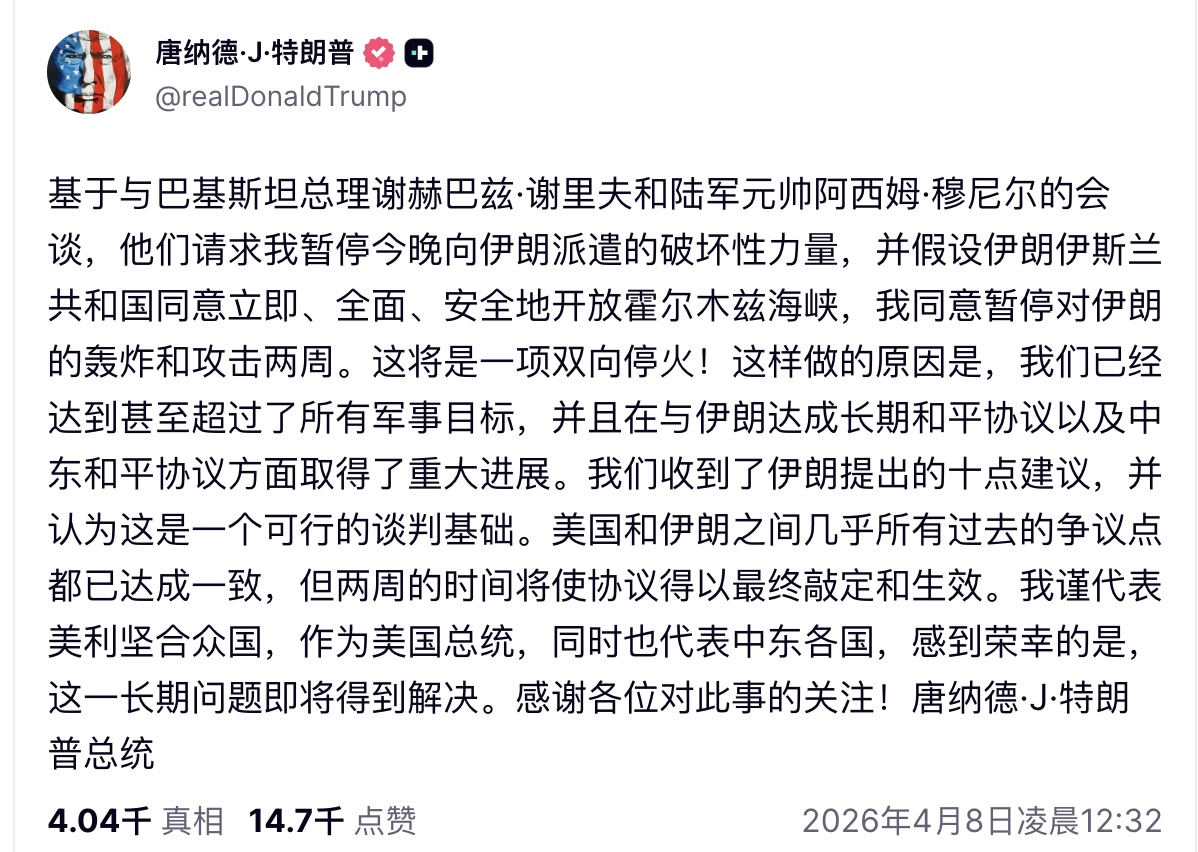
At 8 AM Beijing time on April 8, 2026, just hours after the temporary ceasefire agreement between the US and Iran was established, global asset prices underwent intense repricing: crude oil prices plummeted, gold experienced short-term pressure and fell back, while Bitcoin forcibly broke through the $72,000 threshold, reaching a new peak amid high volatility. According to public data from Planet Daily, Golden Finance, and Foresight, Bitcoin's 24-hour price increase was around 4.58%-5.08%, while the derivatives market saw approximately $209 million in concentrated liquidations within a short time, with long and short leveraged positions indiscriminately liquidated. This stark contrast—with crude oil premiums collapsing instantly while Bitcoin surged on the back of liquidation—raises a sharp question: at a time when geopolitical risks are cooling, is Bitcoin being treated as a new generation of safe-haven asset, or as a high-beta risk chip for trading?
Ceasefire news established: crude oil plummets, Bitcoin rises
On April 8, the announcement confirming the US-Iran "two-week temporary ceasefire agreement" marked a phase of de-escalation of previously simmering geopolitical tensions. The market's pricing framework, which revolved around "escalating conflict—disrupted supply—rising crude oil premiums," was rapidly reversed. Crude oil prices adjusted sharply downward first, and gold, as a traditional safe-haven asset, saw a significant reduction in buying pressure, retreating from its previous highs. At the same moment that risk premiums were rapidly compressed, the crypto market chose a different path: Bitcoin, the most representative risk asset, surged aggressively, becoming one of the most aggressive assets in this round of ceasefire trading.
According to reports from Planet Daily, Golden Finance, and Foresight, during the key trading period following the ceasefire news, Bitcoin's price quickly surged within the $72,000-$72,460 USDT range, showing active trading and a tight upward rhythm, breaking through previous resistance areas in a short time. Considering the 24-hour increase of approximately 4.58%-5.08%, this was not a slow climb but a typical "news-driven + leveraged push" spike. On the order book, after breaking through $72,000, sell orders above were quickly consumed, forcing shorts to cover and driving prices higher in the short term, resulting in a resonating amplification effect between technical and emotional positions.
In market commentary, the expression "After the ceasefire news, the crypto market presented a perfect negative correlation with crude oil" is frequently cited: crude oil dived as geopolitical risk premiums retracted, while Bitcoin surged in the opposite direction; the K-lines of the two assets almost mirrored each other. This negative correlation is not just a coincidence of price curves, but reflects a reallocation of funds across different asset classes under the same macro signal—crude oil, as the direct carrier of geopolitical risk, was reduced, while Bitcoin was viewed by some funds as a hedging tool under a new narrative.
Digital gold emerges: misalignment with traditional safe-haven
Similarly, during the window after the ceasefire establishment, gold's performance was clearly more subdued. As a traditional safe-haven anchor, gold typically receives buying support during times of heightened conflict, but when risk sentiment recedes, its price often trends towards a correction or sideways consolidation. This time, against the backdrop of easing geopolitical tensions, gold did not exhibit a topping pattern like Bitcoin; rather, it showed more of a "pressured + consolidating" state, indicating a release and retreat of safe-haven demand. This starkly contrasts with Bitcoin's strong advance above $72,000: under the same macro event, traditional safe havens and "digital gold" took drastically different paths.
Research briefings indicate that this market behavior once again validates Bitcoin's characteristics as a geopolitically sensitive asset. In recent years, Bitcoin's asset narrative has fluctuated between "high-risk technology growth asset" and "digital gold-like risk-averse asset": during periods of loose liquidity, it resembled a high-beta tech stock, fluctuating with risk appetite; during times of geopolitical uncertainty or currency depreciation concerns, it was seen by some as a candidate for value storage. The performance following the ceasefire on April 8 was even more nuanced: Typically, a cooling risk event should cause safe-haven buying to recede, but Bitcoin chose to surge at this moment, indicating that the market is trading it through the lens of "hedging against failures in traditional risk asset pricing,” rather than simply viewing it as a safe haven during panic.
In the broader macro asset rotation picture, on one end, crude oil could experience a double-digit percentage drop amid a risk premium retraction (the exact number is still being verified, so a precise percentage is not provided here), while on the other end, Bitcoin rose about 5% in 24 hours, with gold being pressured at high levels and lacking direction. This tension illustrates a clear path of capital migration: withdrawing from the crude oil exposure that is highly sensitive to geopolitical risks and constrained by policies and supply-demand dynamics, and favoring Bitcoin, which is more liquid, can be traded 24/7, and is more sensitive to macro and emotional changes. Bitcoin is not merely replacing gold but has gained trading elasticity beyond traditional safe-haven assets under the framework of "hedging against old-world risk pricing."
$209 million liquidation bloodbath: the cost of high leverage
To understand the brutality of this breakout, the focus must shift back to the critical resistance level of $72,000. After a long tug-of-war between longs and shorts, this price level was viewed as a temporary ceiling, gathering a large number of stop-loss and take-profit orders while accumulating considerable leveraged positions. When the ceasefire news broke and the price approached this threshold, the chain reaction in the derivatives market was immediately triggered. According to public data from Golden Finance and others, during Bitcoin's breakout above $72,000, approximately $209 million in concentrated liquidations were triggered in a short time, with high-leverage long and short positions indiscriminately liquidated, causing prices to rise sharply along with the liquidation orders.
From a more granular perspective, during this liquidity shock, the liquidation amount for Bitcoin contracts reached approximately $73.42 million within just 1 hour, while Ethereum's liquidation amount was approximately $41.84 million. This indicates that not only those who bet unidirectionally on Bitcoin were hurt, and not just Bitcoin as a single asset— the entire leveraged chain built around the geopolitical risk and ceasefire gambles faced systemic pressure in a short time: bearish positions that misjudged the direction were forcibly liquidated, and bullish positions that chased high leverage were swept out during subsequent fluctuations, along with major assets’ derivative positions being re-liquidated.
In a high-leverage environment, macro events are often "translated" by the market into a typical "spike—surge—correction" rhythm. When the news just landed, prices initially swept through dense order zones with a sharp spike or drop, triggering the first round of forced liquidations; immediately afterward, driven by strong liquidation orders and passive liquidity, prices accelerated in the direction that had been pried open, completing the technical breakthrough or breakdown; finally, when the liquidation wave subsided and the incremental follow-on capital slowed, the market returned to a new range of oscillation. For those speculative funds that had bet on “conflict escalation or difficulty in ceasefire” long before the Islamabad negotiation news leaked, this rhythm was almost a "full-position physical examination": regardless of whether going long crude oil, long safe-havens, or laying out a unidirectional position on Bitcoin, as long as leverage was too high, they were all shown the exit by the market at the moment of ceasefire and direction reversal.
From the murmurs to ceasefire: expectation misalignment before and after Islamabad negotiations
Before April 8, market whispers surrounding the Islamabad negotiations had already begun to stack positions in the derivatives market. Some traders bet on negotiation breakdown and conflict escalation, leading to rising crude oil prices and pressure on risk assets; others believed the probability of ceasefire is low but favored a neutral scenario of "delay + limited easing." These divergences were ultimately reflected in the leveraged structures of futures and perpetual contracts: the long and short positions of crude oil, gold, and Bitcoin piled up into towers of "expected anticipation" at different exchanges, waiting for reality to provide answers.
When the outcome of the "two-week temporary ceasefire agreement" settled, a clear misalignment emerged between reality and many people's expectations of continued escalation. The mainstream market narrative was highly concentrated around "conflicts are unlikely to cool significantly in the short term," and prices had already partially priced in this pessimistic view. However, the result was that, though the ceasefire was brief, it was sufficient to trigger a systemic "risk premium reassessment," with crude oil's expected premium rapidly compressed and Bitcoin ascending in response; this divergence from common expectations often leads to more intense price fluctuations. Because not only was the direction reversed, but also the leveraged structures based on the "expected continuation of strengthening" were also simultaneously exploded.
Regarding the Islamabad negotiations themselves, details like "Pakistan's mediation terms" and "the previous 45-day ceasefire proposal was rejected" are circulating in the market, but this information remains to be verified. Lacking authoritative texts and unified source support, we can only regard it as background noise during traders' narrative construction, rather than hard data that can be written into trading models. This analysis deliberately avoids making any conclusive statements on these levels and focuses solely on facts repeatedly validated by market prices: the ceasefire period lasts for two weeks, and its timing coincides closely with the plummet of crude oil and the rise of Bitcoin.
Safe-haven or betting chips: how does the market price Bitcoin
As crude oil plunged sharply after the ceasefire and gold weakened at high levels while Bitcoin counter-trended upwards, a vivid "triangular relationship" emerged: crude oil represents direct pricing against geopolitical risks and supply shocks, gold is the traditional value anchor and safe-haven demand, while Bitcoin floats in between, simultaneously endowed with the dual labels of "digital gold" and "high-risk tech asset." Institutional and retail funding interpretations of this event differ: some institutions focus more on Bitcoin's correlation allocation significance within macro asset portfolios, specifically its independence and hedging value during extreme volatility in traditional assets; whereas many retail traders still view this breakout as a "high-odds gamble," trying to capture short-term gains brought by geopolitical events through high leverage.
The narrative of "digital gold" and that of "high-risk tech growth assets" in this round of market behavior are not replacements of one another but rather interwoven: the impulse spurring the market is a typical macro event (ceasefire agreement), but the method of capital landing resembles trading a highly volatile tech stock. Bitcoin’s buying pressure does not simply stem from panic hedging, but from expectations of "event-driven volatility spikes," thus the market operates this asset akin to how one trades tech stocks with common patterns of "news flash—volume surge—leveraged push." It is seen as a complement to traditional safe-haven assets while also being a new trading chip for risk preferences.
This also provides a clear dimension for upcoming observations: if, within the next two weeks, geopolitical situations heat up again, will Bitcoin rally alongside gold and re-exhibit characteristics of a "risk premium asset" similar to crude oil? Conversely, if the ceasefire succeeds in the short term and situations ease further, will Bitcoin align more closely with risk assets, following corrections in the stock and tech sectors, or will it retain relative resilience due to the "digital gold" narrative? The evolution of Bitcoin's correlation with crude oil and gold will directly determine how the market re-prices this asset in the next phase and influence its role in global asset allocation: will it be a "macro hedging tool" in portfolios or a "standardized betting chip" for volatility traders?
There’s only a two-week ceasefire: Bitcoin's sensitivity and fragility
Reflecting on this round of market behavior, three interwoven main lines can be clearly delineated: first, the short-term ceasefire agreement shattered the previous market consensus on the continued escalation of conflict, sparking a rapid reassessment of geopolitical risk premiums; second, crude oil experienced a sharp correction during this process, gold faced pressure at high levels, while Bitcoin simultaneously broke through the $72,000 critical price level, charting a path that deviated significantly from traditional assets; third, none of this occurred in a mild spot flow but was amplified by approximately $209 million in large-scale liquidations in a high-leverage derivatives environment, presented as a "bloody breakthrough."
This further indicates that Bitcoin is substantially being treated by the market as a geopolitically sensitive asset for trading: it responds quickly to macro signals such as ceasefires, sanctions, and conflict escalations, often faster than some traditional assets. However, at the same time, its role as a “hedge” is not pure; it remains deeply embedded in strong speculative and leveraged characteristics—every directional opportunity brought by macro signals is magnified into a volatility feast by massive leverage, leaving a price trajectory marked by high liquidation rates, high turnover rates, and high emotional tension.
In the upcoming two-week ceasefire window and beyond, Bitcoin’s sensitivity and fragility will further expose themselves: sensitive in that it will almost real-time reflect geopolitical news and policy directions, with any new conflicts or negotiation progress potentially being swiftly priced in; fragile in that if the leverage in the derivatives market remains high, then every expectation adjustment, every deviation between reality and narrative, will transform into the old plot of "mutually destructive long and short positions + liquidation." For traders, compared to just watching whether the spot price can refresh previous highs or revisit old highs, it is more crucial to simultaneously track the changes in macro news and leverage: when macro uncertainty rises and leverage is high, risks come not only from incorrect directions but systemic risks from being forced into the next round of liquidation; conversely, when the macro environment is relatively stable and leverage cools significantly, Bitcoin may be closer to a "structural allocation asset" rather than merely an event-driven betting table.
Join our community to discuss and grow stronger together!
Official Telegram community: https://t.me/aicoincn
AiCoin Chinese Twitter: https://x.com/AiCoinzh
OKX benefit group: https://aicoin.com/link/chat?cid=l61eM4owQ
Binance benefit group: https://aicoin.com/link/chat?cid=ynr7d1P6Z
免责声明:本文章仅代表作者个人观点,不代表本平台的立场和观点。本文章仅供信息分享,不构成对任何人的任何投资建议。用户与作者之间的任何争议,与本平台无关。如网页中刊载的文章或图片涉及侵权,请提供相关的权利证明和身份证明发送邮件到support@aicoin.com,本平台相关工作人员将会进行核查。