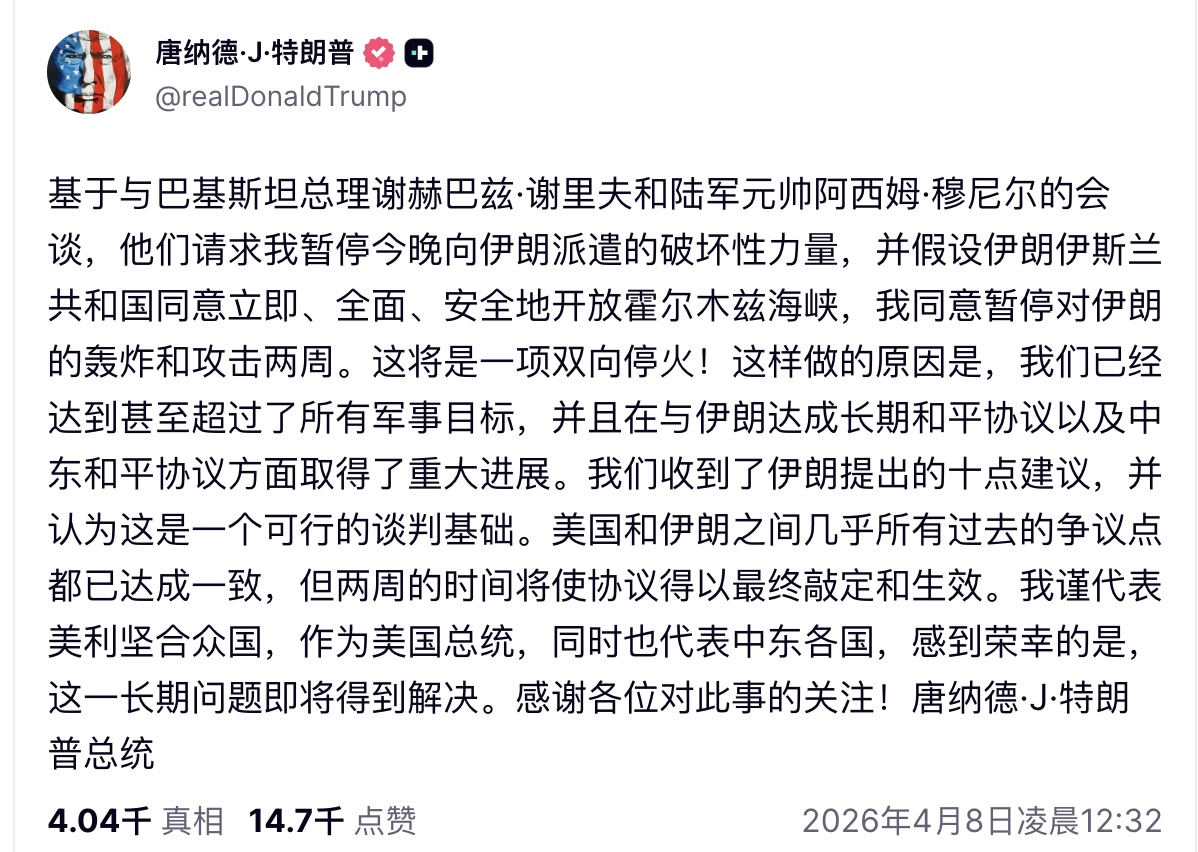
On April 8, 2026, East Eight Time, Iran's Supreme National Security Council officially accepted Pakistan's proposed "two-week ceasefire" plan, locking the key variable of the situation on the secure opening of the Strait of Hormuz. The ceasefire is not simply a military "pause," but is deeply bound with navigation through the Strait, military deployment, and technical coordination. Foreign Minister Araghchi has publicly reminded that there are "technical limitations" and challenges in military coordination. At the same time, as the ceasefire news landed, the US dollar index DXY fell to 99, with a daily drop of 0.68%, as the market's repricing of risk premiums manifested simultaneously in traditional assets and crypto assets. The main storyline is clear: short-term geopolitical risks are retreating from a fever pitch, but this feels more like a stage cooling rather than a safe landing for all risks.
Ceasefire Achieved: The Strait of Hormuz Returns from the Brink of Battlefield to Center of Navigation
The formal decision for this ceasefire was made by Iran's Supreme National Security Council, with mediation and detailed negotiations concentrated in Islamabad. The choice of Islamabad itself carries heavy geopolitical symbolism: it is both a buffer zone between Iran and the United States and a physical stage for Pakistan’s role as a "pressure valve" in the great power game. Iran's acceptance of the two-week ceasefire proposal implies a recognition at the top level of security decision-making of the basic route of "short-term de-escalation for the sake of space," but it does not touch the long-term game framework.
Iranian Foreign Minister Araghchi emphasized in a statement that the ceasefire is directly tied to the safe passage through the Strait of Hormuz, but "it must be under the premise of coordinating with the military and considering technical limitations, and only within two weeks can safe passage through the Strait be realized." The weight of this statement lies in its re-establishment of the ceasefire, which should be a purely political decision, back to the engineering and tactical level: how fleets will be restructured, how radar and air defense systems will be downgraded, and how shipping lanes for tankers will be designated and monitored—all needing the military to complete reconstruction in a very short time. This "technical limitation" means that even if the agreement has been signed on paper, there remains uncertainty in the pace and execution of the Strait's opening.
The Strait of Hormuz is one of the bottlenecks in the global energy and shipping systems, through which a significant amount of crude oil and liquefied gas exports must pass. Any expectation of a blockade will be quickly magnified by the market into an additional premium for oil prices and shipping costs. This ceasefire writing "safe passage through the Strait" into its conditions essentially releases a stage signal of easing for the global energy supply chain. Meanwhile, an anonymous U.S. official disclosed that according to the ceasefire agreement, the U.S. military had stopped its military strikes against Iran. This signifies a return from the brink of continuous confrontation to a fragile and reversible state of easing: the gunfire has temporarily ceased, but military readiness has not truly downgraded.
US Dollar Index Falls Below 100: The Risk Aversion Pendulum Starts Swinging Back
On the news chain, after Iran accepted the ceasefire proposal and the signal of "safe passage through Hormuz within two weeks" was released, the US dollar index DXY fell to around 99, with a daily drop of about 0.68%. The timing of this overlap reflects a rapid repricing of capital's expectations for geopolitical risks—previous safe-haven flows into the dollar began to ease, with some choosing to lock in profits and others tentatively flowing back into other asset classes.
During the tense stages of the conflict, the dollar and crude oil often exhibit typical safe-haven interlinkage: on one hand, risk aversion raises the demand for dollar liquidity; on the other hand, concerns related to Hormuz's supply elevate the "war premium" on crude oil. When the ceasefire signal appears and expectations for Strait passage improve, this narrative chain reverses—panic premiums first retreat in oil and freight rates, and then feedback to DXY's decline through macro expectations and capital flows.
This funding path extending into crypto assets is not unfamiliar. In the earlier phase of conflict escalation, mainstream assets like Bitcoin and Ethereum were briefly viewed by some as a "hedge against dollar devaluation + hedge against extreme tail risks," sharing in the marginal inflow of safe-haven sentiment along with gold and certain government bonds. As DXY began to decline and dollar safe-haven temperatures cooled, the options available to capital shifted from "cash is king" back to "risk asset reallocation": some capital attempted to withdraw from dollars and short bonds, seeking value gaps in equities, commodities, and crypto.
It should be noted that these DXY fluctuations driven by geopolitical events often feature short and sharp characteristics. For short-term traders and high-leverage positions, DXY's sudden rises and falls over several trading days can be magnified to the crypto market's candlestick by risk parity algorithms, margin models, and sentiment feedback. Misjudging the amplitude and rhythm of the "risk aversion pendulum" can easily evolve into a chain reaction of passive deleveraging or even liquidation.
Geopolitical Premium Eases: The Crypto Market Shifts Back to Liquidity Mainstream from War Narratives
From the perspective of market characteristics, the behavior of mainstream coins and certain on-chain assets before and after the ceasefire is not consistent. Prior to this, under expectations of conflict escalation, there were indeed real "safe haven purchases" in the market—allocating assets like BTC with high liquidity to hedge against extreme tail risks—alongside a substantial amount of "event speculative trading," chasing short-term explosive narratives of military chain tokens, energy-related concepts, or small-cap assets with strong narrative traits. The former cares more about large-scale risk control, while the latter closely follows each update from Twitter and news feeds, gaming the time and information differences.
As the phase of geopolitical risk premium retreats, the crypto market typically undergoes a process of "volume cooling, volatility narrowing, narrative switching": trading and holdings revert from event-driven varieties to high market cap assets, with funds re-pricing around liquidity environment, regulatory policy, and macro interest rate paths; war-related fringe themes then begin to recede or even reverse into sell-offs. In the current window, with the US military pausing its strikes against Iran and the Strait of Hormuz likely to achieve safe passage within two weeks, these news collectively weaken the tension of the "extreme tail risks" narrative.
When the probabilities of extreme scenarios like nuclear facilities, full blockades, and misjudgments escalating into full-scale wars are downgraded by the market, the imagination space for crypto assets as "doomsday hedge tools" is compressed; their premiums need to return to on-chain fundamentals, technological iterations, and institutional allocation demands. This does not mean that prices weaken immediately, but rather that the driving narrative shifts from "conflict amplifiers" to "liquidity amplifiers." Within the two-week ceasefire window, the focus of mainstream capital is shifting from one-sided safe-haven bets to comprehensive tracking of variables such as whether the ceasefire can be sustained and whether Strait opening is smooth, rather than simply betting positions on the dual outcome of "war or peace."
Information Warfare and Stakeholder Game: The Emotional Rift Behind Iran's Claim of "Historic Defeat"
On the political rhetoric level, the Iranian side boldly claims that "the enemy suffered a historic defeat," packaging this ceasefire as part of its strategic victory. This expression targets domestic audiences to consolidate support while attempting to shape an image of "Iran is not afraid of pressure; negotiation does not equate to concession" in external public opinion warfare. For risk perception both inside and outside the region, such "victory narratives" create a subtle tension: the outside world sees the ceasefire and de-escalation, yet feels that all parties are still maintaining a high-volume confrontation in the public opinion arena.
This also introduces a potential tail risk: the victory rhetoric may internally strengthen the positions of more hardline factions, pushing them to exert pressure during the ceasefire period to demand more significant concessions at the negotiating table, or else advocating for a re-escalation of military assets after the window period ends. Such internal games will not be directly written into the agreement text, yet will be interpreted by the market as "ceasefire fragility" and "reversible at any time," thus reserving a layer of implicit volatility premium for risk assets like crypto.
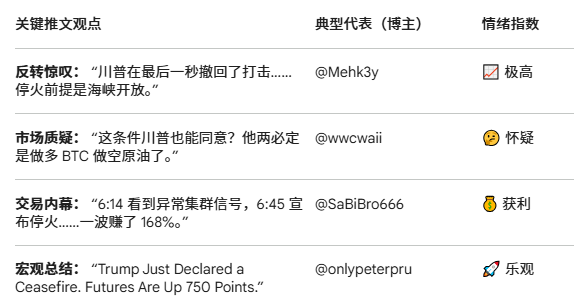
From the trader's perspective, sentiment is clearly polarized during the two-week ceasefire window. One part of the capital chooses to reduce positions at peaks after favorable news is realized, capturing the emotional return from extreme tension to temporary easing, protecting against the shock of a potential protocol collapse. Another part of the capital bets on the continuation of negotiations, the extension of the ceasefire, or even a transformation into a longer-term easing momentum, attempting to layout mid-term space for "risk premium retreat." These two strategies manifest as a weaving of selling pressure and low buying, with prices oscillating at high levels, volatility gradually receding, yet accompanied by a silent restructuring of positions.
Greater uncertainty lies in the asymmetry of information—currently, the details of the agreement text and execution progress are not entirely transparent, with details at the Islamabad negotiating table often leaking through second or third-hand sources. Such an environment naturally leaves room for narrative imagination and amplifies the impact of rumors and single-source information on prices. For the crypto market, every unverified rumor of "default," "attack," or "additional sanctions" can potentially trigger a short-term market shock during periods of relatively thin liquidity.
From Washington to Islamabad: Multilateral Chess Game and Market Probability Betting
This ceasefire arrangement itself is a product of the overlapping roles of the United States, Iran, and Pakistan. Iran and the United States are in direct military opposition, with the U.S. military’s strikes and counter-strike expectations against Iranian targets comprising the main axis of geopolitical premium in the previous phase; Pakistan then plays the mediator role between the Islamic world and the West, turning its capital into a high-density battlefield for this game. From Washington to Islamabad, the multiple scenarios of military adversaries and mediators with great power influences are layered on a timeline of the ceasefire agreement.
For the United States, the decision to temporarily halt military strikes against Iran based on the ceasefire agreement serves both risk control and strategy restructuring purposes. Slowing the direct conflict helps avoid getting drawn into an uncontrollable escalation spiral in the Strait of Hormuz and surrounding areas while creating space for subsequent reshaping of leverage through sanctions, diplomatic pressure, and coordination with regional allies. The market will reassess accordingly: whether the future will see an increase in the weight of sanction tools with a decrease in the weight of military conflict, or merely a temporary rhythm adjustment with the possibility of future escalation? This assessment directly affects the degree of risk discounts on energy, currencies, and crypto assets.
The symbolic significance of Islamabad as the negotiating venue lies in its function as a buffer while also resembling a "pressure cooker" that is continuously heated: on one hand, all parties convey goodwill and bottom lines here, attempting to pull the conflict back into a manageable range; on the other hand, any signals, wording details, or even changes in meeting arrangements released here will be amplified by outsiders as harbingers of "success" or "failure." For traders focusing on macro and geopolitical factors, Islamabad becomes not just a geographic location but a high-sensitivity information coordinate.
In such a multipolar game, the crypto market finds it difficult to price based solely on the actions of a single country. What is truly being traded is the "policy path probability distribution" of these three parties—and the broader coalitions behind them—over the coming weeks to months: whether to continue the ceasefire, maintain limited friction, experience local escalation, or engage in comprehensive confrontation, with different paths corresponding to varying energy price ranges, DXY trajectories, and valuation centers of risk assets. The volatility of crypto assets reflects a collective bet on this entire probability distribution rather than a mere emotional reaction to a single news headline.
Two-Week Window: How Traders Position Themselves in the "Cooling Down" Market
Returning to the direct impact of this event on the market: Iran's acceptance of Pakistan's two-week ceasefire proposal, the prospective safe passage through the Strait of Hormuz after technical coordination, and the U.S. military's pause in strikes against Iran—these variables collectively drove the US dollar index below 100 and led to a phased retreat of geopolitical risk premiums. On the crypto asset level, the premiums previously dominated by risk hedging and event speculation are being compressed, with prices increasingly returning to fundamental pricing based on macro liquidity, regulation, and industry developments. However, this retreat does not mean a complete settlement; the time limits of the ceasefire and the uncertainty of execution still leave a "geopolitical discount" for the market.
For crypto traders, during this "cooling period," it is essential to be cautious of the false sense of security arising from overly optimistic sentiment. When the candlesticks return from explosive ups and downs to narrow oscillations, many may misjudge that risks are far away, leading to increased leverage and relaxed risk controls. However, as long as the ceasefire still carries a clear "two-week window" attribute, the risk of events themselves has not vanished; it has merely shifted from explicit price volatility to the dimension of time. Controlling overall leverage levels and reducing directional exposure to a single geopolitical event are more important at this stage than betting on the final round of "ceasefire extension."
Looking ahead to key observation points two weeks later, three main lines can be identified: first, whether passage through the Strait of Hormuz is smooth, whether tankers and freight can maintain close to pre-war levels under technical limitations; second, whether negotiations in Islamabad can successfully extend the ceasefire or advance more long-term arrangements, or whether they will turn hard under internal political and public pressure; third, whether new signals of military friction will emerge—including small-scale attacks, drone incidents, or missile tests—that could reignite market imagination regarding extreme tail risks.
Overall, this ceasefire resembles a passive initiation of a "pressure release valve" rather than a final verdict of the entire game. Geopolitical risks will cyclically return in the future, continuously shaping the risk pricing structure, including that of crypto assets. For traders, what truly needs to be constructed is not the win-loss of a specific ceasefire window, but a framework of position management and sentiment recognition that can repeatedly apply in the cycle of “fever—cool down—rekindle.”
Join our community to discuss together and grow stronger!
Official Telegram community: https://t.me/aicoincn
AiCoin Chinese Twitter: https://x.com/AiCoinzh
OKX benefits group: https://aicoin.com/link/chat?cid=l61eM4owQ
Binance benefits group: https://aicoin.com/link/chat?cid=ynr7d1P6Z
免责声明:本文章仅代表作者个人观点,不代表本平台的立场和观点。本文章仅供信息分享,不构成对任何人的任何投资建议。用户与作者之间的任何争议,与本平台无关。如网页中刊载的文章或图片涉及侵权,请提供相关的权利证明和身份证明发送邮件到support@aicoin.com,本平台相关工作人员将会进行核查。